Qatar Submarine Market Size, Share & Growth Rate
The Qatar Submarine Market was estimated at USD 1427 Million in 2025 and is projected to reach USD 2039 Million by 2032, growing at a CAGR of 5.2% from 2026 to 2032. This upward trend is primarily driven by Qatar's strategic ambition to enhance its naval capabilities amid regional geopolitical tensions. The focus on modernizing naval assets and acquiring advanced submarines reflects a commitment to ensuring maritime security and asserting influence in a complex geopolitical landscape.
Qatar Submarine Market Year-wise Growth Rate and Key Drivers
This graph highlights how the Qatar Submarine Market has steadily grown over the years, supported by major growth factors.
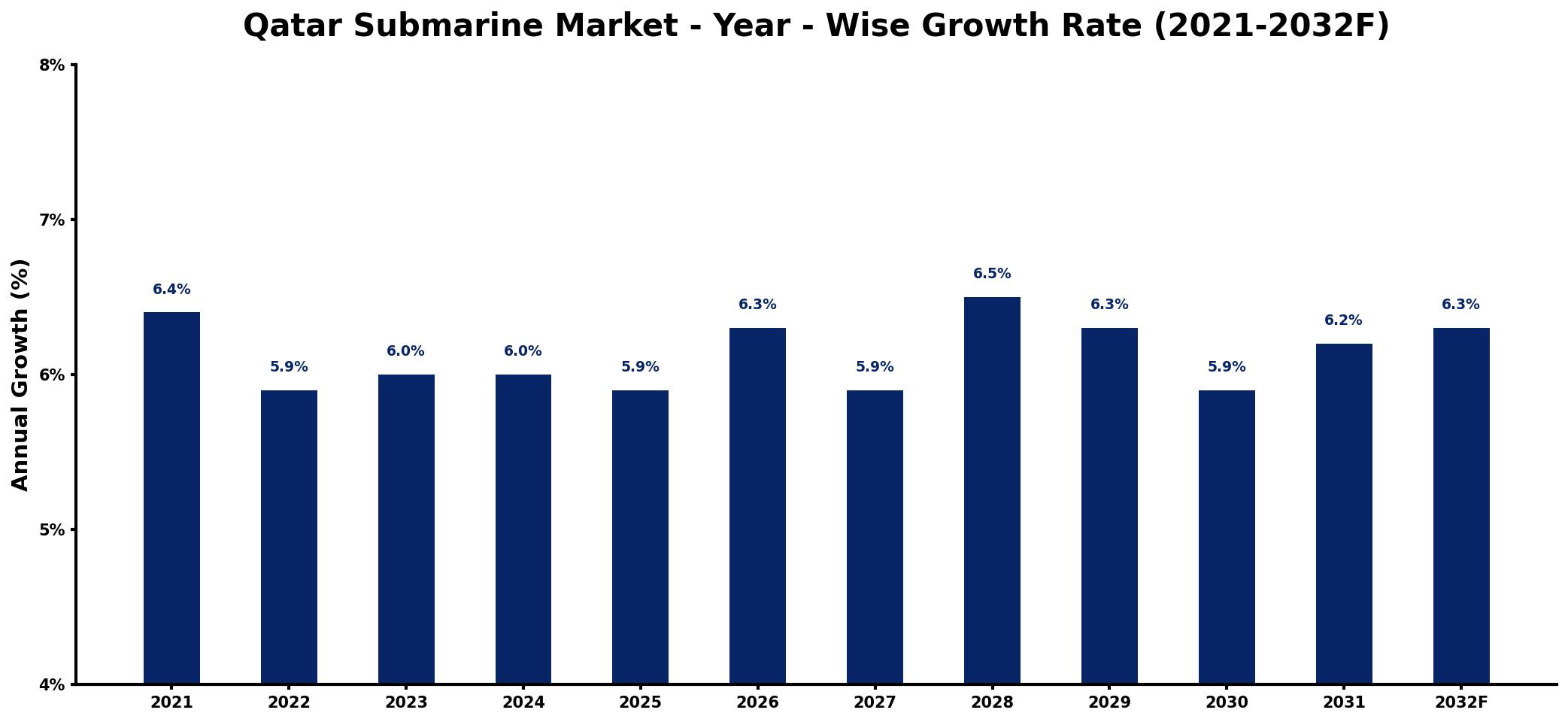
The table below presents the year‑wise growth rates along with the key drivers influencing the market
| Year | Growth Rate | Major Drivers |
| 2021 | 6.4% | Increased defense spending initiatives |
| 2022 | 5.9% | Rising demand for naval security |
| 2023 | 6.0% | Expansion of maritime exploration projects |
| 2024 | 6.0% | Growing interest in underwater technologies |
| 2025 | 5.9% | Enhanced regional security collaborations |
| 2026 | 6.3% | Investment in advanced military capabilities |
| 2027 | 5.9% | Strengthened international defense partnerships |
| 2028 | 6.5% | Surge in underwater research funding |
| 2029 | 6.3% | Emergence of new maritime threats |
| 2030 | 5.9% | Focus on sustainable naval solutions |
| 2031 | 6.2% | Increased military modernization efforts |
| 2032 | 6.3% | Boost in underwater infrastructure development |
Note: Market size estimations and growth projections presented in this report are based on 6Wresearch's proprietary forecasting methodology, utilizing the latest available industry data, government publications, and primary research inputs.
Qatar Submarine Market Synopsis
A fundamental driver of the Qatar Submarine Market is the nations urgent need to bolster its maritime defense strategy. With rising maritime security concerns in the Gulf region, Qatar's proactive approach in procuring sophisticated submarine technology is pivotal to its defense posture.
Moreover, collaborative efforts between international and local firms are likely to shape market dynamics, fostering innovation and enhancing the capabilities of Qatar's naval fleet. This symbiotic relationship aims to achieve a robust defense ecosystem while addressing the nations specific security needs.
Qatar Submarine Market Key Takeaways
- Qatar's geopolitical landscape is a significant driver for the submarine market.
- Investment in modern submarines highlights a commitment to enhancing maritime security.
- International partnerships are crucial in advancing submarine capabilities.
- The market is poised for recovery and growth post-COVID-19, driven by strategic imperatives.
- Ongoing supply chain improvements are expected to stabilize procurement processes.
Evaluation of Restraints in Qatar Submarine Market
The Qatar submarine market is not without its challenges. Geopolitical tensions and concerns regarding regional stability often complicate procurement efforts, necessitating intricate negotiations that can delay acquisitions. Additionally, the evolving maritime security landscape imposes significant operational considerations, potentially affecting the overall effectiveness of submarine operations. These factors create a delicate balance between advancing defense capabilities and navigating the complexities inherent in regional dynamics.
Qatar Submarine Market Trends
Emerging trends in the Qatar submarine market reflect a broader shift towards integrating advanced technologies. The incorporation of artificial intelligence and automation in submarine design is becoming increasingly prevalent, allowing for enhanced operational efficiency. Furthermore, sustainability is gaining traction as a consideration in submarine development, with a focus on reducing environmental impact while maintaining performance. These trends indicate a forward-thinking approach that aligns with global defense initiatives.
Qatar Submarine Market Opportunities
The opportunities within the Qatar submarine market are substantial, particularly in areas such as research and development of next-generation submarines. There is potential for growth in local manufacturing capabilities, enabling Qatar to reduce reliance on foreign technologies. Additionally, the formation of joint ventures with international firms can lead to technology transfer and skill development, fostering a robust domestic defense industry. This landscape presents lucrative avenues for investors looking to capitalize on Qatar's defense modernization efforts.
Government Initiatives in the Qatar Submarine Market
The Qatari government is actively pursuing initiatives to enhance its naval capabilities through substantial public spending on defense. Policies aimed at fostering local industry participation in submarine production and maintenance are being prioritized. Furthermore, strategic partnerships with allied nations and defense firms are encouraged, allowing for shared expertise and resources that can benefit Qatar's maritime security objectives. These initiatives collectively underscore the government's commitment to building a formidable naval defense infrastructure.
Future Insights of the Qatar Submarine Market
Looking ahead to 2026-2032, the Qatar submarine market is poised for significant evolution. With a steadfast focus on enhancing maritime security amid regional uncertainties, the market is expected to witness increased investment in both procurement and technological innovation. The ongoing partnerships with leading defense contractors will likely enhance operational readiness and capability diversification, positioning Qatar as a key player in maritime defense within the Gulf region.
Qatar Submarine Market Latest Developments (2025 - 2026)
Recent developments in the Qatar submarine market indicate a continuing trend of modernization and capability enhancement. There has been a marked increase in collaborative projects aimed at integrating cutting-edge technology into submarine design and operation. Additionally, there are ongoing discussions related to enhancing supply chains that ensure timely procurement and delivery of essential components. This strategic focus aims to solidify Qatar's status as a formidable maritime power in the region.
Qatar Submarine Market - Key Attractiveness of the Report
- 10 Years of Market Numbers
- Historical Data Starting from 2022 to 2025
- Base Year: 2025
- Forecast Data until 2032
- Key Performance Indicators Impacting the Market
- Major Upcoming Developments and Projects
Key Highlights of the Report:
- Qatar Submarine Market Outlook
- Market Size of Qatar Submarine Market, 2025
- Forecast of Qatar Submarine Market, 2032
- Historical Data and Forecast of Qatar Submarine Revenues & Volume for the Period 2022-2032F
- Qatar Submarine Market Trend Evolution
- Qatar Submarine Market Drivers and Challenges
- Qatar Submarine Price Trends
- Qatar Submarine Porter's Five Forces
- Qatar Submarine Industry Life Cycle
- Historical Data and Forecast of Qatar Submarine Market Revenues & Volume By Type for the Period 2022-2032F
- Historical Data and Forecast of Qatar Submarine Market Revenues & Volume By Nuclear Powered Submarine for the Period 2022-2032F
- Historical Data and Forecast of Qatar Submarine Market Revenues & Volume By Diesel Electric Submarine & Ballistic Missile Submarine for the Period 2022-2032F
- Historical Data and Forecast of Qatar Submarine Market Revenues & Volume By Application for the Period 2022-2032F
- Historical Data and Forecast of Qatar Submarine Market Revenues & Volume By Surveillance for the Period 2022-2032F
- Historical Data and Forecast of Qatar Submarine Market Revenues & Volume By Combat for the Period 2022-2032F
- Historical Data and Forecast of Qatar Submarine Market Revenues & Volume By Marine Environmental Monitoring for the Period 2022-2032F
- Historical Data and Forecast of Qatar Submarine Market Revenues & Volume By Detection Of Oil Resources for the Period 2022-2032F
- Historical Data and Forecast of Qatar Submarine Market Revenues & Volume By Scientific Research for the Period 2022-2032F
- Historical Data and Forecast of Qatar Submarine Market Revenues & Volume By Others for the Period 2022-2032F
- Historical Data and Forecast of Qatar Submarine Market Revenues & Volume By Platform for the Period 2022-2032F
- Historical Data and Forecast of Qatar Submarine Market Revenues & Volume By Commercial for the Period 2022-2032F
- Historical Data and Forecast of Qatar Submarine Market Revenues & Volume By Military for the Period 2022-2032F
- Qatar Submarine Import Export Trade Statistics
- Market Opportunity Assessment By Type
- Market Opportunity Assessment By Application
- Market Opportunity Assessment By Platform
- Qatar Submarine Top Companies Market Share
- Qatar Submarine Competitive Benchmarking By Technical and Operational Parameters
- Qatar Submarine Company Profiles
- Qatar Submarine Key Strategic Recommendations






































