United States (US) Submarine Market Size, Share & Growth Rate
The United States (US) Submarine Market was estimated at USD 92 Million in 2025 and is projected to reach USD 108 Million by 2032, growing at a CAGR of 2.3% from 2026 to 2032. This growth trajectory is primarily driven by ongoing modernization initiatives within the US Navy, which aims to enhance naval capabilities in response to evolving global threats. The demand for next-generation submarines and upgrades to existing fleets is fostering a robust environment for innovation and investment in submarine technologies.
United States (US) Submarine Market Year-wise Growth Rate and Key Drivers
This graph highlights how the United States (US) Submarine Market has steadily grown over the years, supported by major growth factors.
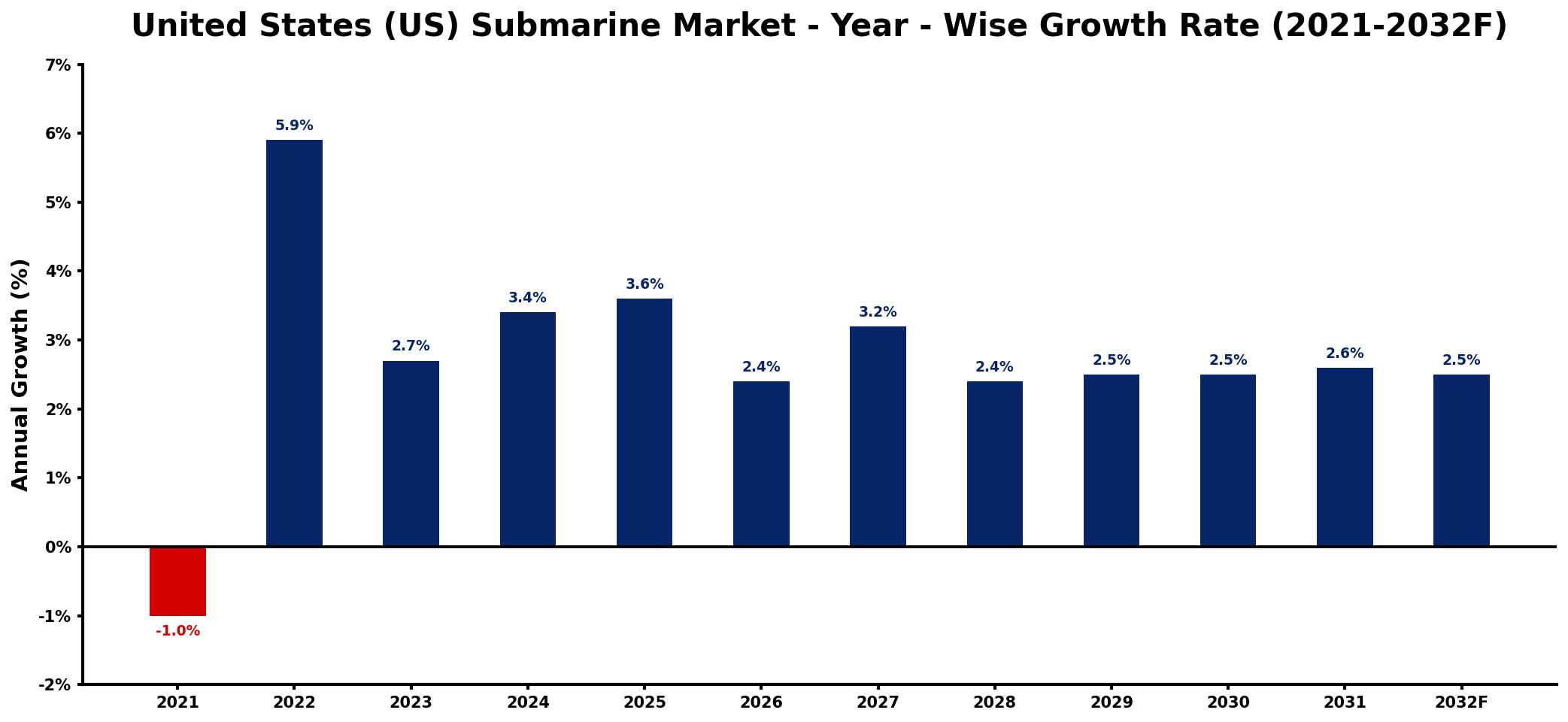
The table below presents the year‑wise growth rates along with the key drivers influencing the market
| Year | Growth Rate | Major Drivers |
| 2021 | -1.0% | reduction in military budgets |
| 2022 | 5.9% | increased defense spending initiatives |
| 2023 | 2.7% | growing geopolitical tensions globally |
| 2024 | 3.4% | expansion of naval modernization efforts |
| 2025 | 3.6% | rising demand for advanced technology |
| 2026 | 2.4% | surge in military contracts awarded |
| 2027 | 3.2% | enhanced focus on maritime security |
| 2028 | 2.4% | growth in allied defense collaborations |
| 2029 | 2.5% | increased investments in R&D |
| 2030 | 2.5% | rising interest in autonomous systems |
| 2031 | 2.6% | increased overall sector activity |
| 2032 | 2.5% | growing demand for training services |
Note: Market size estimations and growth projections presented in this report are based on 6Wresearch's proprietary forecasting methodology, utilizing the latest available industry data, government publications, and primary research inputs.
United States (US) Submarine Market Synopsis
A pivotal force shaping the United States (US) Submarine Market is the increasing focus on national security, spurred by geopolitical tensions and undersea warfare strategies. This shift has resulted in significant investments in the development of advanced submarines that are equipped with enhanced stealth and autonomous capabilities.
The market is characterized by a strong emphasis on technological advancements and modernization, with the US Navy actively pursuing the construction of the Virginia-class and Columbia-class submarines. This commitment not only aims to replace aging fleets but also to ensure that the US maintains its superiority in maritime defense operations.
United States (US) Submarine Market Key Takeaways
- The US Submarine Market is witnessing steady growth driven by modernization efforts and technological advancements.
- Investment in next-generation submarines is crucial for maintaining national security and maritime superiority.
- Emerging technologies such as AI and autonomous underwater vehicles are transforming submarine capabilities.
- Government policies prioritize domestic production, bolstering the defense sector.
- Ongoing geopolitical tensions are likely to sustain demand for advanced underwater warfare systems.
Evaluation of Restraints in United States (US) Submarine Market
While the United States (US) Submarine Market shows significant potential, it faces notable restraints. The high costs associated with advanced submarine development and maintenance can limit accessibility for some defense contractors. Additionally, stringent regulatory requirements and the complexity of defense contracts create challenges for companies vying for market share. Supply chain disruptions and the necessity for robust cybersecurity measures add further complexity, necessitating that firms maintain agility in an unpredictable geopolitical landscape.
United States (US) Submarine Market Trends
A notable trend within the United States (US) Submarine Market is the integration of cutting-edge technologies aimed at enhancing operational efficiency and combat capabilities. The advent of artificial intelligence and unmanned systems is revolutionizing submarine operations, allowing for improved surveillance and data analysis. Furthermore, there is a growing emphasis on renewable energy sources to power submarines, which aligns with global sustainability efforts while simultaneously enhancing operational endurance. This focus on innovation is setting the stage for a new era of submarine warfare.
United States (US) Submarine Market Opportunities
Investment opportunities abound in the United States (US) Submarine Market, particularly for those willing to innovate in submarine construction and technology development. Companies specializing in autonomous underwater vehicles (AUVs) and unmanned underwater vehicles (UUVs) stand to benefit as the Navy increasingly adopts these advanced systems for exploration and surveillance. Additionally, the modernization of existing fleets provides lucrative prospects for maintenance and upgrade solutions, making this market particularly appealing to both established defense firms and emerging technology start-ups.
Government Initiatives in the United States (US) Submarine Market
Government initiatives play a crucial role in shaping the United States (US) Submarine Market, with substantial public spending allocated for submarine design, construction, and maintenance. Policies designed to enhance national security and promote technological advancements underscore the importance of a strong naval presence. The US government also implements regulations that prioritize domestic production, ensuring that the defense industry remains robust and capable of meeting strategic national interests while safeguarding sensitive technologies.
Future Insights of the United States (US) Submarine Market
Looking ahead to 2026-2032, the United States (US) Submarine Market is on a trajectory of steady growth, driven by the ongoing evolution of naval warfare and rising geopolitical tensions. The US Navy's continued investment in submarine procurement programs and the introduction of innovative technologies like advanced stealth systems and autonomous capabilities will be critical for maintaining a competitive edge. This forward momentum will likely present opportunities for defense contractors and technology developers alike, as they align their capabilities with the Navy's strategic goals.
United States (US) Submarine Market Latest Developments (2025 - 2026)
Recent developments in the United States (US) Submarine Market indicate a growing focus on next-generation submarine capabilities, with significant advancements being made in design and technology integration. The US Navy is actively engaged in enhancing its submarine fleet through modernization initiatives that emphasize stealth and autonomous functions. This aligns with broader defense objectives aimed at responding to evolving maritime threats and sustaining national security.
United States (US) Submarine Market - Key Attractiveness of the Report
- 10 Years of Market Numbers
- Historical Data Starting from 2022 to 2025
- Base Year: 2025
- Forecast Data until 2032
- Key Performance Indicators Impacting the Market
- Major Upcoming Developments and Projects
Key Highlights of the Report:
- United States (US) Submarine Market Outlook
- Market Size of United States (US) Submarine Market, 2025
- Forecast of United States (US) Submarine Market, 2032
- Historical Data and Forecast of United States (US) Submarine Revenues & Volume for the Period 2022-2032F
- United States (US) Submarine Market Trend Evolution
- United States (US) Submarine Market Drivers and Challenges
- United States (US) Submarine Price Trends
- United States (US) Submarine Porter's Five Forces
- United States (US) Submarine Industry Life Cycle
- Historical Data and Forecast of United States (US) Submarine Market Revenues & Volume By Type for the Period 2022-2032F
- Historical Data and Forecast of United States (US) Submarine Market Revenues & Volume By Nuclear Powered Submarine for the Period 2022-2032F
- Historical Data and Forecast of United States (US) Submarine Market Revenues & Volume By Diesel Electric Submarine & Ballistic Missile Submarine for the Period 2022-2032F
- Historical Data and Forecast of United States (US) Submarine Market Revenues & Volume By Application for the Period 2022-2032F
- Historical Data and Forecast of United States (US) Submarine Market Revenues & Volume By Surveillance for the Period 2022-2032F
- Historical Data and Forecast of United States (US) Submarine Market Revenues & Volume By Combat for the Period 2022-2032F
- Historical Data and Forecast of United States (US) Submarine Market Revenues & Volume By Marine Environmental Monitoring for the Period 2022-2032F
- Historical Data and Forecast of United States (US) Submarine Market Revenues & Volume By Detection Of Oil Resources for the Period 2022-2032F
- Historical Data and Forecast of United States (US) Submarine Market Revenues & Volume By Scientific Research for the Period 2022-2032F
- Historical Data and Forecast of United States (US) Submarine Market Revenues & Volume By Others for the Period 2022-2032F
- Historical Data and Forecast of United States (US) Submarine Market Revenues & Volume By Platform for the Period 2022-2032F
- Historical Data and Forecast of United States (US) Submarine Market Revenues & Volume By Commercial for the Period 2022-2032F
- Historical Data and Forecast of United States (US) Submarine Market Revenues & Volume By Military for the Period 2022-2032F
- United States (US) Submarine Import Export Trade Statistics
- Market Opportunity Assessment By Type
- Market Opportunity Assessment By Application
- Market Opportunity Assessment By Platform
- United States (US) Submarine Top Companies Market Share
- United States (US) Submarine Competitive Benchmarking By Technical and Operational Parameters
- United States (US) Submarine Company Profiles
- United States (US) Submarine Key Strategic Recommendations






































