Qatar Toggle Clamps Market Size, Share & Growth Rate
The Qatar Toggle Clamps Market was estimated at USD 485 Million in 2025 and is projected to reach USD 696 Million by 2032, growing at a CAGR of 5.3% from 2026 to 2032. This growth trajectory is bolstered by the booming construction sector, which heavily relies on toggle clamps for secure material handling. Additionally, the expanding automotive and manufacturing sectors are adopting these tools for their precision and safety benefits, further driving market demand.
Qatar Toggle Clamps Market Year-wise Growth Rate and Key Drivers
This graph highlights how the Qatar Toggle Clamps Market has steadily grown over the years, supported by major growth factors.
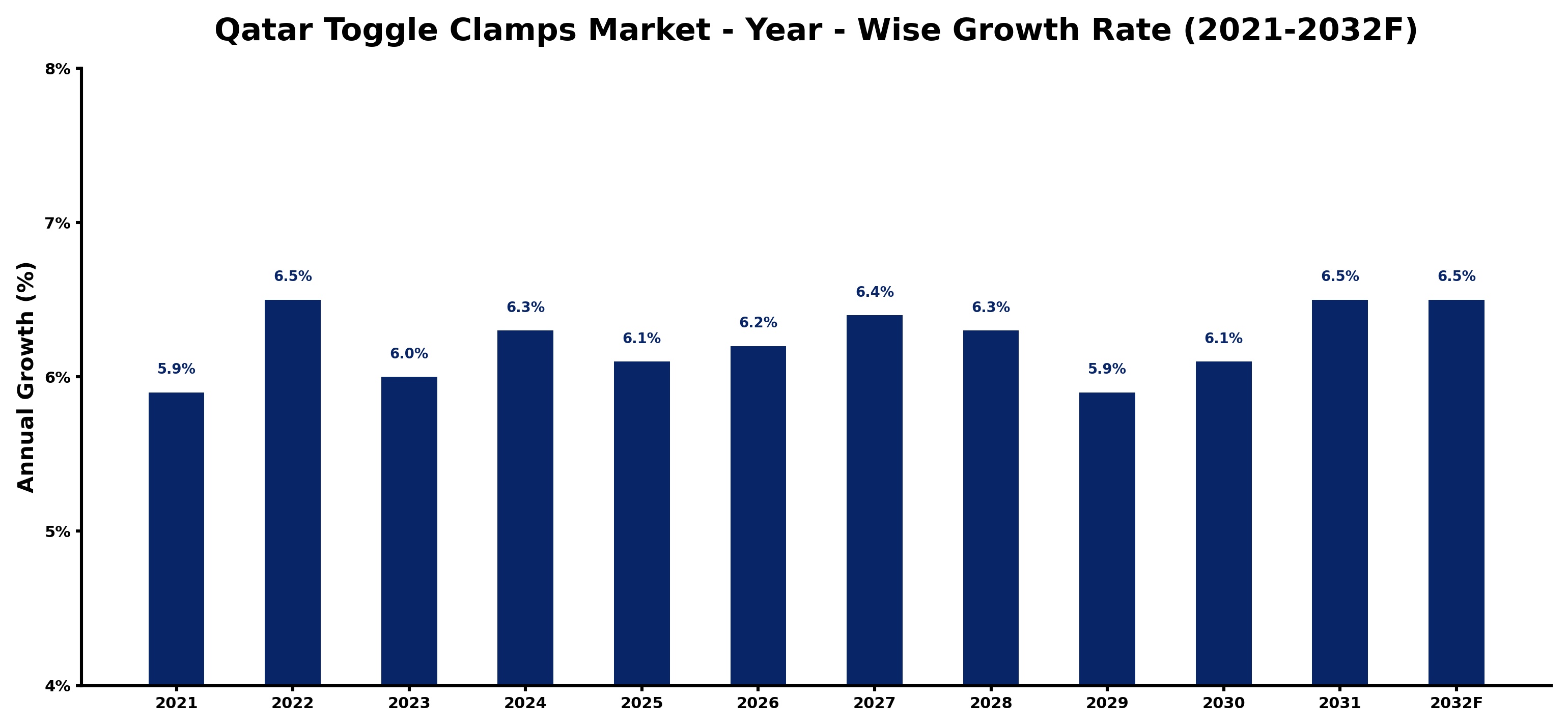
The table below presents the year‑wise growth rates along with the key drivers influencing the market
| Year | Growth Rate | Major Drivers |
| 2021 | 5.9% | Expansion of commercial construction activities |
| 2022 | 6.5% | Expansion of transportation and logistics networks |
| 2023 | 6.0% | Government infrastructure modernization initiatives |
| 2024 | 6.3% | Increasing industrial automation investments |
| 2025 | 6.1% | Increasing smart city development projects |
| 2026 | 6.2% | Increasing industrial automation investments |
| 2027 | 6.4% | Expansion of manufacturing activities |
| 2028 | 6.3% | Growing renewable energy integration projects |
| 2029 | 5.9% | Government infrastructure modernization initiatives |
| 2030 | 6.1% | Expansion of transportation and logistics networks |
| 2031 | 6.5% | Increasing adoption of advanced technologies |
| 2032 | 6.5% | Increasing industrial automation investments |
Note - Market size estimations and growth projections presented in this report are based on 6Wresearch’s advanced forecasting approach, validated with industry datasets as of June 2026.
Qatar Toggle Clamps Market Synopsis
In recent years, the Qatar toggle clamps market has witnessed significant evolution, largely influenced by the rapid industrialization of the region. These clamps are becoming increasingly indispensable across various sectors such as woodworking, welding, and automotive assembly, demonstrating their versatility and efficiency in securing workpieces during complex operations.
As the country's construction projects scale up, the need for reliable tools that enhance safety and productivity is more crucial than ever. Innovations in design and material technology are introducing advanced toggle clamp solutions, capturing the attention of industries eager to improve operational workflows.
Qatar Toggle Clamps Market Key Takeaways
- The market is expected to experience robust growth driven by construction and manufacturing demand.
- Technological advancements are leading to new materials that enhance toggle clamp performance.
- Safety and precision in industrial operations are critical factors fostering market adoption.
- Innovative product designs are becoming essential to meet the growing requirements of end-users.
- The market is characterized by both local and international competition, necessitating a focus on quality and pricing strategies.
Evaluation of Restraints in Qatar Toggle Clamps Market
While the Qatar toggle clamps market shows promising growth potential, it faces constraints that could temper its expansion. The presence of numerous local and international players intensifies competition, compelling manufacturers to prioritize innovation and cost-efficiency. Furthermore, compliance with stringent safety and quality standards can present challenges; companies must invest in consistent quality control measures to maintain customer trust and satisfaction amidst varying market conditions.
Qatar Toggle Clamps Market Trends
Current trends indicate a significant shift towards automation within various sectors, which is reshaping the demand landscape for toggle clamps. As industries increasingly adopt automated solutions, the need for clamps that ensure secure positioning is surging. Moreover, ergonomic designs are becoming a focal point, as manufacturers aim to enhance user comfort and reduce fatigue during extended usage. Sustainable materials are also gaining traction, reflecting a broader commitment to environmental responsibility across industrial practices.
Qatar Toggle Clamps Market Opportunities
Opportunities in the Qatar toggle clamps market are abundant, particularly in sectors emphasizing automation and precision engineering. As industries move towards smart manufacturing, there is a growing need for high-quality toggle clamps that can seamlessly integrate into automated production lines. Additionally, emerging sectors such as renewable energy and advanced manufacturing technologies present new avenues for growth, offering potential partnerships for innovative product development.
Government Initiatives in the Qatar Toggle Clamps Market
The Qatari government is actively investing in infrastructure development and industrial diversification, which directly benefits the toggle clamps market. Initiatives aimed at enhancing local manufacturing capabilities and promoting technology transfer are paving the way for better resource allocation within the industry. Such government support encourages manufacturers to develop products that meet international standards, fostering a more competitive and sustainable market environment.
Future Insights of the Qatar Toggle Clamps Market
Looking ahead to 2026-2032, the Qatar toggle clamps market is poised for substantial growth, driven by a combination of industrial expansion and technological advancements. The rising focus on automation in manufacturing processes will necessitate the continued evolution of toggle clamp designs, enhancing their functionality and reliability. With growing safety regulations and the need for higher operational precision, the market is expected to adapt rapidly, ensuring that manufacturers remain at the forefront of this dynamic sector.
Qatar Toggle Clamps Market Latest Developments (May 2025 - June 2026)
Recent developments in the Qatar toggle clamps market highlight a trend towards greater product innovation and sustainability. Manufacturers are increasingly focused on developing ergonomic designs that cater to the modern user while implementing eco-friendly materials in their production processes. Additionally, a notable shift towards digital marketing strategies is helping companies expand their reach within the competitive landscape, allowing for more direct engagement with potential clients.
Qatar Toggle Clamps Market - Key Attractiveness of the Report
- 10 Years of Market Numbers
- Historical Data Starting from 2022 to 2025
- Base Year: 2025
- Forecast Data until 2032
- Key Performance Indicators Impacting the Market
- Major Upcoming Developments and Projects
Key Highlights of the Report:
- Qatar Toggle Clamps Market Outlook
- Market Size of Qatar Toggle Clamps Market, 2025
- Forecast of Qatar Toggle Clamps Market, 2032
- Historical Data and Forecast of Qatar Toggle Clamps Revenues & Volume for the Period 2022-2032F
- Qatar Toggle Clamps Market Trend Evolution
- Qatar Toggle Clamps Market Drivers and Challenges
- Qatar Toggle Clamps Price Trends
- Qatar Toggle Clamps Porter's Five Forces
- Qatar Toggle Clamps Industry Life Cycle
- Historical Data and Forecast of Qatar Toggle Clamps Market Revenues & Volume By Product Type for the Period 2022-2032F
- Historical Data and Forecast of Qatar Toggle Clamps Market Revenues & Volume By Horizontal Toggle Clamps for the Period 2022-2032F
- Historical Data and Forecast of Qatar Toggle Clamps Market Revenues & Volume By Vertical Toggle Clamps for the Period 2022-2032F
- Historical Data and Forecast of Qatar Toggle Clamps Market Revenues & Volume By Application for the Period 2022-2032F
- Historical Data and Forecast of Qatar Toggle Clamps Market Revenues & Volume By Assembly Technology for the Period 2022-2032F
- Historical Data and Forecast of Qatar Toggle Clamps Market Revenues & Volume By Clamping Technology for the Period 2022-2032F
- Historical Data and Forecast of Qatar Toggle Clamps Market Revenues & Volume By Tool Construction for the Period 2022-2032F
- Historical Data and Forecast of Qatar Toggle Clamps Market Revenues & Volume By Fixture Construction for the Period 2022-2032F
- Qatar Toggle Clamps Import Export Trade Statistics
- Market Opportunity Assessment By Product Type
- Market Opportunity Assessment By Application
- Qatar Toggle Clamps Top Companies Market Share
- Qatar Toggle Clamps Competitive Benchmarking By Technical and Operational Parameters
- Qatar Toggle Clamps Company Profiles
- Qatar Toggle Clamps Key Strategic Recommendations






































