Qatar Underground Mining Equipment Market Size, Share & Growth Rate
The Qatar Underground Mining Equipment Market was estimated at USD 304 Million in 2025 and is projected to reach USD 412 Million by 2032, growing at a CAGR of 4.4% from 2026 to 2032. This anticipated growth is propelled by Qatar's increased focus on mining as part of its economic diversification strategy. The demand for advanced and efficient mining machinery is rising, driven by the country's efforts to explore its mineral resources more thoroughly and sustainably.
Qatar Underground Mining Equipment Market Year-wise Growth Rate and Key Drivers
This graph highlights how the Qatar Underground Mining Equipment Market has steadily grown over the years, supported by major growth factors.
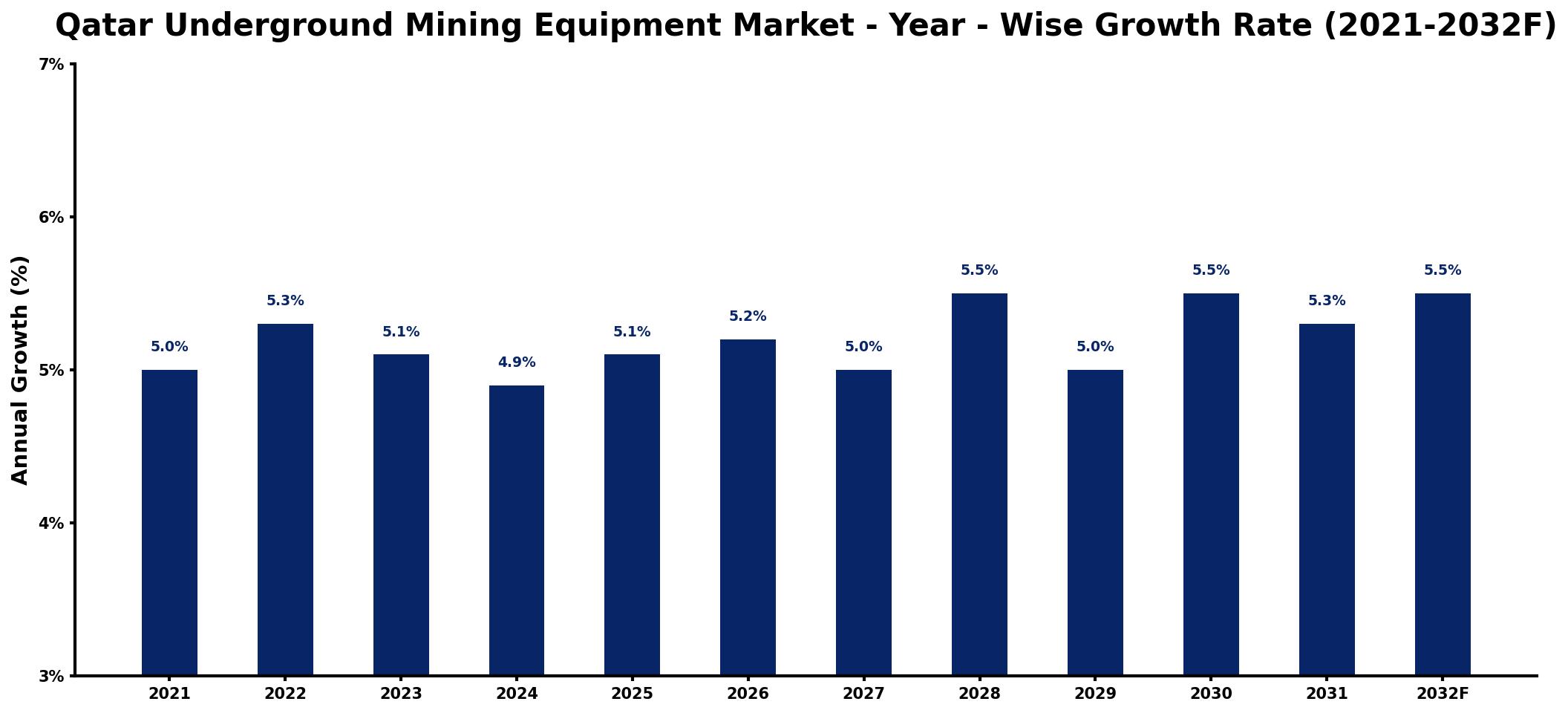
The table below presents the year‑wise growth rates along with the key drivers influencing the market
| Year | Growth Rate | Major Drivers |
| 2021 | 5.0% | Infrastructure projects demand surge |
| 2022 | 5.3% | Increased resource exploration activities |
| 2023 | 5.1% | Technological advancements adoption rise |
| 2024 | 4.9% | Investment in renewable energy sources |
| 2025 | 5.1% | Urbanization driving resource needs |
| 2026 | 5.2% | Government initiatives supporting growth |
| 2027 | 5.0% | Rising global commodity prices impact |
| 2028 | 5.5% | Sustainability practices gaining traction |
| 2029 | 5.0% | Emerging markets expanding resource demand |
| 2030 | 5.5% | Strategic partnerships enhancing opportunities |
| 2031 | 5.3% | Regulatory support fostering investments |
| 2032 | 5.5% | Enhanced efficiency through automation |
Note: Market size estimations and growth projections presented in this report are based on 6Wresearch's proprietary forecasting methodology, utilizing the latest available industry data, government publications, and primary research inputs.
Qatar Underground Mining Equipment Market Synopsis
The Qatar underground mining equipment market is currently experiencing a period of gradual growth, reflecting a shift in focus towards the mining sector. As the nation strives to diversify its economy beyond oil and gas, investments in mining are increasing, leading to a demand for advanced machinery that can operate safely and efficiently in underground environments.
Looking ahead, the market is poised for further expansion, supported by technological advancements and a greater emphasis on sustainable mining practices. While the exploration of mineral resources in Qatar is still in its infancy, the potential for growth is substantial, especially as stakeholders recognize the importance of integrating innovative equipment into their operations.
Qatar Underground Mining Equipment Market Key Takeaways
- Growth is primarily driven by the diversification of Qatars economy and the exploration of mineral resources.
- Advanced technology in equipment is enhancing operational efficiency and safety standards.
- Sustainability concerns are shaping procurement decisions within the mining sector.
- Environmental regulations are becoming more stringent, influencing equipment selection.
- The market remains relatively resilient, demonstrating limited impact from external shocks, such as the COVID-19 pandemic.
Evaluation of Restraints in Qatar Underground Mining Equipment Market
Despite the optimistic growth trajectory, the Qatar underground mining equipment market faces notable restraints. The country's limited natural resource base presents a challenge for extensive mining operations. Additionally, the development of a robust market for underground mining equipment requires substantial long-term investments and a forward-looking vision from stakeholders. Environmental regulations add complexity, demanding that companies adopt practices which not only comply with safety standards but also align with sustainability goals.
Qatar Underground Mining Equipment Market Trends
Current trends in the Qatar underground mining equipment market reflect a shift towards greater automation and digitization of mining operations. Innovations such as real-time monitoring systems, advanced data analytics, and automated machinery are becoming increasingly relevant, enhancing productivity and reducing operational risks. Furthermore, there's a clear move towards integrating eco-friendly technologies to meet both regulatory standards and industry demands for sustainable practices.
Qatar Underground Mining Equipment Market Opportunities
Significant opportunities lie in the advancement of localized mining operations and the establishment of partnerships aimed at enhancing technology transfer. As international firms look to collaborate with local entities, there is potential for joint ventures that can improve both the skill set and technology access for the domestic market. Moreover, with the growing emphasis on sustainable mining practices, equipment that offers eco-friendly operations will likely attract considerable investment.
Government Initiatives in the Qatar Underground Mining Equipment Market
The Qatari government is actively promoting initiatives to bolster the mining sector, recognizing its potential as a pillar of economic diversification. Policies designed to support sustainable mining practices, coupled with investments in infrastructure, are paving the way for a more robust mining landscape. Public spending on technology development and training programs is expected to enhance operational efficiency within the sector.
Future Insights of the Qatar Underground Mining Equipment Market
Between 2026 and 2032, the Qatar underground mining equipment market is anticipated to undergo substantial transformation. As exploration efforts intensify and new projects come online, the demand for specialized equipment will increase. Innovations in machine safety and efficiency will likely become focal points, ensuring that operations are both productive and environmentally responsible. The ability to adapt to evolving regulatory frameworks will be crucial for companies seeking to capitalize on market opportunities.
Qatar Underground Mining Equipment Market Latest Developments (2025 - 2026)
Recent developments in the Qatar underground mining equipment sector indicate a growing interest in integrating smart technologies into mining operations. There is an uptick in collaborations between technology providers and local mining companies, aiming to enhance safety and operational efficiencies. Additionally, discussions around environmental compliance and sustainable practices are gaining prominence, reflecting a shift in industry priorities.
Qatar Underground Mining Equipment Market - Key Attractiveness of the Report
- 10 Years of Market Numbers
- Historical Data Starting from 2022 to 2025
- Base Year: 2025
- Forecast Data until 2032
- Key Performance Indicators Impacting the Market
- Major Upcoming Developments and Projects
Key Highlights of the Report:
- Qatar Underground Mining Equipment Market Outlook
- Market Size of Qatar Underground Mining Equipment Market, 2025
- Forecast of Qatar Underground Mining Equipment Market, 2032
- Historical Data and Forecast of Qatar Underground Mining Equipment Revenues & Volume for the Period 2022-2032F
- Qatar Underground Mining Equipment Market Trend Evolution
- Qatar Underground Mining Equipment Market Drivers and Challenges
- Qatar Underground Mining Equipment Price Trends
- Qatar Underground Mining Equipment Porter's Five Forces
- Qatar Underground Mining Equipment Industry Life Cycle
- Historical Data and Forecast of Qatar Underground Mining Equipment Market Revenues & Volume By Product Type for the Period 2022-2032F
- Historical Data and Forecast of Qatar Underground Mining Equipment Market Revenues & Volume By Mining Loaders for the Period 2022-2032F
- Historical Data and Forecast of Qatar Underground Mining Equipment Market Revenues & Volume By Mining Trucks for the Period 2022-2032F
- Historical Data and Forecast of Qatar Underground Mining Equipment Market Revenues & Volume By Mining Drills for the Period 2022-2032F
- Historical Data and Forecast of Qatar Underground Mining Equipment Market Revenues & Volume By Mining Bolters for the Period 2022-2032F
- Historical Data and Forecast of Qatar Underground Mining Equipment Market Revenues & Volume By Mining Shearer for the Period 2022-2032F
- Historical Data and Forecast of Qatar Underground Mining Equipment Market Revenues & Volume By Continuous Miners for the Period 2022-2032F
- Historical Data and Forecast of Qatar Underground Mining Equipment Market Revenues & Volume By Mining Excavators & Shovels for the Period 2022-2032F
- Historical Data and Forecast of Qatar Mining Loaders Underground Mining Equipment Market Revenues & Volume By Mining Scalers for the Period 2022-2032F
- Historical Data and Forecast of Qatar Underground Mining Equipment Market Revenues & Volume By Mining Technique for the Period 2022-2032F
- Historical Data and Forecast of Qatar Underground Mining Equipment Market Revenues & Volume By Soft Rock Mining for the Period 2022-2032F
- Historical Data and Forecast of Qatar Underground Mining Equipment Market Revenues & Volume By Hard Rock Mining for the Period 2022-2032F
- Historical Data and Forecast of Qatar Underground Mining Equipment Market Revenues & Volume By End Users for the Period 2022-2032F
- Historical Data and Forecast of Qatar Underground Mining Equipment Market Revenues & Volume By Mining Operators for the Period 2022-2032F
- Historical Data and Forecast of Qatar Underground Mining Equipment Market Revenues & Volume By Rental Service Provider for the Period 2022-2032F
- Qatar Underground Mining Equipment Import Export Trade Statistics
- Market Opportunity Assessment By Product Type
- Market Opportunity Assessment By Mining Technique
- Market Opportunity Assessment By End Users
- Qatar Underground Mining Equipment Top Companies Market Share
- Qatar Underground Mining Equipment Competitive Benchmarking By Technical and Operational Parameters
- Qatar Underground Mining Equipment Company Profiles
- Qatar Underground Mining Equipment Key Strategic Recommendations






































