Qatar Wholesale Market Summary
The qatar wholesale market was estimated at USD 266 Million in 2025 and is projected to reach USD 353 Million by 2032, growing at a CAGR of 5.2% from 2026 to 2032.
Qatar Wholesale Market Year-wise Growth Rate and Key Drivers
This graph highlights how the Qatar Wholesale Market has steadily grown over the past five years, supported by major growth factors.
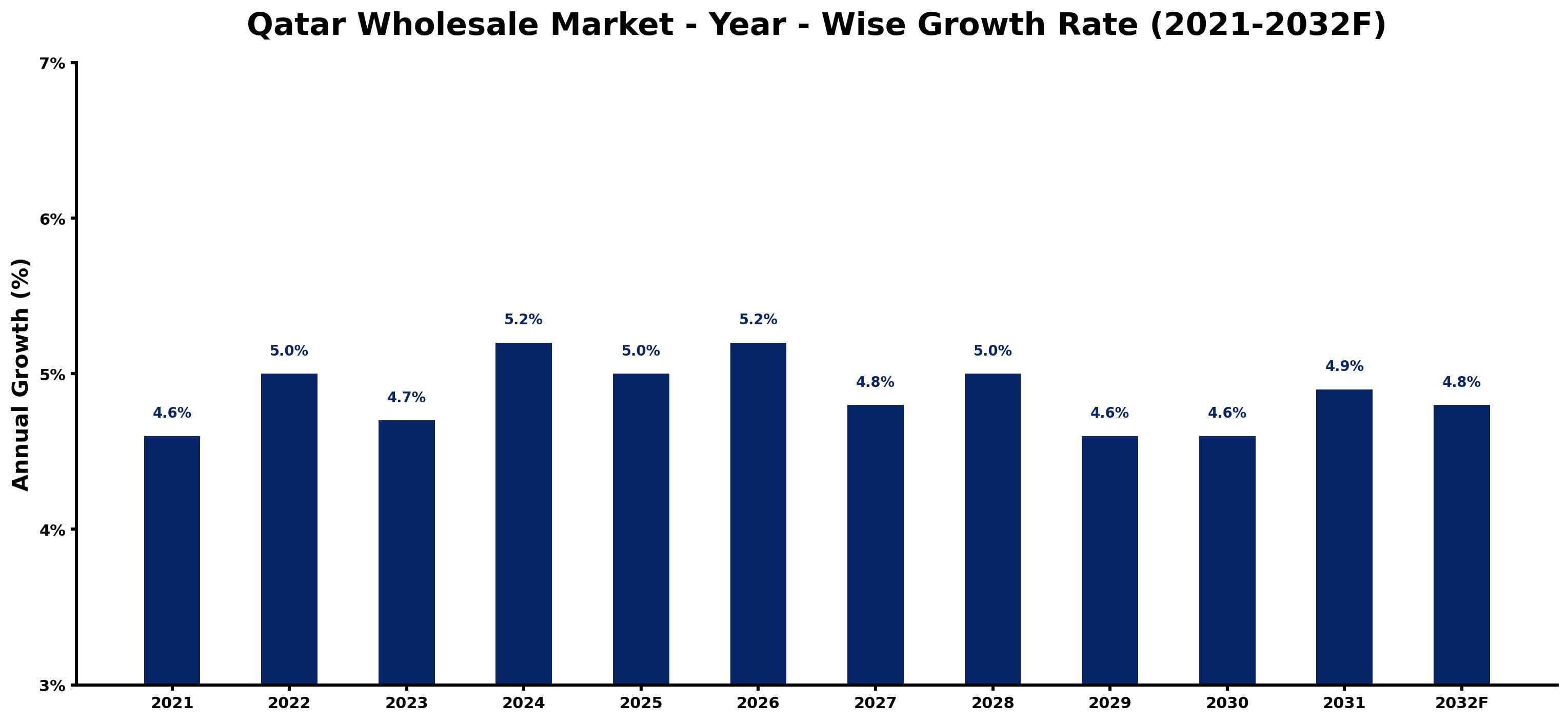
The table below presents the year wise growth rates along with the key drivers influencing the market
| Year | Growth Rate | Major Drivers |
| 2021 | 4.6% | Post-pandemic recovery stimulated various sectors within the Qatari wholesale landscape. |
| 2022 | 5.0% | Increased participation of local businesses enhanced competition among wholesale distributors. |
| 2023 | 4.7% | Investment in logistics infrastructure improved distribution efficiency across the region. |
| 2024 | 5.2% | Qatar's growing population necessitated expansion in food and consumer goods sectors. |
| 2025 | 5.0% | Emerging e-commerce platforms reshaped customer purchasing behavior and expectations. |
| 2026 | 5.2% | The FIFA World Cup catalyzed substantial investments in hospitality and retail sectors. |
| 2027 | 4.8% | Sustainability trends influenced wholesalers to adapt eco-friendlier supply chains. |
| 2028 | 5.0% | Technological innovations enhanced inventory management, streamlining wholesale operations significantly. |
| 2029 | 4.6% | Regional economic stability fostered partnerships between local and international wholesalers. |
| 2030 | 4.6% | GCC trade agreements opened new avenues for expansion in the wholesale market. |
| 2031 | 4.9% | Demand for localized products prompted wholesalers to source within the MENA region. |
| 2032 | 4.8% | Urban development projects increased the need for construction and building materials wholesale. |
Note - Market size estimations and growth projections presented in this report are based on 6Wresearch's advanced forecasting approach, validated with industry datasets as of June 2026.
Qatar Wholesale Market Synopsis
The Qatar Wholesale Market is projected to reach 5.2% and witness significant growth during the forecast period (2026-2032). This market serves as a crucial segment of Qatar's commercial ecosystem, encompassing a diverse range of goods and services that cater to both local consumers and businesses. Renowned as the largest commercial hub in the country, the Qatar Wholesale Market plays a vital role in the economic landscape, providing opportunities for employment and facilitating bulk purchases that enhance profit margins for foreign enterprises.
Qatar Wholesale Market Growth Drivers
The expansion of the Qatar Wholesale Market is primarily driven by several key factors. One significant driver is the strategic geographical positioning of Qatar, which places it at the center of essential trading routes in the region. This advantage enables efficient import and export activities, enhancing the market's attractiveness.
- The increasing population in Qatar fuels demand for various consumer and industrial products, necessitating a robust wholesale sector to meet these needs.
- Government initiatives aimed at bolstering business growth, including support for foreign investment and local industry development, contribute to the market's expansion.
- Enhanced infrastructure, characterized by modern road networks and advanced port facilities, facilitates smoother logistics and distribution, further stimulating wholesale activities.
- Free trade agreements with several countries have simplified import and export processes, leading to a more dynamic wholesale environment.
- Growing interest from global companies investing in Qatar aims to tap into the lucrative opportunities presented by the country's economic development, further driving market growth.
Qatar Wholesale Market Challenges and Restraints
Despite the positive growth trajectory of the Qatar Wholesale Market, several challenges must be addressed to ensure sustainable development. Quality control remains a pressing concern, as variability among suppliers can impact product standards.
- High labor costs associated with shortages of qualified personnel can strain the operational capacity of businesses within the wholesale sector.
- Access to credit poses a significant challenge for small enterprises, often hindering their ability to scale operations and compete effectively.
- Lack of transparency regarding regulations and pricing can create uncertainty for businesses, making market navigation difficult.
- Limited adoption of digital technologies for processes such as ordering and payment can reduce efficiency, impacting competitiveness in an increasingly digital marketplace.
- Security concerns, particularly related to piracy and cyber threats, pose risks to businesses operating in the wholesale sector, necessitating robust risk management strategies.
Qatar Wholesale Market Covid-19 Impact
The Covid-19 pandemic has significantly affected the Qatar economy, disrupting various sectors, including wholesale trade. Lockdowns and restrictions led many businesses to temporarily cease operations, resulting in diminished demand across all sectors.
- The overall decline in consumer spending during the pandemic restricted sales volumes for wholesalers, causing revenue losses.
- Supply chain disruptions further complicated the ability to maintain inventory levels, impacting service delivery.
- As businesses adapted to the challenges of Covid-19, many accelerated the adoption of online platforms for sales and customer engagement.
- Post-pandemic recovery strategies are essential for wholesalers to regain market stability and expand their operations.
- Long-term effects of the pandemic have prompted a renewed focus on resilience and agility within the wholesale sector.
Qatar Wholesale Market Government Investment and Initiatives
The Qatari government has implemented several policies and initiatives to promote growth within the wholesale market. Investment in infrastructure has been a cornerstone of national development plans, enhancing logistics and distribution capabilities.
- Public spending on modernizing transport and port facilities supports the efficient movement of goods, essential for a thriving wholesale market.
- Incentives for small and medium enterprises (SMEs) help stimulate local production, diversifying the product offerings available in the wholesale sector.
- Government-led initiatives to attract foreign investment create a more competitive landscape, enhancing the overall commercial environment.
- Regulatory frameworks are continually being reviewed and updated to foster transparency and ease of doing business, which is crucial for market participants.
- Strategic partnerships between public and private sectors enable collaborative efforts towards market enhancement and economic diversification.
Qatar Wholesale Market Latest Developments (May 2025 - June 2026)
During the period from May 2025 to June 2026, the Qatar Wholesale Market has experienced several notable developments that reflect its evolving dynamics. The government has continued to emphasize infrastructure projects critical to enhancing market operations.
- New regulations have been introduced to improve the efficiency of customs and trade processes, streamlining operations for wholesalers.
- Investment in digital solutions has gained momentum, with companies increasingly adopting e-commerce platforms to reach consumers and businesses more effectively.
- Collaborations between local businesses and international suppliers have increased, fostering diverse product availability within the wholesale market.
- Workshops and training programs aimed at upskilling the workforce are being initiated to address labor shortages and improve service quality.
- Environmental sustainability initiatives are being integrated into operational practices, promoting a greener approach to wholesale trading.
Qatar Wholesale Market - Key Attractiveness of the Report
- 10 Years of Market Numbers
- Historical Data Starting from 2022 to 2025
- Base Year: 2025
- Forecast Data until 2032
- Key Performance Indicators Impacting the Market
- Major Upcoming Developments and Projects
Key Highlights of the Report:
- Qatar Wholesale Market Outlook
- Market Size of Qatar Wholesale Market, 2025
- Forecast of Qatar Wholesale Market, 2032
- Historical Data and Forecast of Qatar Wholesale Revenues & Volume for the Period 2022-2032F
- Qatar Wholesale Market Trend Evolution
- Qatar Wholesale Market Drivers and Challenges
- Qatar Wholesale Price Trends
- Qatar Wholesale Porter's Five Forces
- Qatar Wholesale Industry Life Cycle
- Historical Data and Forecast of Qatar Wholesale Market Revenues & Volume By Type for the Period 2022-2032F
- Historical Data and Forecast of Qatar Wholesale Market Revenues & Volume By Non-Durable Goods Merchant Wholesalers for the Period 2022-2032F
- Historical Data and Forecast of Qatar Wholesale Market Revenues & Volume By Wholesale Electronic Markets And Agents And Brokers for the Period 2022-2032F
- Historical Data and Forecast of Qatar Wholesale Market Revenues & Volume By Durable Goods Merchant Wholesalers for the Period 2022-2032F
- Historical Data and Forecast of Qatar Wholesale Market Revenues & Volume By Ownership for the Period 2022-2032F
- Historical Data and Forecast of Qatar Wholesale Market Revenues & Volume By Wholesale/Distribution Chain for the Period 2022-2032F
- Historical Data and Forecast of Qatar Wholesale Market Revenues & Volume By Independent Wholesalers for the Period 2022-2032F
- Qatar Wholesale Import Export Trade Statistics
- Market Opportunity Assessment By Type
- Market Opportunity Assessment By Ownership
- Qatar Wholesale Top Companies Market Share
- Qatar Wholesale Competitive Benchmarking By Technical and Operational Parameters
- Qatar Wholesale Company Profiles
- Qatar Wholesale Key Strategic Recommendations






































