Romania 2-Hydroxypropanoic Acid Market (2026-2032) | Competitive, Revenue, Opportunities, Investment Trends, Outlook, Drivers, Analysis, Companies, Segments, Share, Pricing Analysis, Segmentation, Competition, Trends, Consumer Insights, Strategy, Demand, Challenges, Restraints, Industry, Forecast, Supply, Strategic Insights, Value, Growth, Size
Market Forecast By Application (Bioplastics, Industrial, Food & Beverage, Pharmaceuticals, Cosmetics), By End-Use (Packaging, Healthcare), By Grade (Food, Industrial, Pharmaceutical), By Production Method (Synthetic, Fermentation) And Competitive Landscape
| Product Code: ETC11431780 | Publication Date: Apr 2025 | Updated Date: May 2026 | Product Type: Market Research Report | |
| Publisher: 6Wresearch | Author: Bhawna Singh | No. of Pages: 70 | No. of Figures: 35 | No. of Tables: 5 |
Romania 2 Hydroxypropanoic Acid Market Size (2020-2030)
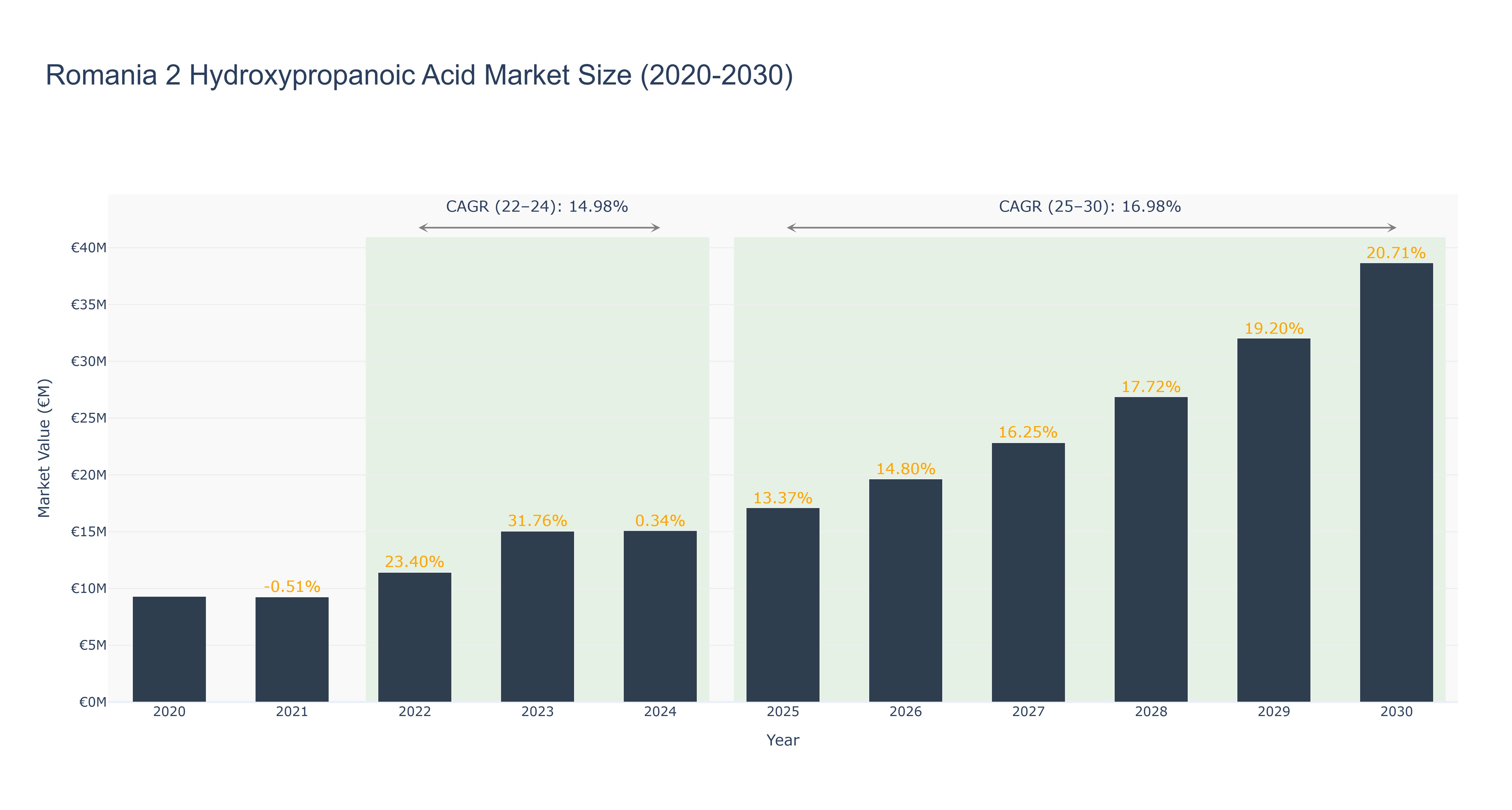
The Romania 2 Hydroxypropanoic Acid Market experienced notable fluctuations between 2020 and 2024, with a peak market size of €15.09 million in 2024, following a significant rebound from a decline in 2021. The actual market size grew from €9.30 million in 2020 to €11.41 million in 2022, reflecting a CAGR of 14.98% during the 2022-2024 period. This growth can be attributed to increased demand in various applications, particularly in pharmaceuticals and cosmetics. Looking ahead, the market is projected to expand further, with forecasted values rising from €17.11 million in 2025 to €38.67 million by 2030, reflecting a robust CAGR of 16.98%. Key drivers for this anticipated growth include advancements in production technologies and rising awareness of the benefits of 2 hydroxypropanoic acid across diverse industries. Continued investment in R&D and sustainable production methods is expected to bolster market development in Romania.
Romania 2 Hydroxypropanoic Acid Market: Production & Trade Performance (2019-2025)
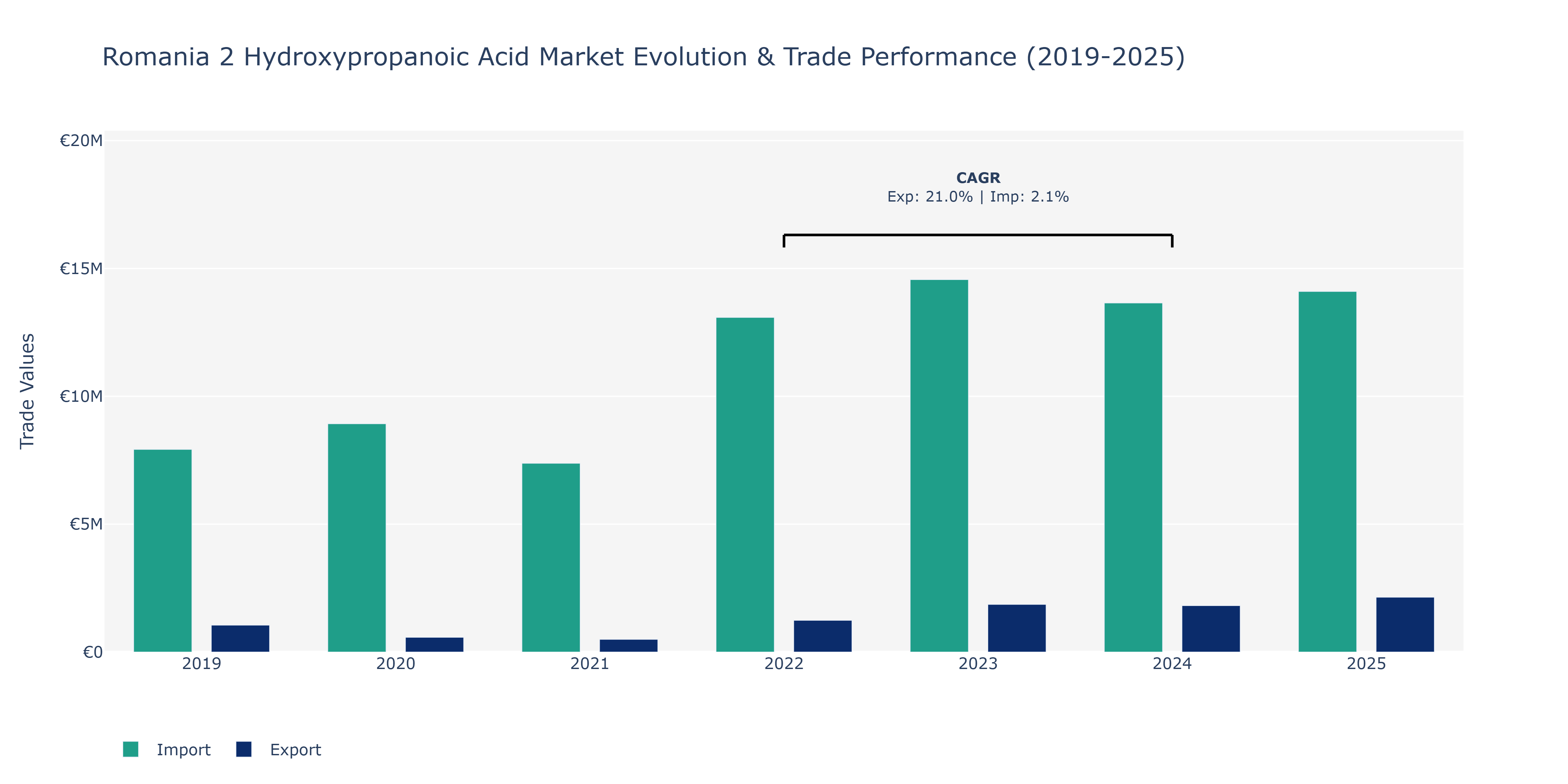
The Romania 2 Hydroxypropanoic Acid market witnessed varying trends in exports and imports from 2019 to 2025. In 2019, exports stood at €1.05 million, with a notable decrease to €575.73 thousand in 2020, likely influenced by global economic uncertainties. However, from 2020 to 2025, exports showed a consistent upward trajectory, reaching €2.14 million in 2025, indicating a recovery and potential market growth. Conversely, imports started at €7.92 million in 2019, showing a slight decline in 2021 to €7.38 million, possibly due to changing trade dynamics. Imports surged in 2023 to €14.56 million, reflecting increased demand or supply chain shifts. The market's export CAGR of 21.04% (2022–2024) suggests improving competitiveness, while the 2.14% import CAGR during the same period may indicate enhanced domestic production capabilities. External factors such as trade agreements or regulatory changes could have influenced these trends. Further research into market dynamics and regulatory developments would provide deeper insights into these fluctuations.
Romania 2-Hydroxypropanoic Acid Market Growth Rate
According to 6Wresearch internal database and industry insights, the Romania 2-Hydroxypropanoic Acid Market is projected to grow at a compound annual growth rate (CAGR) of 7.4% during the forecast period (2026-2032).
Topics Covered in the Romania 2-Hydroxypropanoic Acid Market Report
The Romania 2-Hydroxypropanoic Acid Market report thoroughly covers the market by application, end-use, grade, and production method. The market report provides an unbiased and detailed analysis of ongoing market trends, opportunities/high growth areas, and market drivers, which help stakeholders devise and align their market strategies according to the current and future market dynamics.
Romania 2-Hydroxypropanoic Acid Market Highlights
| Report Name | Romania 2-Hydroxypropanoic Acid Market |
| Forecast period | 2026-2032 |
| CAGR | 7.4% |
| Growing Sector | Bioplastics |
Romania 2-Hydroxypropanoic Acid Market Synopsis
Romania 2-Hydroxypropanoic Acid Market is anticipated to witness substantial growth due to increasing demand for biodegradable products, increasing usage of lactic acid in pharmaceuticals and food processing, and rising focus towards sustainability in industries. Also, due to increasing usage in cosmetic, packaging, and health care sectors where environment-friendly raw materials are gaining more preference. Moreover, innovations in fermentation process and investments made in bio-based chemicals production will further propel growth in the Romania 2-Hydroxypropanoic Acid Market over the next few years. In addition, positive environmental laws and rising consumer inclination towards sustainable products will create new avenues for this market.
Evaluation of Growth Drivers in the Romania 2-Hydroxypropanoic Acid Market (2026- 2032)
Below mentioned are some prominent drivers and their influence on the market dynamics:
| Drivers | Primary Segments Affected | Why it Matters (Evidence) |
| Rising Demand for Sustainable Packaging | Bioplastics; Packaging | Eco-friendly packaging solutions increase demand for bio-based lactic acid materials. |
| Growth in Pharmaceutical Applications | Pharmaceuticals; Healthcare | Lactic acid compounds are increasingly utilized in medical and pharmaceutical formulations. |
| Expansion of Food Processing Industry | Food Grade; Food & Beverage | Food manufacturers require lactic acid for preservation and acidity regulation. |
| Increasing Adoption of Fermentation Technologies | Fermentation; Industrial | Advanced fermentation improves production efficiency and sustainability. |
| Government Focus on Green Manufacturing | Industrial; Packaging | Sustainability initiatives encourage bio-based chemical production and adoption. |
Romania 2-Hydroxypropanoic Acid Market is expected to grow at the CAGR of 7.4% during the forecast period of 2026-2032. Growth is mainly being propelled by growing demand for biodegradable plastics, increased use of sustainable packaging materials, and growing application of lactic acid in the pharmaceutical and food industry. Additionally, the growth of the market can be attributed to technological innovations in fermentation technology. This will help improve product quality and production efficiency. Moreover, there is growing use of hydroxypropanoic acid products in the health care and cosmetic industry due to the advantages associated with using biobased products that comply with green manufacturing techniques.
Evaluation of Restraints in the Romania 2-Hydroxypropanoic Acid Market
Below mentioned are some major restraints and their influence on the market dynamics:
| Restraints | Primary Segments Affected | What This Means (Evidence) |
| High Production Costs | Fermentation; Industrial | Bio-based production technologies increase operational expenses for manufacturers. |
| Limited Raw Material Availability | Bioplastics; Packaging | Dependence on agricultural feedstocks may affect production consistency. |
| Competition by Substitutes | Artificial; Industrial | The use of low-priced substitutes makes it harder for bio-products to gain entry into the market. |
| Regulatory Compliance | Due to Safety & Quality Standards | Regulation is tough due to safety & quality standards. |
| High Energy Consumption | Industrial Grade; Industrial | High energy consumption makes industrial grade manufacturing processes less profitable. |
Romania 2-Hydroxypropanoic Acid Industry Challenges
Despite growing demand for sustainable and bio-based chemical solutions, the Romania 2-Hydroxypropanoic Acid Industry continues to face several operational and market-related challenges. The manufacturers are facing problems like high production costs that result from the use of fermentation techniques and bio-based materials. Moreover, changes in the availability of feedstock in the agriculture sector may lead to variations in production. The stringent environment and pharmaceutical guidelines make things difficult for producers who manufacture products in the European market. Small manufacturers are also unable to adopt modern techniques of processing due to they have to invest a lot in them. On the other hand, competition from synthetic products and changing consumer preferences is pushing organizations to enhance their performance.
Romania 2-Hydroxypropanoic Acid Market Trends
Emerging trends in the Romania 2-Hydroxypropanoic Acid Market include:
- Use of Biodegradable Packaging: Manufacturers of packaging materials are adopting bioplastics made from lactic acid for sustainable production processes.
- Rising Use of Fermentation in Production: Companies are adopting advanced fermentation systems for improved efficiency with reduced carbon footprints.
- Improved Usage in Cosmetic Formulations: Manufacturers of cosmetic products are utilizing hydroxypropanoic acid compounds in their cosmetic products.
Investment Opportunities in the Romania 2-Hydroxypropanoic Acid Market
Major investment opportunities in the Romania 2-Hydroxypropanoic Acid Market include:
- Bioplastics Production Plants – Increasing need for environmentally friendly packaging products will lead to investments in bioplastic production plants.
- Advanced Fermentation Research & Development – Investments are being made by companies towards developing efficient fermentation methods.
- Production of Pharmaceutical Ingredients – Due to increasing health care needs, pharmaceutical grade lactic acid production has been possible.
Top 5 Leading Players in the Romania 2-Hydroxypropanoic Acid Market
Some leading players operating in the Romania 2-Hydroxypropanoic Acid Market include:
1. Corbion N.V.
| Company Name | Corbion N.V. |
|---|---|
| Established Year | 1919 |
| Headquarters | Amsterdam, Netherlands |
| Official Website | Click Here |
Corbion N.V. manufactures lactic acid and bio-based ingredients utilized in bioplastics, food processing, pharmaceuticals, and industrial applications. The company focuses on sustainable production technologies, fermentation innovation, and environmentally responsible chemical manufacturing while serving global packaging and healthcare industries.
2. NatureWorks LLC
| Company Name | NatureWorks LLC |
|---|---|
| Established Year | 1997 |
| Headquarters | Minnesota, USA |
| Official Website | Click Here |
NatureWorks LLC produces polylactic acid materials and bio-based chemical compounds used in biodegradable packaging and industrial applications. The company emphasizes renewable resource utilization, advanced biopolymer development, and sustainable manufacturing practices to support environmentally friendly industrial growth worldwide.
3. Galactic S.A.
| Company Name | Galactic S.A. |
|---|---|
| Established Year | 1994 |
| Headquarters | Brussels, Belgium |
| Official Website | - |
Galactic S.A. develops lactic acid-based solutions for food preservation, pharmaceuticals, cosmetics, and industrial applications. The company is recognized for its expertise in fermentation technologies, sustainable product innovation, and advanced ingredient manufacturing supporting multiple industries across international markets.
4. Henan Jindan Lactic Acid Technology Co., Ltd.
| Company Name | Henan Jindan Lactic Acid Technology Co., Ltd. |
|---|---|
| Established Year | 1984 |
| Headquarters | Henan, China |
| Official Website | - |
Henan Jindan Lactic Acid Technology Co., Ltd. manufactures lactic acid and derivative products utilized in food processing, biodegradable plastics, and industrial chemical applications. The company focuses on large-scale fermentation production, quality improvement, and sustainable chemical manufacturing technologies.
5. Musashino Chemical Laboratory Ltd.
| Company Name | Musashino Chemical Laboratory Ltd. |
|---|---|
| Established Year | 1946 |
| Headquarters | Tokyo, Japan |
| Official Website | Click Here |
Musashino Chemical Laboratory Ltd. supplies specialty lactic acid products and bio-based ingredients for pharmaceutical, cosmetic, and industrial applications. The company emphasizes research-driven innovation, advanced fermentation technologies, and environmentally sustainable manufacturing solutions for global specialty chemical markets.
Government Regulations Introduced in the Romania 2-Hydroxypropanoic Acid Market
According to Romania’s Government Data, a number of sustainability-oriented initiatives and regulations implemented by the government to stimulate the manufacture and use of bio-based chemicals and degradable substances. There are certain environmental and REACH regulation standards adopted in Romania which deal with the manufacture and use of industrial chemicals like hydroxypropanoic acid. Apart from this, there are also some initiatives and programs for green manufacturing that are promoting sustainable packaging as well as bio-based manufacturing. The Romanian Ministry of Environment has also been promoting industrial projects aimed at reducing plastic wastage and promoting biodegradability. Also, the financial incentives that are available for renewable manufacturing technology upgrades and environmental compliance have been aiding the progress in chemical industries.
Future Insights of the Romania 2-Hydroxypropanoic Acid Market
The outlook for the Romania 2-Hydroxypropanoic Acid Market Share remains highly positive due to rising environmental awareness, increasing adoption of biodegradable packaging materials, and growing investments in bio-based chemical manufacturing technologies. Future developments in the use of pharmaceuticals and food processing industries will favor the market, as the purity and sustainability of lactic acid compounds are highly valued in such sectors. Additionally, there might be improvements in the fermentation processes and biotechnology that would make operations in the sector more efficient and cost-effective. The Romanian commitment to green industrialization, along with regulations concerning sustainability in Europe, should further increase the prospects for the development of the market. Increased demand for environmental friendly cosmetics, packages, and healthcare products will add to the expansion of the industry.
Market Segmentation Analysis
The report offers a comprehensive study of the subsequent market segments and their leading categories.
Bioplastics to Dominate the Market – By Application
According to Rahul, Senior Research Analyst, 6Wresearch, the Bioplastics segment dominates the Romania 2-Hydroxypropanoic Acid Market owing to growing demand for sustainable and biodegradable packaging material by the food sector, the retail industry, and the manufacturing industry. The role of hydroxypropanoic acid in the synthesis of polylactic acid (PLA) is important in eco-friendly packaging and disposables. Rising environmental concerns, along with strict rules related to plastic waste, are driving producers toward adopting bio-plastics. Moreover, the packaging industry is making significant investments in the development of biodegradable packaging products owing to their sustainability and preference among consumers. Such developments will further reinforce the dominant position of the bioplastics market over the coming years.
Key Attractiveness of the Report
- 10 Years of Market Numbers.
- Historical Data Starting from 2022 to 2025.
- Base Year: 2025.
- Forecast Data until 2032.
- Key Performance Indicators Impacting the Market.
- Major Upcoming Developments and Projects.
Key Highlights of the Report:
- Romania 2-Hydroxypropanoic Acid Market Outlook
- Market Size of Romania 2-Hydroxypropanoic Acid Market, 2025
- Forecast of Romania 2-Hydroxypropanoic Acid Market, 2032
- Historical Data and Forecast of Romania 2-Hydroxypropanoic Acid Revenues & Volume for the Period 2022-2032F
- Romania 2-Hydroxypropanoic Acid Market Trend Evolution
- Romania 2-Hydroxypropanoic Acid Market Drivers and Challenges
- Romania 2-Hydroxypropanoic Acid Price Trends
- Romania 2-Hydroxypropanoic Acid Porter's Five Forces
- Romania 2-Hydroxypropanoic Acid Industry Life Cycle
- Historical Data and Forecast of Romania 2-Hydroxypropanoic Acid Market Revenues & Volume By Application for the Period 2022-2032F
- Historical Data and Forecast of Romania 2-Hydroxypropanoic Acid Market Revenues & Volume By Bioplastics for the Period 2022-2032F
- Historical Data and Forecast of Romania 2-Hydroxypropanoic Acid Market Revenues & Volume By Industrial for the Period 2022-2032F
- Historical Data and Forecast of Romania 2-Hydroxypropanoic Acid Market Revenues & Volume By Food & Beverage for the Period 2022-2032F
- Historical Data and Forecast of Romania 2-Hydroxypropanoic Acid Market Revenues & Volume By Pharmaceuticals for the Period 2022-2032F
- Historical Data and Forecast of Romania 2-Hydroxypropanoic Acid Market Revenues & Volume By Cosmetics for the Period 2022-2032F
- Historical Data and Forecast of Romania 2-Hydroxypropanoic Acid Market Revenues & Volume By End-Use for the Period 2022-2032F
- Historical Data and Forecast of Romania 2-Hydroxypropanoic Acid Market Revenues & Volume By Packaging for the Period 2022-2032F
- Historical Data and Forecast of Romania 2-Hydroxypropanoic Acid Market Revenues & Volume By Healthcare for the Period 2022-2032F
- Historical Data and Forecast of Romania 2-Hydroxypropanoic Acid Market Revenues & Volume By Grade for the Period 2022-2032F
- Historical Data and Forecast of Romania 2-Hydroxypropanoic Acid Market Revenues & Volume By Food for the Period 2022-2032F
- Historical Data and Forecast of Romania 2-Hydroxypropanoic Acid Market Revenues & Volume By Industrial for the Period 2022-2032F
- Historical Data and Forecast of Romania 2-Hydroxypropanoic Acid Market Revenues & Volume By Pharmaceutical for the Period 2022-2032F
- Historical Data and Forecast of Romania 2-Hydroxypropanoic Acid Market Revenues & Volume By Production Method for the Period 2022-2032F
- Historical Data and Forecast of Romania 2-Hydroxypropanoic Acid Market Revenues & Volume By Synthetic for the Period 2022-2032F
- Historical Data and Forecast of Romania 2-Hydroxypropanoic Acid Market Revenues & Volume By Fermentation for the Period 2022-2032F
- Romania 2-Hydroxypropanoic Acid Import Export Trade Statistics
- Market Opportunity Assessment By Application
- Market Opportunity Assessment By End-Use
- Market Opportunity Assessment By Grade
- Market Opportunity Assessment By Production Method
- Romania 2-Hydroxypropanoic Acid Top Companies Market Share
- Romania 2-Hydroxypropanoic Acid Competitive Benchmarking By Technical and Operational Parameters
- Romania 2-Hydroxypropanoic Acid Company Profiles
- Romania 2-Hydroxypropanoic Acid Key Strategic Recommendations
Market Covered
The report offers a comprehensive study of the subsequent market segments:
By Application
- Bioplastics
- Industrial
- Food & Beverage
- Pharmaceuticals
- Cosmetics
By End-Use
- Packaging
- Healthcare
By Grade
- Food
- Industrial
- Pharmaceutical
By Production Method
- Synthetic
- Fermentation
Romania 2-Hydroxypropanoic Acid Market (2026-2032): FAQs
The Romania 2-Hydroxypropanoic Acid Market is projected to grow at a CAGR of 7.4% during the forecast period 2026-2032.
Romania supports green manufacturing, biodegradable packaging projects, circular economy initiatives, and sustainable industrial development aligned with EU environmental standards.
Opportunities for investment may be made in production of bioplastics, fermentation process, production of pharmaceutical components, and sustainable packaging solutions.
End users are packaging manufacturers, healthcare firms, pharmaceuticals, food industry, cosmetics firms, and industrial chemicals manufacturers.
6Wresearch actively monitors the Romania 2-Hydroxypropanoic Acid Market and publishes its comprehensive annual report, highlighting emerging trends, growth drivers, revenue analysis, and forecast outlook. Our insights help businesses to make data-backed strategic decisions with ongoing market dynamics. Our analysts track relevent industries related to the Romania 2-Hydroxypropanoic Acid Market, allowing our clients with actionable intelligence and reliable forecasts tailored to emerging regional needs.
Yes, we provide customisation as per your requirements. To learn more, feel free to contact us on sales@6wresearch.com
| 1 Executive Summary |
| 2 Introduction |
| 2.1 Key Highlights of the Report |
| 2.2 Report Description |
| 2.3 Market Scope & Segmentation |
| 2.4 Research Methodology |
| 2.5 Assumptions |
| 3 Romania 2-Hydroxypropanoic Acid Market Overview |
| 3.1 Romania Country Macro Economic Indicators |
| 3.2 Romania 2-Hydroxypropanoic Acid Market Revenues & Volume, 2022 & 2032F |
| 3.3 Romania 2-Hydroxypropanoic Acid Market - Industry Life Cycle |
| 3.4 Romania 2-Hydroxypropanoic Acid Market - Porter's Five Forces |
| 3.5 Romania 2-Hydroxypropanoic Acid Market Revenues & Volume Share, By Application, 2022 & 2032F |
| 3.6 Romania 2-Hydroxypropanoic Acid Market Revenues & Volume Share, By End-Use, 2022 & 2032F |
| 3.7 Romania 2-Hydroxypropanoic Acid Market Revenues & Volume Share, By Grade, 2022 & 2032F |
| 3.8 Romania 2-Hydroxypropanoic Acid Market Revenues & Volume Share, By Production Method, 2022 & 2032F |
| 4 Romania 2-Hydroxypropanoic Acid Market Dynamics |
| 4.1 Impact Analysis |
| 4.2 Market Drivers |
| 4.2.1 Increasing demand for eco-friendly and sustainable products in various industries |
| 4.2.2 Growing awareness about the benefits of 2 hydroxypropanoic acid in pharmaceutical and cosmetic applications |
| 4.2.3 Favorable government regulations promoting the use of bio-based chemicals |
| 4.3 Market Restraints |
| 4.3.1 High production costs associated with 2 hydroxypropanoic acid |
| 4.3.2 Limited availability of raw materials for manufacturing 2 hydroxypropanoic acid |
| 4.3.3 Competition from alternative chemicals and substitutes in the market |
| 5 Romania 2-Hydroxypropanoic Acid Market Trends |
| 6 Romania 2-Hydroxypropanoic Acid Market, By Types |
| 6.1 Romania 2-Hydroxypropanoic Acid Market, By Application |
| 6.1.1 Overview and Analysis |
| 6.1.2 Romania 2-Hydroxypropanoic Acid Market Revenues & Volume, By Application, 2022 - 2032F |
| 6.1.3 Romania 2-Hydroxypropanoic Acid Market Revenues & Volume, By Bioplastics, 2022 - 2032F |
| 6.1.4 Romania 2-Hydroxypropanoic Acid Market Revenues & Volume, By Industrial, 2022 - 2032F |
| 6.1.5 Romania 2-Hydroxypropanoic Acid Market Revenues & Volume, By Food & Beverage, 2022 - 2032F |
| 6.1.6 Romania 2-Hydroxypropanoic Acid Market Revenues & Volume, By Pharmaceuticals, 2022 - 2032F |
| 6.1.7 Romania 2-Hydroxypropanoic Acid Market Revenues & Volume, By Cosmetics, 2022 - 2032F |
| 6.2 Romania 2-Hydroxypropanoic Acid Market, By End-Use |
| 6.2.1 Overview and Analysis |
| 6.2.2 Romania 2-Hydroxypropanoic Acid Market Revenues & Volume, By Packaging, 2022 - 2032F |
| 6.2.3 Romania 2-Hydroxypropanoic Acid Market Revenues & Volume, By Healthcare, 2022 - 2032F |
| 6.3 Romania 2-Hydroxypropanoic Acid Market, By Grade |
| 6.3.1 Overview and Analysis |
| 6.3.2 Romania 2-Hydroxypropanoic Acid Market Revenues & Volume, By Food, 2022 - 2032F |
| 6.3.3 Romania 2-Hydroxypropanoic Acid Market Revenues & Volume, By Industrial, 2022 - 2032F |
| 6.3.4 Romania 2-Hydroxypropanoic Acid Market Revenues & Volume, By Pharmaceutical, 2022 - 2032F |
| 6.4 Romania 2-Hydroxypropanoic Acid Market, By Production Method |
| 6.4.1 Overview and Analysis |
| 6.4.2 Romania 2-Hydroxypropanoic Acid Market Revenues & Volume, By Synthetic, 2022 - 2032F |
| 6.4.3 Romania 2-Hydroxypropanoic Acid Market Revenues & Volume, By Fermentation, 2022 - 2032F |
| 7 Romania 2-Hydroxypropanoic Acid Market Import-Export Trade Statistics |
| 7.1 Romania 2-Hydroxypropanoic Acid Market Export to Major Countries |
| 7.2 Romania 2-Hydroxypropanoic Acid Market Imports from Major Countries |
| 8 Romania 2-Hydroxypropanoic Acid Market Key Performance Indicators |
| 8.1 Research and development investment in new applications for 2 hydroxypropanoic acid |
| 8.2 Adoption rate of 2 hydroxypropanoic acid in key industries such as pharmaceuticals and cosmetics |
| 8.3 Number of partnerships and collaborations for expanding market reach and product development |
| 9 Romania 2-Hydroxypropanoic Acid Market - Opportunity Assessment |
| 9.1 Romania 2-Hydroxypropanoic Acid Market Opportunity Assessment, By Application, 2022 & 2032F |
| 9.2 Romania 2-Hydroxypropanoic Acid Market Opportunity Assessment, By End-Use, 2022 & 2032F |
| 9.3 Romania 2-Hydroxypropanoic Acid Market Opportunity Assessment, By Grade, 2022 & 2032F |
| 9.4 Romania 2-Hydroxypropanoic Acid Market Opportunity Assessment, By Production Method, 2022 & 2032F |
| 10 Romania 2-Hydroxypropanoic Acid Market - Competitive Landscape |
| 10.1 Romania 2-Hydroxypropanoic Acid Market Revenue Share, By Companies, 2025 |
| 10.2 Romania 2-Hydroxypropanoic Acid Market Competitive Benchmarking, By Operating and Technical Parameters |
| 11 Company Profiles |
| 12 Recommendations |
| 13 Disclaimer |
Global Go To Market Strategy - 2030
Export potential enables firms to identify high-growth global markets with greater confidence by combining advanced trade intelligence with a structured quantitative methodology. The framework analyzes emerging demand trends and country-level import patterns while integrating macroeconomic and trade datasets such as GDP and population forecasts, bilateral import–export flows, tariff structures, elasticity differentials between developed and developing economies, geographic distance, and import demand projections. Using weighted trade values from 2020–2024 as the base period to project country-to-country export potential for 2030, these inputs are operationalized through calculated drivers such as gravity model parameters, tariff impact factors, and projected GDP per-capita growth. Through an analysis of hidden potentials, demand hotspots, and market conditions that are most favorable to success, this method enables firms to focus on target countries, maximize returns, and global expansion with data, backed by accuracy.
By factoring in the projected importer demand gap that is currently unmet and could be potential opportunity, it identifies the potential for the Exporter (Country) among 190 countries, against the general trade analysis, which identifies the biggest importer or exporter.
To discover high-growth global markets and optimize your business strategy:
Click Here
Pricing
- Single User License$ 1,995
- Department License$ 2,400
- Site License$ 3,120
- Global License$ 3,795

Leadership Perspectives from Industry Events
Search
Thought Leadership and Analyst Meet





Our Clients








6WResearch In News
- Doha a strategic location for EV manufacturing hub: IPA Qatar
- Demand for luxury TVs surging in the GCC, says Samsung
- Empowering Growth: The Thriving Journey of Bangladesh’s Cable Industry
- Demand for luxury TVs surging in the GCC, says Samsung
- Video call with a traditional healer? Once unthinkable, it’s now common in South Africa
- Intelligent Buildings To Smooth GCC’s Path To Net Zero
Latest Reports
- Taiwan Airport Wireless Infrastructure Market (2026-2032)
- Vietnam Airport Wireless Infrastructure Market (2026-2032)
- Thailand Airport Wireless Infrastructure Market (2026-2032)
- South Korea Airport Wireless Infrastructure Market (2026-2032)
- Romania Airport Wireless Infrastructure Market (2026-2032)
- Qatar Airport Wireless Infrastructure Market (2026-2032)
- Philippines Airport Wireless Infrastructure Market (2026-2032)
- Japan Airport Wireless Infrastructure Market (2026-2032)
- Taiwan Airport Winter Services Market (2026-2032)
- Vietnam Airport Winter Services Market (2026-2032)
Industry Events and Analyst Meet

HIMTEX 2026

India Refining Summit 2026

India EV Show 2026

EV tech India Expo 2026

Auto Tech Asia 2026
Whitepaper
- Middle East & Africa Commercial Security Market Click here to view more.
- Middle East & Africa Fire Safety Systems & Equipment Market Click here to view more.
- GCC Drone Market Click here to view more.
- Middle East Lighting Fixture Market Click here to view more.
- GCC Physical & Perimeter Security Market Click here to view more.


