Romania 3D Technology Market Growth Rate
According to 6Wresearch internal databases and industry insights, the Romania 3D Technology Market is projected to grow at a compound annual growth rate (CAGR) of 8.76% during the forecast period 2026–2032.
Romania 3D Technology Market Year-wise Growth Rate and Key Drivers
This graph illustrates the annual growth rates of the Romania 3D Technology Market from 2021 to 2032, highlighting a steady upward trajectory and projected market expansion over the forecast period.
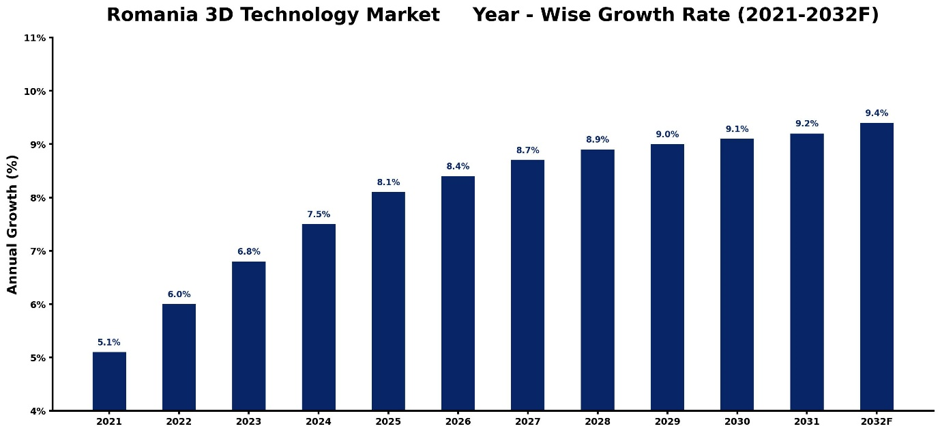
The following table summarizes the historical and forecasted growth rates of the Romania 3D Technology Market, along with the rationale behind each year’s performance.
| Year | Estimated Growth (%) | Market Rationale |
| 2021 | 5.1% | Industrial investments and modernization of manufacturing projects |
| 2022 | 6% | Rise in adoption of digital transformation strategies across sectors. |
| 2023 | 6.8% | Applications for 3D printing are expanding in the automotive and healthcare sectors. |
| 2024 | 7.5% | Governments increase support for Industry 4.0 programs and larger scale smart manufacturing. |
| 2025 | 8.1% | There will be a strong trend of industrial-grade additive manufacturing equipment. |
| 2026 | 8.4% | Most people can now harness the technology of rapid prototyping and custom production as these methods are no longer reserved to few. |
| 2027 | 8.7% | There has been a remarkable increase in aeronautical components manufacturing and digital engineering service sectors. |
| 2028 | 8.9% | More application of reverse engineering and 3D scanning. |
| 2029 | 9% | Healthcare imaging and medical device manufacturing will be areas where investments are increasing. |
| 2030 | 9.1% | There will be a widespread use of advanced manufacturing technologies among SMEs. |
| 2031 | 9.2% | More smart factories and industrial automation projects will be carried out. |
| 2032 | 9.4% | Continued technological advancements and broader enterprise adoption. |
Topics Covered in the Romania 3D Technology Market Report
The Romania 3D Technology Market report covers the market by type and application. The report provides a detailed analysis of prevailing industry trends, investment opportunities, market drivers, challenges, and competitive developments that help stakeholders formulate effective growth strategies.
Romania 3D Technology Market Highlights
| Report Name | Romania 3D Technology Market |
| Forecast period | 2026-2032 |
| CAGR | 8.76% |
| Growing Sector | 3D Printing |
Romania 3D Technology Market Synopsis
The Romania 3D Technology Market is witnessing substantial development due to organizations are increasingly integrating advanced manufacturing, digital design, and visualization technologies into their operations. The 3D technology includes solutions such as 3D printing, 3D scanning, 3D imaging, and 3D display systems that facilitate product development, prototyping, inspection, medical visualization, and customized manufacturing. Market expansion supported by Romania’s growing automotive production base, expanding aerospace ecosystem, healthcare modernization efforts and increasing focus on Industry 4.0 initiatives. And there is adoption of the 3D technology by organizations that seek to cut down on manufacturing time, increase design accuracy, and optimize costs, which in turn create a good atmosphere for market growth.
Evaluation of Growth Drivers in Romania 3D Technology Market (2026–2032)
Below are some major drivers and their influence on the market dynamics:
| Drivers | Primary Segment Affected | Why It Matters (Evidence) |
| Growing Industry 4.0 Adoption | 3D Printing | Manufacturers are increasingly deploying additive manufacturing for rapid prototyping and production flexibility. |
| Expansion of Automotive Manufacturing | Automotive | Vehicle manufacturers require advanced design validation and lightweight component development solutions. |
| Increasing Healthcare Digitization | Healthcare | Hospitals are utilizing 3D imaging and printed anatomical models for treatment planning and surgical preparation. |
| Rising Aerospace Investments | Aerospace & Defense | Demand for precision-engineered parts and complex component manufacturing is increasing. |
| Growth in Engineering and Design Services | 3D Scanning | Engineering firms are adopting reverse engineering and quality inspection technologies. |
Romania 3D Technology Market is projected to grow at a CAGR of 8.76% during 2026–2032. The market is expected to experience robust growth due to increasing investments in digital manufacturing technologies and advanced product development capabilities. The market is projected to grow owing to the use of additive manufacturing for customized production, growing demand for precision engineering in the automotive and aerospace industries and increasing use of 3D visualization technologies in healthcare. Additionally, the increasing involvement of Romania in European industrial modernization initiatives is expected to further drive the demand for 3D technology solutions over the forecast period.
Evaluation of Restraints in Romania 3D Technology Market
Below are some major restraints and their influence on the market dynamics:
| Restraints | Primary Segment Affected | What This Means (Evidence) |
| High Initial Equipment Costs | SMEs | Smaller enterprises face budget constraints when adopting advanced 3D systems. |
| Shortage of Skilled Professionals | Workforce Development | Lack of technical expertise may delay implementation and operational efficiency. |
| Material Cost Volatility | 3D Printing | Fluctuating prices of specialized printing materials affect profitability. |
| Limited Awareness Among Traditional Industries | Manufacturing Enterprises | Some companies remain hesitant to adopt emerging production technologies. |
| Data Security and Intellectual Property Concerns | Commercial Users | Sharing digital design can create risks that affect adoption rates. |
Romania 3D Technology Market Challenges
One of the major challenges for the Romania 3D Technology Industry is the high capital expenditure required to acquire industrial-grade 3D equipment and software platforms. However, there are many businesses which continue to use conventional production techniques because of the financial constraints as well as technological ones. Moreover, a shortage of engineers and experts in additive manufacturing is yet another obstacle that hinders implementation of the technology. Other obstacles include those associated with standardization of materials, interoperability among systems, and the need to protect intellectual property rights of digital designs that exist. If Romania wishes to reap maximum benefits of using 3D technologies, it needs to address these obstacles.
Romania 3D Technology Market Trends
Some emerging trends in the Romania 3D Technology Market Growth are:
- Adoption of 3D Printing in Manufacturing: Industries are utilizing 3D printing technologies for rapid prototyping, customized production, and cost-efficient manufacturing processes.
- Use of 3D Imaging and Visualization Solutions: Healthcare, construction, and engineering sectors are increasingly adopting 3D scanning and visualization tools to improve accuracy and operational efficiency.
- Expansion of Industry 4.0 and Digital Transformation Initiatives: Rising integration of 3D technologies with automation, artificial intelligence, and smart manufacturing systems is enhancing productivity across industrial applications.
Investment Opportunities in the Romania 3D Technology Market
Some prominent Investment Opportunities in the Romania 3D Technology Market Share are:
- Development of Advanced 3D Printing and Additive Manufacturing Facilities: Investments in industrial-grade 3D printing infrastructure can support growing demand from automotive, aerospace, and healthcare sectors.
- Expansion of 3D Software and Digital Design Solutions: Opportunities exist in developing 3D modeling, simulation, visualization, and digital twin platforms for commercial and industrial applications.
- Research and Innovation in Emerging 3D Technologies: Funding for advanced materials, 3D scanning systems, augmented reality integration, and next-generation manufacturing technologies offers strong long-term growth potential.
Top 5 Leading Players in Romania 3D Technology Market
Some leading players operating in the Romania 3D Technology Market
include:
1. Stratasys
| Company Name | Stratasys |
| Established Year | 1989 |
| Headquarters | Minnesota, United States |
| Official Website | Click Here |
Stratasys is a global leader in additive manufacturing solutions, offering industrial 3D printers, software platforms, and advanced materials used across aerospace, healthcare, automotive, and education sectors.
2. EOS GmbH
| Company Name | EOS GmbH |
| Established Year | 1989 |
| Headquarters | Krailling, Germany |
| Official Website | Click Here |
EOS specializes in industrial 3D printing systems for polymer and metal applications. Its technologies are widely utilized for precision manufacturing and advanced production processes.
3. HP Inc.
| Company Name | HP Inc. |
| Established Year | 1939 |
| Headquarters | California, United States |
| Official Website | Click Here |
HP provides Multi Jet Fusion 3D printing technologies that support high-volume industrial manufacturing and rapid prototyping applications across multiple industries.
4. Materialise NV
| Company Name | Materialise NV |
| Established Year | 1990 |
| Headquarters | Leuven, Belgium |
| Official Website | Click Here |
Materialise develops 3D printing software and manufacturing solutions, supporting healthcare, industrial design, and engineering applications through advanced digital workflows.
5. 3D Systems Corporation
| Company Name | 3D Systems Corporation |
| Established Year | 1986 |
| Headquarters | South Carolina, United States |
| Official Website | Click Here |
3D Systems offers comprehensive additive manufacturing technologies including hardware, software, and materials designed for healthcare, aerospace, and industrial production environments.
Government Initiatives being implemented in the Romania 3D Technology Market
The Romanian government promotes advanced manufacturing and digitalization through many initiatives funded by Romania or the European Union. The industry 4.0 initiatives that promote its implementation can encourage manufacturers to focus on automating their production and integrating additive manufacturing and digital engineering. This is seen in the PNRR initiative that funds digitalization initiatives in all industries of Romania. Innovation and research programs financed by the European Union encourage the efforts of universities, institutions of research, and technology-based start-ups in advancing additive manufacturing and other technologies used in industry.
Future Insights of the Romania 3D Technology Market
Romanian 3D Technologies Market seems to have a bright future ahead, considering the shift in manufacturing processes to become more digitalized. Considering the increasing application of additive manufacturing techniques in the automotive, aerospace, and healthcare sectors, it is anticipated that this will influence the future growth of the market. With developments in the field of printing materials and systems, along with AI-integrated design platforms, the industry is expected to be revolutionized. Growing partnerships within this industry are expected to facilitate innovation, making Romania an upcoming destination for manufacturing technology solutions in Eastern Europe.
Market Segmentation Analysis
The report offers a comprehensive study of the following market segments and their leading categories:
By Type
According to Rishil, Senior Research Analyst, 6Wresearch, 3D Printing accounted for 46.28% of the Romania 3D Technology Market share in 2025, supported by increasing deployment in industrial prototyping, customized manufacturing, and product development activities; meanwhile, 3D Scanning is anticipated to register the fastest CAGR of 10.21% during 2026–2032 owing to rising demand for reverse engineering, inspection, and digital measurement solutions.
By Application
Automotive captured 31.74% of the Romania 3D Technology Market revenue in 2025 due to strong utilization of additive manufacturing for design validation, prototyping, and lightweight component development; however, Healthcare is forecast to expand at a CAGR of 10.64% through 2032 driven by increasing use of patient-specific medical models, dental applications, and surgical planning technologies.
Note: Market size estimations and growth projections presented in this report are based on 6Wresearch's advanced forecasting approach, validated with industry datasets as of June 2026.
Key Attractiveness of the Report:
- 10 Years of Market Numbers
- Historical Data Starting from 2022 to 2025
- Base Year: 2025
- Forecast Data until 2032
- Key Performance Indicators Impacting the Market
- Major Upcoming Developments and Projects
Key Highlights of the Report:
- Romania 3D Technology Market Outlook
- Market Size of Romania 3D Technology Market, 2025
- Forecast of Romania 3D Technology Market, 2032
- Historical Data and Forecast of Romania 3D Technology Revenues & Volume for the Period 2022-2032
- Romania 3D Technology Market Trend Evolution
- Romania 3D Technology Market Drivers and Challenges
- Romania 3D Technology Price Trends
- Romania 3D Technology Porter's Five Forces
- Romania 3D Technology Industry Life Cycle
- Historical Data and Forecast of Romania 3D Technology Market Revenues & Volume By Type for the Period 2022-2032
- Historical Data and Forecast of Romania 3D Technology Market Revenues & Volume By 3D Printing for the Period 2022-2032
- Historical Data and Forecast of Romania 3D Technology Market Revenues & Volume By 3D Display for the Period 2022-2032
- Historical Data and Forecast of Romania 3D Technology Market Revenues & Volume By 3D Scanning for the Period 2022-2032
- Historical Data and Forecast of Romania 3D Technology Market Revenues & Volume By 3D Imaging for the Period 2022-2032
- Historical Data and Forecast of Romania 3D Technology Market Revenues & Volume By Others for the Period 2022 - 2032
- Historical Data and Forecast of Romania 3D Technology Market Revenues & Volume By Application for the Period 2022-2032
- Historical Data and Forecast of Romania 3D Technology Market Revenues & Volume By Healthcare for the Period 2022-2032
- Historical Data and Forecast of Romania 3D Technology Market Revenues & Volume By Automotive for the Period 2022-2032
- Historical Data and Forecast of Romania 3D Technology Market Revenues & Volume By Aerospace & Defense for the Period 2022-2032
- Historical Data and Forecast of Romania 3D Technology Market Revenues & Volume By Consumer Electronics for the Period 2022-2032
- Historical Data and Forecast of Romania 3D Technology Market Revenues & Volume By Others for the Period 2022 - 2032
- Romania 3D Technology Import Export Trade Statistics
- Market Opportunity Assessment By Type
- Market Opportunity Assessment By Application
- Romania 3D Technology Top Companies Market Share
- Romania 3D Technology Competitive Benchmarking By Technical and Operational Parameters
- Romania 3D Technology Company Profiles
- Romania 3D Technology Key Strategic Recommendations
Market Covered
The report offers an extensive study of the following market segments:
By Type
- 3D Printing
- 3D Display
- 3D Scanning
- 3D Imaging
- Others
By Application
- Healthcare
- Automotive
- Aerospace & Defense
- Consumer Electronics
- Others






































