Romania 5G Radio Access Network Market Growth Rate
According to 6Wresearch internal database and industry insights, the Romania 5G Radio Access Network Market is projected to grow at a compound annual growth rate (CAGR) of 18.7% during the forecast period (2026-2032).
Romania 5G Radio Access Network Market Year-wise Growth Rate and Key Drivers (2022-2032)
This graph illustrates the annual growth rates of the Romania 5G Radio Access Network Market from 2022 to 2032, highlighting a steady upward trajectory and projected market expansion over the forecast period.
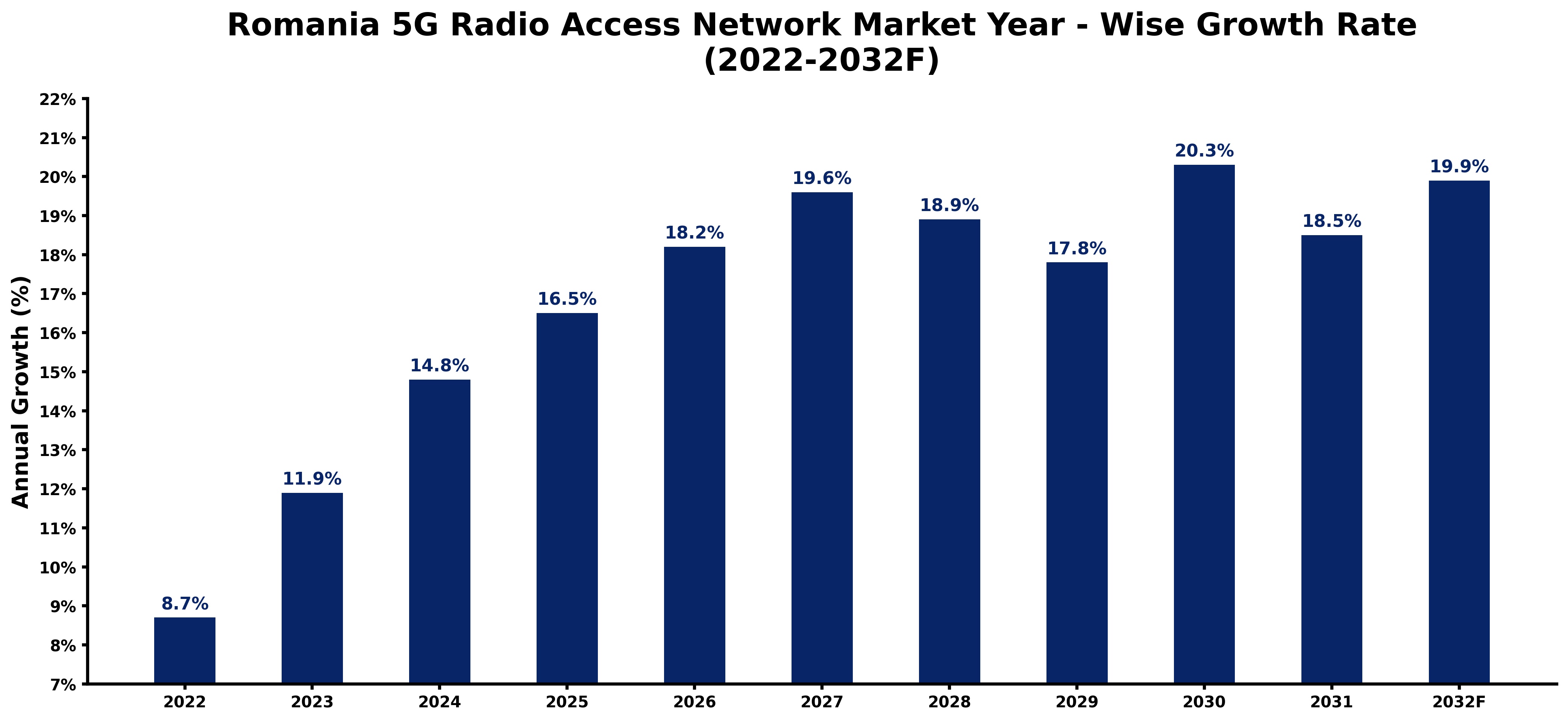
The following table summarizes the historical and forecasted growth rates of the Romania 5G Optical Transceiver Market, along with the rationale behind each year’s performance.
|
Year
|
Estimated Growth (%) | Market Rationale |
| 2022 | 8.7% | Initial 5G deployments, expanding spectrum availability, and telecom infrastructure investments supported early market growth. |
| 2023 | 11.9% | Accelerated rollout of 5G base stations and rising mobile broadband demand increased investments in radio access network equipment. |
| 2024 | 14.8% | Growing enterprise digitalization, private 5G pilots, and smart city initiatives boosted RAN deployment across Romania. |
| 2025 | 16.5% | Telecom operators intensified nationwide network expansion and modernization to improve coverage and capacity. |
| 2026 | 18.2% | Commercial deployment of standalone 5G architecture and increasing demand for ultra-low latency connectivity accelerated market growth. |
| 2027 | 19.6% | Rising adoption of Open RAN, industrial IoT, and enterprise private networks drove strong investment in advanced RAN infrastructure. |
| 2028 | 18.9% | Expansion of smart manufacturing, connected transportation, and edge computing sustained high demand for 5G RAN solutions. |
| 2029 | 17.8% | Continued network densification and broader rural 5G coverage supported stable market expansion despite gradual market maturity. |
| 2030 | 20.3% | Large-scale modernization of telecom infrastructure and increasing demand for high-capacity mobile networks fueled growth. |
| 2031 | 18.5% | Growing adoption of mission-critical communications, AI-enabled network optimization, and enterprise connectivity maintained robust demand. |
| 2032 | 19.9% | Continuous investments in next-generation 5G infrastructure, network upgrades, and digital transformation initiatives sustained long-term market growth. |
Topics Covered in the Romania 5G Radio Access Network Market Report
The Romania 5G Radio Access Network Market report thoroughly covers the market by RAN type, frequency, and deployment type. The market report provides an unbiased and detailed analysis of ongoing market trends, opportunities/high growth areas, and market drivers, which help stakeholders devise and align their market strategies according to the current and future market dynamics.
Romania 5G Radio Access Network Market Highlights
| Report Name | Romania 5G Radio Access Network Market |
| Forecast period | 2026-2032 |
| CAGR | 18.7% |
| Growing Sector | Telecom Network Infrastructure |
Romania 5G Radio Access Network Market Synopsis
Romania 5G Radio Access Network Market is anticipated to record substantial growth due to increased installation of advanced telecommunication infrastructure and the growing need for high-speed mobility connectivity. The 5G Radio Access Network is an integral connection between the mobile phone and the core network that helps achieve rapid information delivery, minimum latency, and increased efficiency of the network. It can be utilized in such applications as smart cities, automation industry, autonomous technologies, and enterprise communications. Additionally, the growing number of investments by telecom carriers, supportive regulatory measures, and increased implementation of digital solutions are expected to promote market growth in Romania.
Evaluation of Growth Drivers in the Romania 5G Radio Access Network Market (2026-2032)
Below mentioned are some prominent drivers and their influence on the market dynamics:
| Drivers | Primary Segments Affected | Why it Matters (Evidence) |
| Expansion of National 5G Networks | Centralized RAN; Sub-6 GHz | Telecom operators require advanced RAN infrastructure to support coverage expansion. |
| Growing Mobile Data Consumption | Distributed RAN; Cloud-based | Rising traffic volumes increase demand for network capacity enhancements. |
| Adoption of Open RAN Architectures | Open RAN; Software-defined | Open ecosystems improve network flexibility and reduce deployment costs. |
| Smart City Development Projects | Virtualized RAN; Hybrid | Smart infrastructure requires reliable and low-latency wireless connectivity. |
| Enterprise Digital Transformation | All RAN Types; Cloud-based | Businesses increasingly depend on advanced communication networks for operations. |
Romania 5G Radio Access Network Market is expected to grow at the CAGR of 18.7% during the forecast period of 2026-2032. Market growth will be driven by greater rollout of 5G infrastructure on a national scale, high demand for mobile broadband services, and investment in telecommunication network upgrading. Providers are working on increasing their coverage, utilizing cloud-native and virtualized approaches for better efficiency. Moreover, trends associated with the industrial Internet of Things, smart cities, and the development of connected enterprises create a need for innovative radio access technologies. Assistance from governments towards digital transformation as well as spectrum policies also play an important role in market development.
Evaluation of Restraints in the Romania 5G Radio Access Network Market
Below mentioned are some major restraints and their influence on the market dynamics:
| Restraints | Primary Segments Affected | What This Means (Evidence) |
| High Network Deployment Costs | Centralized RAN; On-Premise | Significant infrastructure investments may delay project implementation. |
| Complex Integration Requirements | Virtualized RAN; Hybrid | Integration with legacy networks increases deployment challenges. |
| Spectrum Allocation Constraints | All RAN Types; All Frequencies | Regulatory delays may impact network rollout schedules. |
| Cybersecurity Risks | Cloud-based; Software-defined | Advanced networks require continuous security monitoring and protection. |
| Skilled Workforce Shortages | Open RAN; Virtualized RAN | Lack of specialized professionals can slow technology adoption. |
Romania 5G Radio Access Network Industry Challenges
Despite of strong market momentum, the Romania 5G Radio Access Network Industry faces several challenges that may affect deployment timelines and investment decisions. There is a considerable amount of capital required for infrastructure development, especially in underdeveloped and rural regions. Besides, the combination of modern RAN architecture with the current networks is quite challenging from a technological perspective. Telecommunications companies have to deal with the ever-increasing cyberthreats due to software-based networks. There are not enough competent individuals who could oversee cloud-based and virtual network environments. Moreover, ensuring the quality of the network despite the growing data flows constitutes a problem for operators aiming at efficient 5G implementation.
Romania 5G Radio Access Network Market Trends
Key developments in the Romania 5G Radio Access Network Market Growth include:
- Growing Open RAN Adoption: Telecom operators are increasingly exploring Open RAN architectures to improve flexibility and reduce vendor dependency.
- Expansion of Virtualized Network Infrastructure: Network virtualization is helping operators improve scalability and optimize operational costs.
- Increased Cloud-Native Deployments: Cloud-based network functions are becoming essential for efficient and agile service delivery.
- Rising Investment in Smart City Connectivity: Municipal digitalization projects are generating demand for advanced wireless infrastructure.
- Integration of Artificial Intelligence in Network Management: AI-powered analytics are improving network optimization, maintenance, and performance monitoring.
Investment Opportunities in the Romania 5G Radio Access Network Market
Prominent investment opportunities in the Romania 5G Radio Access Network Market include:
- Open RAN Infrastructure Development – Investments in interoperable network solutions can support flexible and cost-efficient deployments.
- Cloud-Native RAN Platforms – Growing demand for virtualized architectures creates opportunities for software and platform providers.
- Rural Network Expansion Projects – Extending 5G coverage to underserved regions presents long-term growth potential.
- Smart City Communication Infrastructure – Urban digitalization projects require advanced radio access network capabilities.
- AI-Based Network Optimization Solutions – Intelligent network management technologies can improve efficiency and service quality.
Top 5 Leading Players in the Romania 5G Radio Access Network Market
Some leading players operating in the Romania 5G Radio Access Network Market include:
1. Ericsson AB
| Company Name | Ericsson AB |
|---|---|
| Established Year | 1876 |
| Headquarters | Stockholm, Sweden |
| Official Website | Click Here |
Ericsson is a leading provider of 5G radio access network solutions, offering advanced RAN equipment, Open RAN technologies, and cloud-native platforms that enhance network performance and efficiency.
2. Nokia Corporation
| Company Name | Nokia Corporation |
|---|---|
| Established Year | 1865 |
| Headquarters | Espoo, Finland |
| Official Website | Click Here |
Nokia delivers comprehensive 5G radio access solutions, including AirScale RAN platforms, cloud-native architectures, and Open RAN technologies that support scalable and energy-efficient wireless networks.
3. Huawei Technologies Co., Ltd.
| Company Name | Huawei Technologies Co., Ltd. |
|---|---|
| Established Year | 1987 |
| Headquarters | Shenzhen, China |
| Official Website | Click Here |
Huawei develops advanced 5G radio access network equipment featuring massive MIMO technologies, intelligent network management, and cloud-based architectures that improve coverage, capacity, and efficiency.
4. Samsung Electronics Co., Ltd.
| Company Name | Samsung Electronics Co., Ltd. |
|---|---|
| Established Year | 1969 |
| Headquarters | Suwon, South Korea |
| Official Website | Click Here |
Samsung offers innovative 5G infrastructure solutions, including virtualized RAN, Open RAN systems, and advanced radio technologies that enable flexible and scalable wireless connectivity.
5. Mavenir Systems, Inc.
| Company Name | Mavenir Systems, Inc. |
|---|---|
| Established Year | 2005 |
| Headquarters | Texas, USA |
| Official Website | Click Here |
Mavenir specializes in cloud-native Open RAN solutions, helping telecom operators deploy software-driven radio access networks with greater flexibility, virtualization, and operational efficiency.
Government Regulations Introduced in the Romania 5G Radio Access Network Market
According to Romania's Government Data, several measures have been formulated to promote the deployment of more modern telecommunications facilities. In Romania, the National Recovery and Resilience Plan (NRRP) continue to be promoted by the government, offering financial resources to support projects in relation to broadband connectivity, digitalization, and the development of smart infrastructure. In addition to this, the Romanian 5G Strategy aims at 5G deployment, spectrum utilization, and network security improvement. The Romanian National Authority for Management and Regulation in Communications (ANCOM) has implemented several spectrum allocation measures aiming to foster investments in the telecommunications sector.
Future Insights of the Romania 5G Radio Access Network Market
Romania 5G Radio Access Network Market is expected to experience substantial growth as telecom operators continue expanding next-generation connectivity services across the country. Adoption of cloud computing infrastructure, Open RAN architecture, and virtual network can cause changes in the competitive scenario in the coming years. It is predicted that such solutions are going to have high adoption as there is an increased need for connectivity solutions within industries, smart cities, automation technology, and corporate communication systems. In addition to this, investment in digital infrastructure development and rise in mobile data usage will play an important role in network development. With increasing adoption of advanced technologies like AI and edge computing, demands for next-generation radio access network solutions may grow rapidly.
Market Segmentation Analysis
The report offers a comprehensive study of the following market segments and their leading categories:
By RAN Type – Centralized RAN Dominated Market, Open RAN Set for Fastest Growth
According to Bhawna Singh, Assistant Manager, 6Wresearch, the Centralized RAN segment dominated the Romania 5G Radio Access Network Market with an estimated market share of 41.8% in 2025, owing to its operational efficiency, centralized management capabilities, streamlined network optimization, and widespread adoption among telecom operators deploying large-scale 5G infrastructure. Meanwhile, the Open RAN segment is projected to grow at a CAGR of 23.9% during 2026–2032, driven by increasing operator demand for vendor flexibility, cost optimization, interoperable network ecosystems, and support for open-standard network architectures.
By Frequency – Sub-6 GHz Led the Market, 26–39 GHz Segment Witnessing Rapid Expansion
By frequency, the Sub-6 GHz segment accounted for the largest share of the Romania 5G Radio Access Network Market, capturing 63.7% of revenue in 2025. Its dominance was attributed to its ability to provide broad geographic coverage, strong indoor penetration, and cost-effective deployment across urban, suburban, and semi-rural environments. In contrast, the 26–39 GHz segment is anticipated to register the fastest CAGR of 22.6% during 2026–2032, supported by increasing demand for ultra-high-speed connectivity, enhanced network capacity, and growing deployment in densely populated urban areas requiring superior bandwidth performance.
By Deployment Type – On-Premise Deployment Dominated Market, Cloud-Based Deployment Gaining Momentum
By deployment type, the On-Premise segment dominated the Romania 5G Radio Access Network Market with a 46.4% share in 2025, supported by telecom operators’ preference for direct infrastructure control, enhanced security, reliable network performance, and greater operational oversight. Meanwhile, the Cloud-Based deployment segment is projected to grow at a CAGR of 24.7% during 2026–2032, fueled by increasing adoption of cloud-native architectures, greater operational flexibility, scalable network management solutions, and the growing need for efficient resource utilization across next-generation telecommunications networks.
Note: Market size estimations and growth projections presented in this report are based on 6Wresearch’s advanced forecasting approach, validated with industry datasets as of June 2026.
Key Attractiveness of the Report
- 10 Years of Market Numbers.
- Historical Data Starting from 2022 to 2025.
- Base Year: 2025.
- Forecast Data until 2032.
- Key Performance Indicators Impacting the Market.
- Major Upcoming Developments and Projects.
Key Highlights of the Report:
- Romania 5G Radio Access Network Market Outlook
- Market Size of Romania 5G Radio Access Network Market, 2025
- Forecast of Romania 5G Radio Access Network Market, 2032
- Historical Data and Forecast of Romania 5G Radio Access Network Revenues & Volume for the Period 2022-2032F
- Romania 5G Radio Access Network Market Trend Evolution
- Romania 5G Radio Access Network Market Drivers and Challenges
- Romania 5G Radio Access Network Price Trends
- Romania 5G Radio Access Network Porter's Five Forces
- Romania 5G Radio Access Network Industry Life Cycle
- Historical Data and Forecast of Romania 5G Radio Access Network Market Revenues & Volume By RAN Type for the Period 2022-2032F
- Historical Data and Forecast of Romania 5G Radio Access Network Market Revenues & Volume By Centralized RAN for the Period 2022-2032F
- Historical Data and Forecast of Romania 5G Radio Access Network Market Revenues & Volume By Open RAN for the Period 2022-2032F
- Historical Data and Forecast of Romania 5G Radio Access Network Market Revenues & Volume By Virtualized RAN for the Period 2022-2032F
- Historical Data and Forecast of Romania 5G Radio Access Network Market Revenues & Volume By Distributed RAN for the Period 2022-2032F
- Historical Data and Forecast of Romania 5G Radio Access Network Market Revenues & Volume By Frequency for the Period 2022-2032F
- Historical Data and Forecast of Romania 5G Radio Access Network Market Revenues & Volume By Sub-6 GHz for the Period 2022-2032F
- Historical Data and Forecast of Romania 5G Radio Access Network Market Revenues & Volume By mmWave for the Period 2022-2032F
- Historical Data and Forecast of Romania 5G Radio Access Network Market Revenues & Volume By 26-39 GHz for the Period 2022-2032F
- Historical Data and Forecast of Romania 5G Radio Access Network Market Revenues & Volume By Above 39 GHz for the Period 2022-2032F
- Historical Data and Forecast of Romania 5G Radio Access Network Market Revenues & Volume By Deployment Type for the Period 2022-2032F
- Historical Data and Forecast of Romania 5G Radio Access Network Market Revenues & Volume By Cloud-based for the Period 2022-2032F
- Historical Data and Forecast of Romania 5G Radio Access Network Market Revenues & Volume By Hybrid for the Period 2022-2032F
- Historical Data and Forecast of Romania 5G Radio Access Network Market Revenues & Volume By Software-defined for the Period 2022-2032F
- Historical Data and Forecast of Romania 5G Radio Access Network Market Revenues & Volume By On-Premise for the Period 2022-2032F
- Romania 5G Radio Access Network Import Export Trade Statistics
- Market Opportunity Assessment By RAN Type
- Market Opportunity Assessment By Frequency
- Market Opportunity Assessment By Deployment Type
- Romania 5G Radio Access Network Top Companies Market Share
- Romania 5G Radio Access Network Competitive Benchmarking By Technical and Operational Parameters
- Romania 5G Radio Access Network Company Profiles
- Romania 5G Radio Access Network Key Strategic Recommendations
Market Covered
The report offers a comprehensive study of the subsequent market segments:
By RAN Type
- Centralized RAN
- Open RAN
- Virtualized RAN
- Distributed RAN
By Frequency
- Sub-6 GHz
- mmWave
- 26-39 GHz
- Above 39 GHz
By Deployment Type
- Cloud-based
- Hybrid
- Software-defined
- On-Premise






































