Romania Active Phased Array Radar Market Growth Rate
According to 6Wresearch internal database and industry insights, the Romania Active Phased Array Radar Market is projected to grow at a compound annual growth rate (CAGR) of 7.4% during the forecast period (2026-2032).
Romania Active Phased Array Radar Market Year-wise Growth Rate and Key Drivers (2022-2032)
This graph illustrates the annual growth rates of the Romania Active Phased Array Radar Market from 2022 to 2032, highlighting a steady upward trajectory and projected market expansion over the forecast period.
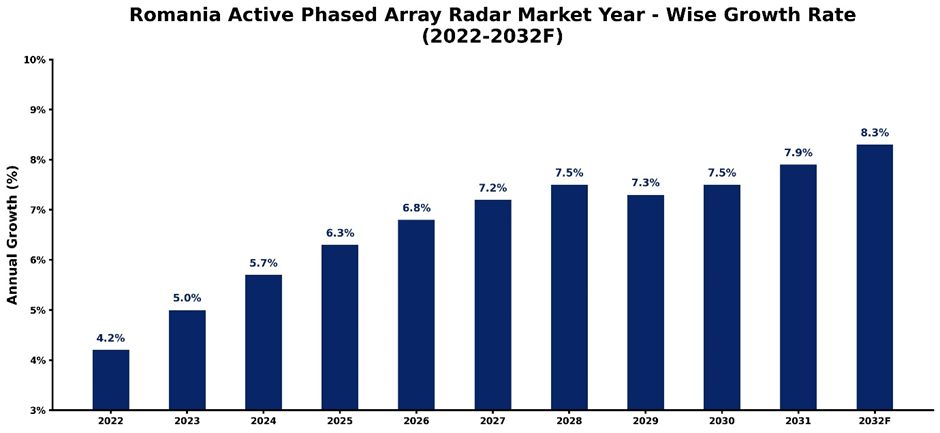
The following table summarizes the historical and forecasted growth rates of the Romania Active Phased Array Radar Market, along with the rationale behind each year’s performance.
| Year | Estimated Growth (%) | Market Rationale |
| 2022 | 4.2% | Rising NATO interoperability requirements and initial air-defence modernization programs supported demand for advanced radar systems. |
| 2023 | 5% | Higher regional security concerns and expanding surveillance requirements encouraged investment in modern electronically scanned radar technologies. |
| 2024 | 5.7% | Increased drone activity around the wider Black Sea region strengthened demand for faster aerial detection and tracking capabilities. |
| 2025 | 6.3% | Romania’s approval of an additional Patriot system equipped with an upgraded AN/MPQ-65 radar strengthened procurement activity. (Mapn) |
| 2026 | 6.8% | Continued airspace surveillance requirements and defence modernization are supporting investment in digitally enabled radar infrastructure. |
| 2027 | 7.2% | Growing counter-drone requirements and integrated air-defence deployment are expected to accelerate demand for multifunctional AESA radar systems. |
| 2028 | 7.5% | Expansion of networked surveillance systems and modernization of military sensor infrastructure are expected to sustain stronger radar procurement. |
| 2029 | 7.3% | Growth is expected to moderate slightly as several major procurement programs mature, although replacement and upgrade requirements remain strong. |
| 2030 | 7.5% | Wider adoption of software-defined radar and advanced signal processing is expected to improve detection of drones and low-observable threats. |
| 2031 | 7.9% | Continued NATO capability development and modernization of Romania’s surveillance infrastructure are expected to support higher radar deployment. |
| 2032 | 8.3% | Strong demand for mobile, multifunctional, network-enabled radar systems is expected to sustain market expansion through advanced airspace monitoring requirements. |
Topics Covered in the Romania Active Phased Array Radar Market Report
The Romania Active Phased Array Radar Market Report provides a comprehensive analysis based on Type and End User. It offers detailed insights into key industry trends, growth drivers, emerging opportunities, competitive developments, and high-growth segments. The report presents an objective assessment of current dynamics and future prospects, enabling stakeholders to make informed business decisions and develop effective strategies aligned with the evolving industry landscape.
Romania Active Phased Array Radar Market Highlights
| Report Name | Romania Active Phased Array Radar Market |
| Forecast period | 2026-2032 |
| CAGR | 7.4% |
| Growing Sector | Military & Defense |
Romania Active Phased Array Radar Market Synopsis
Romania Active Phased Array Radar Market is anticipated to record notable growthas Romania improves its abilities for air space surveillance, missile defense, and compatibility with NATO. An active phased array radar solution uses electronic steering antennas that provide rapid detection of multiple air threats. The use of this technology can be seen in many areas, including air defense surveillance, missile warning, drone countermeasures, and battlefield surveillance. Growing orders of integrated air-defensive solutions and upgrades of surveillance assets are generating ongoing demand. Romania’s strategic position along the Black Sea and continued regional security requirements are further encouraging investment in mobile, network-enabled, and digitally upgradeable radar technologies.
Evaluation of Growth Drivers in the Romania Active Phased Array Radar Market (2026- 2032)
Below mentioned are some prominent drivers and their influence on the market dynamics:
| Drivers | Primary Segments Affected | Why it Matters (Evidence) |
| Increased Airspace Surveillance Efforts | Digital Radar; Military & Defense | Continuous monitoring requirements are increasing demand for radar systems capable of rapidly detecting, classifying, and tracking aerial targets. |
| Expansion of Integrated Air Defense | Digital Radar; Military & Defense | Romania’s acquisition of a replacement Patriot system containing an upgraded AN/MPQ-65 radar demonstrates continued investment in layered air defence. (Mapn) |
| Rising Counter-Drone Requirements | Digital Radar; Military & Defense | Increasing unmanned-aircraft activity is encouraging demand for sensors capable of detecting small, slow-moving, and low-altitude targets. |
| NATO Interoperability Requirements | Digital Radar; Military & Defense; Aerospace | Radar systems capable of exchanging information across allied command networks are becoming increasingly important for coordinated surveillance and response. |
| Modernization of Radar Technology | Digital Radar; Aerospace; Civil Aviation | AESA technology provides rapid electronic beam steering, multifunction operation, and flexible target tracking, supporting replacement of older radar platforms. Saab’s latest Giraffe AMB D illustrates this technology direction. (Saab) |
Romania Active Phased Array Radar Market is positioned for a CAGR of 7.4% during the forecast period of 2026-2032. The outlook is supported by continued investment in Romanian defence capabilities and increasing requirements for persistent airspace awareness. Romania planned to raise defence spending to 2.5% of GDP in 2025 from slightly above 2.2% in 2024, while longer-term NATO commitments are expected to encourage additional capability investment. Romania received U.S. approval to acquire a new Patriot air-defense system, including an AN/MPQ-65 radar, two M903 launch stations, and a launch control station. The acquisition is being financed through non-reimbursable external funds and the Immediate Action on Air Defence Initiative, strengthening air-defense capabilities.
Evaluation of Restraints in the Romania Active Phased Array Radar Market
Below mentioned are some major restraints and their influence on the market dynamics:
| Restraints | Primary Segments Affected | What This Means (Evidence) |
| High Procurement Costs | Digital Radar; Military & Defense | Advanced AESA systems require substantial investment in antenna arrays, processors, software, integration, testing, and lifecycle support. |
| Complex System Integration | Digital Radar; Military & Defense | Integration with existing command-and-control infrastructure can increase deployment time and require extensive interoperability testing. |
| Dependence on Specialized Components | Digital Radar; Aerospace | Dependence on advanced RF modules, semiconductor components, processors, and specialized suppliers can create procurement constraints. |
| Limited Specialized Workforce | Digital Radar; Aerospace | Shortages of highly trained radar, RF, software, and electronic-warfare specialists can slow deployment and modernization. |
| Lengthy Defence Procurement Cycles | All Types; Military & Defense | Large defence programs require detailed technical evaluation, budgeting, approvals, testing, and integration before operational deployment. |
Romania Active Phased Array Radar Industry Challenges
Despite the positive outlook for the Romania active phased array radar market, there are still a number of technical difficulties to be expected while working in the field. The modern radar network needs to be able to detect even small-size unmanned aerial vehicles while performing efficiently under challenging conditions of the electromagnetic environment. Romania, due to its location close to the Black Sea and Ukraine, has seen increased interest in the implementation of monitoring systems in order to provide persistent surveillance. The Ministry of National Defence of Romania regularly reports on the activity of monitoring the air space, as well as interaction with Allied organizations. At the same time, AESA systems require special RF components, software, cooling system, cybersecurity and qualified personnel.
Romania Active Phased Array Radar Market Trends
Major trends influencing the Romania Active Phased Array Radar Market Industry include the following:
- Shift Toward Digital AESA Architectures: Defence organizations are increasingly adopting electronically scanned radar platforms as they provide faster beam steering, multifunction operation, and greater flexibility in tracking multiple targets.
- Network-Centric Target Surveillance: The integration of radar systems with command-and-control networks ensures that target information is shared between multiple defence systems quickly.
- Use of Software Defined Radars: Through software architecture, it becomes possible to upgrade the system to add new functionality rather than replacing the entire radar system.
Investment Opportunities in the Romania Active Phased Array Radar Market
Promising investment avenues in the market include the following:
- Integrated Air-Defence Radar Infrastructure: Investment in networked radar nodes can improve continuous surveillance and enable faster coordination between sensors, command centres, and defence systems.
- Counter-Drone Radar Solutions: Development of compact AESA systems for detecting and tracking unmanned aircraft can benefit from increasing counter-UAS requirements.
- AESA Component Manufacturing: Investment in RF modules, antenna technologies, processors, and advanced semiconductor components can strengthen domestic participation in the radar value chain.
- NATO-Compatible Radar Integration – Secure communication and systems-integration solutions can benefit from Romania’s continuing efforts to improve interoperability with Allied defence networks.
Top Players in Romania Active Phased Array Radar Market
Some leading players operating in the Romania Active Phased Array Radar Market include:
1. RTX Corporation
| Company Name | RTX Corporation |
|---|---|
| Established Year | 2020 |
| Headquarters | Arlington, Virginia, USA |
| Official Website | Click Here |
RTX develops advanced radar and integrated air-defense technologies, including Patriot radar solutions supporting detection, tracking, missile defense, and counter-UAS applications.
2. Saab AB
| Company Name | Saab AB |
|---|---|
| Established Year | 1937 |
| Headquarters | Stockholm, Sweden |
| Official Website | Click Here |
Saab develops multifunctional AESA radar platforms, including Giraffe systems designed for air surveillance, drone detection, target tracking, and mobile defense operations.
3. Leonardo S.p.A.
| Company Name | Leonardo S.p.A. |
|---|---|
| Established Year | 1948 |
| Headquarters | Rome, Italy |
| Official Website | Click Here |
Leonardo develops advanced radar and electronic technologies supporting aerospace, defense, air-surveillance, naval, and integrated multi-domain detection applications.
4. Lockheed Martin Corporation
| Company Name | Lockheed Martin Corporation |
|---|---|
| Established Year | 1995 |
| Headquarters | Bethesda, Maryland, USA |
| Official Website | Click Here |
Lockheed Martin develops advanced radar technologies and integrated air-and-missile-defense solutions designed for long-range surveillance, target tracking, and complex threat environments.
5. Thales Group
| Company Name | Thales Group |
|---|---|
| Established Year | 2000 |
| Headquarters | Paris, France |
| Official Website | Click Here |
Thales develops multifunction radar and surveillance technologies for defense and aerospace applications, supporting airspace monitoring, target detection, tracking, and networked operations.
Government Regulations Introduced in the Romania Active Phased Array Radar Market
According to Romania’s Government Data, defence modernization policies and NATO capability commitments are supporting investment in advanced radar and air-defence infrastructure. Romania’s Ministry of National Defence approved the acquisition of a replacement Patriot system after donating one system to Ukraine in 2024. The replacement includes an upgraded AN/MPQ-65 radar, two M903 launch stations, and a launch control station. The procurement is being supported through non-reimbursable external funds and the Immediate Action on Air Defence Initiative. In addition, Romania’s planned increase in defense spending and NATO’s strengthened defense-spending commitment through 2035 are expected to reinforce the country’s long-term military modernization priorities, supporting continued investment in advanced defense systems and capabilities.
Future Insights of the Romania Active Phased Array Radar Market
Romania Active Phased Array Radar Market is expected to evolve toward more integrated, software-defined, mobile, and multifunctional surveillance architectures through 2032. Growing requirements for continuous monitoring around the Black Sea and eastern airspace are likely to maintain demand for electronically scanned radar technologies. The country’s continued participation in NATO capability development should further encourage interoperable sensor networks, faster target information exchange, and advanced air-defence coordination. Increasing emphasis on modern air-defence modernization and network-centric operations is also supporting the adoption of advanced phased array radar systems across military and surveillance applications.
Market Segmentation Analysis
This report presents a detailed analysis of the market segments along with their leading categories.
By Type- Digital Radar Leads Market, Analog Radar Retains Replacement Demand
According to Bhawna Singh, Assistant Manager, 6Wresearch, digital radar solutions secured a dominant 68.60% of the Romania active phased array radar market share in 2025, supported by rapid electronic beam steering, advanced signal processing, multifunction operation, and compatibility with integrated air-defence networks. Conversely, analog radar solutions are projected to advance at a CAGR of 4.85% during 2026–2032, mainly supported by replacement requirements and continued operation of legacy surveillance infrastructure. Active phased array radar is projected to gain more prominence in Romania in light of its focus on real-time situational awareness, counter-drone detection, secure information sharing, and air-defence systems compatible with NATO.
By End User- Military & Defense Dominates Market, Aerospace Shows Strong Expansion
By end user, Military & Defense accounted for 72.40% of the Romania active phased array radar market share in 2025, supported by air-defence modernization, border surveillance, NATO interoperability, and the replacement of aging radar infrastructure. Meanwhile, Aerospace is anticipated to expand at a CAGR of 8.15% during 2026–2032, driven by increasing requirements for electronically scanned radar technologies across airborne surveillance platforms, military aircraft, and advanced avionics. Automotive applications are expected to develop steadily through radar-based perception systems, while civil aviation demand should benefit from modernization of airport surveillance and air-traffic monitoring infrastructure requiring higher accuracy and dependable target identification.
Note: Market size estimations and growth projections presented in this report are based on 6Wresearch's proprietary forecasting methodology, utilizing the latest available industry data, government publications, and primary research inputs.
Key Attractiveness of the Report
- 10 Years of Market Numbers.
- Historical Data Starting from 2022 to 2025.
- Base Year: 2025.
- Forecast Data until 2032.
- Key Performance Indicators Impacting the Market.
- Major Upcoming Developments and Projects.
Key Highlights of the Report:
- Romania Active Phased Array Radar Market Outlook
- Market Size of Romania Active Phased Array Radar Market, 2025
- Forecast of Romania Active Phased Array Radar Market, 2032
- Historical Data and Forecast of Romania Active Phased Array Radar Revenues & Volume for the Period 2022-2032F
- Romania Active Phased Array Radar Market Trend Evolution
- Romania Active Phased Array Radar Market Drivers and Challenges
- Romania Active Phased Array Radar Price Trends
- Romania Active Phased Array Radar Porter's Five Forces
- Romania Active Phased Array Radar Industry Life Cycle
- Historical Data and Forecast of Romania Active Phased Array Radar Market Revenues & Volume By Type for the Period 2022-2032F
- Historical Data and Forecast of Romania Active Phased Array Radar Market Revenues & Volume By Analog Radar for the Period 2022-2032F
- Historical Data and Forecast of Romania Active Phased Array Radar Market Revenues & Volume By Digital Radar for the Period 2022-2032F
- Historical Data and Forecast of Romania Active Phased Array Radar Market Revenues & Volume By End User for the Period 2022-2032F
- Historical Data and Forecast of Romania Active Phased Array Radar Market Revenues & Volume By Military & Defense for the Period 2022-2032F
- Historical Data and Forecast of Romania Active Phased Array Radar Market Revenues & Volume By Aerospace for the Period 2022-2032F
- Historical Data and Forecast of Romania Active Phased Array Radar Market Revenues & Volume By Automotive for the Period 2022-2032F
- Historical Data and Forecast of Romania Active Phased Array Radar Market Revenues & Volume By Civil Aviation for the Period 2022-2032F
- Romania Active Phased Array Radar Import Export Trade Statistics
- Market Opportunity Assessment By Type
- Market Opportunity Assessment By End User
- Romania Active Phased Array Radar Top Companies Market Share
- Romania Active Phased Array Radar Competitive Benchmarking By Technical and Operational Parameters
- Romania Active Phased Array Radar Company Profiles
- Romania Active Phased Array Radar Key Strategic Recommendations
Market Covered
The report offers a comprehensive study of the subsequent market segments:
By Type
- Analog Radar
- Digital Radar
By End User
- Military & Defense
- Aerospace
- Automotive
- Civil Aviation






































