Romania Apiculture Market Size, Share & Growth Rate
The Romania Apiculture Market was estimated at USD 154 Million in 2025 and is projected to reach USD 205 Million by 2032, growing at a CAGR of 4.2% from 2026 to 2032. This growth trajectory is primarily driven by the rising consumer demand for organic and natural honey products, coupled with increased awareness of the health benefits associated with honey consumption. Additionally, the support from government initiatives aimed at promoting sustainable beekeeping practices further fortifies the market's development.
Romania Apiculture Market Year-wise Growth Rate and Key Drivers
This graph highlights how the Romania Apiculture Market has steadily grown over the years, supported by major growth factors.
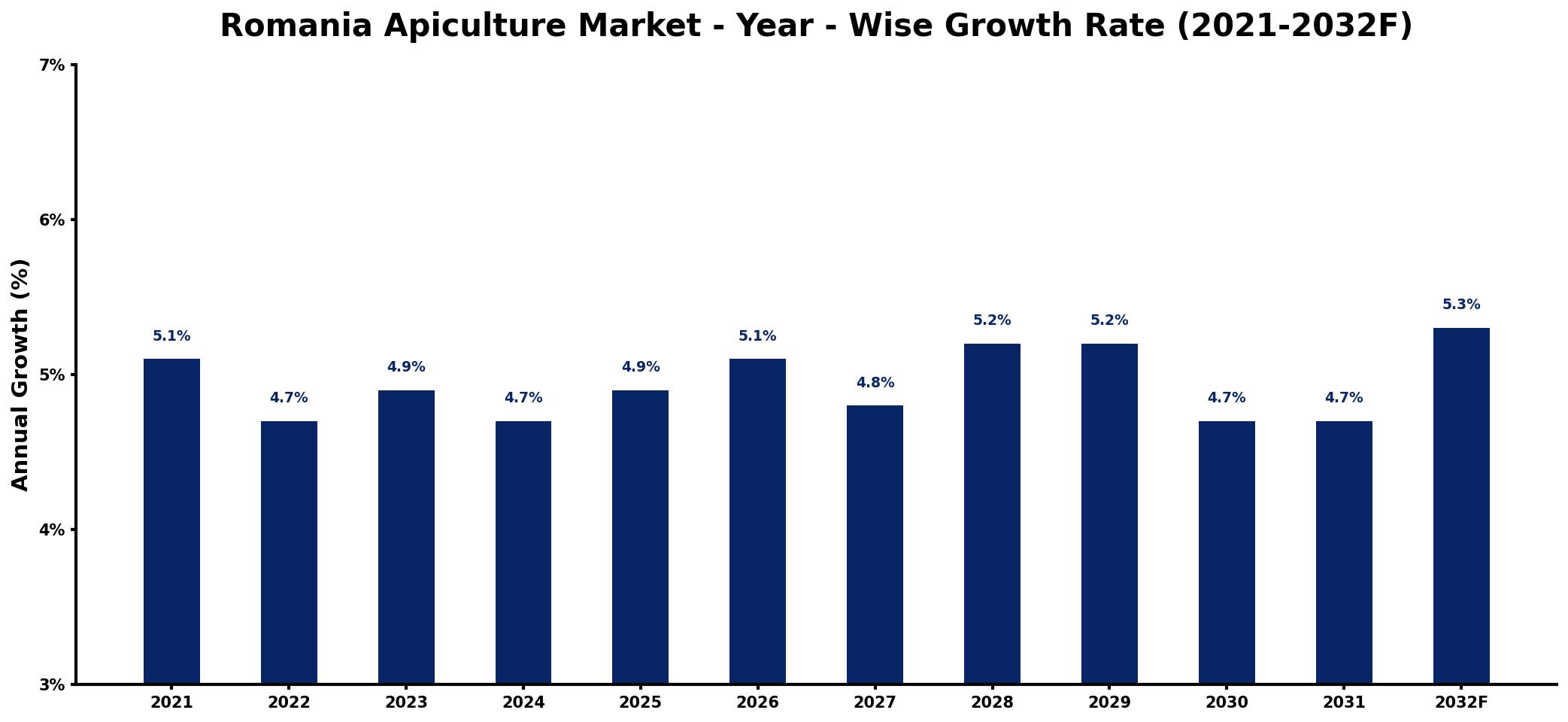
The table below presents the year‑wise growth rates along with the key drivers influencing the market
| Year | Growth Rate | Major Drivers |
| 2021 | 5.1% | Rising consumer health awareness |
| 2022 | 4.7% | Increased organic farming adoption |
| 2023 | 4.9% | Growing demand for natural sweeteners |
| 2024 | 4.7% | Expansion of local honey markets |
| 2025 | 4.9% | Emergence of bee tourism initiatives |
| 2026 | 5.1% | Investments in sustainable farming practices |
| 2027 | 4.8% | Boost in educational programs |
| 2028 | 5.2% | Strengthening of local cooperatives |
| 2029 | 5.2% | Enhanced distribution networks established |
| 2030 | 4.7% | Growing interest in biodiversity conservation |
| 2031 | 4.7% | Development of innovative beekeeping technologies |
| 2032 | 5.3% | Rise in community-supported agriculture |
Note: Market size estimations and growth projections presented in this report are based on 6Wresearch's proprietary forecasting methodology, utilizing the latest available industry data, government publications, and primary research inputs.
Romania Apiculture Market Synopsis
Romania boasts a rich heritage in beekeeping, where small-scale apiarists play a vital role in shaping the local honey market. The diverse floral sources in the region contribute to an array of distinct honey flavors, appealing to both domestic and international consumers. As a result, honey production is not merely an economic activity, but an essential part of Romania's cultural fabric.
Despite facing challenges such as climate change and increased competition from imported honey, the Romania apiculture market is witnessing a renaissance. Growing interest in organic honey and niche varieties like acacia and linden honey is elevating the sector, supported by a community of dedicated beekeepers and an engaged consumer base.
Romania Apiculture Market Key Takeaways
- The Romania apiculture market is poised for consistent growth, driven by demand for high-quality, locally sourced honey.
- Investment opportunities abound in both traditional and value-added bee products, catering to a discerning consumer base.
- Government support for sustainable practices strengthens the market's foundations.
- Small-scale beekeepers contribute significantly, highlighting the importance of local knowledge and craftsmanship in honey production.
- Innovation and modernization in beekeeping techniques are necessary to enhance productivity and mitigate the impacts of climate change.
Evaluation of Restraints in Romania Apiculture Market
The Romania apiculture market is currently navigating a landscape fraught with several restraints. Notably, increasing competition from imported honey products threatens the market share of local producers. Fluctuating global honey prices further complicate the economic viability of small-scale beekeepers, who often face higher production costs due to limited access to resources. Additionally, environmental factors, particularly changing weather patterns and pesticide usage, pose significant threats to bee populations and overall honey quality, necessitating urgent attention from stakeholders to ensure the industry's sustainability.
Romania Apiculture Market Trends
Emerging trends within the Romania apiculture market reveal a strong inclination towards organic and natural products. Beekeepers are increasingly adopting modern technologies and practices to enhance honey quality and production efficiency, aligning with consumer preferences for sustainability. This shift is complemented by a rising demand for niche honey varieties, such as acacia and sunflower honey, which cater to diverse tastes and culinary applications. Additionally, the expanding export market reflects a growing international interest in premium Romanian honey, further solidifying the market's position on the global stage.
Romania Apiculture Market Opportunities
The Romania apiculture market presents numerous investment opportunities, particularly in the sectors of honey production and value-added products. Investors can explore the establishment of commercial apiaries focused on high-quality honey, beeswax, propolis, and royal jelly. Furthermore, the potential for developing skincare items and dietary supplements based on bee products is substantial, tapping into the global trend towards natural health solutions. Collaborations with local beekeepers and leveraging e-commerce for product distribution can provide a competitive edge in this growing market.
Government Initiatives in the Romania Apiculture Market
The Romanian government has launched several initiatives aimed at bolstering the apiculture market. Subsidies for beekeepers, alongside support for sustainable practices, are key components of these efforts. Regulatory measures to ensure quality standards for honey production and monitoring pesticide usage are also in place to protect bee populations. Furthermore, investments in research and development seek to enhance productivity and competitiveness, ensuring a thriving future for Romania's apiculture sector.
Future Insights of the Romania Apiculture Market
Looking ahead to 2026-2032, the Romania apiculture market is expected to continue its upward trajectory. Increasing consumer awareness of the health benefits of honey will drive demand for both traditional and organic products. The market's growth will be bolstered by favorable climatic conditions for beekeeping and government incentives that promote sustainability. However, addressing challenges such as climate change impacts and international competition will be critical in ensuring the long-term viability and success of the Romanian apiculture sector.
Romania Apiculture Market Latest Developments (2025 - 2026)
Recent developments in the Romania apiculture market indicate a shift towards modernization and sustainable practices among beekeepers. The adoption of innovative technologies for honey extraction and hive management is becoming increasingly prevalent. Additionally, local cooperatives are forming to enhance the bargaining power of small-scale beekeepers, facilitating better access to markets and resources. Increased collaboration between the government and industry stakeholders has also been noted, aimed at improving quality standards and promoting Romanian honey internationally.
Romania Apiculture Market - Key Attractiveness of the Report
- 10 Years of Market Numbers
- Historical Data Starting from 2022 to 2025
- Base Year: 2025
- Forecast Data until 2032
- Key Performance Indicators Impacting the Market
- Major Upcoming Developments and Projects
Key Highlights of the Report:
- Romania Apiculture Market Outlook
- Market Size of Romania Apiculture Market, 2025
- Forecast of Romania Apiculture Market, 2032
- Historical Data and Forecast of Romania Apiculture Revenues & Volume for the Period 2022-2032F
- Romania Apiculture Market Trend Evolution
- Romania Apiculture Market Drivers and Challenges
- Romania Apiculture Price Trends
- Romania Apiculture Porter's Five Forces
- Romania Apiculture Industry Life Cycle
- Historical Data and Forecast of Romania Apiculture Market Revenues & Volume By Product Type for the Period 2022-2032F
- Historical Data and Forecast of Romania Apiculture Market Revenues & Volume By Honey for the Period 2022-2032F
- Historical Data and Forecast of Romania Apiculture Market Revenues & Volume By Beeswax for the Period 2022-2032F
- Historical Data and Forecast of Romania Apiculture Market Revenues & Volume By Live-bees for the Period 2022-2032F
- Historical Data and Forecast of Romania Apiculture Market Revenues & Volume By Others for the Period 2022-2032F
- Historical Data and Forecast of Romania Apiculture Market Revenues & Volume By Application for the Period 2022-2032F
- Historical Data and Forecast of Romania Apiculture Market Revenues & Volume By Medical for the Period 2022-2032F
- Historical Data and Forecast of Romania Apiculture Market Revenues & Volume By Food Beverages for the Period 2022-2032F
- Historical Data and Forecast of Romania Apiculture Market Revenues & Volume By Cosmetics for the Period 2022-2032F
- Historical Data and Forecast of Romania Apiculture Market Revenues & Volume By Others for the Period 2022-2032F
- Romania Apiculture Import Export Trade Statistics
- Market Opportunity Assessment By Product Type
- Market Opportunity Assessment By Application
- Romania Apiculture Top Companies Market Share
- Romania Apiculture Competitive Benchmarking By Technical and Operational Parameters
- Romania Apiculture Company Profiles
- Romania Apiculture Key Strategic Recommendations






































