Romania Endpoint Security Market Size & Growth Rate (2026-2032)
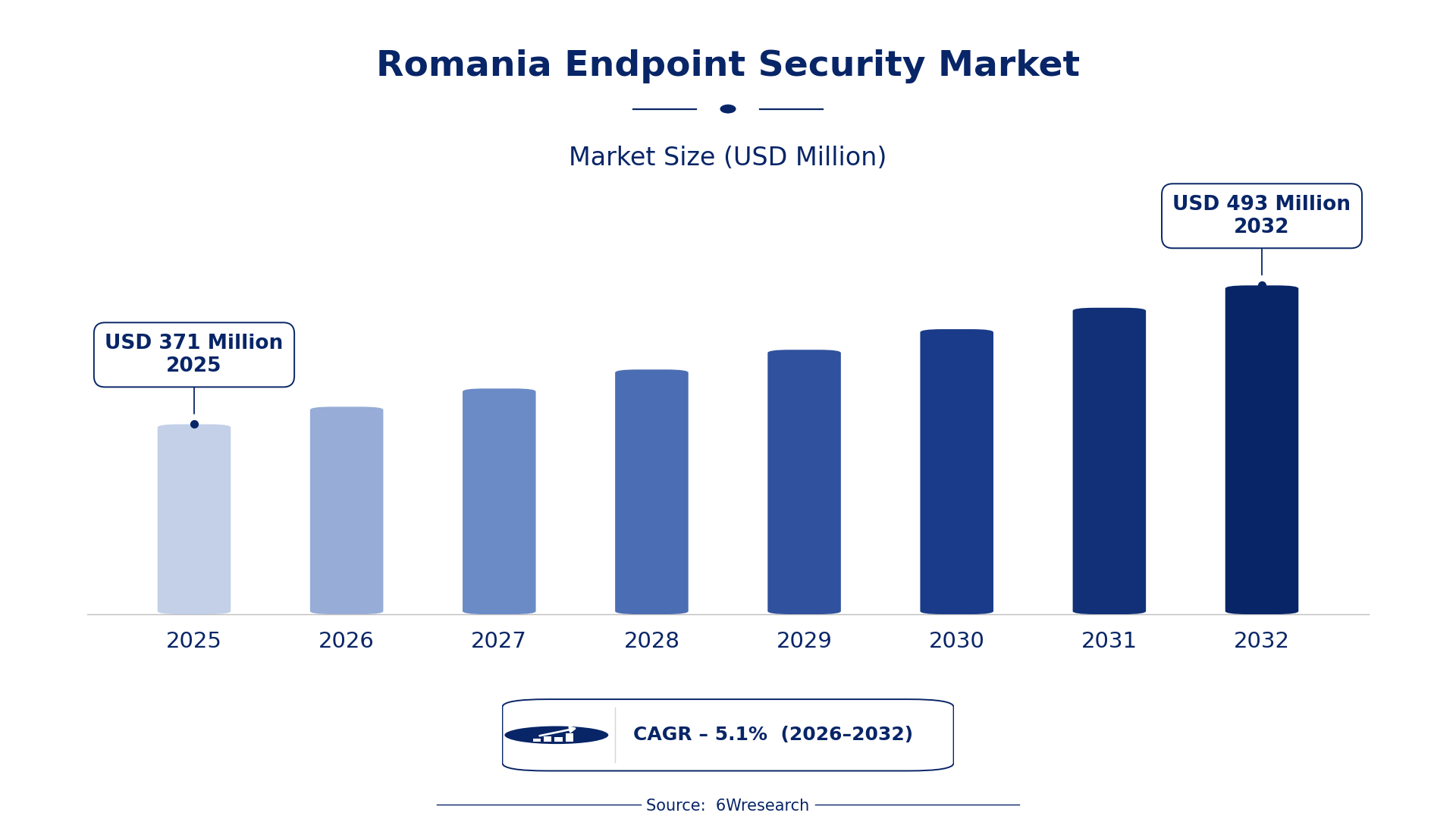
The Romania Endpoint Security Market was estimated at USD 371 Million in 2025 and is projected to reach USD 493 Million by 2032, growing at a CAGR of 5.1% from 2026 to 2032.
Romania Endpoint Security Market Synopsis
The Romania Endpoint Security Market is currently enjoying steady growth, primarily propelled by heightened awareness of cyber threats and the accelerating shift towards digitalization across various sectors. Companies are increasingly recognizing the necessity of robust security solutions to safeguard sensitive data against a backdrop of evolving cybercrime tactics.
Looking ahead, the demand for sophisticated endpoint security measures is expected to surge, particularly as remote work practices become more entrenched. Organizations are not just protecting their infrastructure; they’re also investing in cutting-edge technologies to ensure resilience against cyberattacks, positioning themselves for a more secure digital future.
Romania Endpoint Security Market Year-wise Growth Rate and Key Drivers
This graph illustrates the annual growth rates of the Romania Endpoint Security Market from 2021 to 2032, highlighting a steady upward trajectory and projected expansion over the forecast period.
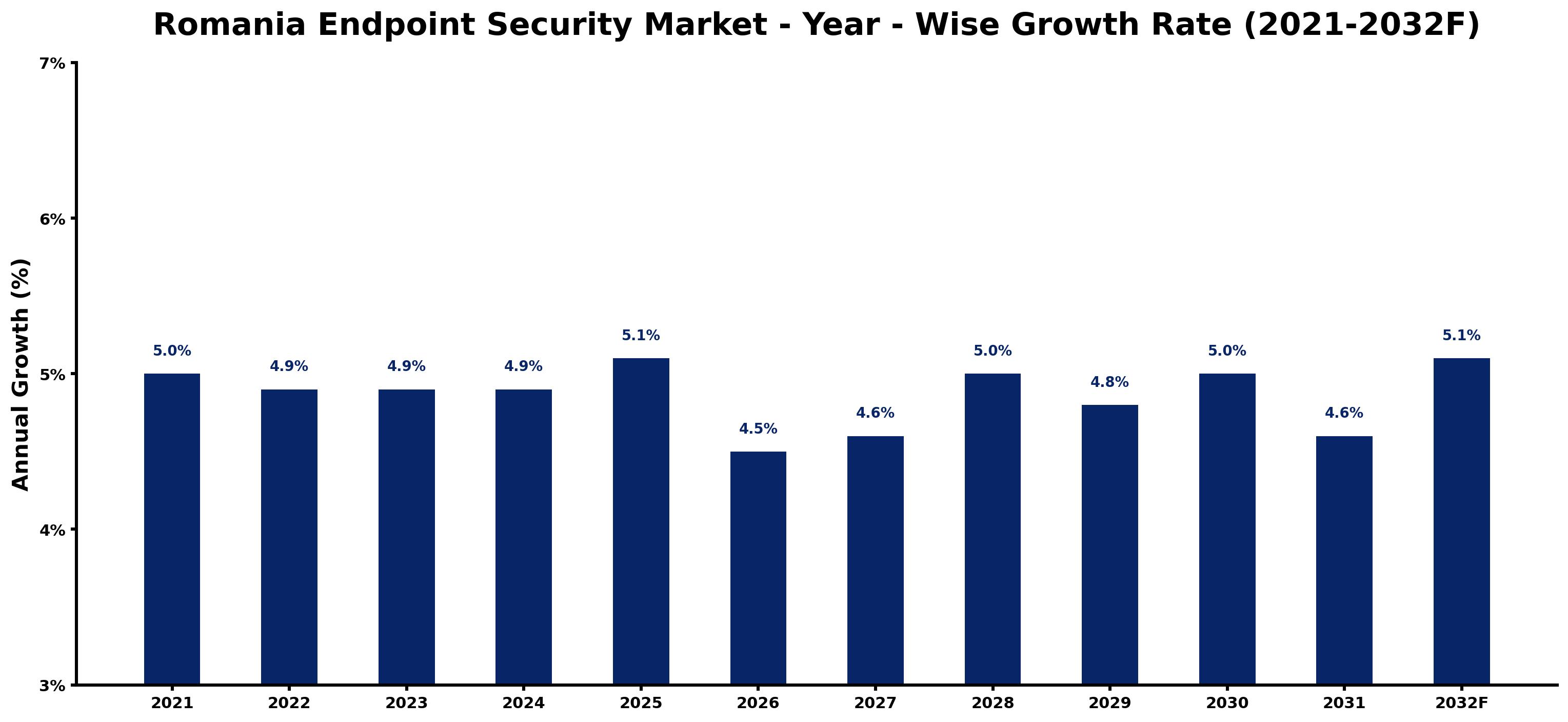
The table below presents the year‑wise growth rates along with the key drivers influencing the market
| Year | Growth Rate | Major Drivers |
| 2021 | 5.0% | EU GDPR compliance driving demand for cybersecurity solutions |
| 2022 | 4.9% | Increased cyber threats stimulating endpoint protection investments |
| 2023 | 4.9% | Remote work boom necessitating robust endpoint security measures |
| 2024 | 4.9% | National cybersecurity strategy enhancing enterprise protection efforts |
| 2025 | 5.1% | Post-pandemic digitization fueling endpoint security growth |
| 2026 | 4.5% | Rising IoT adoption prompting secure endpoint requirements |
| 2027 | 4.6% | Increased public sector cybersecurity initiatives boosting market |
| 2028 | 5.0% | Growing awareness of cyber risks among SMEs driving demand |
| 2029 | 4.8% | Investment in digital infrastructure enhancing security needs |
| 2030 | 5.0% | Local tech startups advancing innovative endpoint security solutions |
| 2031 | 4.6% | Regulations pushing companies towards improved cyber defenses |
| 2032 | 5.1% | Emerging threats leading to advanced security technology adoption |
Note: Market size estimations and growth projections presented in this report are based on 6Wresearch's proprietary forecasting methodology, utilizing the latest available industry data, government publications, and primary research inputs.
Romania Endpoint Security Market Key Takeaways
Below are some of the specific key takeaways from the market, including:
- The market is driven by the urgent need for advanced security measures amid rising cyber threats.
- Cloud-based solutions are gaining traction, offering flexibility and scalability for organizations.
- SMEs are increasingly prioritizing endpoint security investments to protect sensitive data.
- Compliance with evolving data protection regulations is pushing demand for secure endpoint solutions.
- Continuous advancements in technology are reshaping endpoint security offerings, focusing on real-time threat detection.
Evaluation of Restraints in Romania Endpoint Security Market
The Romania Endpoint Security Market faces notable restraints that hinder its full potential. The rapidly changing nature of cyber threats poses a substantial challenge for organizations trying to keep up with the necessary security measures. Many businesses, especially small and medium-sized enterprises, often lack the resources or expertise to implement comprehensive solutions. This gap in awareness, combined with financial constraints, leaves many organizations vulnerable to attacks, impeding market growth.
Romania Endpoint Security Market Trends
Current trends in the Romania Endpoint Security Market highlight a shift towards automated solutions that can rapidly respond to threats. The emphasis is on proactive security, moving beyond traditional measures to advanced endpoint detection and response systems. Additionally, the adoption of artificial intelligence in threat detection is on the rise, facilitating quicker identification and mitigation of risks. Organizations are increasingly demanding multi-layered security approaches that provide comprehensive protection across devices and platforms.
Romania Endpoint Security Market Opportunities
The Romania Endpoint Security Market presents a wealth of investment opportunities, particularly in developing tailored security solutions for local businesses. There is a growing demand for consulting services that can assist organizations in fortifying their cybersecurity posture. on top of that, partnerships with local technology providers can enhance market reach and effectiveness. Innovative product development focused on addressing the unique threats faced by Romanian enterprises is crucial for capturing a larger market share.
Government Initiatives in the Romania Endpoint Security Market
The Romanian government is actively shaping the Endpoint Security Market through strategic policies aimed at enhancing national cybersecurity. These initiatives reflect a commitment to safeguarding critical infrastructure and private data across the country. With increasing regulatory pressures and a focus on compliance, businesses are compelled to invest in robust endpoint security measures.
- A National Cyber Security Strategy was recently launched, focusing on improving overall cybersecurity resilience.
- Current efforts include ongoing collaborations with EU cybersecurity initiatives aimed at harmonizing standards across member states.
- Planned regulations are set to enforce stricter compliance protocols for data protection, anticipated to roll out in 2026.
- The establishment of cybersecurity training programs in collaboration with local universities is currently underway, enhancing workforce readiness.
- A public-private partnership initiative aimed at increasing investment in digital security technologies is being formulated, expected to launch in 2027.
Future Insights of the Romania Endpoint Security Market
From 2026 to 2032, the Romania Endpoint Security Market is projected to evolve significantly. As organizations grapple with the increasing sophistication of cyber threats, they will prioritize comprehensive security frameworks. The market will likely see more investments in advanced technologies like machine learning and AI, enabling real-time analytics and enhanced threat response capabilities. With regulatory pressures mounting, compliance will also drive demand for security solutions tailored to meet specific legal requirements.
Romania Endpoint Security Market Latest Developments
In the past year, the Romania Endpoint Security Market has witnessed a flurry of activity as businesses ramp up their cybersecurity initiatives. The urgency to secure digital assets against rising threats has led to a surge in demand for innovative endpoint solutions. Various sectors are now actively seeking partnerships and technologies that can enhance their security posture.
- A major technology vendor recently launched a new endpoint detection solution designed to integrate seamlessly with existing IT infrastructure, introduced in early Q3 2025.
- An initiative focused on enhancing cybersecurity awareness among SMEs is currently underway, led by industry associations and educational institutions.
- By mid-2026, a rollout of a national cybersecurity awareness campaign is expected, aimed at educating businesses on best practices.
- A collaborative project involving local universities to develop next-generation cybersecurity curricula was initiated in late 2025 and remains ongoing.
- An upcoming venture is planned for Q4 2026 that aims to establish a cybersecurity innovation hub, fostering new technologies and start-ups in the field.
Romania Endpoint Security Market - Key Attractiveness of the Report
- 10 Years of Market Numbers
- Historical Data Starting from 2022 to 2025
- Base Year: 2025
- Forecast Data until 2032
- Key Performance Indicators Impacting the Market
- Major Upcoming Developments and Projects
Key Highlights of the Report:
- Romania Endpoint Security Market Outlook
- Market Size of Romania Endpoint Security Market, 2025
- Forecast of Romania Endpoint Security Market, 2032
- Historical Data and Forecast of Romania Endpoint Security Revenues & Volume for the Period 2022-2032F
- Romania Endpoint Security Market Trend Evolution
- Romania Endpoint Security Market Drivers and Challenges
- Romania Endpoint Security Price Trends
- Romania Endpoint Security Porter's Five Forces
- Romania Endpoint Security Industry Life Cycle
- Historical Data and Forecast of Romania Endpoint Security Market Revenues & Volume By Solution for the Period 2022-2032F
- Historical Data and Forecast of Romania Endpoint Security Market Revenues & Volume By Endpoint Protection Platform for the Period 2022-2032F
- Historical Data and Forecast of Romania Endpoint Security Market Revenues & Volume By Endpoint Detection for the Period 2022-2032F
- Historical Data and Forecast of Romania Endpoint Security Market Revenues & Volume By Response for the Period 2022-2032F
- Historical Data and Forecast of Romania Endpoint Security Market Revenues & Volume By Vertical for the Period 2022-2032F
- Historical Data and Forecast of Romania Endpoint Security Market Revenues & Volume By Healthcare for the Period 2022-2032F
- Historical Data and Forecast of Romania Endpoint Security Market Revenues & Volume By Retail for the Period 2022-2032F
- Historical Data and Forecast of Romania Endpoint Security Market Revenues & Volume By eCommerce for the Period 2022-2032F
- Historical Data and Forecast of Romania Endpoint Security Market Revenues & Volume By Government for the Period 2022-2032F
- Historical Data and Forecast of Romania Endpoint Security Market Revenues & Volume By Organization Size for the Period 2022-2032F
- Historical Data and Forecast of Romania Endpoint Security Market Revenues & Volume By Small and Medium-Sized Enterprises (SMEs) for the Period 2022-2032F
- Historical Data and Forecast of Romania Endpoint Security Market Revenues & Volume By Large Enterprises for the Period 2022-2032F
- Historical Data and Forecast of Romania Endpoint Security Market Revenues & Volume By Deployment Mode for the Period 2022-2032F
- Historical Data and Forecast of Romania Endpoint Security Market Revenues & Volume By On-premises for the Period 2022-2032F
- Historical Data and Forecast of Romania Endpoint Security Market Revenues & Volume By Cloud for the Period 2022-2032F
- Historical Data and Forecast of Romania Endpoint Security Market Revenues & Volume By Service for the Period 2022-2032F
- Historical Data and Forecast of Romania Endpoint Security Market Revenues & Volume By Professional Services for the Period 2022-2032F
- Historical Data and Forecast of Romania Endpoint Security Market Revenues & Volume By Managed Services for the Period 2022-2032F
- Romania Endpoint Security Import Export Trade Statistics
- Market Opportunity Assessment By Solution
- Market Opportunity Assessment By Vertical
- Market Opportunity Assessment By Organization Size
- Market Opportunity Assessment By Deployment Mode
- Market Opportunity Assessment By Service
- Romania Endpoint Security Top Companies Market Share
- Romania Endpoint Security Competitive Benchmarking By Technical and Operational Parameters
- Romania Endpoint Security Company Profiles
- Romania Endpoint Security Key Strategic Recommendations






































