Romania Managed Services Market Size & Growth Rate (2026-2032)
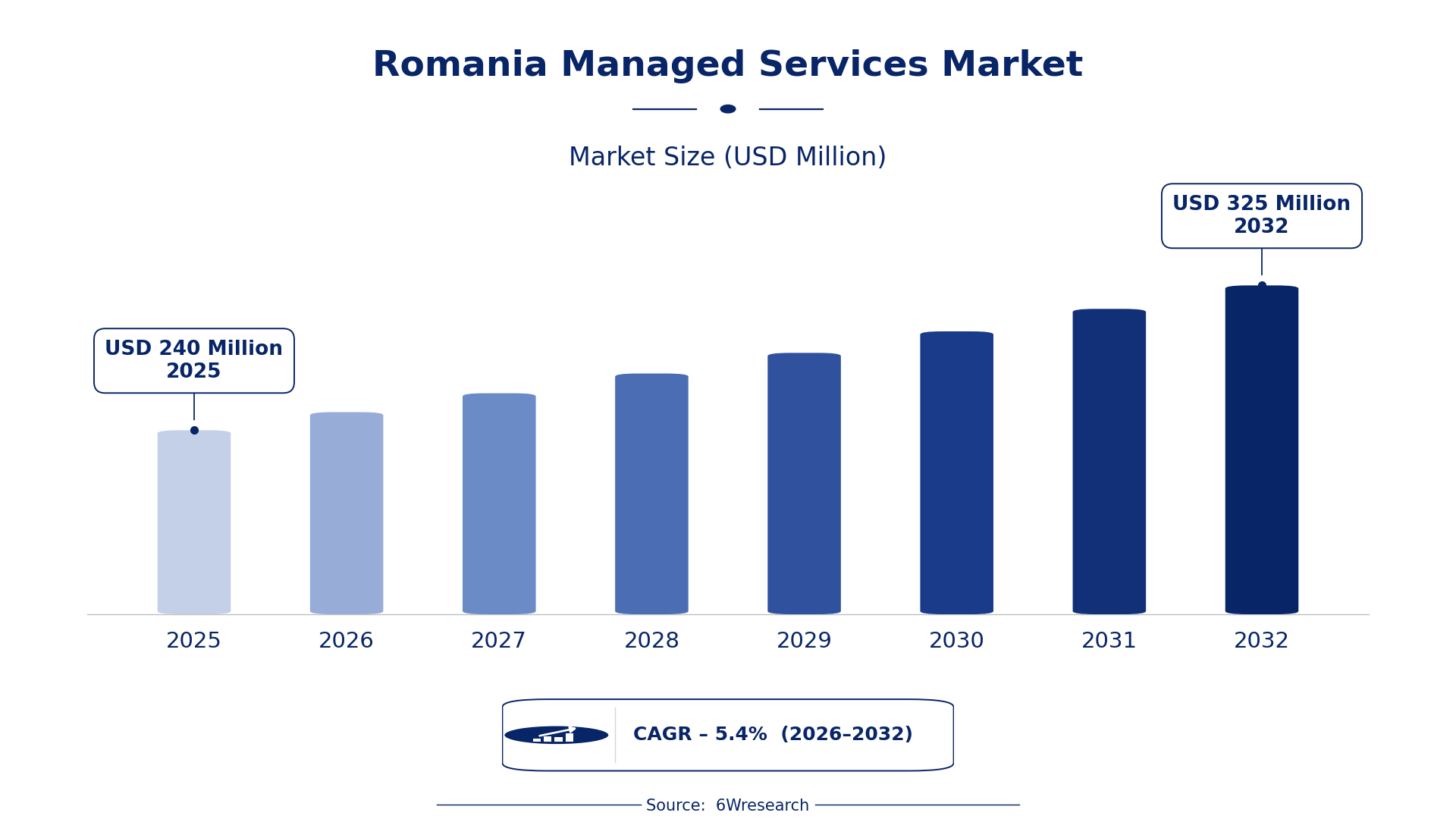
The Romania Managed Services Market was estimated at USD 240 Million in 2025 and is projected to reach USD 325 Million by 2032, growing at a CAGR of 5.4% from 2026 to 2032.
Romania Managed Services Market Synopsis
A surge in cloud service adoption is driving the Romania Managed Services Market. As businesses seek innovative solutions to stay competitive, managed service providers are stepping up to deliver essential IT infrastructure management and security services.
Small and medium-sized enterprises are increasingly outsourcing their IT functions, which allows them to concentrate on their core competencies. This trend is particularly pronounced in sectors like healthcare and finance, where compliance and security needs are paramount.
Romania Managed Services Market Year-wise Growth Rate and Key Drivers
This graph illustrates the annual growth rates of the Romania Managed Services Market from 2021 to 2032, highlighting a steady upward trajectory and projected expansion over the forecast period.
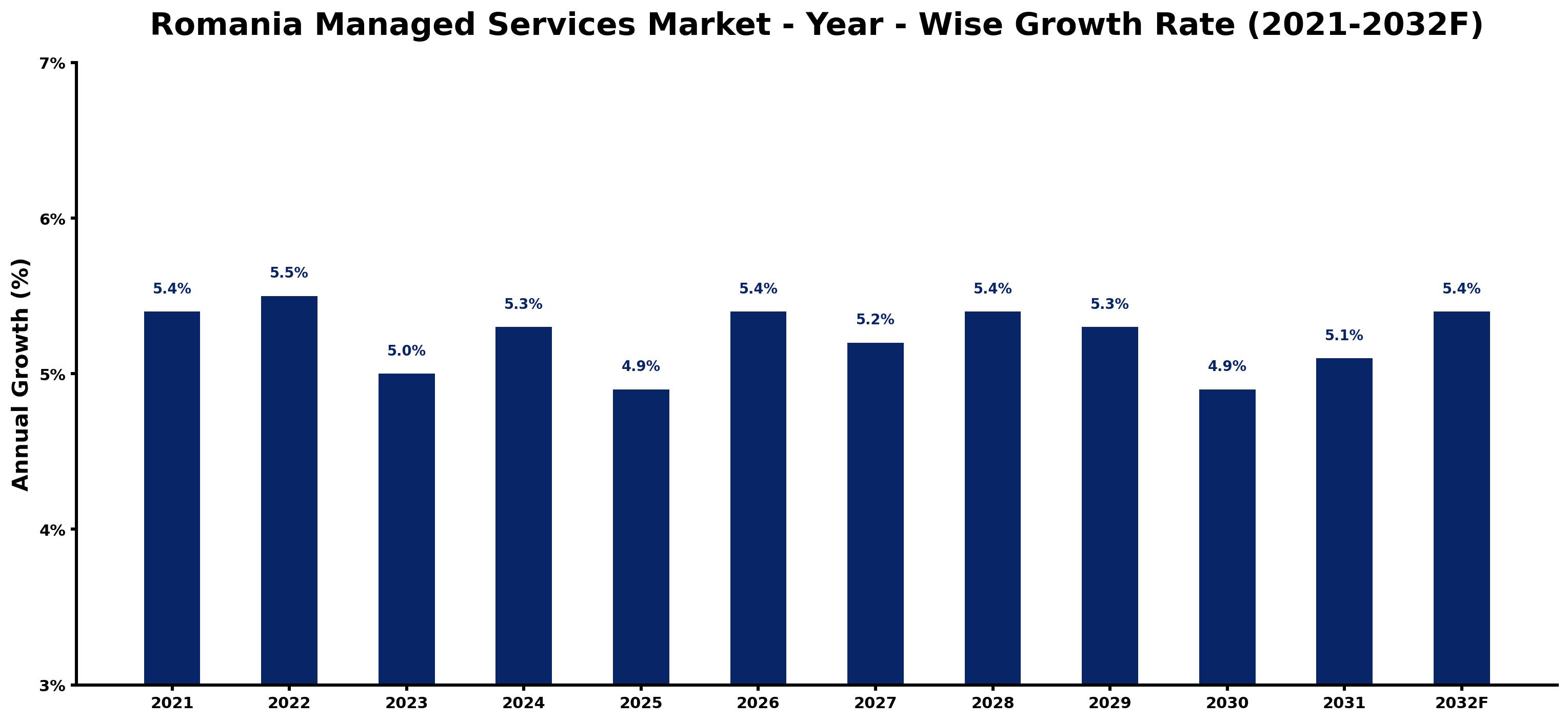
The table below presents the year‑wise growth rates along with the key drivers influencing the market
| Year | Growth Rate | Major Drivers |
| 2021 | 5.4% | Increased remote work driving IT service needs. |
| 2022 | 5.5% | Local SMEs investing in cybersecurity managed solutions. |
| 2023 | 5.0% | EU digital economy funding fueling IT service contracts. |
| 2024 | 5.3% | Adoption of AI technologies in managed service offerings. |
| 2025 | 4.9% | Regulatory compliance driving demand for managed services. |
| 2026 | 5.4% | Growing e-commerce sector requiring enhanced IT support. |
| 2027 | 5.2% | Rise in digital startups needing managed service partnerships. |
| 2028 | 5.4% | Government digitalization roadmap boosting IT service uptake. |
| 2029 | 5.3% | Surge in data analytics services for businesses. |
| 2030 | 4.9% | Increased focus on IT disaster recovery solutions. |
| 2031 | 5.1% | Local regulations favoring cloud service provider partnerships. |
| 2032 | 5.4% | Emergence of IoT services requiring comprehensive management. |
Note: Market size estimations and growth projections presented in this report are based on 6Wresearch's proprietary forecasting methodology, utilizing the latest available industry data, government publications, and primary research inputs.
Romania Managed Services Market Key Takeaways
Below are some of the specific key takeaways from the market, including:
- Growing demand for managed cloud services is reshaping business IT strategies.
- Cybersecurity remains a top priority, driving the need for managed security services.
- SMEs are increasingly recognizing the value of outsourcing IT management.
- Sector-specific solutions are gaining traction, particularly in healthcare and finance.
- Adoption of advanced technologies like AI is enhancing service delivery.
Evaluation of Restraints in Romania Managed Services Market
Despite its growth potential, the Romania Managed Services Market faces several restraints. A primary concern is the lack of awareness among businesses regarding the benefits of managed services. Many organizations remain hesitant to outsource due to uncertainty about the ROI and potential risks. This hesitancy is compounded by the fragmented market, where numerous small providers complicate the vendor selection process. on top of that, data security and compliance regulations pose significant challenges for providers, necessitating robust measures to protect sensitive information.
Romania Managed Services Market Trends
The landscape of the Romania Managed Services Market is evolving with distinct trends. One of the most noticeable shifts is towards managed security services, driven by an increase in cyber threats. Additionally, the demand for managed cloud services is growing as businesses seek to enhance their agility and scalability. The need for managed IT infrastructure services is also on the rise, as organizations look to improve operational efficiency and reduce costs.
Romania Managed Services Market Opportunities
The Romania Managed Services Market presents several exciting growth opportunities. Tailored service packages for SMEs are increasingly in demand, allowing providers to cater to the unique needs of smaller businesses. Leveraging advanced technologies like automation and artificial intelligence can further enhance service delivery, making offerings more attractive. Expanding into emerging sectors such as e-commerce also presents a lucrative avenue for service providers looking to diversify their portfolios.
Government Initiatives in the Romania Managed Services Market
Government policies play a crucial role in shaping the Romania Managed Services Market. With a strong focus on promoting digital technologies, the government has initiated several programs aimed at enhancing the country’s digital infrastructure. These initiatives not only support the growth of the IT sector but also encourage businesses to adopt managed services to meet compliance and security standards.
- A national digital infrastructure upgrade program now in its rollout phase aims to enhance broadband access across urban and rural areas.
- A regulatory framework introduced in 2025 mandating data protection compliance has increased demand for managed services.
- Currently ongoing initiatives focus on cybersecurity training and awareness programs to educate businesses about managed services benefits.
- Planned public-private partnerships expected to facilitate the integration of cloud services in public administration by 2028.
Future Insights of the Romania Managed Services Market
Looking ahead to 2026-2032, the Romania Managed Services Market is set to experience continuous growth. The increasing reliance on cloud technologies and the need for digital transformation will drive businesses to seek specialized managed services. As operational efficiency becomes a critical competitive factor, outsourcing IT functions will gain traction. on top of that, sectors such as healthcare and finance will continue to push for enhanced cybersecurity measures, ensuring steady demand for managed services.
Romania Managed Services Market Latest Developments
Recent activity in the Romania Managed Services Market indicates a strong push towards innovation and security enhancements. Over the past year, several key developments have emerged that reflect the market’s dynamic nature.
- A leading regional operator launched a comprehensive managed security service suite in Q1 2025, catering specifically to the financial sector.
- An initiative that began in mid-2025 is currently underway, focusing on integrating AI capabilities into existing managed services.
- In early 2025, a major technology vendor expanded its cloud service offerings to include tailored packages for SMEs.
- A rollout expected to begin in the second half of 2026 aims to enhance data center capabilities nationwide.
Romania Managed Services Market - Key Attractiveness of the Report
- 10 Years of Market Numbers
- Historical Data Starting from 2022 to 2025
- Base Year: 2025
- Forecast Data until 2032
- Key Performance Indicators Impacting the Market
- Major Upcoming Developments and Projects
Key Highlights of the Report:
- Romania Managed Services Market Outlook
- Market Size of Romania Managed Services Market, 2025
- Forecast of Romania Managed Services Market, 2032
- Historical Data and Forecast of Romania Managed Services Revenues & Volume for the Period 2022-2032F
- Romania Managed Services Market Trend Evolution
- Romania Managed Services Market Drivers and Challenges
- Romania Managed Services Price Trends
- Romania Managed Services Porter's Five Forces
- Romania Managed Services Industry Life Cycle
- Historical Data and Forecast of Romania Managed Services Market Revenues & Volume By Service Type for the Period 2022-2032F
- Historical Data and Forecast of Romania Managed Services Market Revenues & Volume By Managed Security Services for the Period 2022-2032F
- Historical Data and Forecast of Romania Managed Services Market Revenues & Volume By Managed Network Services for the Period 2022-2032F
- Historical Data and Forecast of Romania Managed Services Market Revenues & Volume By Managed Data Center and IT Infrastructure Services for the Period 2022-2032F
- Historical Data and Forecast of Romania Managed Services Market Revenues & Volume By Managed Communication and Collaboration Services for the Period 2022-2032F
- Historical Data and Forecast of Romania Managed Services Market Revenues & Volume By Managed Mobility Services for the Period 2022-2032F
- Historical Data and Forecast of Romania Managed Services Market Revenues & Volume By Managed Information Services for the Period 2022-2032F
- Historical Data and Forecast of Romania Managed Services Market Revenues & Volume By Deployment Type for the Period 2022-2032F
- Historical Data and Forecast of Romania Managed Services Market Revenues & Volume By Cloud for the Period 2022-2032F
- Historical Data and Forecast of Romania Managed Services Market Revenues & Volume By On-Premises for the Period 2022-2032F
- Historical Data and Forecast of Romania Managed Services Market Revenues & Volume By Organization Size for the Period 2022-2032F
- Historical Data and Forecast of Romania Managed Services Market Revenues & Volume By Small and Medium-sized Enterprises (SMEs) for the Period 2022-2032F
- Historical Data and Forecast of Romania Managed Services Market Revenues & Volume By Large Enterprises for the Period 2022-2032F
- Historical Data and Forecast of Romania Managed Services Market Revenues & Volume By Vertical for the Period 2022-2032F
- Historical Data and Forecast of Romania Managed Services Market Revenues & Volume By BFSI for the Period 2022-2032F
- Historical Data and Forecast of Romania Managed Services Market Revenues & Volume By IT and Telecom for the Period 2022-2032F
- Historical Data and Forecast of Romania Managed Services Market Revenues & Volume By Retail and Consumer Goods for the Period 2022-2032F
- Historical Data and Forecast of Romania Managed Services Market Revenues & Volume By Manufacturing for the Period 2022-2032F
- Historical Data and Forecast of Romania Managed Services Market Revenues & Volume By Government for the Period 2022-2032F
- Historical Data and Forecast of Romania Managed Services Market Revenues & Volume By Healthcare and Life Sciences for the Period 2022-2032F
- Historical Data and Forecast of Romania Managed Services Market Revenues & Volume By Energy and Utilities for the Period 2022-2032F
- Historical Data and Forecast of Romania Managed Services Market Revenues & Volume By Media and Entertainment for the Period 2022-2032F
- Romania Managed Services Import Export Trade Statistics
- Market Opportunity Assessment By Service Type
- Market Opportunity Assessment By Deployment Type
- Market Opportunity Assessment By Organization Size
- Market Opportunity Assessment By Vertical
- Romania Managed Services Top Companies Market Share
- Romania Managed Services Competitive Benchmarking By Technical and Operational Parameters
- Romania Managed Services Company Profiles
- Romania Managed Services Key Strategic Recommendations






































