Romania Passwordless Authentication Market Size & Growth Rate (2026-2032)
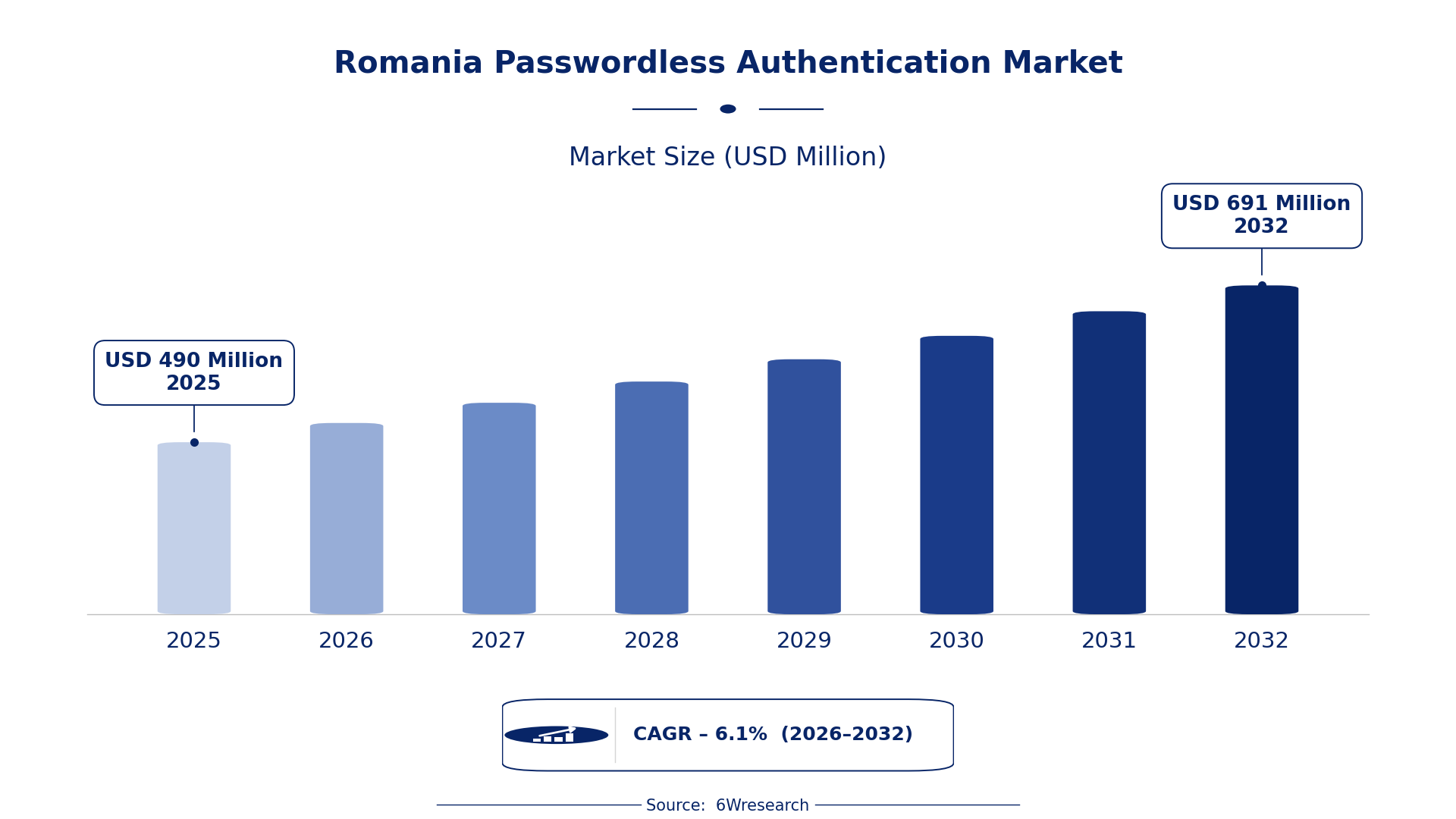
The Romania Passwordless Authentication Market was estimated at USD 490 Million in 2025 and is projected to reach USD 691 Million by 2032, growing at a CAGR of 6.1% from 2026 to 2032.
Romania Passwordless Authentication Market Synopsis
Recent years have seen a substantial uptick in the adoption of passwordless authentication solutions in Romania, driven by the escalating risks of cyber threats and the inadequacies of traditional password systems. The future trajectory indicates a continued shift as organizations embrace more advanced, user-friendly methods for secure access.
As businesses begin to understand the limitations of conventional authentication methods, the move towards biometric solutions like facial and fingerprint recognition is intensifying. This evolution reflects a broader recognition of the need for enhanced security measures and improved user experiences in a market ripe for transformation.
Romania Passwordless Authentication Market Year-wise Growth Rate and Key Drivers
This graph illustrates the annual growth rates of the Romania Passwordless Authentication Market from 2021 to 2032, highlighting a steady upward trajectory and projected expansion over the forecast period.
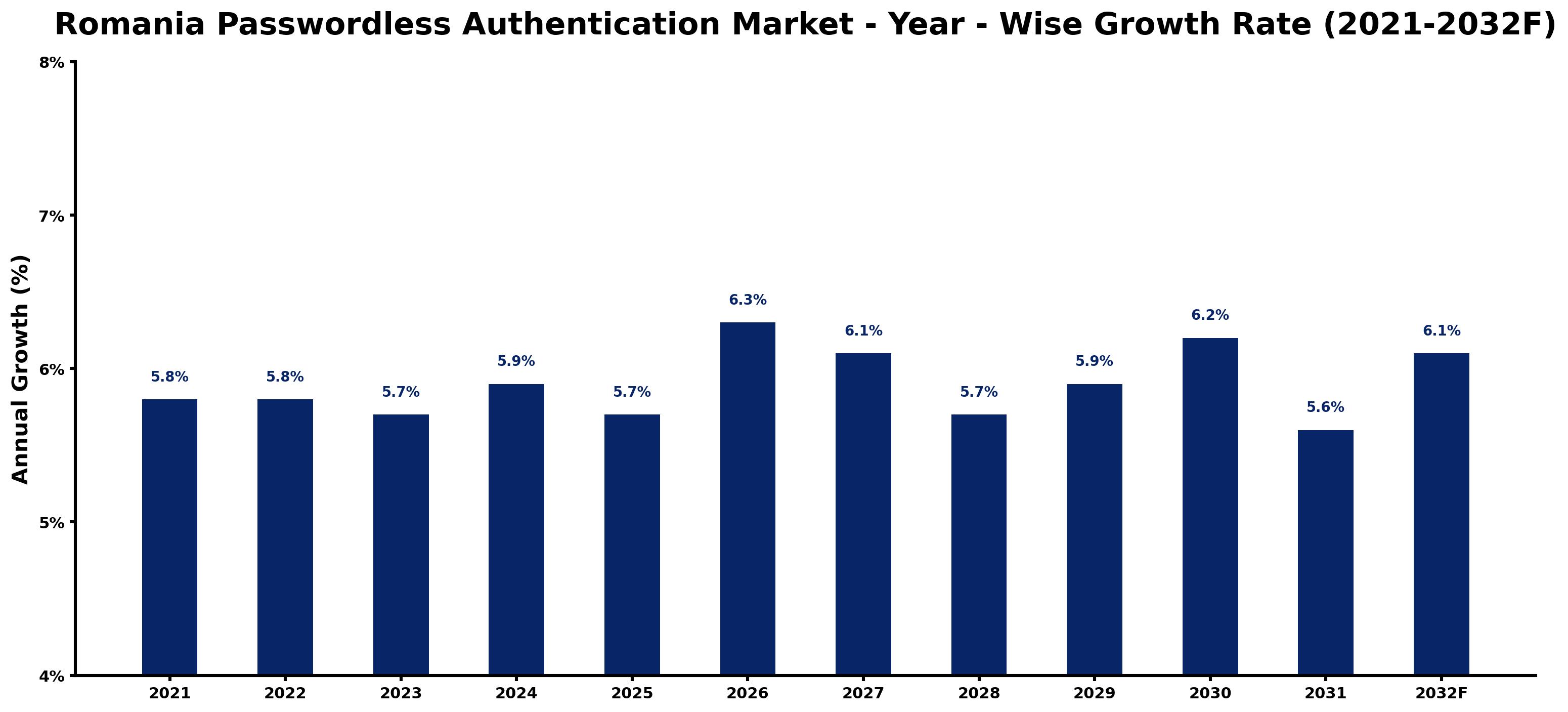
The table below presents the year‑wise growth rates along with the key drivers influencing the market
| Year | Growth Rate | Major Drivers |
| 2021 | 5.8% | Increased focus on cybersecurity by local businesses. |
| 2022 | 5.8% | Adoption of GDPR driving demand for secure authentication. |
| 2023 | 5.7% | Rise in remote workheightening passwordless solutions needs. |
| 2024 | 5.9% | Local banks implementing biometric KYC processes. |
| 2025 | 5.7% | Government promoting digital identity frameworks for citizens. |
| 2026 | 6.3% | Tech startups advancing biometric authentication technologies. |
| 2027 | 6.1% | Increased regulatory pressure on data protection compliance. |
| 2028 | 5.7% | Growing consumer awareness about online security best practices. |
| 2029 | 5.9% | Adoption of 5G enhancing mobile authentication capabilities. |
| 2030 | 6.2% | Enterprise investments in zero-trust security architectures rising. |
| 2031 | 5.6% | Strong demand for seamless user experiences in fintech. |
| 2032 | 6.1% | Collaboration between tech firms and universities boosting innovation. |
Note: Market size estimations and growth projections presented in this report are based on 6Wresearch's proprietary forecasting methodology, utilizing the latest available industry data, government publications, and primary research inputs.
Romania Passwordless Authentication Market Key Takeaways
Below are some of the specific key takeaways from the market, including:
- The growing awareness of security vulnerabilities has accelerated the shift towards passwordless authentication methods.
- Biometric solutions, particularly fingerprint and facial recognition, are gaining traction among organizations across various sectors.
- Remote work trends are driving demand for more secure and convenient authentication solutions.
- Regulatory compliance remains a crucial factor influencing the adoption of passwordless technologies.
- Investment opportunities are emerging as businesses seek innovative solutions to counteract rising cyber threats.
Evaluation of Restraints in Romania Passwordless Authentication Market
A major restraint hindering the growth of the Romania Passwordless Authentication Market is the persistent reliance on traditional password-based systems among many organizations. This reluctance stems from a lack of understanding of the benefits that passwordless solutions can provide. Concerns over security, compatibility with existing systems, and the costs associated with transitioning to new technologies often lead to hesitation. Addressing these barriers is crucial for wider adoption, highlighting the importance of stakeholder education and providing robust support during implementation.
Romania Passwordless Authentication Market Trends
The trend towards biometric authentication methods is gaining momentum, with organizations increasingly adopting techniques like fingerprint and facial recognition for secure access. This pivot to passwordless solutions is not merely about enhancing security; it’s also about streamlining the user experience. The rise of remote work has underscored the need for strong, user-friendly authentication technologies, further propelling the demand for innovative solutions in Romania.
Romania Passwordless Authentication Market Opportunities
The landscape is rife with growth opportunities as businesses seek advanced security measures to protect sensitive data. Investments in passwordless authentication technologies, particularly those utilizing biometrics and multi-factor authentication, promise high returns. The transition from traditional methods to innovative solutions presents an attractive avenue for businesses aiming to enhance security while improving user satisfaction.
Government Initiatives in the Romania Passwordless Authentication Market
The Romanian government is increasingly focused on strengthening cybersecurity measures, indirectly fostering the growth of the Passwordless Authentication Market. While there are no specific policies targeting passwordless technologies, the broader regulatory framework emphasizes data privacy and security, shaping how organizations implement authentication strategies. This regulatory posture is critical as Romania aligns with EU standards like the GDPR, reinforcing the need for secure digital transactions.
- A national cybersecurity enhancement initiative launched in early 2024 aims to bolster digital transaction security across sectors.
- Current discussions are underway about introducing a regulatory framework that would encourage the adoption of passwordless solutions in public services.
- A planned public-private partnership aims to facilitate an infrastructure upgrade for digital identities by 2027.
- Ongoing workshops and seminars focusing on cybersecurity education and awareness for businesses are being conducted throughout 2025.
- Regulatory bodies are reviewing existing frameworks to incorporate guidelines specific to passwordless authentication solutions in 2026.
Future Insights of the Romania Passwordless Authentication Market
Looking ahead to 2026-2032, the Romania Passwordless Authentication Market is expected to witness continued growth fueled by rising cybersecurity concerns and a shift towards more efficient, user-centric authentication solutions. The increasing adoption of cloud services and advancements in biometric technologies will further drive innovation. As organizations prioritize security and compliance, the market stands to gain significant momentum, positioning passwordless authentication at the forefront of digital security measures.
Romania Passwordless Authentication Market Latest Developments
In the past year, the Romania Passwordless Authentication Market has experienced notable developments reflecting the growing importance of security in digital transactions. Organizations are actively seeking innovative solutions to protect sensitive data while enhancing user experience. This focus on improved security measures is evident in recent industry activities.
- A new biometric authentication solution was launched in Q1 2025, integrating voice recognition and facial scanning to enhance security protocols.
- Currently ongoing is a pilot program evaluating the effectiveness of hardware token-based authentication methods across various sectors, set to conclude in mid-2026.
- A partnership between a tech startup and a major industry player has been established to develop next-generation passwordless solutions, with initial results expected by late 2025.
- Upcoming training sessions for organizations on implementing passwordless systems are scheduled for Q3 2026, aimed at increasing awareness and capability.
- An initiative to improve cross-sector collaboration on cybersecurity practices has begun in early 2025, focusing on shared resources and knowledge.
Romania Passwordless Authentication Market - Key Attractiveness of the Report
- 10 Years of Market Numbers
- Historical Data Starting from 2022 to 2025
- Base Year: 2025
- Forecast Data until 2032
- Key Performance Indicators Impacting the Market
- Major Upcoming Developments and Projects
Key Highlights of the Report:
- Romania Passwordless Authentication Market Outlook
- Market Size of Romania Passwordless Authentication Market, 2025
- Forecast of Romania Passwordless Authentication Market, 2032
- Historical Data and Forecast of Romania Passwordless Authentication Revenues & Volume for the Period 2022-2032F
- Romania Passwordless Authentication Market Trend Evolution
- Romania Passwordless Authentication Market Drivers and Challenges
- Romania Passwordless Authentication Price Trends
- Romania Passwordless Authentication Porter's Five Forces
- Romania Passwordless Authentication Industry Life Cycle
- Historical Data and Forecast of Romania Passwordless Authentication Market Revenues & Volume By Offering for the Period 2022-2032F
- Historical Data and Forecast of Romania Passwordless Authentication Market Revenues & Volume By Hardware for the Period 2022-2032F
- Historical Data and Forecast of Romania Passwordless Authentication Market Revenues & Volume By Software for the Period 2022-2032F
- Historical Data and Forecast of Romania Passwordless Authentication Market Revenues & Volume By Services for the Period 2022-2032F
- Historical Data and Forecast of Romania Passwordless Authentication Market Revenues & Volume By Motility for the Period 2022-2032F
- Historical Data and Forecast of Romania Passwordless Authentication Market Revenues & Volume By Fixed/Rack Mounted for the Period 2022-2032F
- Historical Data and Forecast of Romania Passwordless Authentication Market Revenues & Volume By Mobile/Portable for the Period 2022-2032F
- Historical Data and Forecast of Romania Passwordless Authentication Market Revenues & Volume By Authentication Type for the Period 2022-2032F
- Historical Data and Forecast of Romania Passwordless Authentication Market Revenues & Volume By Single-factor for the Period 2022-2032F
- Historical Data and Forecast of Romania Passwordless Authentication Market Revenues & Volume By Multi-factor for the Period 2022-2032F
- Historical Data and Forecast of Romania Passwordless Authentication Market Revenues & Volume By End User for the Period 2022-2032F
- Historical Data and Forecast of Romania Passwordless Authentication Market Revenues & Volume By BFSI for the Period 2022-2032F
- Historical Data and Forecast of Romania Passwordless Authentication Market Revenues & Volume By IT and ITeS for the Period 2022-2032F
- Historical Data and Forecast of Romania Passwordless Authentication Market Revenues & Volume By Government and Law Enforcement for the Period 2022-2032F
- Historical Data and Forecast of Romania Passwordless Authentication Market Revenues & Volume By Healthcare for the Period 2022-2032F
- Historical Data and Forecast of Romania Passwordless Authentication Market Revenues & Volume By Manufacturing for the Period 2022-2032F
- Historical Data and Forecast of Romania Passwordless Authentication Market Revenues & Volume By Retail and Consumer Electronics for the Period 2022-2032F
- Historical Data and Forecast of Romania Passwordless Authentication Market Revenues & Volume By Travel and Hospitality for the Period 2022-2032F
- Historical Data and Forecast of Romania Passwordless Authentication Market Revenues & Volume By Other Verticals (Education; Energy and Utilities; Aerospace and Defense; Media and Entertainment; Online Gaming; and Transportation and Logistics) for the Period 2022-2032F
- Romania Passwordless Authentication Import Export Trade Statistics
- Market Opportunity Assessment By Offering
- Market Opportunity Assessment By Motility
- Market Opportunity Assessment By Authentication Type
- Market Opportunity Assessment By End User
- Romania Passwordless Authentication Top Companies Market Share
- Romania Passwordless Authentication Competitive Benchmarking By Technical and Operational Parameters
- Romania Passwordless Authentication Company Profiles
- Romania Passwordless Authentication Key Strategic Recommendations






































