Romania Pasta And Noodles Market Size (2020-2030)
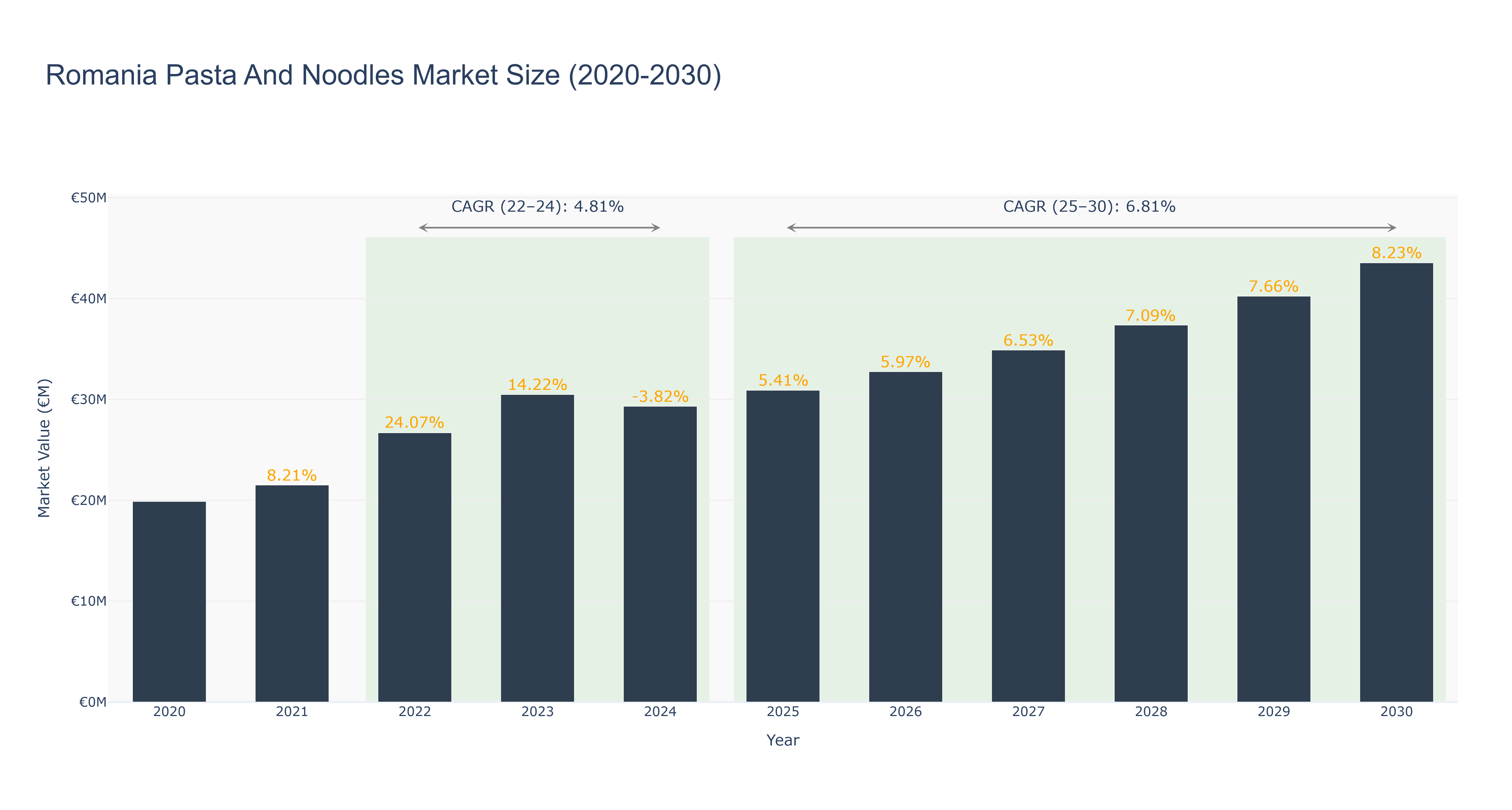
Romania Pasta And Noodles Market has shown a steady growth trajectory, reaching its peak market size of €43.55 million in 2030. The market witnessed a slight decline from €30.49 million in 2023 to €29.32 million in 2024, attributed to changing consumer preferences and economic factors. However, it rebounded and continued to grow, with a forecasted market size of €32.76 million in 2026. The market is expected to maintain a strong growth momentum with a CAGR of 6.81% from 2025 to 2030. Industry drivers such as increasing health consciousness and convenience are fueling this growth. In line with this trend, upcoming developments in the market include the introduction of innovative pasta and noodles variants catering to health-conscious consumers, along with sustainable packaging initiatives to align with environmental concerns.
Romania Pasta And Noodles Market: Production & Trade Performance (2019-2025)
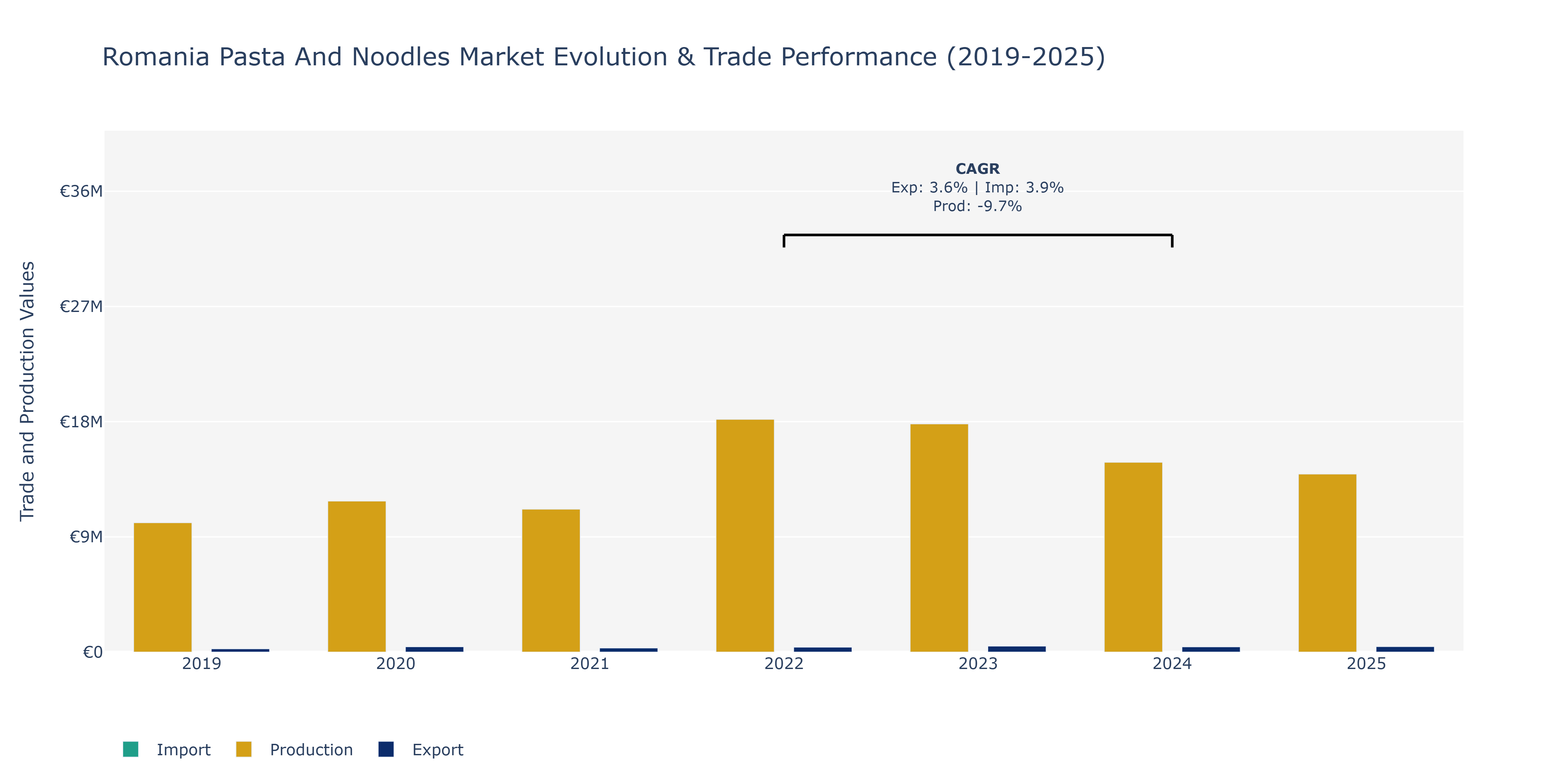
Between 2019 and 2025, Romania's Pasta and Noodles Market witnessed fluctuations in exports, imports, and production. Exports showed growth from 2019 to 2020, reaching €408.18 thousand, before decreasing in 2021, only to rise again in the following years, hitting €418.53 thousand in 2025. Imports, on the other hand, experienced a downward trend from 2019 to 2020, rebounded in 2021, and continued to increase annually, reaching €12.35 million in 2025. In contrast, production peaked in 2022 at €18.18 million and then declined consistently to €13.91 million by 2025. The fluctuations in exports and imports can be attributed to changing consumer preferences, health trends influencing pasta consumption, and global trade dynamics impacting the import-export balance. The drop in production may be influenced by supply chain disruptions, raw material availability, and market saturation leading to a recalibration in production volumes to align with demand shifts.
Romania Pasta and Noodles Market Overview
The Romania Pasta and Noodles Market is experiencing steady growth driven by the increasing demand for convenient and affordable meal options among consumers. Factors such as busy lifestyles, rising disposable incomes, and changing dietary preferences are fueling the market`s expansion. Traditional pasta varieties like spaghetti and penne remain popular, while there is a growing trend towards healthier options such as whole wheat and gluten-free pasta. The market is highly competitive, with both domestic and international players vying for market share through product innovation, marketing strategies, and pricing tactics. Retail channels like supermarkets, hypermarkets, and online platforms play a crucial role in distributing pasta and noodles products to consumers across Romania. With the evolving consumer preferences and the introduction of new product variants, the Romania Pasta and Noodles Market is expected to continue its growth trajectory in the coming years.
Romania Pasta and Noodles Market Trends
The Romania Pasta and Noodles Market is experiencing several key trends. One significant trend is the growing demand for healthier and more natural pasta and noodle products, driven by increasing consumer awareness of health and wellness. This has led to a rise in the availability of organic, whole grain, and gluten-free options in the market. Another notable trend is the popularity of convenience products such as ready-to-eat pasta and noodles, catering to busy lifestyles and the need for quick meal solutions. Additionally, there is a growing preference for innovative and exotic flavors and varieties, as consumers seek unique and diverse dining experiences. Overall, the Romania Pasta and Noodles Market is witnessing a shift towards healthier, convenient, and more diverse product offerings to meet evolving consumer preferences.
Romania Pasta and Noodles Market Challenges
In the Romania Pasta and Noodles Market, some key challenges include intense competition from both domestic and international brands, price sensitivity among consumers due to economic factors, and changing consumer preferences towards healthier and more diverse food options. Additionally, fluctuations in raw material costs, supply chain disruptions, and regulatory changes can also impact the market dynamics. To succeed in this competitive landscape, companies need to focus on product innovation, marketing strategies tailored to the local market, and efficient distribution channels to reach a wide consumer base. Adapting to trends such as increased demand for organic or gluten-free options and addressing sustainability concerns can also present opportunities for growth in the Romania Pasta and Noodles Market.
Romania Pasta and Noodles Market Investment Opportunities
The Romania Pasta and Noodles Market presents promising investment opportunities due to the growing demand for convenient and affordable food products. With a rising urban population and changing consumer preferences towards convenience foods, there is a significant market potential for pasta and noodles in Romania. Investors can consider opportunities in expanding production capacities, introducing innovative product offerings such as organic or gluten-free options, and leveraging digital marketing strategies to reach a wider consumer base. Additionally, partnerships with local distributors or retailers can help in penetrating the market more effectively. Overall, investing in the Romania Pasta and Noodles Market offers a chance to capitalize on the increasing demand for convenient and diverse food options in the country.
Romania Pasta and Noodles Market Government Policy
In Romania, government policies related to the pasta and noodles market focus on food safety, labeling requirements, and import regulations to ensure consumer protection and fair competition. The Romanian government has implemented strict standards for the production and distribution of pasta and noodles to guarantee the quality and safety of these products. Additionally, labeling regulations mandate that all pasta and noodle products must accurately disclose ingredient information and nutritional content to inform consumers. Import regulations aim to facilitate trade while safeguarding local producers from unfair competition. Overall, these government policies play a crucial role in regulating the Romania pasta and noodles market to ensure compliance with quality standards, consumer protection, and fair competition among market players.
Romania Pasta and Noodles Market Future Outlook
The future outlook for the Romania Pasta and Noodles Market appears positive, driven by factors such as increasing consumer demand for convenient and affordable food options, growing awareness of different cuisines, and a shift towards healthier eating habits. The market is expected to witness steady growth due to the rising popularity of pasta and noodles as staple food items in Romanian households. Additionally, the introduction of innovative product varieties, such as gluten-free and organic options, is likely to attract a wider consumer base. As disposable incomes continue to rise and urbanization accelerates, the convenience factor associated with pasta and noodles is expected to further boost market growth. Overall, the Romania Pasta and Noodles Market is poised for expansion in the coming years.
Key Highlights of the Report:
- Romania Pasta and Noodles Market Outlook
- Market Size of Romania Pasta and Noodles Market, 2025
- Forecast of Romania Pasta and Noodles Market, 2032
- Historical Data and Forecast of Romania Pasta and Noodles Revenues & Volume for the Period 2018 - 2032
- Romania Pasta and Noodles Market Trend Evolution
- Romania Pasta and Noodles Market Drivers and Challenges
- Romania Pasta and Noodles Price Trends
- Romania Pasta and Noodles Porter's Five Forces
- Romania Pasta and Noodles Industry Life Cycle
- Historical Data and Forecast of Romania Pasta and Noodles Market Revenues & Volume By Product for the Period 2018 - 2032
- Historical Data and Forecast of Romania Pasta and Noodles Market Revenues & Volume By Ambient for the Period 2018 - 2032
- Historical Data and Forecast of Romania Pasta and Noodles Market Revenues & Volume By Dried for the Period 2018 - 2032
- Historical Data and Forecast of Romania Pasta and Noodles Market Revenues & Volume By Chilled for the Period 2018 - 2032
- Romania Pasta and Noodles Import Export Trade Statistics
- Market Opportunity Assessment By Product
- Romania Pasta and Noodles Top Companies Market Share
- Romania Pasta and Noodles Competitive Benchmarking By Technical and Operational Parameters
- Romania Pasta and Noodles Company Profiles
- Romania Pasta and Noodles Key Strategic Recommendations






































