Romania Thermoplastic Pipe Market: Import Trend Analysis
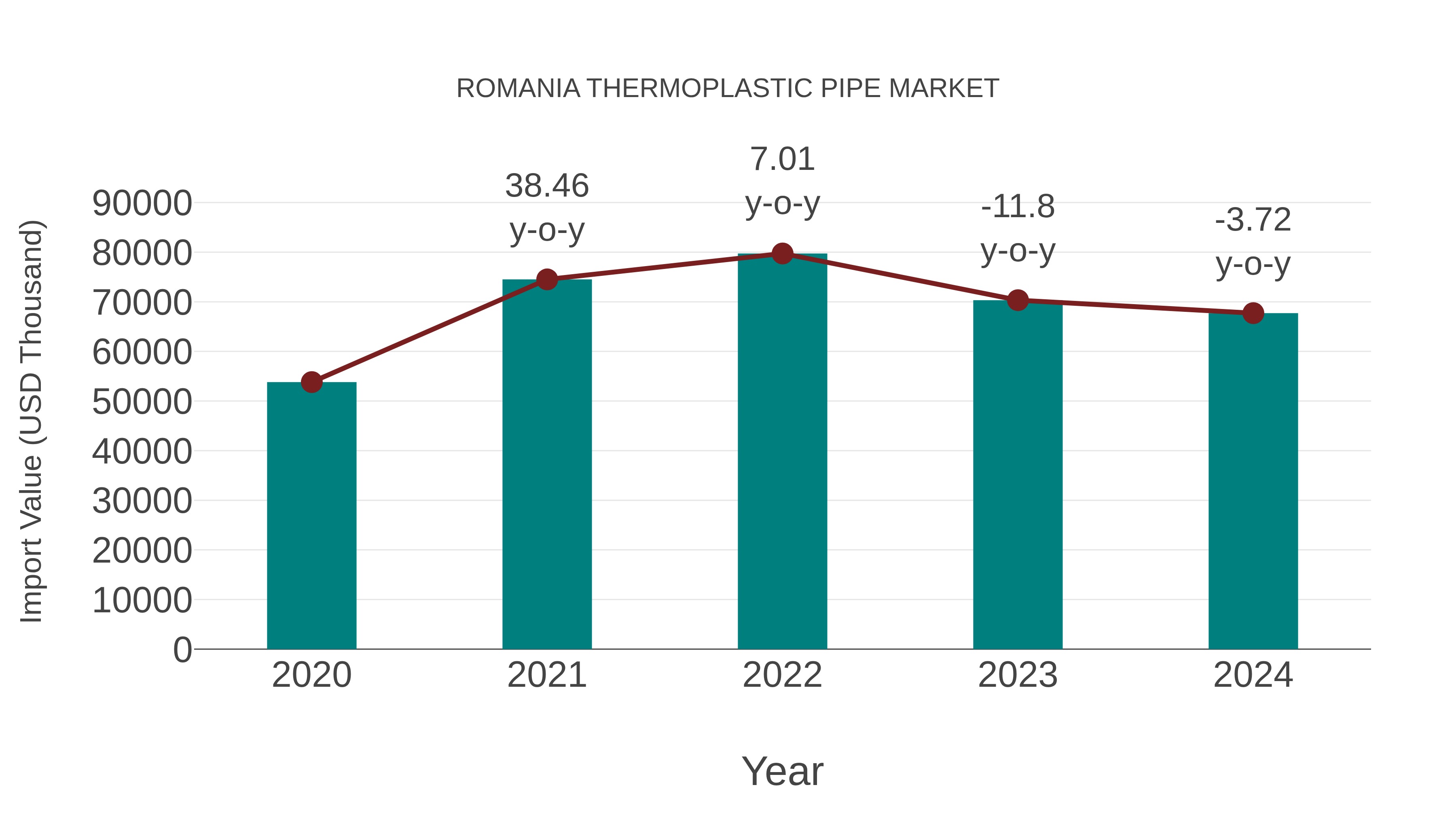
In the Romania thermoplastic pipe market, the import trend experienced a decline from 2023 to 2024, with a growth rate of -3.72%. However, the compound annual growth rate (CAGR) from 2020 to 2024 stood at 5.91%. This negative momentum in imports could be attributed to shifting demand patterns or changes in trade policies impacting market stability.
Romania Thermoplastic Pipe Market Synopsis
The Romania thermoplastic pipe market is experiencing steady growth due to factors such as increasing demand from the construction, water supply, and chemical industries. The market is driven by the advantages of thermoplastic pipes, including their lightweight nature, resistance to corrosion, and flexibility in installation. The construction sector is a key contributor to the market growth, with applications in plumbing, drainage systems, and sewage disposal. Additionally, government initiatives to improve water infrastructure and the rising awareness of the benefits of thermoplastic pipes are further propelling market expansion. Key players in the Romania thermoplastic pipe market include Pipelife Romania, Aquatherm Romania, and Wavin Romania, among others, who are continuously innovating to offer high-quality and sustainable solutions to meet the evolving needs of the market.
Romania Thermoplastic Pipe Market Trends
The Romania thermoplastic pipe market is experiencing steady growth driven by increasing investments in infrastructure projects, particularly in the construction and water management sectors. The rise in demand for thermoplastic pipes can be attributed to their advantages such as corrosion resistance, lightweight, and cost-effectiveness compared to traditional materials. Additionally, the implementation of stringent regulations regarding environmental protection and sustainability is further boosting the market for thermoplastic pipes in Romania. Opportunities in the market lie in the development of innovative products with enhanced durability and performance, as well as expanding applications in industries such as oil and gas, agriculture, and wastewater management. Collaborations with key players in the industry and strategic partnerships can also help companies capitalize on the growing demand for thermoplastic pipes in Romania.
Romania Thermoplastic Pipe Market Challenges
In the Romania Thermoplastic Pipe Market, one of the main challenges faced is the competition from traditional materials such as metal and concrete pipes. These materials have been widely used in the country for infrastructure projects, and there is often resistance to adopting thermoplastic pipes due to perceptions of lower durability and strength. Additionally, the lack of awareness and understanding among consumers and contractors about the benefits and applications of thermoplastic pipes poses a significant challenge. Furthermore, fluctuating raw material prices and regulatory uncertainties can also impact the market dynamics. Overcoming these challenges would require increased education and promotion efforts to showcase the advantages of thermoplastic pipes, as well as strategic partnerships and innovations to improve product performance and cost-effectiveness.
Romania Thermoplastic Pipe Market Investment Opportunities
The Romania thermoplastic pipe market is primarily driven by the increasing demand for durable and cost-effective piping solutions in various industries such as water and wastewater, oil and gas, and chemicals. The growing construction activities in the country, coupled with government initiatives to improve infrastructure, are also fueling the market growth. Additionally, the advantages of thermoplastic pipes, such as corrosion resistance, lightweight nature, ease of installation, and longer lifespan, are further driving their adoption in different applications. Technological advancements in thermoplastic pipe manufacturing processes, leading to the development of innovative products with enhanced performance characteristics, are expected to contribute to the market expansion in Romania. Overall, the demand for thermoplastic pipes is likely to continue rising due to their superior properties and increasing applications across various sectors in the country.
Romania Thermoplastic Pipe Market Government Polices
The Romania Thermoplastic Pipe Market is influenced by various government policies aimed at regulating the industry and promoting sustainable practices. The Romanian government has implemented regulations regarding the production, distribution, and usage of thermoplastic pipes to ensure compliance with safety and environmental standards. These policies include standards for material quality, installation procedures, and maintenance requirements to safeguard public health and the environment. Additionally, the government encourages the adoption of thermoplastic pipes through incentives such as tax breaks or subsidies for companies investing in eco-friendly technologies. Overall, the government plays a crucial role in shaping the Romania Thermoplastic Pipe Market by creating a favorable regulatory environment that promotes innovation, sustainability, and safety in the industry.
Romania Thermoplastic Pipe Market Future Outlook
The future outlook for the Romania Thermoplastic Pipe Market appears to be promising, with steady growth anticipated in the coming years. Factors such as increasing investments in infrastructure projects, rising demand for water management systems, and the growing construction industry are expected to drive the market expansion. Additionally, the focus on sustainable and efficient piping solutions is likely to boost the adoption of thermoplastic pipes, given their lightweight nature, corrosion resistance, and ease of installation. Technological advancements leading to improved product offerings and the emphasis on cost-effective solutions are also projected to contribute to the market`s growth. Overall, the Romania Thermoplastic Pipe Market is poised for positive development, offering opportunities for key players to capitalize on the evolving market trends and demands.
Key Highlights of the Report:
- Romania Thermoplastic Pipe Market Outlook
- Market Size of Romania Thermoplastic Pipe Market, 2025
- Forecast of Romania Thermoplastic Pipe Market, 2032
- Historical Data and Forecast of Romania Thermoplastic Pipe Revenues & Volume for the Period 2022 - 2032F
- Romania Thermoplastic Pipe Market Trend Evolution
- Romania Thermoplastic Pipe Market Drivers and Challenges
- Romania Thermoplastic Pipe Price Trends
- Romania Thermoplastic Pipe Porter's Five Forces
- Romania Thermoplastic Pipe Industry Life Cycle
- Historical Data and Forecast of Romania Thermoplastic Pipe Market Revenues & Volume By Product Type for the Period 2022 - 2032F
- Historical Data and Forecast of Romania Thermoplastic Pipe Market Revenues & Volume By TCP for the Period 2022 - 2032F
- Historical Data and Forecast of Romania Thermoplastic Pipe Market Revenues & Volume By RTP for the Period 2022 - 2032F
- Historical Data and Forecast of Romania Thermoplastic Pipe Market Revenues & Volume By Polymer Type for the Period 2022 - 2032F
- Historical Data and Forecast of Romania Thermoplastic Pipe Market Revenues & Volume By PE for the Period 2022 - 2032F
- Historical Data and Forecast of Romania Thermoplastic Pipe Market Revenues & Volume By PP for the Period 2022 - 2032F
- Historical Data and Forecast of Romania Thermoplastic Pipe Market Revenues & Volume By PVDF for the Period 2022 - 2032F
- Historical Data and Forecast of Romania Thermoplastic Pipe Market Revenues & Volume By PVC for the Period 2022 - 2032F
- Historical Data and Forecast of Romania Thermoplastic Pipe Market Revenues & Volume By Others for the Period 2022 - 2032F
- Historical Data and Forecast of Romania Thermoplastic Pipe Market Revenues & Volume By Application for the Period 2022 - 2032F
- Historical Data and Forecast of Romania Thermoplastic Pipe Market Revenues & Volume By Onshore for the Period 2022 - 2032F
- Historical Data and Forecast of Romania Thermoplastic Pipe Market Revenues & Volume By Offshore for the Period 2022 - 2032F
- Romania Thermoplastic Pipe Import Export Trade Statistics
- Market Opportunity Assessment By Product Type
- Market Opportunity Assessment By Polymer Type
- Market Opportunity Assessment By Application
- Romania Thermoplastic Pipe Top Companies Market Share
- Romania Thermoplastic Pipe Competitive Benchmarking By Technical and Operational Parameters
- Romania Thermoplastic Pipe Company Profiles
- Romania Thermoplastic Pipe Key Strategic Recommendations






































