Romania Whiskey Market Size (2020-2030)
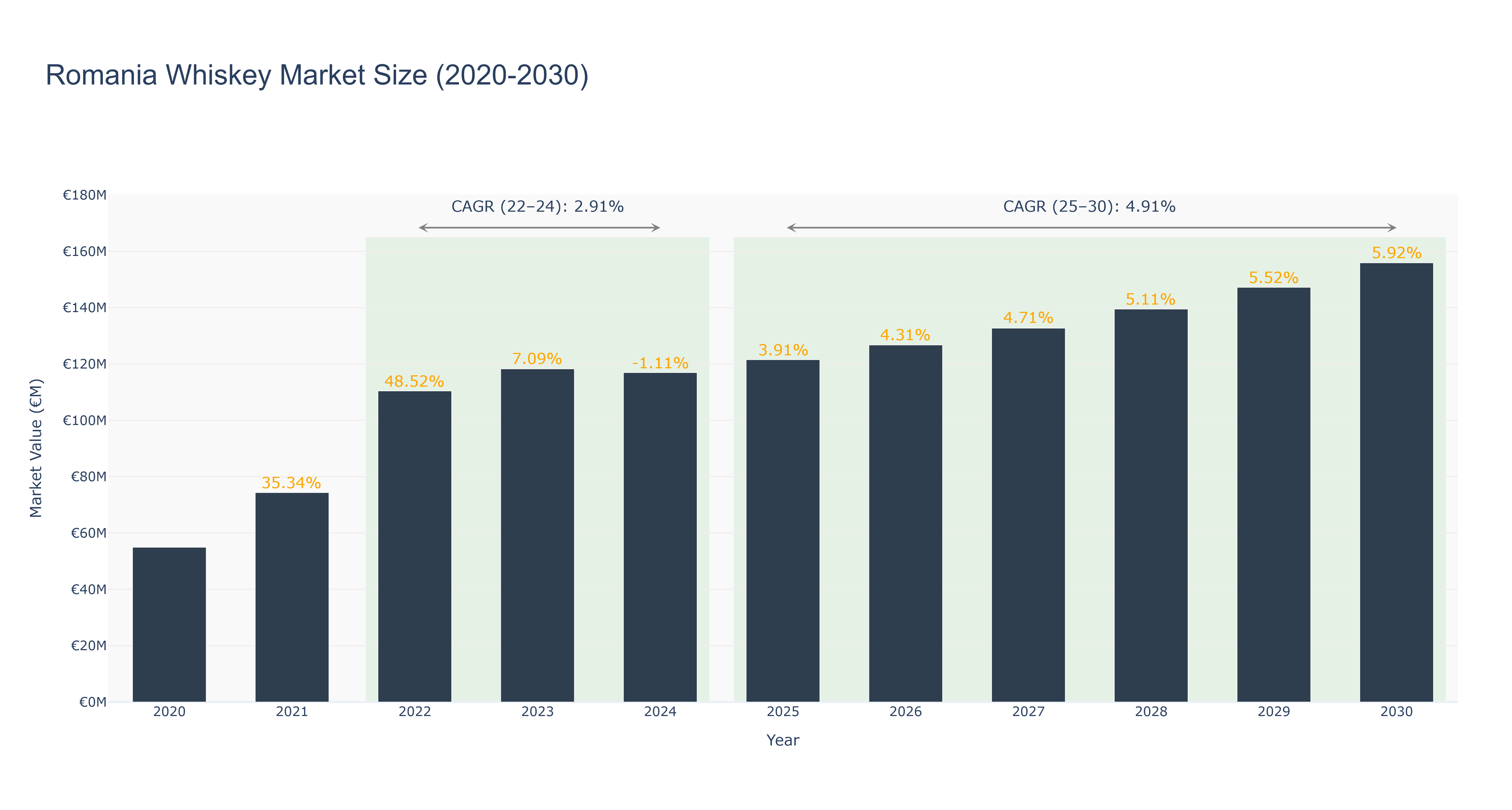
Romania Whiskey Market has shown a steady growth trajectory over the years. The peak market size of €155.92 million is forecasted for 2030, with a notable increase in market size from €54.94 million in 2020 to €121.52 million in 2025. The market experienced a slight decline in 2024 due to a temporary shift in consumer preferences but quickly rebounded. The CAGR for the period 2022-24 is 2.91%, while the CAGR for 2025-30 is projected at 4.91%. Industry drivers such as increasing disposable income and a growing appreciation for premium spirits have fueled this growth. Looking ahead, Romania is set to introduce new regulations promoting local whiskey production, attracting both domestic and international investors to capitalize on the market's potential.
Romania Whiskey Market: Production & Trade Performance (2019-2025)
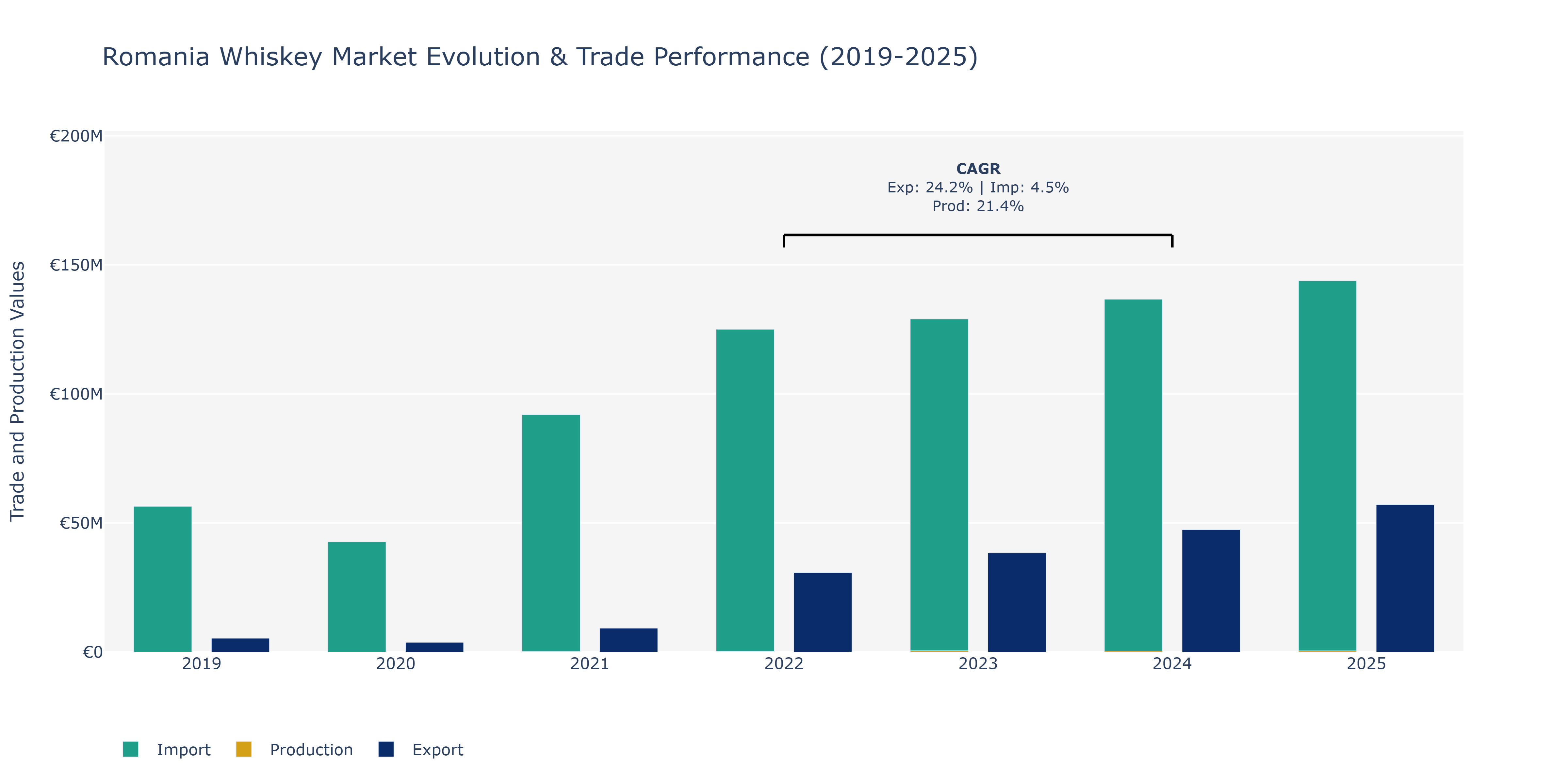
Between 2019 and 2025, Romania's Whiskey Market witnessed notable shifts in exports, imports, and production. Export value demonstrated a substantial climb from €5.39 million in 2019 to €57.2 million in 2025, indicating a consistent upward trajectory each year. Conversely, imports also saw an upward trend, rising from €56.5 million in 2019 to €143.88 million in 2025. Production volumes showed significant growth, reaching €132.68 million in 2021 and peaking at €437 million in 2025. The impressive rise in exports can be attributed to increasing demand for Romanian whiskey globally, potentially bolstered by the country's reputation for quality spirits. Import growth reflects a rising domestic market appetite for whiskey products. The surge in production aligns with the market's efforts to meet both domestic and international demand, possibly driven by enhanced production capabilities and efficiency improvements within the industry.
Romania Whiskey Market Overview
The whiskey market in Romania encompasses the production, distribution, and consumption of whiskey, a distilled alcoholic beverage made from fermented grain mash. Whiskey types include Scotch, Bourbon, Irish, and Canadian whiskey, each distinguished by specific production methods and regional characteristics. Market dynamics are influenced by consumer preferences for premium and craft spirits, evolving drinking habits, and regulatory frameworks governing alcohol production and sales. Distilleries and importers in Romania are introducing new whiskey brands, flavors, and packaging formats to attract discerning consumers and capitalize on the growing popularity of whiskey as a premium beverage choice.
Drivers of the market
The whiskey market in Romania is influenced by evolving consumer preferences, premiumization trends, and expanding beverage culture. Factors such as rising disposable incomes, urbanization, and interest in luxury spirits drive market growth. Demand for diverse whiskey varieties, including single malt, blended, and craft whiskeys, supports market expansion. Brand innovations, aging techniques, and marketing strategies cater to connoisseurship and lifestyle trends, enhancing whiskey`s market presence and consumer appeal.
Challenges of the market
The whiskey market in Romania faces challenges such as high production costs and the need for continuous innovation to keep up with evolving consumer preferences and trends. Ensuring the quality and authenticity of whiskey products is crucial for maintaining customer loyalty. Additionally, market players must navigate complex regulatory environments and ensure compliance with alcohol safety standards.
Government Policy of the market
The Romanian government supports policies for the whiskey market that focus on consumer protection, product authenticity, and alcohol regulation. Regulations govern whiskey production methods, labeling requirements, and marketing practices to ensure transparency and adherence to quality standards. The government promotes responsible consumption, enforces legal drinking age restrictions, and supports initiatives that educate consumers on whiskey appreciation and cultural heritage. Collaborative efforts with industry stakeholders aim to strengthen market integrity and promote sustainable growth in the Romanian whiskey industry.
Key Highlights of the Report:
- Romania Whiskey Market Outlook
- Market Size of Romania Whiskey Market, 2024
- Forecast of Romania Whiskey Market, 2031
- Historical Data and Forecast of Romania Whiskey Revenues & Volume for the Period 2018 - 2031
- Romania Whiskey Market Trend Evolution
- Romania Whiskey Market Drivers and Challenges
- Romania Whiskey Price Trends
- Romania Whiskey Porter's Five Forces
- Romania Whiskey Industry Life Cycle
- Historical Data and Forecast of Romania Whiskey Market Revenues & Volume By Product Type for the Period 2018 - 2031
- Historical Data and Forecast of Romania Whiskey Market Revenues & Volume By American Whisky for the Period 2018 - 2031
- Historical Data and Forecast of Romania Whiskey Market Revenues & Volume By Irish Whisky for the Period 2018 - 2031
- Historical Data and Forecast of Romania Whiskey Market Revenues & Volume By Scotch Whisky for the Period 2018 - 2031
- Historical Data and Forecast of Romania Whiskey Market Revenues & Volume By Canadian Whisky for the Period 2018 - 2031
- Historical Data and Forecast of Romania Whiskey Market Revenues & Volume By Others for the Period 2018 - 2031
- Historical Data and Forecast of Romania Whiskey Market Revenues & Volume By Distribution Channel for the Period 2018 - 2031
- Historical Data and Forecast of Romania Whiskey Market Revenues & Volume By On-trade for the Period 2018 - 2031
- Historical Data and Forecast of Romania Whiskey Market Revenues & Volume By Off-trade for the Period 2018 - 2031
- Romania Whiskey Import Export Trade Statistics
- Market Opportunity Assessment By Product Type
- Market Opportunity Assessment By Distribution Channel
- Romania Whiskey Top Companies Market Share
- Romania Whiskey Competitive Benchmarking By Technical and Operational Parameters
- Romania Whiskey Company Profiles
- Romania Whiskey Key Strategic Recommendations






































