Russia Containers as a Service Market Size & Growth Rate (2026-2032)
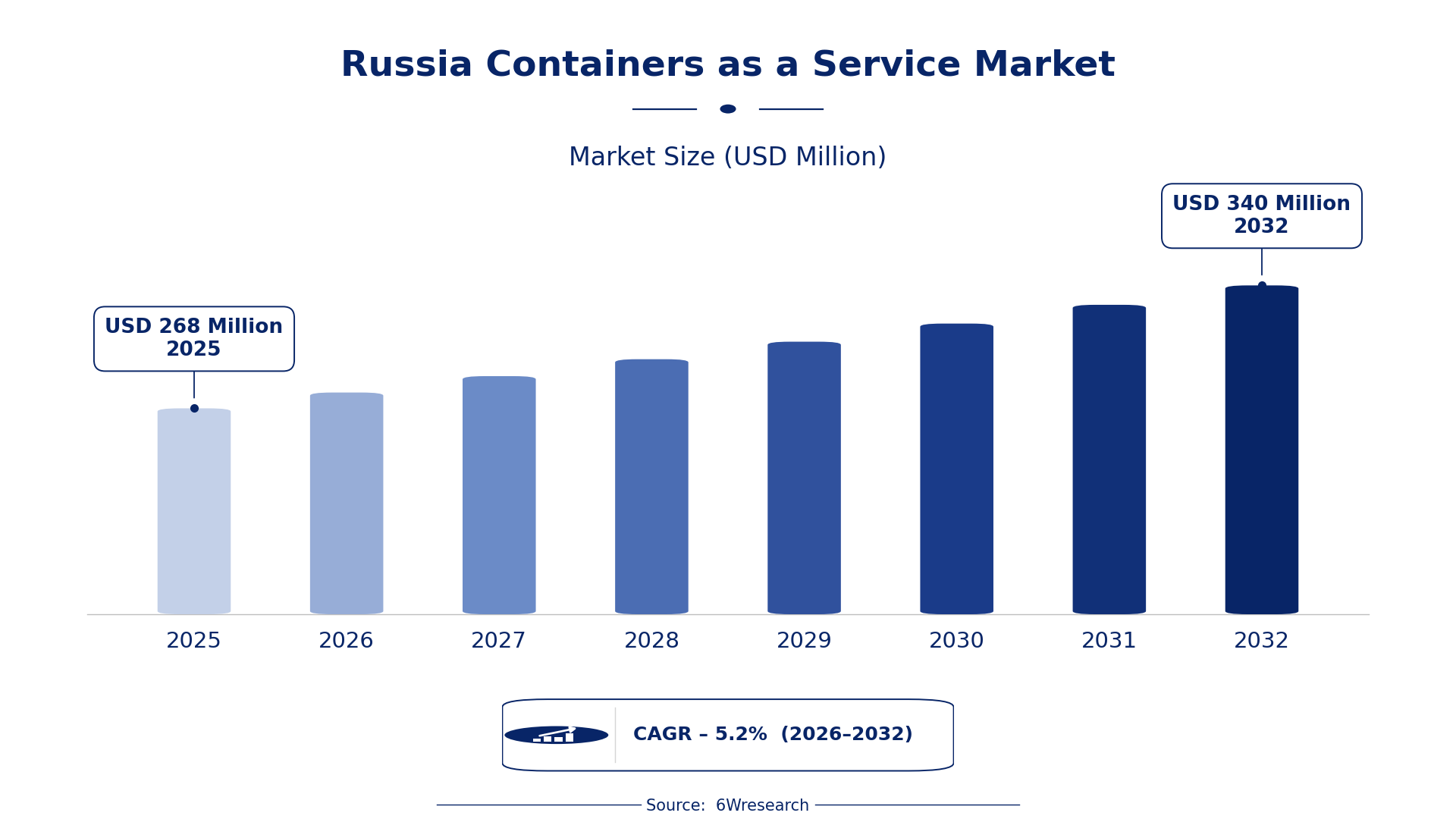
The Russia Containers as a Service Market was estimated at USD 268 Million in 2025 and is projected to reach USD 340 Million by 2032, growing at a CAGR of 5.2% from 2026 to 2032.
Russia Containers as a Service Market Synopsis
The accelerating shift towards cloud-native architectures stands out as the primary force shaping the Russia Containers as a Service Market. As organizations increasingly seek to enhance their agility and efficiency, CaaS has emerged as a vital solution, enabling seamless management of containerized applications without the burden of underlying infrastructure.
In Russia, businesses are embracing CaaS to foster innovation and improve operational efficiency. The demand for Kubernetes-based services is particularly strong, reflecting a broader trend of automation and self-service capabilities in application deployment. This trend is not just a passing phase; it's indicative of a deeper transformation in how enterprises approach technology solutions.
Russia Containers as a Service Market Year-wise Growth Rate and Key Drivers
This graph illustrates the annual growth rates of the Russia Containers as a Service Market from 2021 to 2032, highlighting a steady upward trajectory and projected expansion over the forecast period.
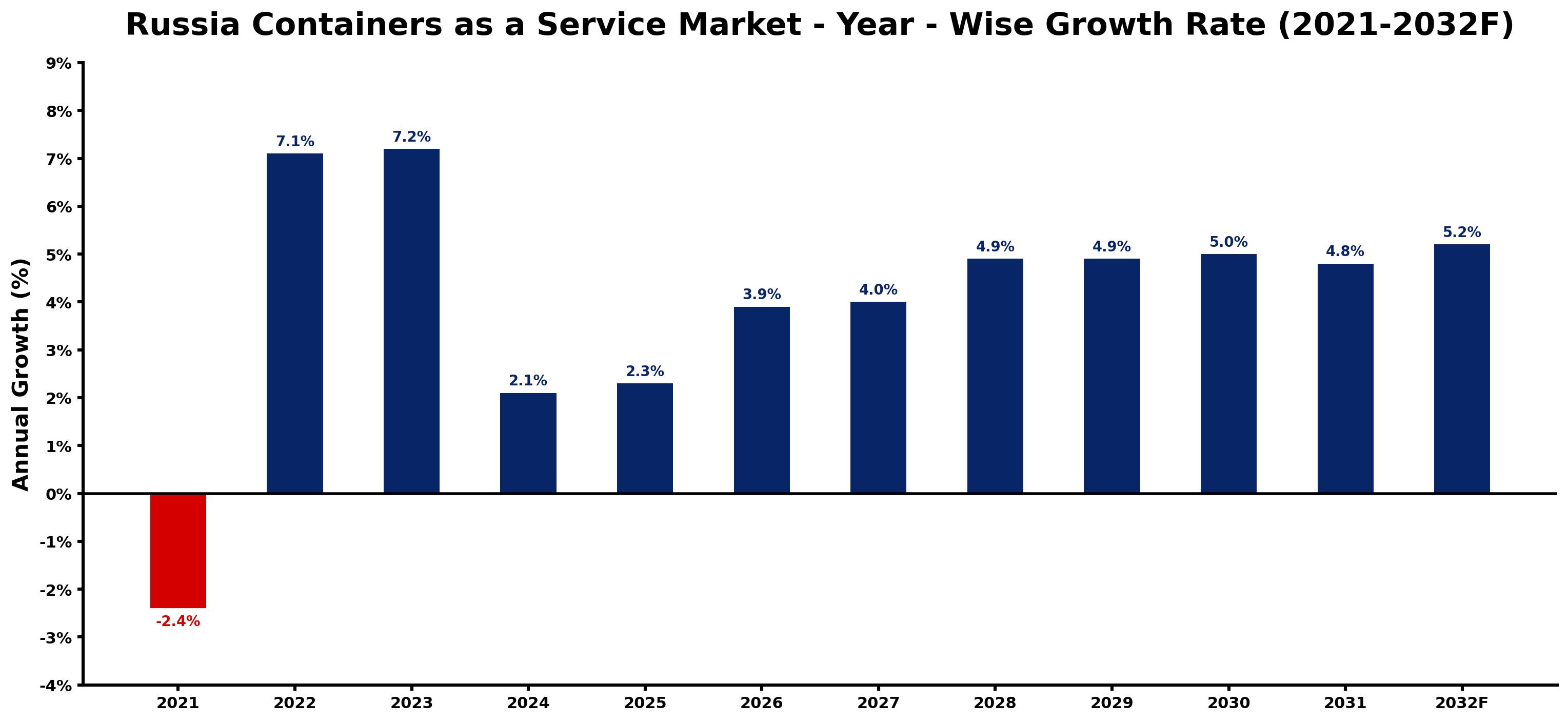
The table below presents the year‑wise growth rates along with the key drivers influencing the market
| Year | Growth Rate | Major Drivers |
| 2021 | -2.4% | Regulatory restrictions from the Federal Antimonopoly Service |
| 2022 | 7.1% | Surge in demand for cloud-native application development. |
| 2023 | 7.2% | Increased investments in local tech startups and innovations. |
| 2024 | 2.1% | Local regulatory support for digital transformation initiatives. |
| 2025 | 2.3% | Rising popularity of DevOps practices among Russian enterprises. |
| 2026 | 3.9% | Adoption of remote work solutions driving container usage. |
| 2027 | 4.0% | Government incentives for tech-driven automation strategies. |
| 2028 | 4.9% | Growth of AI adoption leading to higher service needs. |
| 2029 | 4.9% | Local enterprises shifting towards hybrid cloud solutions. |
| 2030 | 5.0% | Emergence of container orchestration platforms in Russia. |
| 2031 | 4.8% | Rising IT budget allocations enhancing service adoption. |
| 2032 | 5.2% | Increased focus on cybersecurity driving container technology use. |
Note: Market size estimations and growth projections presented in this report are based on 6Wresearch's proprietary forecasting methodology, utilizing the latest available industry data, government publications, and primary research inputs.
Russia Containers as a Service Market Key Takeaways
Below are some of the specific key takeaways from the market, including:
- The market is witnessing increased adoption of hybrid and multi-cloud strategies among enterprises.
- Automation and self-service capabilities are becoming essential features for CaaS solutions.
- Integration with existing IT infrastructure remains a key focus for organizations looking to implement CaaS.
- Local managed service providers are tailoring CaaS offerings to meet the unique demands of Russian businesses.
- Government initiatives are supporting the growth of cloud-native technologies across various sectors.
Evaluation of Restraints in Russia Containers as a Service Market
Despite the positive growth trajectory, the CaaS market in Russia faces significant restraints. A lack of awareness around the benefits of containerization hampers enterprise adoption. Additionally, the challenges of integrating CaaS with existing IT infrastructures complicate migration processes. Concerns about data residency, regulatory compliance, and the desire for local service options further influence the decision-making process for businesses considering CaaS solutions.
Russia Containers as a Service Market Trends
Several trends are shaping the demand for CaaS in Russia. The emphasis on DevOps methodologies and microservices architecture is driving the need for efficient container management solutions. Enterprises are increasingly leaning towards automated workflows, aiming to shorten application development cycles. This trend, coupled with the rising demand for Kubernetes-based managed services, underscores a significant shift towards cloud-native strategies.
Russia Containers as a Service Market Opportunities
There are abundant opportunities for growth in the Russia Containers as a Service Market. As more companies adopt hybrid cloud models, the demand for tailored CaaS solutions that facilitate smooth transitions and integrations will rise. Additionally, the push for local service providers to develop offerings that comply with regulatory frameworks presents a unique avenue for innovation and investment.
Government Initiatives in the Russia Containers as a Service Market
The Russian government is actively promoting the adoption of Containers as a Service to foster digital transformation across sectors. Public policy is increasingly focused on supporting cloud-native technologies to enhance IT agility and scalability. By encouraging local solutions, the government aims to reduce dependency on foreign providers, ensuring that domestic enterprises can thrive in a secure environment.
- A national initiative launched in early 2025 to enhance digital infrastructure includes specific provisions for CaaS adoption.
- Current efforts are underway to establish a regulatory framework that mandates transparency in cloud service billing.
- Training and certification programs to develop a skilled workforce in container management are actively being promoted.
- A planned public-private partnership is expected to focus on expanding access to CaaS solutions by 2026.
Future Insights of the Russia Containers as a Service Market
Looking ahead to 2026-2032, the Russia Containers as a Service Market is set to evolve significantly. The increasing complexity of enterprise IT environments will necessitate more sophisticated CaaS solutions. As organizations strive to improve their operational efficiencies, the integration of artificial intelligence and machine learning into container management processes is likely to emerge as a key trend. This evolution will not only enhance resource utilization but also streamline application development cycles, positioning CaaS as an indispensable tool for modern enterprises.
Russia Containers as a Service Market Latest Developments
In the past year, the Russia Containers as a Service Market has seen notable advancements, with organizations increasingly investing in cloud-native solutions. The focus on automation and integration has become more pronounced, pushing service providers to innovate rapidly. Companies are exploring partnerships to enhance their CaaS offerings and expand their service portfolios in response to growing demand.
- A major technology vendor introduced an enhanced CaaS platform in Q1 2025, improving scalability and resource management.
- An ongoing initiative to develop localized CaaS solutions began in mid-2025, aimed at addressing specific regulatory requirements.
- A new partnership between regional providers was announced in early 2025 to streamline CaaS deployment for small to medium enterprises.
- A rollout expected to start in late 2026 will introduce advanced automation features to existing CaaS platforms.
Russia Containers as a Service Market - Key Attractiveness of the Report
- 10 Years of Market Numbers
- Historical Data Starting from 2022 to 2025
- Base Year: 2025
- Forecast Data until 2032
- Key Performance Indicators Impacting the Market
- Major Upcoming Developments and Projects
Key Highlights of the Report:
- Russia Containers as a Service Market Outlook
- Market Size of Russia Containers as a Service Market, 2025
- Forecast of Russia Containers as a Service Market, 2032
- Historical Data and Forecast of Russia Containers as a Service Revenues & Volume for the Period 2022-2032F
- Russia Containers as a Service Market Trend Evolution
- Russia Containers as a Service Market Drivers and Challenges
- Russia Containers as a Service Price Trends
- Russia Containers as a Service Porter's Five Forces
- Russia Containers as a Service Industry Life Cycle
- Historical Data and Forecast of Russia Containers as a Service Market Revenues & Volume By Service Type for the Period 2022-2032F
- Historical Data and Forecast of Russia Containers as a Service Market Revenues & Volume By Management & Orchestration for the Period 2022-2032F
- Historical Data and Forecast of Russia Containers as a Service Market Revenues & Volume By Security for the Period 2022-2032F
- Historical Data and Forecast of Russia Containers as a Service Market Revenues & Volume By Monitoring and Analytics for the Period 2022-2032F
- Historical Data and Forecast of Russia Containers as a Service Market Revenues & Volume By Storage and Networking for the Period 2022-2032F
- Historical Data and Forecast of Russia Containers as a Service Market Revenues & Volume By Continuous Integration and Continuous Deployment (CI/CD) for the Period 2022-2032F
- Historical Data and Forecast of Russia Containers as a Service Market Revenues & Volume By Training and Consulting for the Period 2022-2032F
- Historical Data and Forecast of Russia Containers as a Service Market Revenues & Volume By Support and Maintenance for the Period 2022-2032F
- Historical Data and Forecast of Russia Containers as a Service Market Revenues & Volume By Deployment Model for the Period 2022-2032F
- Historical Data and Forecast of Russia Containers as a Service Market Revenues & Volume By Public Cloud for the Period 2022-2032F
- Historical Data and Forecast of Russia Containers as a Service Market Revenues & Volume By Private Cloud for the Period 2022-2032F
- Historical Data and Forecast of Russia Containers as a Service Market Revenues & Volume By Hybrid Cloud for the Period 2022-2032F
- Historical Data and Forecast of Russia Containers as a Service Market Revenues & Volume By Organization Size for the Period 2022-2032F
- Historical Data and Forecast of Russia Containers as a Service Market Revenues & Volume By Small and Medium-Sized Enterprises (SMEs) for the Period 2022-2032F
- Historical Data and Forecast of Russia Containers as a Service Market Revenues & Volume By Large Enterprises for the Period 2022-2032F
- Historical Data and Forecast of Russia Containers as a Service Market Revenues & Volume By Vertical for the Period 2022-2032F
- Historical Data and Forecast of Russia Containers as a Service Market Revenues & Volume By Retail and Consumer Goods for the Period 2022-2032F
- Historical Data and Forecast of Russia Containers as a Service Market Revenues & Volume By Manufacturing for the Period 2022-2032F
- Historical Data and Forecast of Russia Containers as a Service Market Revenues & Volume By Media, Entertainment and Gaming for the Period 2022-2032F
- Historical Data and Forecast of Russia Containers as a Service Market Revenues & Volume By IT and Telecommunications for the Period 2022-2032F
- Historical Data and Forecast of Russia Containers as a Service Market Revenues & Volume By Healthcare for the Period 2022-2032F
- Historical Data and Forecast of Russia Containers as a Service Market Revenues & Volume By BFSI for the Period 2022-2032F
- Historical Data and Forecast of Russia Containers as a Service Market Revenues & Volume By Transportation & Logistics for the Period 2022-2032F
- Russia Containers as a Service Import Export Trade Statistics
- Market Opportunity Assessment By Service Type
- Market Opportunity Assessment By Deployment Model
- Market Opportunity Assessment By Organization Size
- Market Opportunity Assessment By Vertical
- Russia Containers as a Service Top Companies Market Share
- Russia Containers as a Service Competitive Benchmarking By Technical and Operational Parameters
- Russia Containers as a Service Company Profiles
- Russia Containers as a Service Key Strategic Recommendations






































