Russia Data Classification Market Size & Growth Rate (2026-2032)
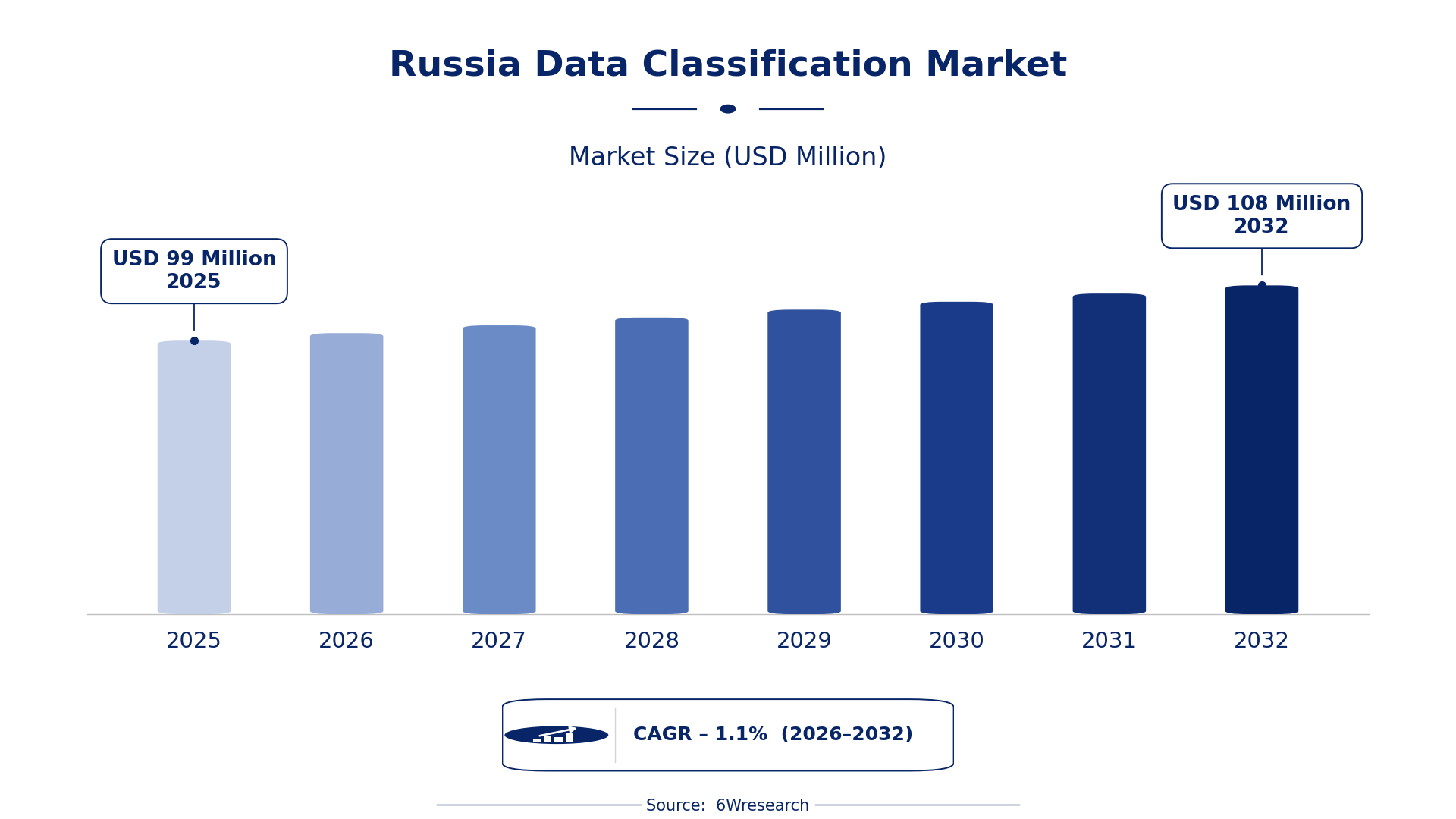
The Russia Data Classification Market was estimated at USD 99 Million in 2025 and is projected to reach USD 108 Million by 2032, growing at a CAGR of 1.1% from 2026 to 2032.
Russia Data Classification Market Synopsis
The surge in cyber threats and strict data protection laws are compelling organizations in Russia to prioritize data classification solutions. Companies recognize that effective data classification is not just about compliance; it’s a crucial strategy for safeguarding sensitive information in an increasingly digital world.
This market exhibits a diverse mix of domestic and international providers who cater to various industry needs. Advanced technologies like artificial intelligence and machine learning are being adopted to streamline data classification processes, enabling firms to better manage risks associated with data breaches.
Russia Data Classification Market Year-wise Growth Rate and Key Drivers
This graph illustrates the annual growth rates of the Russia Data Classification Market from 2021 to 2032, highlighting a steady upward trajectory and projected expansion over the forecast period.
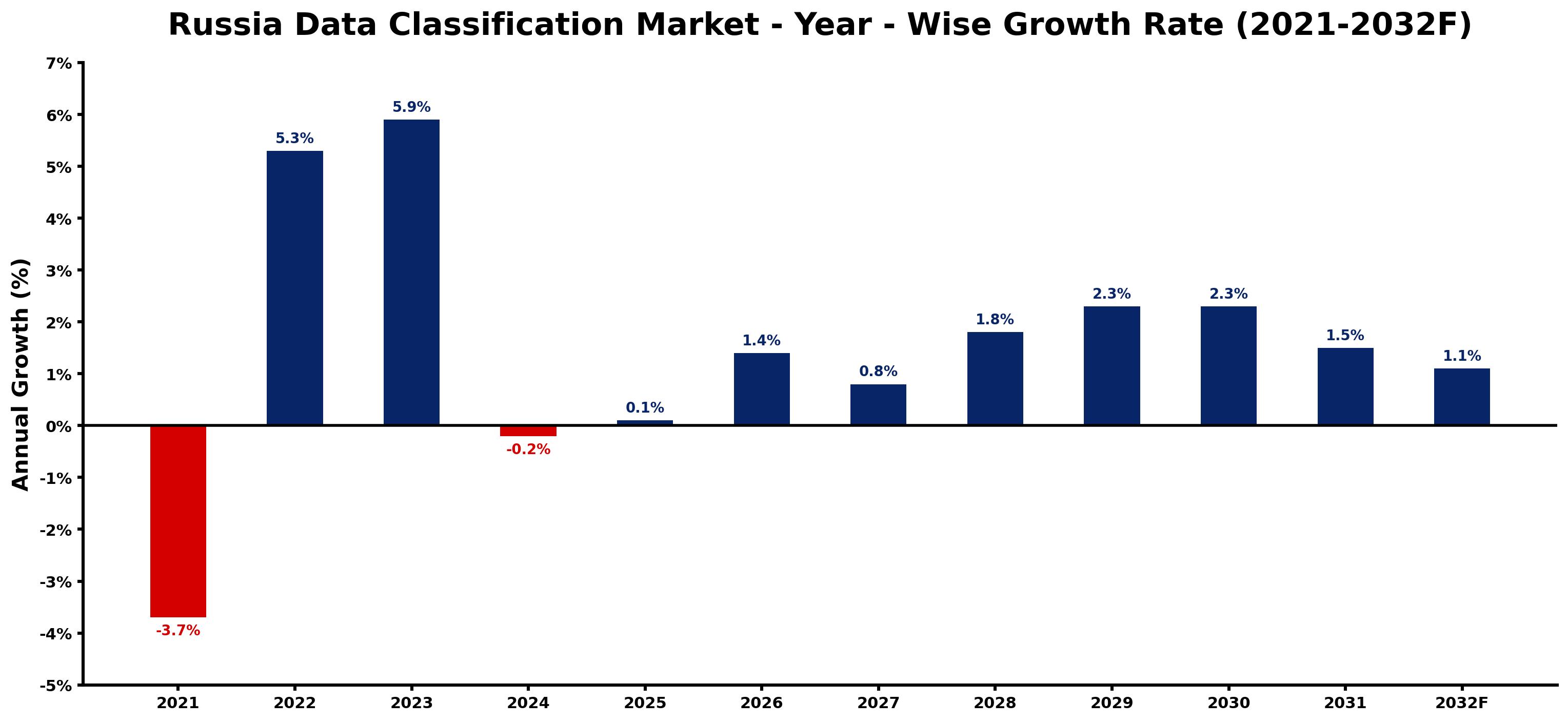
The table below presents the year‑wise growth rates along with the key drivers influencing the market
| Year | Growth Rate | Major Drivers |
| 2021 | -3.7% | Roskomnadzor's data localization policy increased compliance costs. |
| 2022 | 5.3% | Implementation of Russia's new data localization laws |
| 2023 | 5.9% | Increased demand for compliance with GDPR-like regulations |
| 2024 | -0.2% | Sanction impacts reduced investment in data infrastructure. |
| 2025 | 0.1% | Adoption of enhanced cybersecurity measures post-data breaches |
| 2026 | 1.4% | Government initiatives to bolster digital data governance |
| 2027 | 0.8% | Growing need for robust data protection in enterprises |
| 2028 | 1.8% | Rising local demand for advanced data management solutions |
| 2029 | 2.3% | Emergence of AI-driven data classification tools in market |
| 2030 | 2.3% | Regulatory updates promoting data transparency among businesses |
| 2031 | 1.5% | Shift towards cloud solutions requiring data classification |
| 2032 | 1.1% | Enhanced focus on privacy legislation compliance enforcement |
Note: Market size estimations and growth projections presented in this report are based on 6Wresearch's proprietary forecasting methodology, utilizing the latest available industry data, government publications, and primary research inputs.
Russia Data Classification Market Key Takeaways
Below are some of the specific key takeaways from the market, including:
- The increasing volume of digital data necessitates more robust data classification solutions.
- Organizations are seeking integration of classification tools with existing cybersecurity measures for enhanced protection.
- Cloud-based classification solutions are gaining popularity due to their scalability and flexibility.
- Local compliance with government regulations drives investments in data classification technologies.
- AI-driven automated solutions are transforming traditional classification methodologies.
Evaluation of Restraints in Russia Data Classification Market
Despite the opportunities, the Russia Data Classification Market faces several limitations. Strict government regulations create a challenging compliance environment that may overwhelm smaller organizations. on top of that, there is often insufficient awareness about the importance of data classification, leading to inadequate adoption of necessary technologies. These hurdles are compounded by a lack of standardized practices across industries, hindering overall market maturity.
Russia Data Classification Market Trends
Emerging trends in the Russia Data Classification Market are shifting the focus towards more sophisticated data protection solutions. The integration of artificial intelligence is facilitating automated data classification, making it possible to handle large volumes of data efficiently. Additionally, businesses are increasingly prioritizing tools that provide real-time threat detection and compliance capabilities, reflecting a heightened awareness of data privacy laws. The growing adoption of cloud-based services is also changing the game, allowing organizations to classify and protect their data dynamically.
Russia Data Classification Market Opportunities
Investment opportunities are plentiful as businesses recognize the critical nature of data classification. Companies specializing in data classification software development and cybersecurity services are well-positioned to benefit. There is also a notable demand for consulting firms that can assist organizations in navigating data governance and compliance. Partnering with local entities that prioritize enhancing their data security can yield fruitful returns in this expanding market.
Government Initiatives in the Russia Data Classification Market
Government policy plays a crucial role in shaping the dynamics of the Russia Data Classification Market. With stringent regulations mandating data localization and robust protection standards, businesses are compelled to implement effective data classification practices. This regulatory framework not only supports local technology providers but also establishes a clear compliance roadmap for all organizations handling personal data.
- A regulatory framework mandating data localization laws was introduced in 2022, requiring all personal data of Russian citizens to be stored within the country.
- Current initiatives promote domestic cybersecurity technologies, enhancing the capabilities of local data classification providers.
- Plans for a new data protection regulation are slated for introduction in 2025, which will further impact classification practices.
- A national cybersecurity strategy aimed at improving infrastructure and response capabilities is currently underway, emphasizing data classification as a critical component.
Future Insights of the Russia Data Classification Market
Looking ahead to 2026-2032, the Russia Data Classification Market is set for steady growth. As organizations increasingly recognize the importance of data governance in the face of rising cyber threats, demand for advanced classification tools will continue to escalate. on top of that, the ongoing evolution of regulatory measures will likely push businesses to invest in solutions that ensure compliance while protecting sensitive data. This progressive approach to data management will catalyze market expansion and innovation.
Russia Data Classification Market Latest Developments
In the past year, there has been significant activity in the Russia Data Classification Market as organizations ramp up their data protection strategies. Companies are actively seeking solutions that meet regulatory demands while also enhancing their cybersecurity posture. This environment has fostered a wave of innovations and collaborations aimed at improving data classification practices.
- A major technology vendor launched a new AI-driven data classification tool in Q2 2025 that promises to streamline the classification process.
- An ongoing partnership between cybersecurity firms has been established to create comprehensive data governance solutions, set to be completed by early 2026.
- A regional operator is currently testing a cloud-based data classification service with select enterprise clients, expected to expand in Q3 2026.
- A planned initiative by the government to upgrade national cybersecurity measures is scheduled for rollout in 2025, focusing heavily on data classification standards.
Russia Data Classification Market - Key Attractiveness of the Report
- 10 Years of Market Numbers
- Historical Data Starting from 2022 to 2025
- Base Year: 2025
- Forecast Data until 2032
- Key Performance Indicators Impacting the Market
- Major Upcoming Developments and Projects
Key Highlights of the Report:
- Russia Data Classification Market Outlook
- Market Size of Russia Data Classification Market, 2025
- Forecast of Russia Data Classification Market, 2032
- Historical Data and Forecast of Russia Data Classification Revenues & Volume for the Period 2022-2032F
- Russia Data Classification Market Trend Evolution
- Russia Data Classification Market Drivers and Challenges
- Russia Data Classification Price Trends
- Russia Data Classification Porter's Five Forces
- Russia Data Classification Industry Life Cycle
- Historical Data and Forecast of Russia Data Classification Market Revenues & Volume By Component for the Period 2022-2032F
- Historical Data and Forecast of Russia Data Classification Market Revenues & Volume By Solutions (Standalone and Integrated) for the Period 2022-2032F
- Historical Data and Forecast of Russia Data Classification Market Revenues & Volume By Services for the Period 2022-2032F
- Historical Data and Forecast of Russia Data Classification Market Revenues & Volume By Application for the Period 2022-2032F
- Historical Data and Forecast of Russia Data Classification Market Revenues & Volume By Access Control for the Period 2022-2032F
- Historical Data and Forecast of Russia Data Classification Market Revenues & Volume By GRC for the Period 2022-2032F
- Historical Data and Forecast of Russia Data Classification Market Revenues & Volume By Web for the Period 2022-2032F
- Historical Data and Forecast of Russia Data Classification Market Revenues & Volume By Mobile & Email Protection for the Period 2022-2032F
- Historical Data and Forecast of Russia Data Classification Market Revenues & Volume By Centralized Management for the Period 2022-2032F
- Historical Data and Forecast of Russia Data Classification Market Revenues & Volume By Methodology for the Period 2022-2032F
- Historical Data and Forecast of Russia Data Classification Market Revenues & Volume By Content-based Classification for the Period 2022-2032F
- Historical Data and Forecast of Russia Data Classification Market Revenues & Volume By Context-based Classification for the Period 2022-2032F
- Historical Data and Forecast of Russia Data Classification Market Revenues & Volume By User-based Classification for the Period 2022-2032F
- Historical Data and Forecast of Russia Data Classification Market Revenues & Volume By Vertical for the Period 2022-2032F
- Historical Data and Forecast of Russia Data Classification Market Revenues & Volume By BFSI for the Period 2022-2032F
- Historical Data and Forecast of Russia Data Classification Market Revenues & Volume By Healthcare and Lifesciences for the Period 2022-2032F
- Historical Data and Forecast of Russia Data Classification Market Revenues & Volume By Government and Defense for the Period 2022-2032F
- Historical Data and Forecast of Russia Data Classification Market Revenues & Volume By Education for the Period 2022-2032F
- Historical Data and Forecast of Russia Data Classification Market Revenues & Volume By Telecom for the Period 2022-2032F
- Historical Data and Forecast of Russia Data Classification Market Revenues & Volume By Media and Entertainment for the Period 2022-2032F
- Historical Data and Forecast of Russia Data Classification Market Revenues & Volume By Others (Retail and Ecommerce, Manufacturing, and Energy and Utilities) for the Period 2022-2032F
- Russia Data Classification Import Export Trade Statistics
- Market Opportunity Assessment By Component
- Market Opportunity Assessment By Application
- Market Opportunity Assessment By Methodology
- Market Opportunity Assessment By Vertical
- Russia Data Classification Top Companies Market Share
- Russia Data Classification Competitive Benchmarking By Technical and Operational Parameters
- Russia Data Classification Company Profiles
- Russia Data Classification Key Strategic Recommendations






































