Russia Desktop Virtualization Market Size, Share & Growth Rate
The Russia Desktop Virtualization Market was estimated at USD 143 Million in 2025 and is projected to reach USD 156 Million by 2032, growing at a CAGR of 1.3% from 2026 to 2032. This steady growth trajectory is primarily driven by enterprises increasingly adopting virtualization technologies to enhance productivity and operational efficiency. The rising trend of remote working further propels demand, as businesses seek cost-effective IT solutions that can support a flexible workforce.
Russia Desktop Virtualization Market Year-wise Growth Rate and Key Drivers
This graph highlights how the Russia Desktop Virtualization Market has steadily grown over the years, supported by major growth factors.
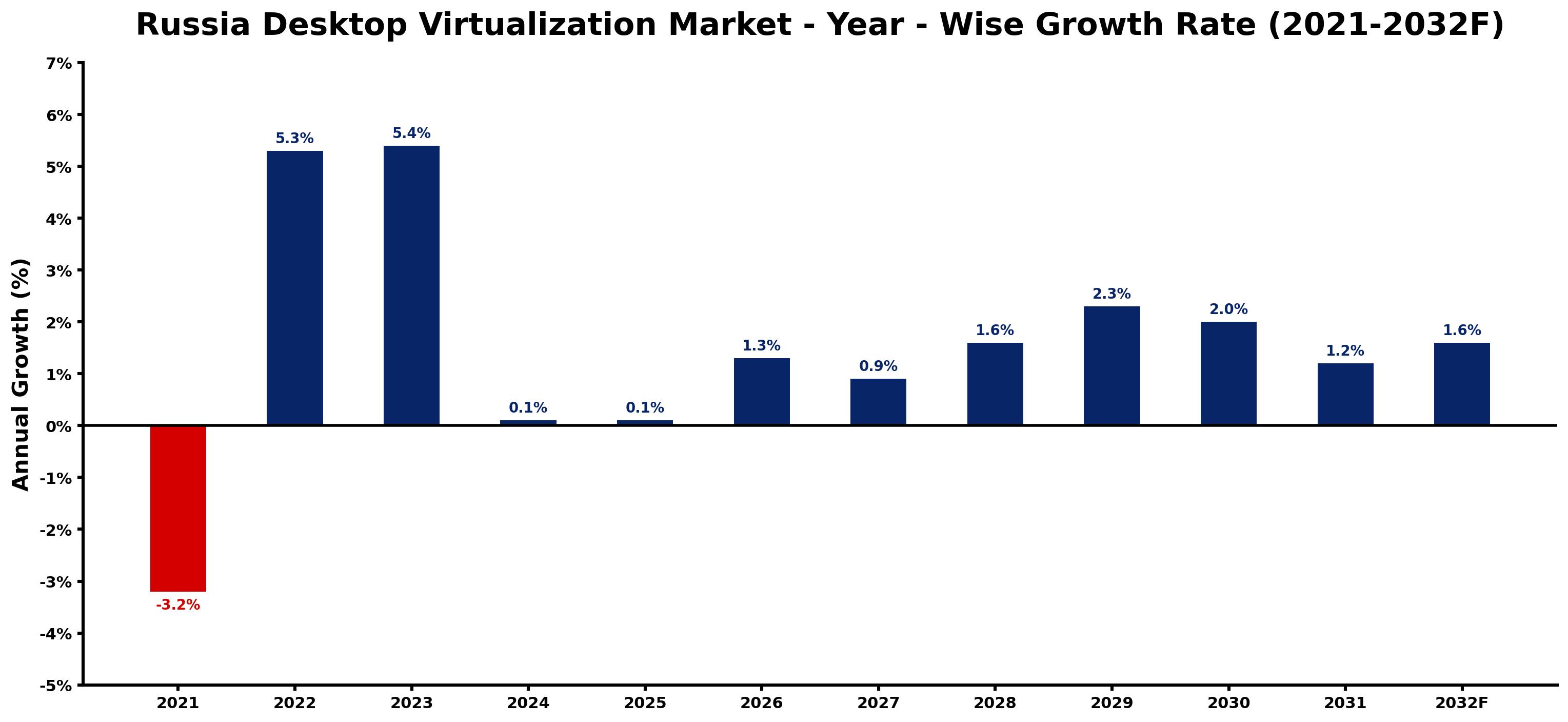
The table below presents the year‑wise growth rates along with the key drivers influencing the market
| Year | Growth Rate | Major Drivers |
| 2021 | -3.2% | Increasing adoption of advanced technologies |
| 2022 | 5.3% | Growing urbanization and commercial development |
| 2023 | 5.4% | Increasing smart city development projects |
| 2024 | 0.1% | Growing urbanization and commercial development |
| 2025 | 0.1% | Rising electricity demand across industries |
| 2026 | 1.3% | Expansion of transportation and logistics networks |
| 2027 | 0.9% | Increasing smart city development projects |
| 2028 | 1.6% | Rising electricity demand across industries |
| 2029 | 2.3% | Rising electricity demand across industries |
| 2030 | 2.0% | Expansion of manufacturing activities |
| 2031 | 1.2% | Expansion of commercial construction activities |
| 2032 | 1.6% | Increasing adoption of advanced technologies |
Note - Market size estimations and growth projections presented in this report are based on 6Wresearch's advanced forecasting approach, validated with industry datasets as of June 2026.
Russia Desktop Virtualization Market Synopsis
Recent momentum in the Russia Desktop Virtualization Market highlights a significant shift towards adopting cloud-based virtual desktop infrastructure (VDI) solutions. As organizations embrace remote working, there is a pronounced demand for secure and scalable IT environments. In contrast, the future trajectory points to continued digital transformation, where the focus on data security and integration with existing systems will redefine market offerings.
As businesses increasingly recognize the benefits of desktop virtualization—such as enhanced efficiency and workforce mobility—this market is on an upward trajectory. However, addressing concerns around data privacy and ensuring seamless integration with legacy IT systems will be critical for unlocking the full potential of virtualization technologies in Russia.
Russia Desktop Virtualization Market Key Takeaways
- The market is driven by the rising demand for flexible and cost-effective IT solutions.
- Cloud-based VDI solutions are gaining traction, reshaping how organizations approach desktop management.
- Security and data protection are becoming central to the adoption of virtualization technologies.
- The government actively supports virtualization through policies that promote digitalization.
- Investment opportunities abound in software development for tailored desktop virtualization solutions.
Evaluation of Restraints in Russia Desktop Virtualization Market
Despite the promising growth, the Russia Desktop Virtualization Market faces several restraints. Data security concerns remain paramount, particularly regarding storing sensitive information offsite, which can deter organizations from fully embracing virtualization. Additionally, potential users often lack awareness and understanding of the technology, further complicating adoption efforts. The high initial investment required for implementing desktop virtualization solutions and the intricacies involved in integrating these technologies with existing IT infrastructures add layers of complexity that hinder growth. A limited pool of skilled IT professionals proficient in managing virtual environments presents another challenge that organizations must navigate.
Russia Desktop Virtualization Market Trends
The current trends within the Russia Desktop Virtualization Market emphasize the migration towards cloud-based solutions. As organizations seek greater flexibility, the shift towards hyper-converged infrastructure (HCI) is gaining traction, allowing businesses to streamline IT operations. Additionally, an increasing focus on security and data protection is driving the adoption of VDI to safeguard sensitive information. The demand for remote desktop solutions continues to rise, fueled by the ongoing trend of remote work, highlighting the need for solutions that enhance workforce mobility while maintaining security standards.
Russia Desktop Virtualization Market Opportunities
The Russia Desktop Virtualization Market presents multiple avenues for genuine growth and investment. There is a notable surge in demand for software development focused on virtual desktop infrastructure (VDI) and desktop as a service (DaaS) offerings, catering specifically to the evolving needs of Russian businesses. Additionally, investments aimed at enhancing cybersecurity measures are crucial to ensure data protection while aligning with local regulatory compliance. This market is ripe for those who can provide innovative, secure, and user-friendly solutions tailored to the unique challenges faced by organizations in Russia.
Government Initiatives in the Russia Desktop Virtualization Market
The Russian government has actively recognized the importance of desktop virtualization technologies, implementing various policies to foster market growth. Initiatives include tax incentives for businesses investing in virtualization solutions and funding programs to facilitate VDI implementation in public institutions. There is also a strong focus on enhancing cybersecurity through the adoption of virtualized environments. These governmental actions reflect an understanding of the transformative potential of desktop virtualization in improving operational efficiency and bolstering the country's digital landscape.
Future Insights of the Russia Desktop Virtualization Market
Looking ahead to 2026-2032, the Russia Desktop Virtualization Market is poised for significant expansion. The ongoing digital transformation and increasing demand for flexible, secure IT solutions will drive this growth. As organizations continue to embrace remote working models and adopt Bring Your Own Device (BYOD) policies, the need for effective desktop virtualization solutions will become even more pronounced. With the government's continued push for digitalization and modernized IT infrastructure across industries, the market is expected to thrive, highlighting the need for innovative and adaptable virtualization technologies.
Russia Desktop Virtualization Market Latest Developments (May 2025 - June 2026)
In recent months, the Russia Desktop Virtualization Market has witnessed a flurry of activity as companies rush to adapt to evolving workforce needs. Innovations in cloud-based solutions and enhanced security measures have taken center stage, reflecting organizations' commitment to securing remote access and ensuring data integrity. Moreover, the government has continued to introduce programs aimed at accelerating the adoption of virtualization technologies in both the private and public sectors, laying a foundation for further growth in this vital area.
Russia Desktop Virtualization Market - Key Attractiveness of the Report
- 10 Years of Market Numbers
- Historical Data Starting from 2022 to 2025
- Base Year: 2025
- Forecast Data until 2032
- Key Performance Indicators Impacting the Market
- Major Upcoming Developments and Projects
Key Highlights of the Report:
- Russia Desktop Virtualization Market Outlook
- Market Size of Russia Desktop Virtualization Market, 2025
- Forecast of Russia Desktop Virtualization Market, 2032
- Historical Data and Forecast of Russia Desktop Virtualization Revenues & Volume for the Period 2022-2032F
- Russia Desktop Virtualization Market Trend Evolution
- Russia Desktop Virtualization Market Drivers and Challenges
- Russia Desktop Virtualization Price Trends
- Russia Desktop Virtualization Porter's Five Forces
- Russia Desktop Virtualization Industry Life Cycle
- Historical Data and Forecast of Russia Desktop Virtualization Market Revenues & Volume By Desktop Delivery Platform for the Period 2022-2032F
- Historical Data and Forecast of Russia Desktop Virtualization Market Revenues & Volume By Hosted Virtual Desktop (HVD) for the Period 2022-2032F
- Historical Data and Forecast of Russia Desktop Virtualization Market Revenues & Volume By Hosted Shared Desktop (HSD) for the Period 2022-2032F
- Historical Data and Forecast of Russia Desktop Virtualization Market Revenues & Volume By Other Desktop Delivery Platforms for the Period 2022-2032F
- Historical Data and Forecast of Russia Desktop Virtualization Market Revenues & Volume By Deployment Mode for the Period 2022-2032F
- Historical Data and Forecast of Russia Desktop Virtualization Market Revenues & Volume By On-premise for the Period 2022-2032F
- Historical Data and Forecast of Russia Desktop Virtualization Market Revenues & Volume By Cloud-Based for the Period 2022-2032F
- Historical Data and Forecast of Russia Desktop Virtualization Market Revenues & Volume By End-users for the Period 2022-2032F
- Historical Data and Forecast of Russia Desktop Virtualization Market Revenues & Volume By Financial Services for the Period 2022-2032F
- Historical Data and Forecast of Russia Desktop Virtualization Market Revenues & Volume By Healthcare for the Period 2022-2032F
- Historical Data and Forecast of Russia Desktop Virtualization Market Revenues & Volume By Manufacturing for the Period 2022-2032F
- Historical Data and Forecast of Russia Desktop Virtualization Market Revenues & Volume By IT and Telecommunications for the Period 2022-2032F
- Historical Data and Forecast of Russia Desktop Virtualization Market Revenues & Volume By Other End-user Verticals for the Period 2022-2032F
- Russia Desktop Virtualization Import Export Trade Statistics
- Market Opportunity Assessment By Desktop Delivery Platform
- Market Opportunity Assessment By Deployment Mode
- Market Opportunity Assessment By End-users
- Russia Desktop Virtualization Top Companies Market Share
- Russia Desktop Virtualization Competitive Benchmarking By Technical and Operational Parameters
- Russia Desktop Virtualization Company Profiles
- Russia Desktop Virtualization Key Strategic Recommendations






































