Russia Digital Market Size & Growth Rate (2026-2032)
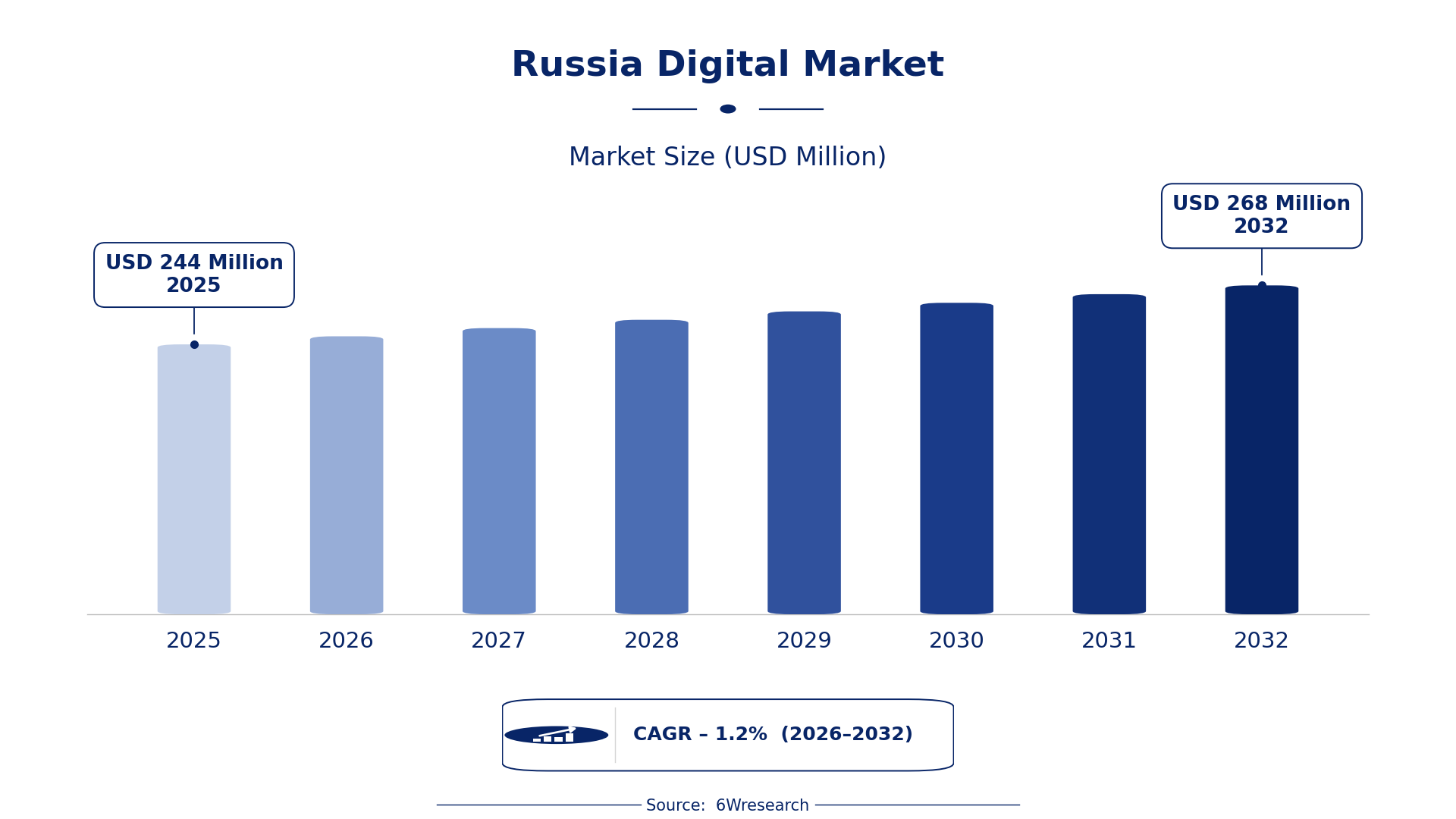
The Russia Digital Market was estimated at USD 244 Million in 2025 and is projected to reach USD 268 Million by 2032, growing at a CAGR of 1.2% from 2026 to 2032.
Russia Digital Market Synopsis
With a population of over 140 million, Russia offers a vast pool of potential consumers for digital businesses. The rapid adoption of mobile internet and e-commerce has reshaped consumer behavior, driving an increasing number of Russians to shop online and engage with digital content.
E-commerce stands out as a key growth engine, with platforms increasingly catering to the demand for convenience and variety. Social media continues to be a major channel for interaction and marketing, while the push for cybersecurity measures underlines the evolving nature of the digital environment in Russia.
Russia Digital Market Year-wise Growth Rate and Key Drivers
This graph illustrates the annual growth rates of the Russia Digital Market from 2021 to 2032, highlighting a steady upward trajectory and projected expansion over the forecast period.
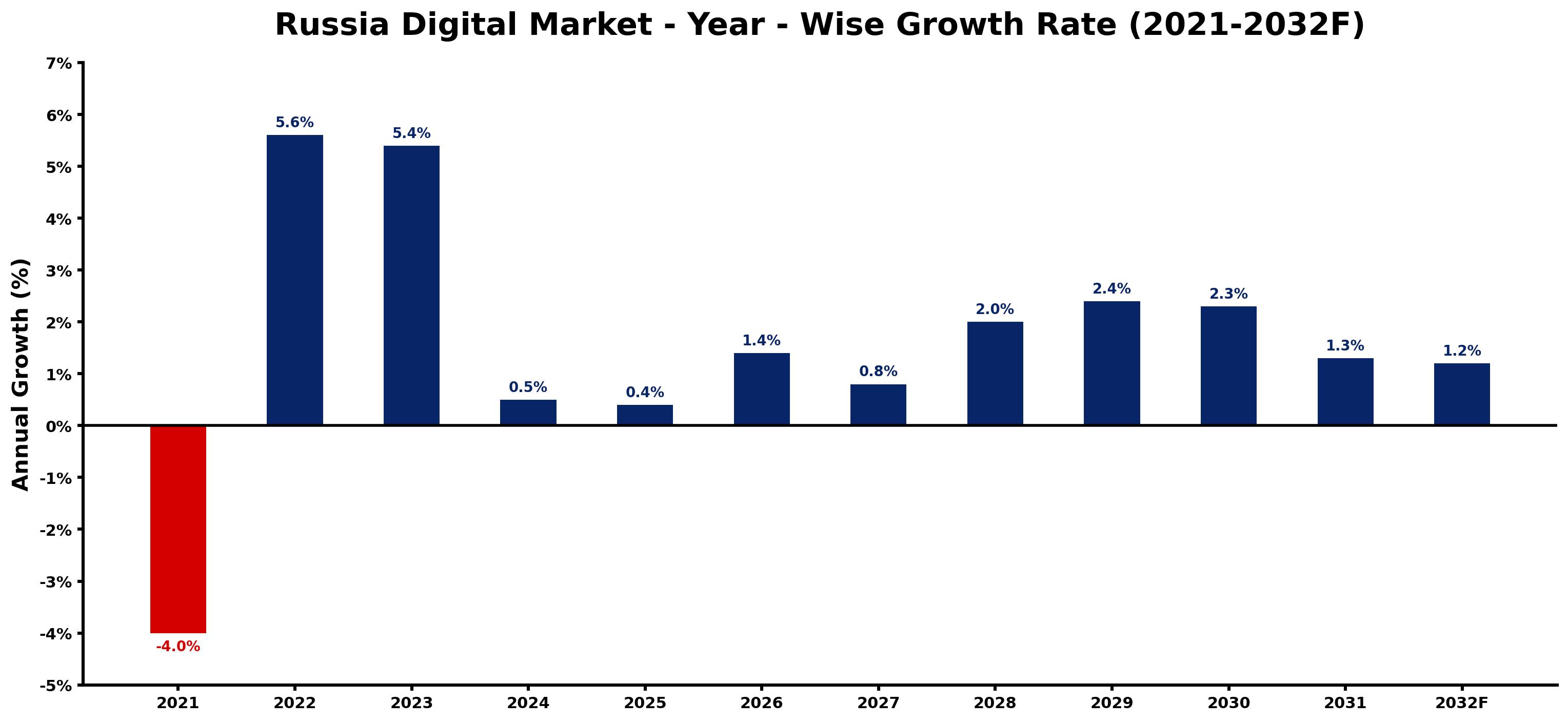
The table below presents the year‑wise growth rates along with the key drivers influencing the market
| Year | Growth Rate | Major Drivers |
| 2021 | -4.0% | New data privacy laws hindered online business expansion. |
| 2022 | 5.6% | Increased demand for remote work technologies post-pandemic |
| 2023 | 5.4% | Growth of local e-commerce platforms like Ozon and Wildberries |
| 2024 | 0.5% | Government support for digitalization in SMEs through grants |
| 2025 | 0.4% | Rising internet penetration in rural regions boosting online services |
| 2026 | 1.4% | Increase in digital payments adoption following new regulations |
| 2027 | 0.8% | Growing online education sector amid changing workforce needs |
| 2028 | 2.0% | Local startups innovating in fintech and digital health sectors |
| 2029 | 2.4% | Investment in cybersecurity solutions driven by heightened risks |
| 2030 | 2.3% | Demand for digital media content surging among youth demographics |
| 2031 | 1.3% | Emergence of AI-driven solutions in customer service industries |
| 2032 | 1.2% | Accelerated digital transformation initiatives fueled by government policies |
Note: Market size estimations and growth projections presented in this report are based on 6Wresearch's proprietary forecasting methodology, utilizing the latest available industry data, government publications, and primary research inputs.
Russia Digital Market Key Takeaways
Below are some of the specific key takeaways from the market, including:
- The digital market is expanding rapidly, driven by increased internet penetration and mobile usage.
- E-commerce is a primary growth driver, with online shopping becoming more prevalent among consumers.
- Social media platforms like VKontakte are essential for marketing and customer engagement.
- Investment opportunities exist in fintech, digital advertising, and software development.
- Government regulations pose both challenges and frameworks for growth within the market.
Evaluation of Restraints in Russia Digital Market
The Russian digital market is hindered by a complex regulatory environment that imposes restrictions on data handling and online content. The Data Localization Law mandates that all user data be stored within the country, complicating operations for foreign firms. Additionally, the political landscape often introduces uncertainty, creating an environment that can be unpredictable for investors. Cybersecurity threats and issues related to online fraud further challenge businesses striving for growth in this market.
Russia Digital Market Trends
The shift toward e-commerce continues to gain momentum as consumers increasingly favor online shopping for its convenience. Social media usage is expanding, with platforms serving as vital hubs for communication and advertising. Mobile internet access is rising rapidly, pushing demand for mobile applications and advertising solutions. Companies are reallocating marketing budgets towards digital platforms, reflecting a broader shift in advertising strategies. As digital transactions become commonplace, there is a growing emphasis on data privacy and cybersecurity measures.
Russia Digital Market Opportunities
The e-commerce sector presents substantial investment opportunities, particularly in online retail platforms that cater to diverse consumer needs. Additionally, the fintech market is witnessing significant growth, driven by innovations in digital payments and financial services. Software development also shows promise, especially in areas like cybersecurity and data analytics, as local IT firms gain recognition for their expertise. Companies that can navigate cultural nuances and adapt to local preferences will find fertile ground for expansion.
Government Initiatives in the Russia Digital Market
Government policy plays a crucial role in shaping the dynamics of the Russia Digital Market. Recent initiatives focus on enhancing digital infrastructure and ensuring data security while promoting the growth of domestic companies. Understanding these policies is essential for businesses aiming to succeed in this environment.
- A national digital infrastructure upgrade programme is currently underway to improve connectivity across urban and rural areas.
- In 2023, a regulatory framework mandating billing transparency for digital services was introduced to protect consumers.
- Currently, the government is implementing a cybersecurity enhancement initiative that focuses on securing online transactions.
- There are plans for a public-private partnership aimed at expanding access to high-speed internet by 2028.
- A recently completed project involved launching a national campaign to promote digital literacy among citizens.
Future Insights of the Russia Digital Market
Looking ahead to 2026-2032, the Russia Digital Market is expected to continue its upward trajectory. With a growing tech-savvy population and increasing mobile penetration, demand for online services will expand. Government initiatives aimed at digital transformation will likely drive innovation and investment. However, businesses must remain vigilant regarding regulatory challenges and cybersecurity threats that could influence growth patterns.
Russia Digital Market Latest Developments
Recent months have witnessed significant activity in the Russia Digital Market, with various companies and government initiatives pushing for advancements in technology and infrastructure. The emphasis on digital transformation continues to shape the competitive environment, leading to new offerings and partnerships.
- A major technology vendor launched a new digital payment platform in early 2023, aimed at enhancing transaction security and user experience.
- A leading regional operator is currently upgrading its mobile network infrastructure to support 5G services, expected to enhance connectivity by late 2024.
- A public initiative to increase digital literacy among school children began in Q1 2023 and remains ongoing.
- Upcoming plans include a nationwide rollout of a digital health platform, set to begin in mid-2025, focusing on telemedicine and remote consultations.
- A recent partnership between several e-commerce firms aims to streamline logistics and delivery processes, enhancing customer satisfaction, with implementation underway.
Russia Digital Market - Key Attractiveness of the Report
- 10 Years of Market Numbers
- Historical Data Starting from 2022 to 2025
- Base Year: 2025
- Forecast Data until 2032
- Key Performance Indicators Impacting the Market
- Major Upcoming Developments and Projects
Key Highlights of the Report:
- Russia Digital Market Outlook
- Market Size of Russia Digital Market, 2025
- Forecast of Russia Digital Market, 2032
- Historical Data and Forecast of Russia Digital Revenues & Volume for the Period 2022-2032F
- Russia Digital Market Trend Evolution
- Russia Digital Market Drivers and Challenges
- Russia Digital Price Trends
- Russia Digital Porter's Five Forces
- Russia Digital Industry Life Cycle
- Historical Data and Forecast of Russia Digital Market Revenues & Volume By Software for the Period 2022-2032F
- Historical Data and Forecast of Russia Digital Market Revenues & Volume By CRM Software for the Period 2022-2032F
- Historical Data and Forecast of Russia Digital Market Revenues & Volume By Email Marketing Software for the Period 2022-2032F
- Historical Data and Forecast of Russia Digital Market Revenues & Volume By Social Media Advertising for the Period 2022-2032F
- Russia Digital Import Export Trade Statistics
- Market Opportunity Assessment By Software
- Russia Digital Top Companies Market Share
- Russia Digital Competitive Benchmarking By Technical and Operational Parameters
- Russia Digital Company Profiles
- Russia Digital Key Strategic Recommendations






































