Russia Field Force Automation Market Size & Growth Rate (2026-2032)
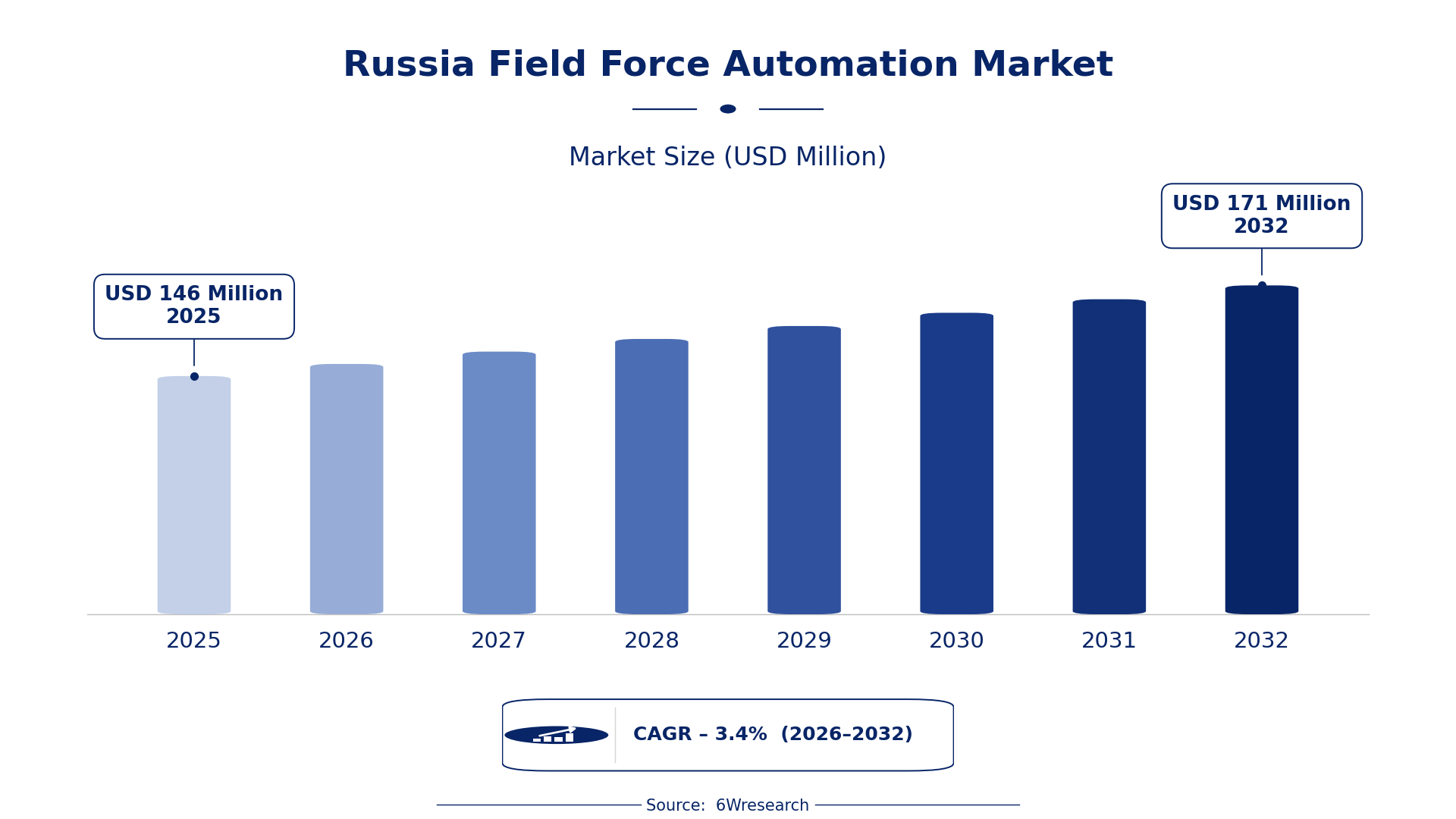
The Russia Field Force Automation Market was estimated at USD 146 Million in 2025 and is projected to reach USD 171 Million by 2032, growing at a CAGR of 3.4% from 2026 to 2032.
Russia Field Force Automation Market Synopsis
The demand for real-time data access in various sectors is driving the growth of the Russia Field Force Automation market. As industries such as manufacturing and retail increasingly adopt digital tools, businesses are recognizing the need to enhance operational efficiency and optimize workforce management.
Cloud-based solutions and mobile applications are becoming essential for streamlining field operations. Companies are now prioritizing IoT integration, predictive maintenance, and AI-driven analytics, pushing the boundaries of what field force automation can achieve.
Russia Field Force Automation Market Year-wise Growth Rate and Key Drivers
This graph illustrates the annual growth rates of the Russia Field Force Automation Market from 2021 to 2032, highlighting a steady upward trajectory and projected expansion over the forecast period.
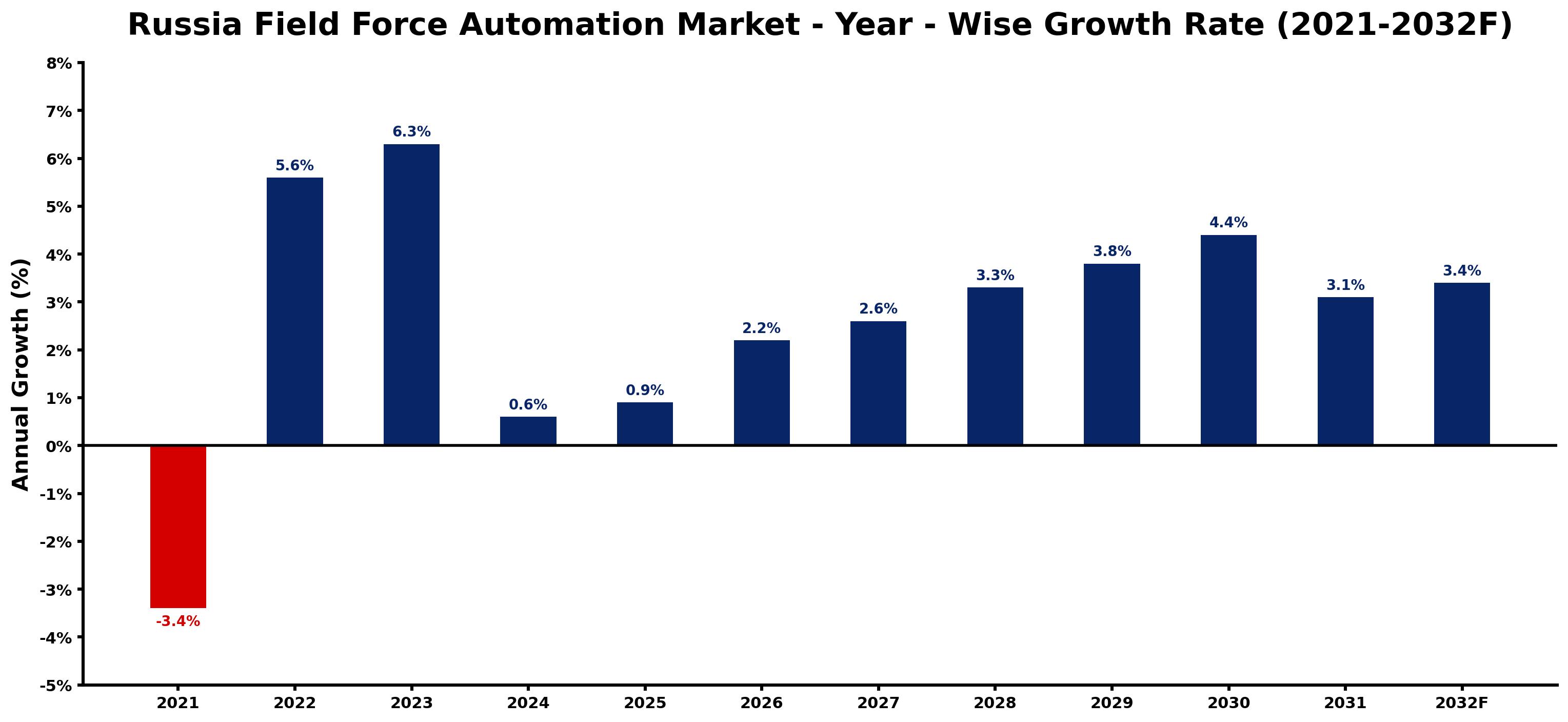
The table below presents the year‑wise growth rates along with the key drivers influencing the market
| Year | Growth Rate | Major Drivers |
| 2021 | -3.4% | Russian sanctions limit foreign technology investments. |
| 2022 | 5.6% | Increased investment in retail optimization technologies across Russia. |
| 2023 | 6.3% | Growth in e-commerce boosting need for field automation. |
| 2024 | 0.6% | Adoption of SaaS solutions by local distribution firms. |
| 2025 | 0.9% | Surge in on-demand delivery services requiring automation. |
| 2026 | 2.2% | Implementation of AI-driven analytics for sales processes. |
| 2027 | 2.6% | Government support for technology integration in agriculture. |
| 2028 | 3.3% | Youth employment rise driving adoption of digital tools. |
| 2029 | 3.8% | Retailers enhancing operational efficiency with automated workflows. |
| 2030 | 4.4% | Shift towards omnichannel retail strategies demanding automation. |
| 2031 | 3.1% | Emergence of mobile workforce solutions for sales teams. |
| 2032 | 3.4% | Investment in supply chain digitalization amid economic shifts. |
Note: Market size estimations and growth projections presented in this report are based on 6Wresearch's proprietary forecasting methodology, utilizing the latest available industry data, government publications, and primary research inputs.
Russia Field Force Automation Market Key Takeaways
Below are some of the specific key takeaways from the market, including:
- Increasing adoption of mobile workforce management solutions is reshaping operational strategies.
- Cloud-based platforms are enhancing communication between field staff and headquarters.
- Integration of advanced technologies like AI and IoT is driving predictive capabilities and efficiency.
- Customization and user-friendliness of solutions are gaining importance across diverse industries.
- The market is set for growth, driven by digital transformation initiatives across sectors.
Evaluation of Restraints in Russia Field Force Automation Market
While the Russia Field Force Automation market shows promise, several restraints are limiting its full potential. The strict regulatory environment concerning data privacy presents a challenge for companies aiming to implement effective automation solutions. Additionally, cultural factors, such as language barriers, can hinder the adoption of technology. The country’s vast geographical diversity leads to varying levels of technological infrastructure, complicating connectivity and real-time data access across regions.
Russia Field Force Automation Market Trends
Current trends in the Russia Field Force Automation market indicate a strong shift toward mobile and cloud-based solutions. Businesses are increasingly looking for tools that offer real-time data analytics and improved resource management. The integration of machine learning for route optimization and predictive maintenance is gaining traction, helping companies respond proactively to operational challenges. on top of that, user-centric design is becoming a priority, as organizations seek to cater to the specific needs of their workforce.
Russia Field Force Automation Market Opportunities
Investment opportunities within the Russia Field Force Automation market are robust. Key areas include mobile workforce management software and field service management applications. Industries such as logistics, healthcare, and utilities are particularly ripe for adopting automation solutions that enhance operational efficiency and reduce costs. Companies looking to invest in this market should focus on technology providers that emphasize innovation and customization, addressing the unique needs of Russian enterprises.
Government Initiatives in the Russia Field Force Automation Market
Government policy plays a crucial role in shaping the Russia Field Force Automation market. A focus on enhancing operational efficiency through technology has led to supportive regulatory measures. By funding research and development, the government is incentivizing businesses to invest in advanced automation solutions. These initiatives are essential for promoting digital transformation across various sectors.
- A national digital infrastructure upgrade programme that commenced in early 2025 aims to improve connectivity for field operations.
- Currently underway is a framework established in 2025 mandating compliance with data security and privacy regulations for technology providers.
- A public-private partnership initiated in mid-2026 is expected to enhance the capabilities of telecommunications infrastructure in rural areas.
- A planned incentive programme for 2028 encourages businesses to adopt IoT technologies for workforce optimization.
Future Insights of the Russia Field Force Automation Market
Looking ahead, the Russia Field Force Automation market is set to experience notable advancements. The increasing demand for real-time data analytics and enhanced communication tools will continue to drive growth. As more industries embrace digital transformation, technology solutions that offer customization and integration with existing systems will become crucial. The influence of mobile devices and IoT will likely reshape operational practices, leading to more efficient workforce management strategies.
Russia Field Force Automation Market Latest Developments
Recent months have witnessed dynamic activity in the Russia Field Force Automation market, reflecting a keen interest in digital transformation. Companies are actively seeking innovative solutions to enhance their field operations, with a strong emphasis on integrating advanced technologies.
- A leading regional operator launched a new mobile workforce management application in early 2025, aimed at improving operational efficiency.
- Currently, a technology vendor is implementing AI-powered analytics capabilities for predictive maintenance, enhancing service delivery across several sectors.
- An upcoming rollout expected to begin in Q3 2026 will introduce advanced IoT integration in field force automation solutions.
- A collaborative initiative initiated in late 2025 is focusing on developing customized solutions for the healthcare sector, emphasizing real-time data access.
Russia Field Force Automation Market - Key Attractiveness of the Report
- 10 Years of Market Numbers
- Historical Data Starting from 2022 to 2025
- Base Year: 2025
- Forecast Data until 2032
- Key Performance Indicators Impacting the Market
- Major Upcoming Developments and Projects
Key Highlights of the Report:
- Russia Field Force Automation Market Outlook
- Market Size of Russia Field Force Automation Market, 2025
- Forecast of Russia Field Force Automation Market, 2032
- Historical Data and Forecast of Russia Field Force Automation Revenues & Volume for the Period 2022-2032F
- Russia Field Force Automation Market Trend Evolution
- Russia Field Force Automation Market Drivers and Challenges
- Russia Field Force Automation Price Trends
- Russia Field Force Automation Porter's Five Forces
- Russia Field Force Automation Industry Life Cycle
- Historical Data and Forecast of Russia Field Force Automation Market Revenues & Volume By Component for the Period 2022-2032F
- Historical Data and Forecast of Russia Field Force Automation Market Revenues & Volume By Solution for the Period 2022-2032F
- Historical Data and Forecast of Russia Field Force Automation Market Revenues & Volume By Services for the Period 2022-2032F
- Historical Data and Forecast of Russia Field Force Automation Market Revenues & Volume By Industry for the Period 2022-2032F
- Historical Data and Forecast of Russia Field Force Automation Market Revenues & Volume By IT and Telecom for the Period 2022-2032F
- Historical Data and Forecast of Russia Field Force Automation Market Revenues & Volume By Healthcare and Life Sciences for the Period 2022-2032F
- Historical Data and Forecast of Russia Field Force Automation Market Revenues & Volume By Manufacturing for the Period 2022-2032F
- Historical Data and Forecast of Russia Field Force Automation Market Revenues & Volume By Transportation and Logistics for the Period 2022-2032F
- Historical Data and Forecast of Russia Field Force Automation Market Revenues & Volume By Construction and Real Estate for the Period 2022-2032F
- Historical Data and Forecast of Russia Field Force Automation Market Revenues & Volume By Energy and Utilities for the Period 2022-2032F
- Historical Data and Forecast of Russia Field Force Automation Market Revenues & Volume By Others for the Period 2022-2032F
- Historical Data and Forecast of Russia Field Force Automation Market Revenues & Volume By Deployment Type for the Period 2022-2032F
- Historical Data and Forecast of Russia Field Force Automation Market Revenues & Volume By On-Premises for the Period 2022-2032F
- Historical Data and Forecast of Russia Field Force Automation Market Revenues & Volume By Cloud for the Period 2022-2032F
- Historical Data and Forecast of Russia Field Force Automation Market Revenues & Volume By Organization Size for the Period 2022-2032F
- Historical Data and Forecast of Russia Field Force Automation Market Revenues & Volume By SMEs for the Period 2022-2032F
- Historical Data and Forecast of Russia Field Force Automation Market Revenues & Volume By Large Enterprises for the Period 2022-2032F
- Russia Field Force Automation Import Export Trade Statistics
- Market Opportunity Assessment By Component
- Market Opportunity Assessment By Industry
- Market Opportunity Assessment By Deployment Type
- Market Opportunity Assessment By Organization Size
- Russia Field Force Automation Top Companies Market Share
- Russia Field Force Automation Competitive Benchmarking By Technical and Operational Parameters
- Russia Field Force Automation Company Profiles
- Russia Field Force Automation Key Strategic Recommendations































