Russia IoT Market Size & Growth Rate (2026-2032)
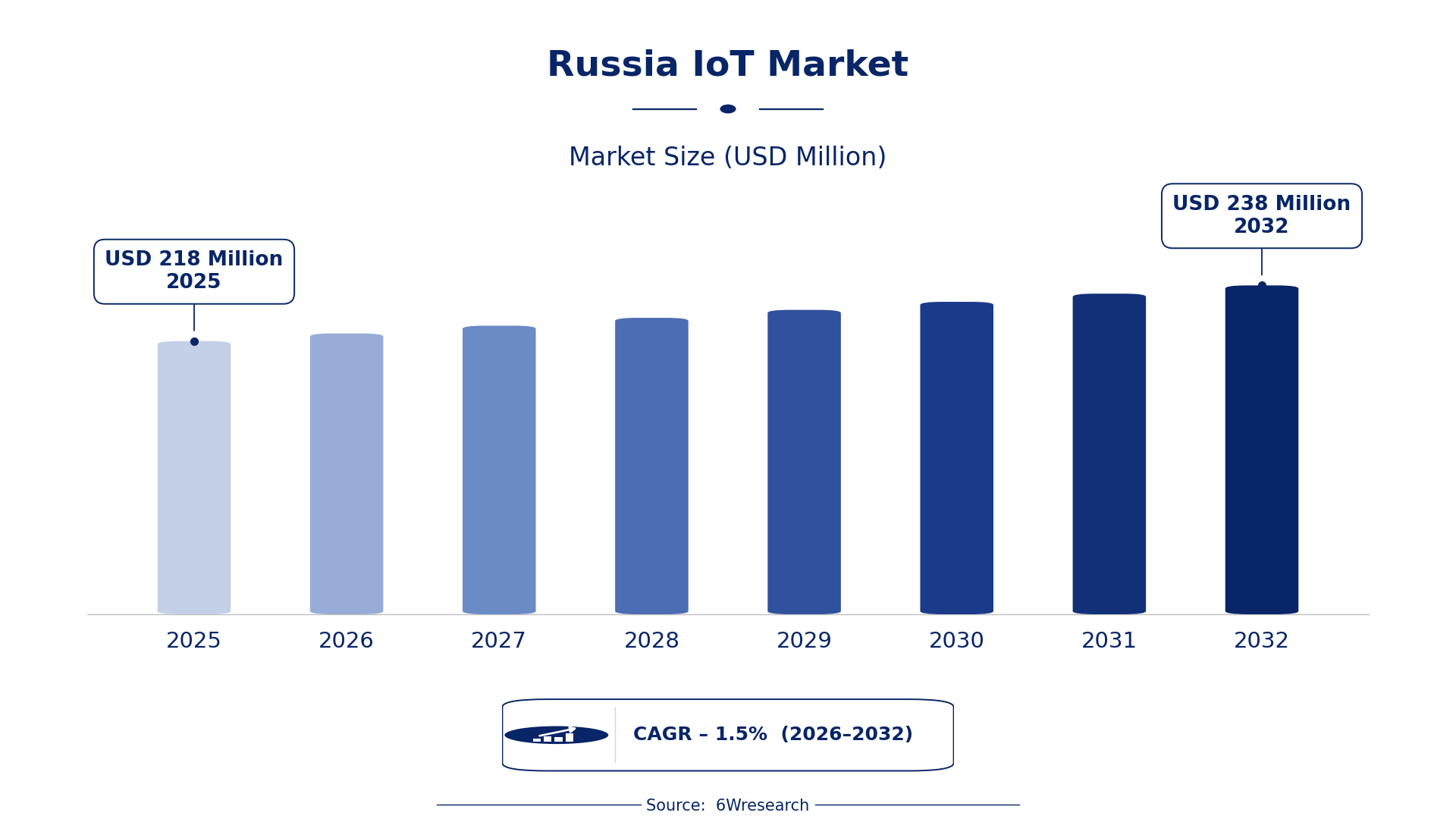
The Russia IoT Market was estimated at USD 218 Million in 2025 and is projected to reach USD 238 Million by 2032, growing at a CAGR of 1.5% from 2026 to 2032.
Russia IoT Market Synopsis
The primary driver of the Russia IoT Market is the government’s push towards digital transformation across various sectors. This initiative is complemented by the increasing integration of IoT technologies in manufacturing, healthcare, and smart city projects, which are vital for enhancing efficiency and productivity.
on top of that, the growing awareness among organizations regarding the value of data-driven decision-making is propelling demand for IoT solutions. Businesses are recognizing that leveraging connected devices can lead to improved operational workflows and customer experiences, presenting a lucrative opportunity for IoT vendors.
Russia IoT Market Year-wise Growth Rate and Key Drivers
This graph illustrates the annual growth rates of the Russia IoT Market from 2021 to 2032, highlighting a steady upward trajectory and projected expansion over the forecast period.
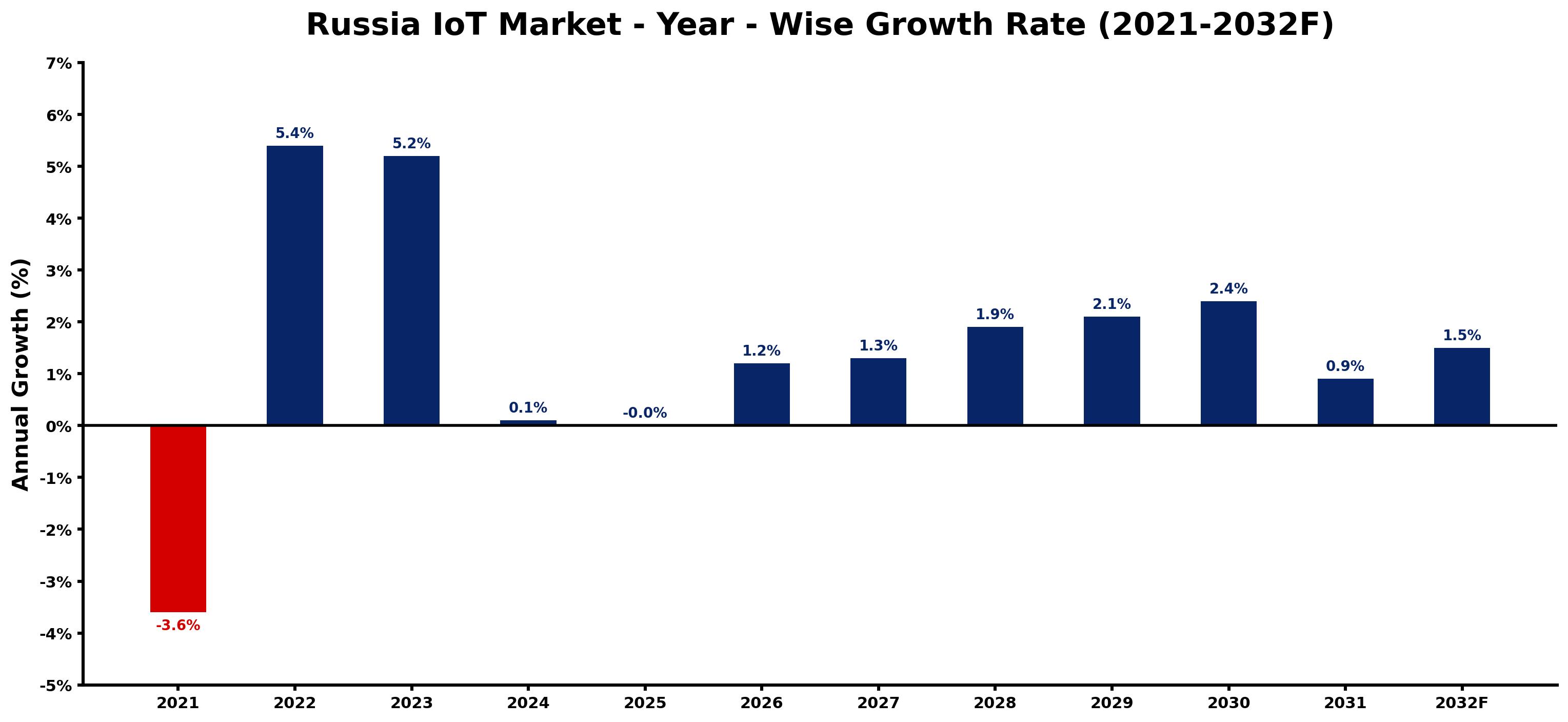
The table below presents the year‑wise growth rates along with the key drivers influencing the market
| Year | Growth Rate | Major Drivers |
| 2021 | -3.6% | Sanctions limiting foreign technology investments in IoT |
| 2022 | 5.4% | Rise in demand for remote monitoring solutions in agriculture. |
| 2023 | 5.2% | Implementation of the Russian Digital Economy program supports IoT adoption. |
| 2024 | 0.1% | Increased focus on smart manufacturing through local innovation hubs. |
| 2025 | -0.0% | Rising electricity demand across industries |
| 2026 | 1.2% | Growing necessity for asset tracking in logistics sector. |
| 2027 | 1.3% | Government initiatives promoting smart city projects across regions. |
| 2028 | 1.9% | Surge in demand for predictive maintenance in industrial sectors. |
| 2029 | 2.1% | Adoption of IoT-enabled security systems in private enterprises. |
| 2030 | 2.4% | Strong growth in environmental monitoring IoT applications. |
| 2031 | 0.9% | Emergence of IoT use cases in energy management solutions. |
| 2032 | 1.5% | Rising popularity of agricultural IoT for crop yield optimization. |
Note: Market size estimations and growth projections presented in this report are based on 6Wresearch's proprietary forecasting methodology, utilizing the latest available industry data, government publications, and primary research inputs.
Russia IoT Market Key Takeaways
Below are some of the specific key takeaways from the market, including:
- The Russian government is actively promoting digital initiatives that support IoT adoption across various sectors.
- Manufacturing and healthcare are among the leading industries integrating IoT solutions to enhance efficiency.
- Cybersecurity concerns are driving the demand for robust IoT security solutions.
- The focus on smart city developments is contributing to the expansion of connected infrastructure.
- Investment opportunities are emerging in sectors like industrial IoT and connected healthcare systems.
Evaluation of Restraints in Russia IoT Market
Despite the positive trajectory, the Russia IoT Market faces notable constraints. Regulatory complexities, especially concerning data protection laws, often create barriers for IoT companies. The absence of standardized regulations across the EMEA region compounds these difficulties, leading to compliance challenges for businesses operating in multiple jurisdictions. on top of that, some areas in Russia still struggle with inadequate connectivity infrastructure, impacting the scalability of IoT solutions.
Russia IoT Market Trends
Current trends indicate a marked increase in the adoption of IoT technologies across various industries. A significant focus is placed on enhancing cybersecurity measures to protect sensitive data as more devices become interconnected. Additionally, the integration of edge computing and artificial intelligence into IoT frameworks is emerging as a critical factor, enabling real-time decision-making and improving operational outcomes.
Russia IoT Market Opportunities
Investment opportunities are robust within the Russia IoT Market, particularly in sectors like manufacturing, healthcare, and transportation. Smart city initiatives are gaining momentum, creating demand for connected solutions that enhance urban infrastructure. Investors should focus on IoT platforms, advanced sensors, and data analytics tools, as these areas are ripe for development, offering substantial growth potential.
Government Initiatives in the Russia IoT Market
The Russian government is taking an active role in shaping the IoT market through strategic initiatives aimed at fostering digital transformation. By prioritizing the development of digital infrastructure and regulatory frameworks that ensure data security, the government is creating an environment conducive to innovation. These policies are critical for attracting investments and encouraging collaboration between public and private sectors.
- A recently completed initiative focused on enhancing the digital infrastructure to support IoT applications across various sectors.
- A current program promoting collaboration between governmental bodies and technology providers to drive IoT innovation.
- A planned public-private partnership aimed at expanding telecommunications infrastructure access by 2028.
- Ongoing regulations to ensure data privacy and security in IoT systems, addressing cybersecurity concerns.
- A future initiative intended to introduce tax incentives for companies investing in IoT technologies.
Future Insights of the Russia IoT Market
Looking ahead to 2026-2032, the Russia IoT Market is set for steady growth driven by ongoing advancements in connectivity and increasing government support for digital initiatives. As sectors such as healthcare and manufacturing continue to adopt IoT technologies, the demand for innovative solutions will intensify. on top of that, the anticipated rollout of 5G technology will enhance the capabilities of IoT applications, enabling new use cases and efficiencies across the board.
Russia IoT Market Latest Developments
Recent developments in the Russia IoT Market highlight the sector's dynamic nature and commitment to innovation. Over the past year, there has been a notable increase in partnerships aimed at developing IoT applications tailored to local industry needs, as well as significant investment in cybersecurity solutions to safeguard connected devices.
- A major technology vendor launched a new IoT platform tailored for smart city applications in early 2025, enhancing urban management capabilities.
- An initiative that began in mid-2025 is currently underway, focusing on integrating AI with IoT systems for improved analytics and decision-making.
- A recent collaboration between local government and tech firms aims to create a comprehensive IoT ecosystem, expected to conclude by late 2025.
- An upcoming rollout planned for the second half of 2026 will focus on expanding IoT connectivity in rural areas, addressing previous infrastructure gaps.
Russia IoT Market - Key Attractiveness of the Report
- 10 Years of Market Numbers
- Historical Data Starting from 2022 to 2025
- Base Year: 2025
- Forecast Data until 2032
- Key Performance Indicators Impacting the Market
- Major Upcoming Developments and Projects
Key Highlights of the Report:
- Russia IoT Market Outlook
- Market Size of Russia IoT Market, 2025
- Forecast of Russia IoT Market, 2032
- Historical Data and Forecast of Russia IoT Revenues & Volume for the Period 2022-2032F
- Russia IoT Market Trend Evolution
- Russia IoT Market Drivers and Challenges
- Russia IoT Price Trends
- Russia IoT Porter's Five Forces
- Russia IoT Industry Life Cycle
- Historical Data and Forecast of Russia IoT Market Revenues & Volume By Component for the Period 2022-2032F
- Historical Data and Forecast of Russia IoT Market Revenues & Volume By Platform for the Period 2022-2032F
- Historical Data and Forecast of Russia IoT Market Revenues & Volume By Service for the Period 2022-2032F
- Historical Data and Forecast of Russia IoT Market Revenues & Volume By Software Solution for the Period 2022-2032F
- Historical Data and Forecast of Russia IoT Market Revenues & Volume By Application for the Period 2022-2032F
- Historical Data and Forecast of Russia IoT Market Revenues & Volume By Building & Home Automation for the Period 2022-2032F
- Historical Data and Forecast of Russia IoT Market Revenues & Volume By Smart Energy for the Period 2022-2032F
- Historical Data and Forecast of Russia IoT Market Revenues & Volume By Smart Manufacturing for the Period 2022-2032F
- Historical Data and Forecast of Russia IoT Market Revenues & Volume By Connected Logistics for the Period 2022-2032F
- Historical Data and Forecast of Russia IoT Market Revenues & Volume By Connected Health for the Period 2022-2032F
- Historical Data and Forecast of Russia IoT Market Revenues & Volume By Smart Retail for the Period 2022-2032F
- Historical Data and Forecast of Russia IoT Market Revenues & Volume By Smart Mobility & Transportation for the Period 2022-2032F
- Historical Data and Forecast of Russia IoT Market Revenues & Volume By Security & Emergencies for the Period 2022-2032F
- Historical Data and Forecast of Russia IoT Market Revenues & Volume By Platform for the Period 2022-2032F
- Historical Data and Forecast of Russia IoT Market Revenues & Volume By Device Management Platform for the Period 2022-2032F
- Historical Data and Forecast of Russia IoT Market Revenues & Volume By Application Management Software for the Period 2022-2032F
- Historical Data and Forecast of Russia IoT Market Revenues & Volume By Network Management Software for the Period 2022-2032F
- Historical Data and Forecast of Russia IoT Market Revenues & Volume By Software Solution for the Period 2022-2032F
- Historical Data and Forecast of Russia IoT Market Revenues & Volume By Real-time Stream Analytics for the Period 2022-2032F
- Historical Data and Forecast of Russia IoT Market Revenues & Volume By Security Solution for the Period 2022-2032F
- Historical Data and Forecast of Russia IoT Market Revenues & Volume By Data Management for the Period 2022-2032F
- Historical Data and Forecast of Russia IoT Market Revenues & Volume By Remote Monitoring System for the Period 2022-2032F
- Historical Data and Forecast of Russia IoT Market Revenues & Volume By Network Bandwidth Management for the Period 2022-2032F
- Historical Data and Forecast of Russia IoT Market Revenues & Volume By Service for the Period 2022-2032F
- Historical Data and Forecast of Russia IoT Market Revenues & Volume By Professional Services for the Period 2022-2032F
- Historical Data and Forecast of Russia IoT Market Revenues & Volume By Managed Services for the Period 2022-2032F
- Russia IoT Import Export Trade Statistics
- Market Opportunity Assessment By Component
- Market Opportunity Assessment By Application
- Market Opportunity Assessment By Platform
- Market Opportunity Assessment By Software Solution
- Market Opportunity Assessment By Service
- Russia IoT Top Companies Market Share
- Russia IoT Competitive Benchmarking By Technical and Operational Parameters
- Russia IoT Company Profiles
- Russia IoT Key Strategic Recommendations






































