Russia IoT Security Market Size & Growth Rate (2026-2032)
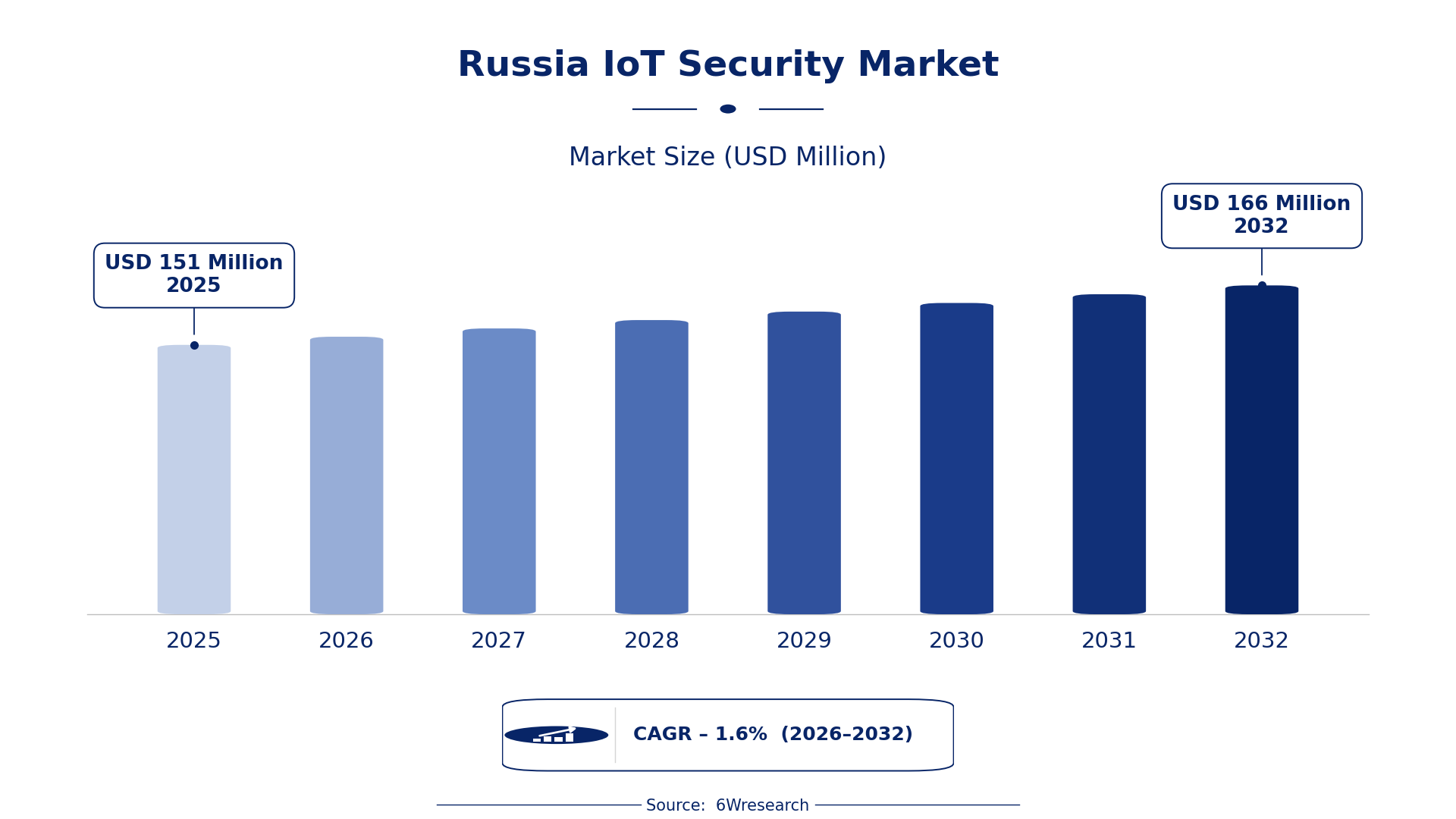
The Russia IoT Security Market was estimated at USD 151 Million in 2025 and is projected to reach USD 166 Million by 2032, growing at a CAGR of 1.6% from 2026 to 2032.
Russia IoT Security Market Synopsis
The escalating threat of cyberattacks targeting Internet of Things (IoT) devices is the foremost force driving the Russia IoT Security Market. Businesses across various sectors are increasingly aware that as they integrate more connected devices, they become more vulnerable to unauthorized access and data breaches, prompting urgent investments in security solutions.
Alongside this, the Russian government's commitment to enhancing cybersecurity frameworks plays a crucial role in shaping market dynamics. Stringent regulations and compliance requirements are pushing enterprises to adopt comprehensive security measures, creating a fertile environment for growth in IoT security solutions.
Russia IoT Security Market Year-wise Growth Rate and Key Drivers
This graph illustrates the annual growth rates of the Russia IoT Security Market from 2021 to 2032, highlighting a steady upward trajectory and projected expansion over the forecast period.
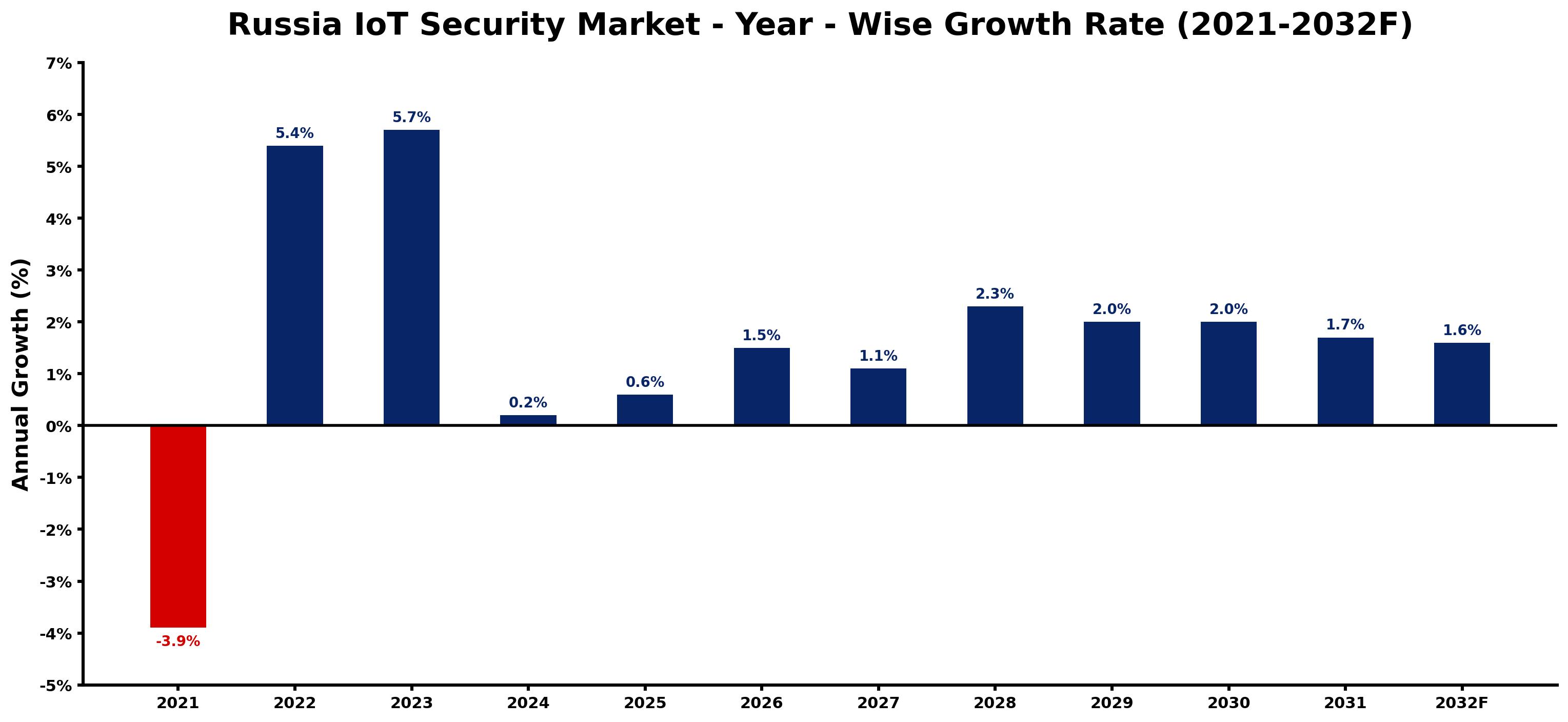
The table below presents the year‑wise growth rates along with the key drivers influencing the market
| Year | Growth Rate | Major Drivers |
| 2021 | -3.9% | Sanctions hinder technology imports and partnerships. |
| 2022 | 5.4% | Increased concerns over data privacy regulations in Russia. |
| 2023 | 5.7% | Heightened demand for securing smart home devices in Russia. |
| 2024 | 0.2% | Implementation of stricter IoT security certifications by government. |
| 2025 | 0.6% | Rise in state-sponsored cyber threat awareness initiatives. |
| 2026 | 1.5% | Local industries investing in IoT network security solutions. |
| 2027 | 1.1% | Increased focus on industrial IoT security among manufacturers. |
| 2028 | 2.3% | Growing adoption of smart city projects in major cities. |
| 2029 | 2.0% | Emerging residential IoT security solutions gaining market traction. |
| 2030 | 2.0% | Regulatory push for enhanced security in critical infrastructure. |
| 2031 | 1.7% | Local tech companies advancing IoT encryption technologies. |
| 2032 | 1.6% | Expanding interest in remote security management services. |
Note: Market size estimations and growth projections presented in this report are based on 6Wresearch's proprietary forecasting methodology, utilizing the latest available industry data, government publications, and primary research inputs.
Russia IoT Security Market Key Takeaways
Below are some of the specific key takeaways from the market, including:
- Cyber threats targeting IoT devices are rising, leading to increased demand for robust security solutions.
- Government regulations are a driving force, mandating compliance with cybersecurity standards.
- Enterprises are prioritizing investments in technologies that secure data integrity and protect against malware.
- There is a critical shortage of skilled cybersecurity professionals, impacting the speed of market growth.
- Awareness among organizations about the importance of IoT security is steadily increasing.
Evaluation of Restraints in Russia IoT Security Market
Despite the growth potential, the Russia IoT Security Market faces significant constraints. The rapid proliferation of connected devices has expanded the attack surface, making it challenging for organizations to safeguard their networks. Additionally, the lack of a comprehensive regulatory framework leaves gaps in security that cybercriminals can exploit. Compounding these issues is the shortage of skilled cybersecurity professionals, which hampers the implementation of effective security measures across industries.
Russia IoT Security Market Trends
Several trends are currently shaping the Russia IoT Security Market. First, there's a noticeable shift towards adopting AI-driven security solutions, as organizations seek to automate threat detection and response. Second, the integration of blockchain technology is gaining traction, enhancing data integrity and security in IoT networks. Lastly, collaborative initiatives between private companies and government entities are becoming more common, aiming to create a unified approach to tackling IoT security challenges.
Russia IoT Security Market Opportunities
Opportunities abound for growth and investment in the Russia IoT Security Market. Companies that specialize in innovative security technologies are well-positioned to benefit from rising demand. The increasing focus on smart cities and industrial IoT applications presents further avenues for investment. Additionally, as government regulations tighten, there will be a growing need for compliance-oriented security solutions, making this a lucrative area for development.
Government Initiatives in the Russia IoT Security Market
The Russian government is taking significant steps to bolster IoT security in response to rising cyber threats. With a focus on enhancing national security and protecting critical infrastructure, recent policy implementations reflect a strong regulatory posture. The emphasis on local cybersecurity solutions and collaboration between the public and private sectors is crucial in addressing the emerging challenges in the IoT landscape.
- A regulatory framework was introduced in early 2023 mandating compliance with cybersecurity standards for IoT devices.
- Current initiatives include a national program aimed at upgrading digital infrastructure, emphasizing the need for secure IoT networks.
- A planned public-private partnership expected to launch in 2026 will focus on developing advanced IoT security technologies.
- In 2024, the government initiated a campaign to raise awareness about IoT security among enterprises, highlighting best practices.
- Ongoing assessments of IoT security vulnerabilities are being conducted to inform future policy decisions.
Future Insights of the Russia IoT Security Market
Looking ahead to 2026-2032, the Russia IoT Security Market is expected to evolve significantly. As the number of connected devices continues to rise, the demand for advanced security solutions will only intensify. Organizations will likely prioritize investments in technologies that not only protect against current threats but also anticipate future vulnerabilities. With government support and increased collaboration among stakeholders, the market is set for steady growth, presenting ample opportunities for innovation and investment.
Russia IoT Security Market Latest Developments
In the past year, the Russia IoT Security Market has witnessed notable developments, particularly in response to the increasing number of cyber threats. Enterprises are actively seeking solutions to enhance their security posture, while the government is implementing stricter regulations to safeguard connected devices. The pace of innovation is accelerating, and companies are racing to launch new products and services tailored for the IoT security space.
- A major technology vendor launched an AI-based security solution aimed at IoT networks in Q1 2025, enhancing threat detection capabilities.
- An initiative that began in early 2025 focuses on training cybersecurity professionals to address the skills gap in the market.
- A collaboration between several key industry players is underway, aiming to create a unified security protocol for IoT devices by mid-2026.
- In late 2024, a public-private partnership completed a project to improve cybersecurity infrastructure for critical IoT applications.
- Upcoming in 2026, a new regulatory body will be established to monitor compliance with IoT security standards.
Russia IoT Security Market - Key Attractiveness of the Report
- 10 Years of Market Numbers
- Historical Data Starting from 2022 to 2025
- Base Year: 2025
- Forecast Data until 2032
- Key Performance Indicators Impacting the Market
- Major Upcoming Developments and Projects
Key Highlights of the Report:
- Russia IoT Security Market Outlook
- Market Size of Russia IoT Security Market, 2025
- Forecast of Russia IoT Security Market, 2032
- Historical Data and Forecast of Russia IoT Security Revenues & Volume for the Period 2022-2032F
- Russia IoT Security Market Trend Evolution
- Russia IoT Security Market Drivers and Challenges
- Russia IoT Security Price Trends
- Russia IoT Security Porter's Five Forces
- Russia IoT Security Industry Life Cycle
- Historical Data and Forecast of Russia IoT Security Market Revenues & Volume By Type for the Period 2022-2032F
- Historical Data and Forecast of Russia IoT Security Market Revenues & Volume By Network Security for the Period 2022-2032F
- Historical Data and Forecast of Russia IoT Security Market Revenues & Volume By Endpoint Security for the Period 2022-2032F
- Historical Data and Forecast of Russia IoT Security Market Revenues & Volume By Application Security for the Period 2022-2032F
- Historical Data and Forecast of Russia IoT Security Market Revenues & Volume By Cloud Security for the Period 2022-2032F
- Historical Data and Forecast of Russia IoT Security Market Revenues & Volume By Other Security Types for the Period 2022-2032F
- Historical Data and Forecast of Russia IoT Security Market Revenues & Volume By Deployment Mode for the Period 2022-2032F
- Historical Data and Forecast of Russia IoT Security Market Revenues & Volume By Small and Medium Enterprises for the Period 2022-2032F
- Historical Data and Forecast of Russia IoT Security Market Revenues & Volume By Large Enterprises for the Period 2022-2032F
- Historical Data and Forecast of Russia IoT Security Market Revenues & Volume By Component for the Period 2022-2032F
- Historical Data and Forecast of Russia IoT Security Market Revenues & Volume By Solutions for the Period 2022-2032F
- Historical Data and Forecast of Russia IoT Security Market Revenues & Volume By Services for the Period 2022-2032F
- Historical Data and Forecast of Russia IoT Security Market Revenues & Volume By Solution for the Period 2022-2032F
- Historical Data and Forecast of Russia IoT Security Market Revenues & Volume By Identity and Access Management for the Period 2022-2032F
- Historical Data and Forecast of Russia IoT Security Market Revenues & Volume By Data Encryption and Tokenization for the Period 2022-2032F
- Historical Data and Forecast of Russia IoT Security Market Revenues & Volume By Intrusion Detection System/Intrusion Prevention System for the Period 2022-2032F
- Historical Data and Forecast of Russia IoT Security Market Revenues & Volume By Device Authentication and Management for the Period 2022-2032F
- Historical Data and Forecast of Russia IoT Security Market Revenues & Volume By Secure Communications for the Period 2022-2032F
- Historical Data and Forecast of Russia IoT Security Market Revenues & Volume By PKI Lifecycle Management for the Period 2022-2032F
- Historical Data and Forecast of Russia IoT Security Market Revenues & Volume By Distributed Denial of Service Protection for the Period 2022-2032F
- Historical Data and Forecast of Russia IoT Security Market Revenues & Volume By Security Analytics for the Period 2022-2032F
- Historical Data and Forecast of Russia IoT Security Market Revenues & Volume By Application Area for the Period 2022-2032F
- Historical Data and Forecast of Russia IoT Security Market Revenues & Volume By Smart Manufacturing for the Period 2022-2032F
- Historical Data and Forecast of Russia IoT Security Market Revenues & Volume By Smart Energy and Utilities for the Period 2022-2032F
- Historical Data and Forecast of Russia IoT Security Market Revenues & Volume By Connected Logistics for the Period 2022-2032F
- Historical Data and Forecast of Russia IoT Security Market Revenues & Volume By Smart Home and Consumer Electronics for the Period 2022-2032F
- Historical Data and Forecast of Russia IoT Security Market Revenues & Volume By Connected Healthcare for the Period 2022-2032F
- Historical Data and Forecast of Russia IoT Security Market Revenues & Volume By Smart Government and Defense for the Period 2022-2032F
- Historical Data and Forecast of Russia IoT Security Market Revenues & Volume By Smart Retail for the Period 2022-2032F
- Historical Data and Forecast of Russia IoT Security Market Revenues & Volume By Other Application Areas for the Period 2022-2032F
- Historical Data and Forecast of Russia IoT Security Market Revenues & Volume By Organization Size for the Period 2022-2032F
- Historical Data and Forecast of Russia IoT Security Market Revenues & Volume By Small and Medium-sized Enterprises for the Period 2022-2032F
- Historical Data and Forecast of Russia IoT Security Market Revenues & Volume By Large Enterprises for the Period 2022-2032F
- Historical Data and Forecast of Russia IoT Security Market Revenues & Volume By Service for the Period 2022-2032F
- Historical Data and Forecast of Russia IoT Security Market Revenues & Volume By Professional Services for the Period 2022-2032F
- Historical Data and Forecast of Russia IoT Security Market Revenues & Volume By Managed Services for the Period 2022-2032F
- Russia IoT Security Import Export Trade Statistics
- Market Opportunity Assessment By Type
- Market Opportunity Assessment By Deployment Mode
- Market Opportunity Assessment By Component
- Market Opportunity Assessment By Solution
- Market Opportunity Assessment By Application Area
- Market Opportunity Assessment By Organization Size
- Market Opportunity Assessment By Service
- Russia IoT Security Top Companies Market Share
- Russia IoT Security Competitive Benchmarking By Technical and Operational Parameters
- Russia IoT Security Company Profiles
- Russia IoT Security Key Strategic Recommendations






































