Russia Managed Services Market Size & Growth Rate (2026-2032)
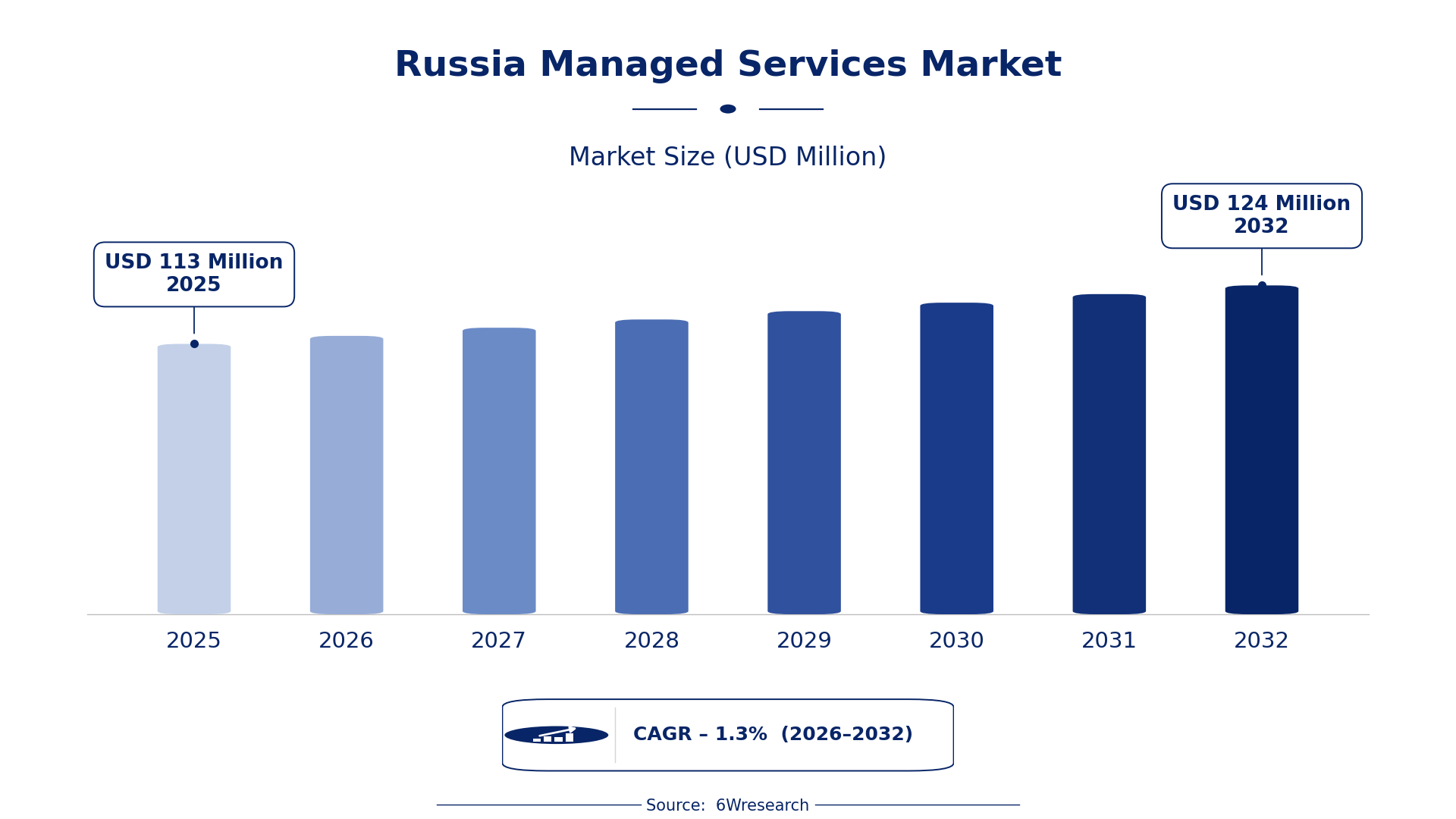
The Russia Managed Services Market was estimated at USD 113 Million in 2025 and is projected to reach USD 124 Million by 2032, growing at a CAGR of 1.3% from 2026 to 2032.
Russia Managed Services Market Synopsis
The Russia Managed Services Market has been gaining traction as businesses increasingly embrace digital transformation and cloud-based solutions. As companies look for cost-effective IT strategies, the demand for managed services continues to rise, indicating a solid momentum for growth.
Looking ahead, this market is set to expand further. Organizations are not just seeking traditional IT support; they are increasingly interested in proactive, strategic services that encompass security, compliance, and advanced technologies like AI and IoT.
Russia Managed Services Market Year-wise Growth Rate and Key Drivers
This graph illustrates the annual growth rates of the Russia Managed Services Market from 2021 to 2032, highlighting a steady upward trajectory and projected expansion over the forecast period.
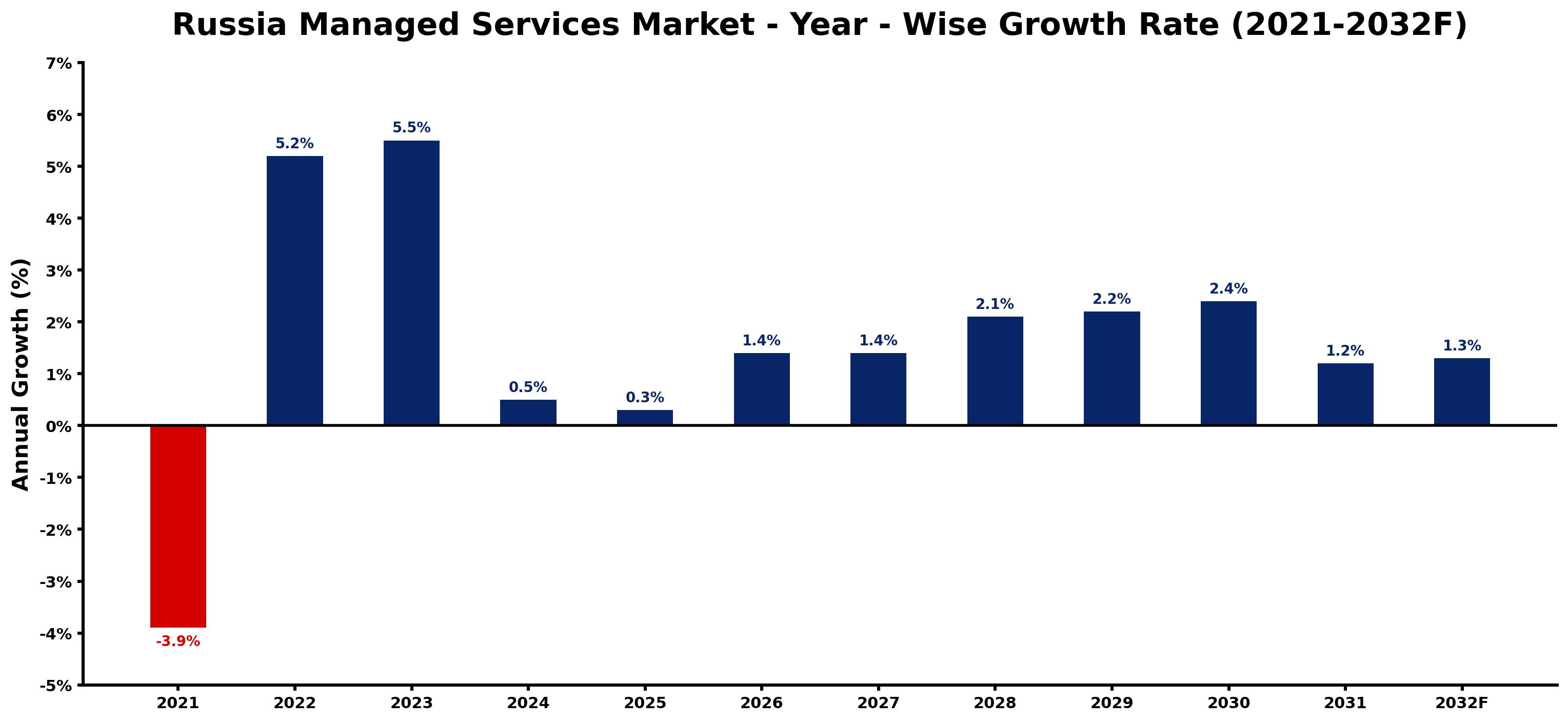
The table below presents the year‑wise growth rates along with the key drivers influencing the market
| Year | Growth Rate | Major Drivers |
| 2021 | -3.9% | New sanctions from the US hindered technology investments. |
| 2022 | 5.2% | Rising digital transformation initiatives across Russian enterprises. |
| 2023 | 5.5% | Enhanced focus on remote work solutions post-pandemic. |
| 2024 | 0.5% | Implementation of new data residency laws boosting local services. |
| 2025 | 0.3% | Increased government funding for digital infrastructure projects. |
| 2026 | 1.4% | Growing adoption of AI technologies in managed services. |
| 2027 | 1.4% | Strong demand for virtualization due to economic sanctions. |
| 2028 | 2.1% | Corporate investments in cybersecurity for critical infrastructure. |
| 2029 | 2.2% | Emergence of local tech startups driving service innovation. |
| 2030 | 2.4% | Development of industry-specific managed services in finance. |
| 2031 | 1.2% | Regulatory support for small businesses enhancing service uptake. |
| 2032 | 1.3% | Rising collaboration between state enterprises and IT providers. |
Note: Market size estimations and growth projections presented in this report are based on 6Wresearch's proprietary forecasting methodology, utilizing the latest available industry data, government publications, and primary research inputs.
Russia Managed Services Market Key Takeaways
Below are some of the specific key takeaways from the market, including:
- Growing adoption of cloud-based managed services is reshaping IT infrastructure.
- Cybersecurity is becoming a central focus in managed services offerings.
- Industry-specific solutions are on the rise, catering to sectors like healthcare and finance.
- Competition is intensifying, driving innovation and service differentiation.
- Geopolitical factors are influencing investment decisions and market dynamics.
Evaluation of Restraints in Russia Managed Services Market
The Russia Managed Services Market faces several constraints that can hinder growth. Geopolitical tensions and economic sanctions have created an unpredictable environment for investment, complicating business operations for managed service providers. on top of that, a shortage of skilled IT professionals poses challenges in recruitment and retention, which can impede service delivery quality. Data privacy regulations are stringent, requiring organizations to maintain compliance while adapting to evolving cybersecurity threats, further complicating operational landscapes.
Russia Managed Services Market Trends
Several trends are currently shaping the Russia Managed Services Market. The increasing reliance on cloud-based services is driving demand for scalable and flexible IT solutions. Cybersecurity has emerged as a non-negotiable aspect of managed services, as companies recognize the need to protect their sensitive information. Industry-specific managed services are becoming more prevalent, ensuring that solutions are tailored to the unique challenges faced by sectors such as healthcare, finance, and manufacturing. Additionally, providers are shifting towards offering more strategic services, including digital transformation consulting and hybrid IT management.
Russia Managed Services Market Opportunities
Investment opportunities abound in the Russia Managed Services Market, particularly in areas such as IT infrastructure management, network security, and cloud services. As businesses increasingly adopt digital technologies, the need for outsourced managed services to boost operational efficiency is clear. Investing in providers with strong cybersecurity measures and customized solutions can yield substantial returns. on top of that, government initiatives aimed at digital transformation are likely to enhance growth prospects for the managed services sector.
Government Initiatives in the Russia Managed Services Market
Government policy plays a significant role in shaping the Russia Managed Services Market. Regulatory frameworks are being established to promote data localization and enhance cybersecurity measures. These policies create both hurdles and opportunities for service providers, emphasizing the need for compliance while fostering innovation.
- A recently completed initiative mandates data localization, requiring that personal data of Russian citizens be stored within the country.
- Currently underway is a comprehensive cybersecurity strategy aimed at enhancing data protection across sectors.
- Planned initiatives include a public-private partnership expected to develop nationwide digital infrastructure by 2028.
- Regulations introduced in 2025 focus on transparency in billing practices for managed services.
- New standards for cloud service security are being developed to align with global best practices.
Future Insights of the Russia Managed Services Market
The future of the Russia Managed Services Market appears promising, with growth expected to continue through 2032. As organizations increasingly prioritize cost-effective solutions, the appeal of managed services will rise. The integration of advanced technologies like AI and IoT into service offerings will likely drive further innovation. However, organizations must remain vigilant regarding compliance and security challenges, which could impact growth trajectories. The market's ability to adapt to these conditions will determine its success.
Russia Managed Services Market Latest Developments
Over the past year, the Russia Managed Services Market has seen a flurry of activity as companies adapt to changing demands and regulatory environments. Providers are increasingly focusing on enhancing their service offerings to stay competitive, particularly in cybersecurity and cloud solutions.
- A major technology vendor launched a new managed security service in early 2025, designed to protect against evolving cyber threats.
- A leading regional operator is currently expanding its cloud service capabilities, with efforts ongoing since late 2025.
- A new collaborative initiative aimed at improving IT infrastructure for small businesses is set to begin in mid-2026.
- A prominent managed services provider upgraded its data analytics offerings, with the rollout completed by the end of 2025.
- Several companies are preparing for a planned launch of an AI-driven service management platform in 2027.
Russia Managed Services Market - Key Attractiveness of the Report
- 10 Years of Market Numbers
- Historical Data Starting from 2022 to 2025
- Base Year: 2025
- Forecast Data until 2032
- Key Performance Indicators Impacting the Market
- Major Upcoming Developments and Projects
Key Highlights of the Report:
- Russia Managed Services Market Outlook
- Market Size of Russia Managed Services Market, 2025
- Forecast of Russia Managed Services Market, 2032
- Historical Data and Forecast of Russia Managed Services Revenues & Volume for the Period 2022-2032F
- Russia Managed Services Market Trend Evolution
- Russia Managed Services Market Drivers and Challenges
- Russia Managed Services Price Trends
- Russia Managed Services Porter's Five Forces
- Russia Managed Services Industry Life Cycle
- Historical Data and Forecast of Russia Managed Services Market Revenues & Volume By Service Type for the Period 2022-2032F
- Historical Data and Forecast of Russia Managed Services Market Revenues & Volume By Managed Security Services for the Period 2022-2032F
- Historical Data and Forecast of Russia Managed Services Market Revenues & Volume By Managed Network Services for the Period 2022-2032F
- Historical Data and Forecast of Russia Managed Services Market Revenues & Volume By Managed Data Center and IT Infrastructure Services for the Period 2022-2032F
- Historical Data and Forecast of Russia Managed Services Market Revenues & Volume By Managed Communication and Collaboration Services for the Period 2022-2032F
- Historical Data and Forecast of Russia Managed Services Market Revenues & Volume By Managed Mobility Services for the Period 2022-2032F
- Historical Data and Forecast of Russia Managed Services Market Revenues & Volume By Managed Information Services for the Period 2022-2032F
- Historical Data and Forecast of Russia Managed Services Market Revenues & Volume By Deployment Type for the Period 2022-2032F
- Historical Data and Forecast of Russia Managed Services Market Revenues & Volume By Cloud for the Period 2022-2032F
- Historical Data and Forecast of Russia Managed Services Market Revenues & Volume By On-Premises for the Period 2022-2032F
- Historical Data and Forecast of Russia Managed Services Market Revenues & Volume By Organization Size for the Period 2022-2032F
- Historical Data and Forecast of Russia Managed Services Market Revenues & Volume By Small and Medium-sized Enterprises (SMEs) for the Period 2022-2032F
- Historical Data and Forecast of Russia Managed Services Market Revenues & Volume By Large Enterprises for the Period 2022-2032F
- Historical Data and Forecast of Russia Managed Services Market Revenues & Volume By Vertical for the Period 2022-2032F
- Historical Data and Forecast of Russia Managed Services Market Revenues & Volume By BFSI for the Period 2022-2032F
- Historical Data and Forecast of Russia Managed Services Market Revenues & Volume By IT and Telecom for the Period 2022-2032F
- Historical Data and Forecast of Russia Managed Services Market Revenues & Volume By Retail and Consumer Goods for the Period 2022-2032F
- Historical Data and Forecast of Russia Managed Services Market Revenues & Volume By Manufacturing for the Period 2022-2032F
- Historical Data and Forecast of Russia Managed Services Market Revenues & Volume By Government for the Period 2022-2032F
- Historical Data and Forecast of Russia Managed Services Market Revenues & Volume By Healthcare and Life Sciences for the Period 2022-2032F
- Historical Data and Forecast of Russia Managed Services Market Revenues & Volume By Energy and Utilities for the Period 2022-2032F
- Historical Data and Forecast of Russia Managed Services Market Revenues & Volume By Media and Entertainment for the Period 2022-2032F
- Russia Managed Services Import Export Trade Statistics
- Market Opportunity Assessment By Service Type
- Market Opportunity Assessment By Deployment Type
- Market Opportunity Assessment By Organization Size
- Market Opportunity Assessment By Vertical
- Russia Managed Services Top Companies Market Share
- Russia Managed Services Competitive Benchmarking By Technical and Operational Parameters
- Russia Managed Services Company Profiles
- Russia Managed Services Key Strategic Recommendations






































