Russia Parachute Market Size, Share & Growth Rate
The Russia Parachute Market was estimated at USD 239 Million in 2025 and is projected to reach USD 261 Million by 2032, growing at a CAGR of 1.3% from 2026 to 2032. This upward trajectory is primarily fueled by the increasing interest in adventure sports, particularly skydiving, which is rapidly gaining traction among the Russian populace. Additionally, the defense sector remains a vital contributor, as the demand for advanced parachute systems for military operations continues to grow.
Russia Parachute Market Year-wise Growth Rate and Key Drivers
This graph highlights how the Russia Parachute Market has steadily grown over the years, supported by major growth factors.
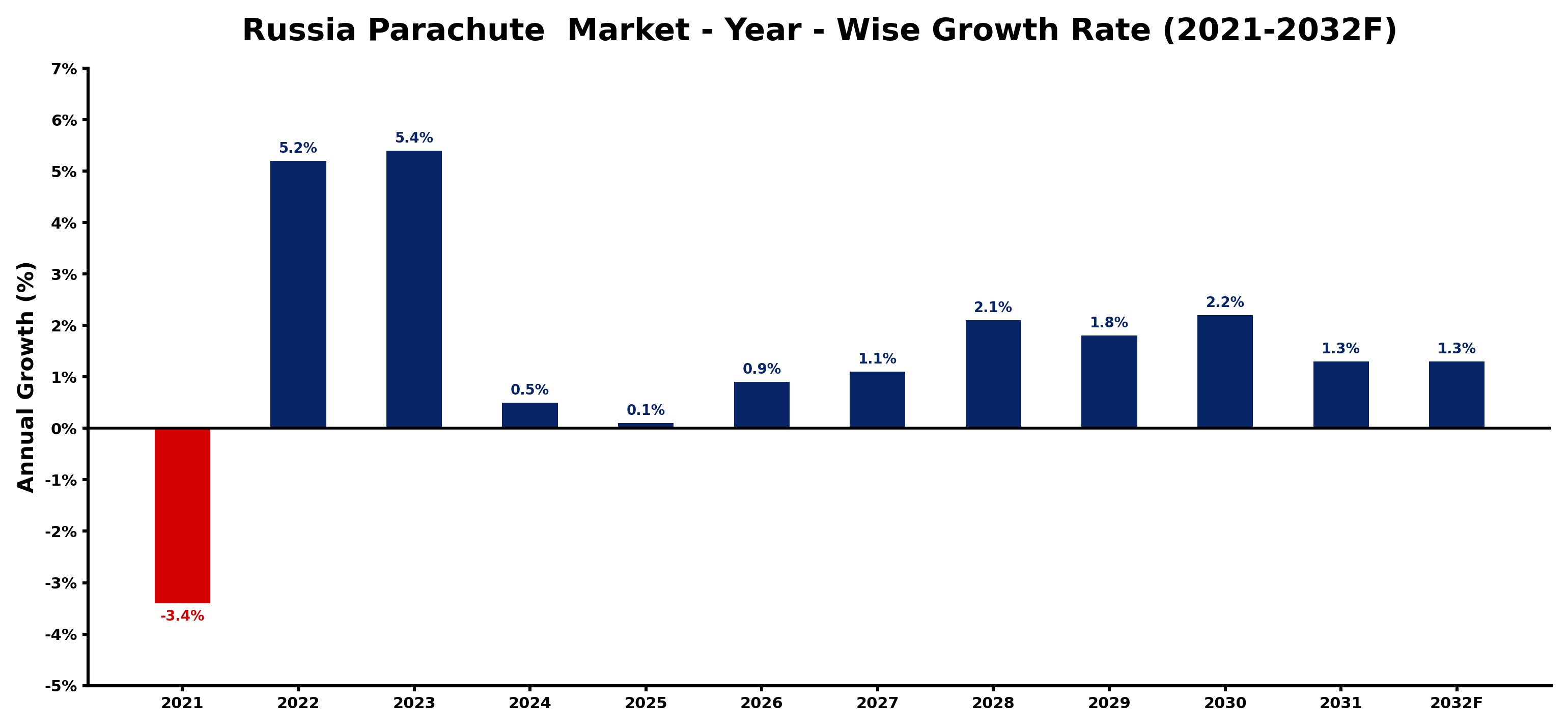
The table below presents the year‑wise growth rates along with the key drivers influencing the market
| Year | Growth Rate | Major Drivers |
| 2021 | -3.4% | Increasing smart city development projects |
| 2022 | 5.2% | Increasing industrial automation investments |
| 2023 | 5.4% | Expansion of commercial construction activities |
| 2024 | 0.5% | Increasing industrial automation investments |
| 2025 | 0.1% | Expansion of commercial construction activities |
| 2026 | 0.9% | Expansion of transportation and logistics networks |
| 2027 | 1.1% | Expansion of transportation and logistics networks |
| 2028 | 2.1% | Increasing industrial automation investments |
| 2029 | 1.8% | Expansion of manufacturing activities |
| 2030 | 2.2% | Growing urbanization and commercial development |
| 2031 | 1.3% | Increasing industrial infrastructure investments |
| 2032 | 1.3% | Increasing industrial automation investments |
Note - Market size estimations and growth projections presented in this report are based on 6Wresearch’s advanced forecasting approach, validated with industry datasets as of June 2026.
Russia Parachute Market Synopsis
A notable driver in the Russia Parachute Market is the surge in recreational parachuting among civilians. As more people seek exhilarating experiences, there is a marked increase in demand for beginner-friendly parachute options, making the sport more accessible to the general public. This trend is complemented by advancements in parachute design and technology, which enhance user safety and performance.
The market also exhibits a diverse product range tailored to various applications, from military uses to sports and recreational parachuting. This variety allows manufacturers to meet specific customer preferences, including customization and eco-friendly options. Such adaptability is crucial as consumer expectations evolve, further shaping the landscape of the parachute market in Russia.
Russia Parachute Market Key Takeaways
- The market is predominantly driven by the defense sector, accounting for a significant share of parachute sales.
- Growing recreational parachuting interest among civilians is expanding consumer demographics.
- Technological innovations focus on safety and performance, propelling market advancements.
- Customization and eco-friendly materials are becoming essential in consumer preferences.
- The market is poised for steady growth despite economic fluctuations and regulatory challenges.
Evaluation of Restraints in Russia Parachute Market
Despite its promising growth, the Russia Parachute Market faces several significant restraints. Strict regulatory requirements and certification processes can hinder market entry for new players and add to operational costs for existing manufacturers. Additionally, limited availability of training facilities and qualified instructors poses challenges for expanding the consumer base for parachuting as a sport. Consumer awareness and interest in skydiving activities remain relatively low compared to other recreational sports, which further restricts market growth potential. The economic uncertainties and fluctuations in disposable income levels can also affect consumer spending on adventure sports, including parachuting.
Russia Parachute Market Trends
Several current trends are shaping the Russia Parachute Market. A growing focus on advanced parachute systems with enhanced safety features is prevalent, particularly within the military sector where high-performance parachutes are essential for tactical operations. Additionally, there is an increased demand for beginner-friendly and affordable parachutes among recreational users, reflecting a shift toward inclusivity in the sport. Customization is gaining popularity, with consumers seeking unique designs that reflect their personal styles. Furthermore, sustainability is emerging as a key trend, with an emphasis on using eco-friendly materials and manufacturing processes.
Russia Parachute Market Opportunities
The Russia Parachute Market presents various investment opportunities, particularly driven by the increasing popularity of recreational skydiving and robust military applications. Investors can explore avenues in manufacturing and supplying parachutes, along with related accessories that enhance the skydiving experience. Collaborating with local skydiving clubs and training centers is another pathway for market entry, enabling companies to reach a broader audience of potential customers. Additionally, as adventure tourism expands in the region, there is substantial potential for growth in both civilian and defense sectors, presenting diverse investment prospects.
Government Initiatives in the Russia Parachute Market
The Russian government has established stringent regulations and standards for the parachute market to ensure safety and quality. The Federal Air Transport Agency (Rosaviatsiya) is responsible for overseeing the certification process for parachute equipment, ensuring compliance with specific technical requirements. Moreover, restrictions are in place regarding the use of certain types of parachutes in high-risk areas, such as near airports or densely populated regions. These initiatives aim to enhance consumer safety and maintain high industry standards, reflecting the government's commitment to regulating the market effectively.
Future Insights of the Russia Parachute Market
Looking ahead to 2026-2032, the Russia Parachute Market is expected to continue its growth trajectory, driven by increasing interest in adventure sports and recreational activities. As technological advancements in parachute design further enhance safety and performance, more individuals are likely to engage in activities like skydiving and paragliding. The rising disposable income among the Russian population will also contribute to market expansion, making parachuting more accessible. Despite potential economic and geopolitical challenges, the overall outlook remains positive, creating substantial opportunities for domestic and international manufacturers to capitalize on the growing demand.
Russia Parachute Market Latest Developments (May 2025 - June 2026)
Recent developments in the Russia Parachute Market indicate a shift towards innovation and sustainability. Many manufacturers are investing in research and development to create parachute systems that incorporate advanced materials designed for improved performance and environmental impact. Additionally, there is a noticeable increase in promotional activities aimed at educating the public about skydiving, thereby boosting consumer interest. Partnerships between manufacturers and local adventure tourism operators are also emerging, fostering a collaborative approach to expanding the recreational use of parachutes.
Russia Parachute Market - Key Attractiveness of the Report
- 10 Years of Market Numbers
- Historical Data Starting from 2022 to 2025
- Base Year: 2025
- Forecast Data until 2032
- Key Performance Indicators Impacting the Market
- Major Upcoming Developments and Projects
Key Highlights of the Report:
- Russia Parachute Market Outlook
- Market Size of Russia Parachute Market, 2025
- Forecast of Russia Parachute Market, 2032
- Historical Data and Forecast of Russia Parachute Revenues & Volume for the Period 2022-2032F
- Russia Parachute Market Trend Evolution
- Russia Parachute Market Drivers and Challenges
- Russia Parachute Price Trends
- Russia Parachute Porter's Five Forces
- Russia Parachute Industry Life Cycle
- Historical Data and Forecast of Russia Parachute Market Revenues & Volume By Type for the Period 2022-2032F
- Historical Data and Forecast of Russia Parachute Market Revenues & Volume By Round Parachute for the Period 2022-2032F
- Historical Data and Forecast of Russia Parachute Market Revenues & Volume By Cruciform Parachute for the Period 2022-2032F
- Historical Data and Forecast of Russia Parachute Market Revenues & Volume By Ram Air Parachute for the Period 2022-2032F
- Historical Data and Forecast of Russia Parachute Market Revenues & Volume By Other Types for the Period 2022-2032F
- Historical Data and Forecast of Russia Parachute Market Revenues & Volume By Application for the Period 2022-2032F
- Historical Data and Forecast of Russia Parachute Market Revenues & Volume By Military for the Period 2022-2032F
- Historical Data and Forecast of Russia Parachute Market Revenues & Volume By Cargo for the Period 2022-2032F
- Historical Data and Forecast of Russia Parachute Market Revenues & Volume By Other Applications for the Period 2022-2032F
- Russia Parachute Import Export Trade Statistics
- Market Opportunity Assessment By Type
- Market Opportunity Assessment By Application
- Russia Parachute Top Companies Market Share
- Russia Parachute Competitive Benchmarking By Technical and Operational Parameters
- Russia Parachute Company Profiles
- Russia Parachute Key Strategic Recommendations






































