Russia Seafood Processing Market Size, Share & Growth Rate
The Russia Seafood Processing Market was estimated at USD 160 Million in 2025 and is projected to reach USD 175 Million by 2032, growing at a CAGR of 1.3% from 2026 to 2032. This growth trajectory is propelled by rising domestic consumption driven by increasing health consciousness among consumers, as well as expanding export opportunities fueled by the country's vast marine resources. Additionally, innovations in processing technology are enhancing product quality, making Russian seafood more competitive in international markets.
Russia Seafood Processing Market Year-wise Growth Rate and Key Drivers
This graph highlights how the Russia Seafood Processing Market has steadily grown over the years, supported by major growth factors.
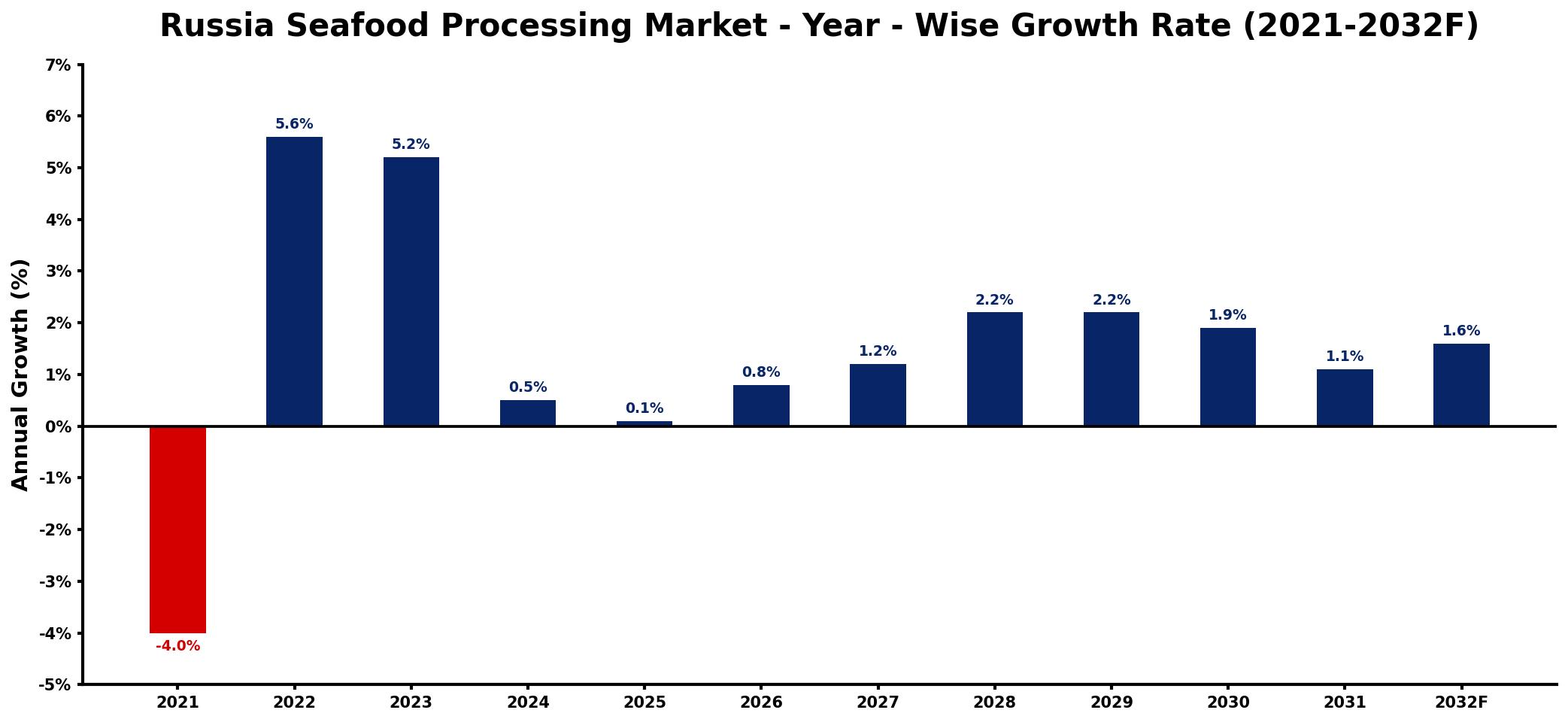
The table below presents the year‑wise growth rates along with the key drivers influencing the market
| Year | Growth Rate | Major Drivers |
| 2021 | -4.0% | decreased consumer demand for imports |
| 2022 | 5.6% | increased domestic production capabilities |
| 2023 | 5.2% | growing exports to new markets |
| 2024 | 0.5% | rising health consciousness among consumers |
| 2025 | 0.1% | expansion of distribution networks |
| 2026 | 0.8% | enhanced technological advancements adoption |
| 2027 | 1.2% | growing popularity of convenience foods |
| 2028 | 2.2% | increased investment in infrastructure |
| 2029 | 2.2% | growing demand for sustainable practices |
| 2030 | 1.9% | rising interest in premium products |
| 2031 | 1.1% | expanding culinary tourism opportunities |
| 2032 | 1.6% | increased focus on product innovation |
Note: Market size estimations and growth projections presented in this report are based on 6Wresearch's proprietary forecasting methodology, utilizing the latest available industry data, government publications, and primary research inputs.
Russia Seafood Processing Market Synopsis
The Russian seafood processing industry is thriving, characterized by a broad array of processed seafood products, including fish, crustaceans, and mollusks. This variety not only caters to domestic consumption but also positions Russia as a significant exporter of quality seafood to global markets.
Consumer trends are shifting towards value-added seafood products, such as ready-to-eat meals and gourmet snacks, highlighting a growing demand for convenience without sacrificing health. This evolving demand is prompting processors to adapt and innovate, ensuring their offerings align with consumer preferences.
Russia Seafood Processing Market Key Takeaways
- The market is poised for steady growth, backed by increasing consumer health awareness and disposable income.
- Technological advancements are crucial, enhancing efficiency and product quality in processing facilities.
- Sustainability and traceability in seafood sourcing are becoming significant factors influencing consumer choices.
- The rise of e-commerce platforms is transforming the distribution landscape for seafood products.
- Investment opportunities are emerging in value-added product development and facility modernization.
Evaluation of Restraints in Russia Seafood Processing Market
The Russia Seafood Processing Market faces several restraints that could hinder its potential. Regulatory complexities, including stringent import and export regulations, pose significant challenges for industry stakeholders. Furthermore, high production costs, influenced by labor and transportation expenses, limit profitability. Many processors contend with aging infrastructure, which can impact operational efficiency and product quality. Addressing these issues through targeted investment and modernization will be essential for sustaining growth in the sector.
Russia Seafood Processing Market Trends
Several trends are shaping the Russia Seafood Processing Market. A notable shift towards value-added products is evident, as consumers seek convenient and healthy meal options. The focus on sustainability is becoming increasingly important, with processors emphasizing the traceability of their seafood sources to meet consumer demand for responsible sourcing practices. Additionally, advancements in processing technology are not only improving efficiency but also enabling the development of higher-quality products, which is vital for competing in both domestic and international markets.
Russia Seafood Processing Market Opportunities
Investors will find numerous opportunities within the Russia Seafood Processing Market due to its extensive coastline and rich marine resources. The modernization of processing facilities presents a significant avenue for growth, particularly as the demand for quality seafood continues to rise. There is also substantial potential in diversifying product offerings to include innovative and value-added products that cater to evolving consumer preferences. With strategic investments, particularly in technology and efficiency improvements, the market can enhance its competitiveness on a global scale.
Government Initiatives in the Russia Seafood Processing Market
The Russian government is actively supporting the seafood processing sector through various initiatives aimed at ensuring sustainable practices and enhancing operational standards. Policies are in place to regulate fishing quotas, ensuring marine resources are managed sustainably. Additionally, strict processing and quality control standards are enforced to uphold the reputation of Russian seafood products in international markets. These initiatives not only aim to protect the environment but also foster growth in the seafood processing industry, aligning with both economic and ecological goals.
Future Insights of the Russia Seafood Processing Market
Looking towards the future, the Russia Seafood Processing Market is set for promising expansion. The anticipated increase in consumer demand for high-quality seafood products, coupled with ongoing technological advancements, is expected to drive market growth from 2026 to 2032. Moreover, with the governments commitment to enhancing the seafood industrys infrastructure and export capabilities, the market is positioned to overcome current challenges, paving the way for sustained development and competitiveness on a global scale.
Russia Seafood Processing Market Latest Developments (2025 - 2026)
Recent developments in the Russia Seafood Processing Market indicate a growing emphasis on sustainable practices and technological upgrades. Companies are increasingly investing in modern processing facilities to enhance efficiency and meet international quality standards. Additionally, there is a marked increase in collaborations between local processors and international firms aimed at expanding product ranges and exploring new markets. This strategic focus on innovation and sustainability is set to reshape the industry landscape significantly.
Russia Seafood Processing Market - Key Attractiveness of the Report
- 10 Years of Market Numbers
- Historical Data Starting from 2022 to 2025
- Base Year: 2025
- Forecast Data until 2032
- Key Performance Indicators Impacting the Market
- Major Upcoming Developments and Projects
Key Highlights of the Report:
- Russia Seafood Processing Market Outlook
- Market Size of Russia Seafood Processing Market, 2025
- Forecast of Russia Seafood Processing Market, 2032
- Historical Data and Forecast of Russia Seafood Processing Revenues & Volume for the Period 2022-2032F
- Russia Seafood Processing Market Trend Evolution
- Russia Seafood Processing Market Drivers and Challenges
- Russia Seafood Processing Price Trends
- Russia Seafood Processing Porter's Five Forces
- Russia Seafood Processing Industry Life Cycle
- Historical Data and Forecast of Russia Seafood Processing Market Revenues & Volume By Equipment Type for the Period 2022-2032F
- Historical Data and Forecast of Russia Seafood Processing Market Revenues & Volume By Gutting Equipment for the Period 2022-2032F
- Historical Data and Forecast of Russia Seafood Processing Market Revenues & Volume By Sealing Equipment for the Period 2022-2032F
- Historical Data and Forecast of Russia Seafood Processing Market Revenues & Volume By Filleting Equipment for the Period 2022-2032F
- Historical Data and Forecast of Russia Seafood Processing Market Revenues & Volume By Deboning Equipment for the Period 2022-2032F
- Historical Data and Forecast of Russia Seafood Processing Market Revenues & Volume By other Equipment for the Period 2022-2032F
- Historical Data and Forecast of Russia Seafood Processing Market Revenues & Volume By Category for the Period 2022-2032F
- Historical Data and Forecast of Russia Seafood Processing Market Revenues & Volume By Single-Function Equipment for the Period 2022-2032F
- Historical Data and Forecast of Russia Seafood Processing Market Revenues & Volume By Multi-Function Equipment for the Period 2022-2032F
- Historical Data and Forecast of Russia Seafood Processing Market Revenues & Volume By Seafood Type for the Period 2022-2032F
- Historical Data and Forecast of Russia Seafood Processing Market Revenues & Volume By Fish for the Period 2022-2032F
- Historical Data and Forecast of Russia Seafood Processing Market Revenues & Volume By Crustaceans for the Period 2022-2032F
- Historical Data and Forecast of Russia Seafood Processing Market Revenues & Volume By Mollusks for the Period 2022-2032F
- Historical Data and Forecast of Russia Seafood Processing Market Revenues & Volume By others for the Period 2022-2032F
- Russia Seafood Processing Import Export Trade Statistics
- Market Opportunity Assessment By Equipment Type
- Market Opportunity Assessment By Category
- Market Opportunity Assessment By Seafood Type
- Russia Seafood Processing Top Companies Market Share
- Russia Seafood Processing Competitive Benchmarking By Technical and Operational Parameters
- Russia Seafood Processing Company Profiles
- Russia Seafood Processing Key Strategic Recommendations






































