Russia Transaction Monitoring Market Size & Growth Rate (2026-2032)
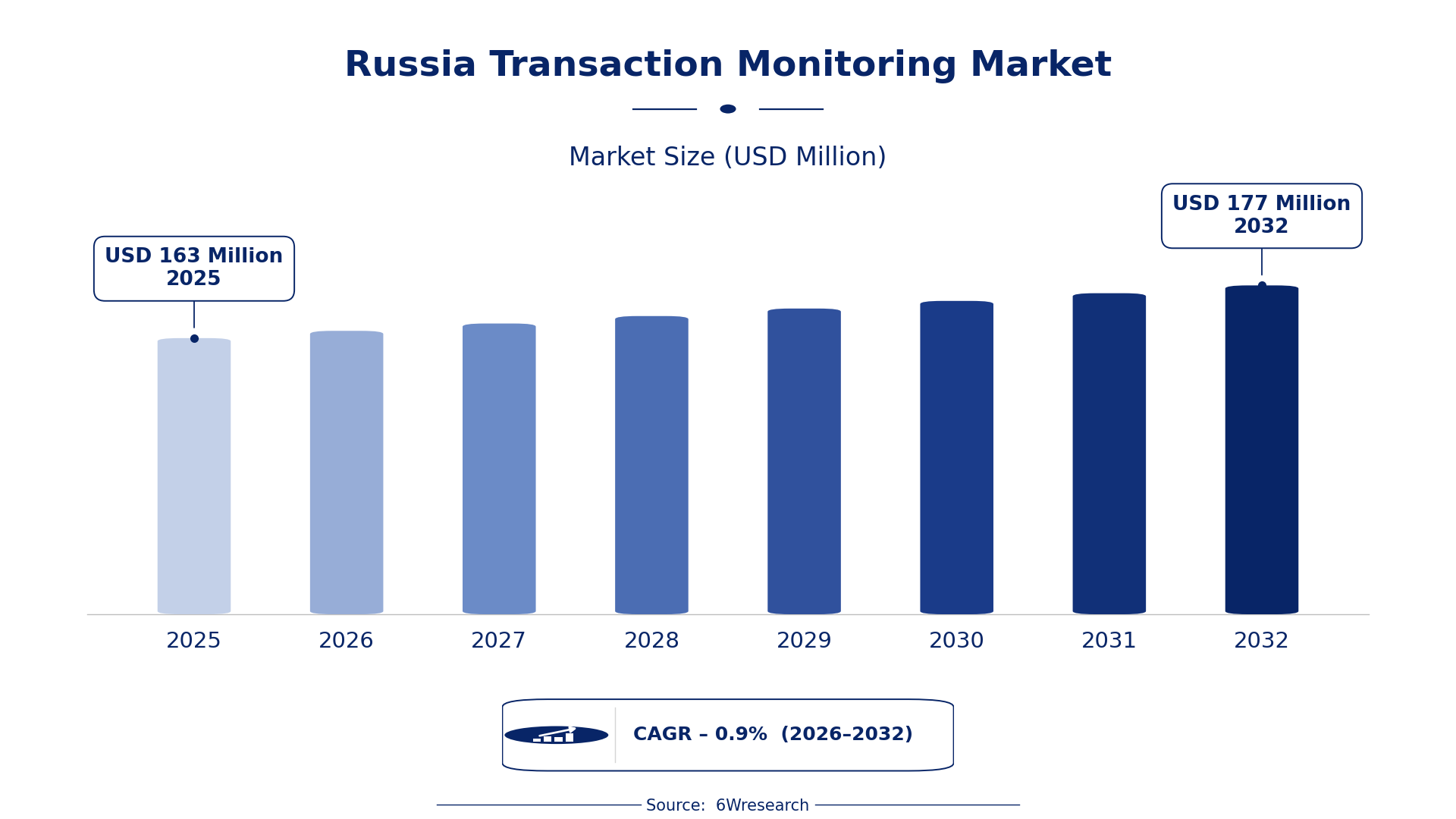
The Russia Transaction Monitoring Market was estimated at USD 163 Million in 2025 and is projected to reach USD 177 Million by 2032, growing at a CAGR of 0.9% from 2026 to 2032.
Russia Transaction Monitoring Market Synopsis
The Russia Transaction Monitoring Market is currently riding a wave of heightened regulatory scrutiny and an alarming uptick in financial crimes. As authorities ramp up their efforts to combat fraud and money laundering, businesses find themselves in a race to implement more advanced monitoring solutions. This has created a fertile ground for innovation and technology adoption, setting the stage for significant growth.
However, the path forward is not without its challenges. As the market evolves, companies must not only grapple with compliance demands but also adapt to increasingly sophisticated criminal tactics. The drive for more effective solutions and the shift towards cloud-based services present both hurdles and opportunities, urging stakeholders to rethink their strategies.
Russia Transaction Monitoring Market Year-wise Growth Rate and Key Drivers
This graph illustrates the annual growth rates of the Russia Transaction Monitoring Market from 2021 to 2032, highlighting a steady upward trajectory and projected expansion over the forecast period.
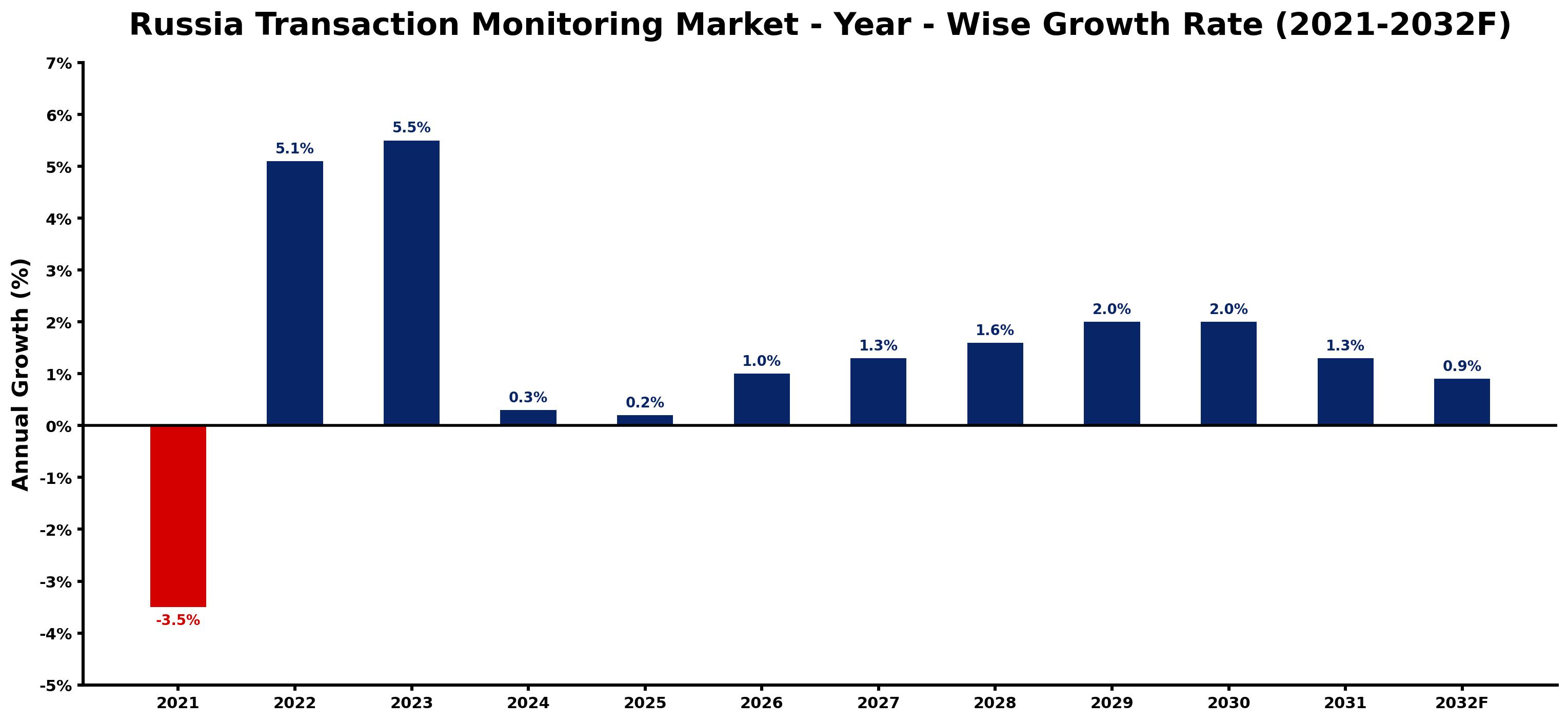
The table below presents the year‑wise growth rates along with the key drivers influencing the market
| Year | Growth Rate | Major Drivers |
| 2021 | -3.5% | Central Bank of Russia tightened compliance regulations. |
| 2022 | 5.1% | Enhanced AML regulations by the Central Bank of Russia |
| 2023 | 5.5% | Increasing cross-border transaction scrutiny amid sanctions measures |
| 2024 | 0.3% | Rising investment in cybersecurity frameworks for transaction safety |
| 2025 | 0.2% | Focus on digital identity verification fueled by local startups |
| 2026 | 1.0% | Adoption of AI technologies for fraud detection improving efficiency |
| 2027 | 1.3% | Government initiatives promoting fintech innovation and compliance |
| 2028 | 1.6% | Growing sophistication of money laundering techniques demands monitoring |
| 2029 | 2.0% | Increased collaboration between banks to share transaction data |
| 2030 | 2.0% | Implementation of new legislative frameworks enhancing compliance standards |
| 2031 | 1.3% | Strengthening of cooperative agreements with international regulatory bodies |
| 2032 | 0.9% | Advancements in blockchain technology improving transparency and traceability |
Note: Market size estimations and growth projections presented in this report are based on 6Wresearch's proprietary forecasting methodology, utilizing the latest available industry data, government publications, and primary research inputs.
Russia Transaction Monitoring Market Key Takeaways
Below are some of the specific key takeaways from the market, including:
- The market is fueled by rising regulatory requirements and a growing emphasis on AML and KYC practices.
- Investment in artificial intelligence and machine learning technologies is becoming commonplace among companies.
- Cloud-based transaction monitoring solutions are gaining traction for their scalability and flexibility.
- Financial institutions are prioritizing customizable solutions to meet specific compliance needs.
- The complexity of financial crimes continues to drive innovation in detection and monitoring systems.
Evaluation of Restraints in Russia Transaction Monitoring Market
The growth of the Russia Transaction Monitoring Market is hampered by several significant restraints. One of the primary issues is the stringent regulatory environment, which imposes heavy compliance burdens on financial institutions. Many organizations struggle to keep up with evolving laws, leading to gaps in their monitoring capabilities. on top of that, the sophistication of financial crimes presents a constant challenge, as traditional detection methods often fall short. Limited resources and expertise in implementing cutting-edge technologies like AI further exacerbate these difficulties, complicating the efforts to build effective monitoring systems.
Russia Transaction Monitoring Market Trends
There is a noticeable trend towards the integration of advanced technologies in transaction monitoring systems. Financial institutions increasingly rely on artificial intelligence and machine learning to enhance the accuracy and speed of identifying suspicious activities. This shift reflects the urgent need for more sophisticated solutions amidst a backdrop of complex financial crime tactics. Another prominent trend is the rising demand for cloud-based solutions, allowing for improved scalability as organizations process larger volumes of transactions. Tailored solutions designed to meet the unique needs of specific sectors within the market are also becoming increasingly important.
Russia Transaction Monitoring Market Opportunities
Amidst the regulatory pressure and growing incidence of financial crimes, the Russia Transaction Monitoring Market is presenting a plethora of investment opportunities. As digital transactions proliferate, there is a strong demand for efficient monitoring solutions capable of real-time detection of illicit activities. Organizations looking to enhance their AML and fraud prevention efforts represent prime targets for investment. on top of that, partnerships with technology providers specializing in AI and machine learning offer a promising avenue for growth and innovation in this sector.
Government Initiatives in the Russia Transaction Monitoring Market
The Russian government is actively shaping the transaction monitoring environment through stringent regulatory frameworks aimed at enhancing financial system integrity. The emphasis on compliance is not merely bureaucratic; it is a national priority in the battle against money laundering and terrorist financing. Policies established by the Central Bank and various regulatory agencies are essential for maintaining transparency and security in financial transactions.
- Recently completed: The introduction of a regulatory framework mandating advanced transaction monitoring systems across financial institutions, completed in early 2023.
- Currently ongoing: An initiative focused on integrating real-time data analytics into existing AML/CFT practices, currently in its pilot phase across select banks.
- Planned: A comprehensive public-private partnership aimed at developing a national transaction monitoring network expected to begin by 2025.
- Ongoing: Continuous training programs for compliance officers organized by the Federal Financial Monitoring Service to ensure effective implementation of new policies.
- Upcoming: The rollout of new guidelines emphasizing cross-border data sharing to enhance collaborative efforts in tackling financial crime, anticipated to launch in late 2024.
Future Insights of the Russia Transaction Monitoring Market
Looking ahead to 2026-2032, the Russia Transaction Monitoring Market is set for sustained growth, largely fueled by the mounting focus on compliance in the face of evolving financial crimes. As organizations increasingly prioritize the integration of advanced technologies, particularly AI and machine learning, their capabilities in detecting and preventing illicit activities are expected to improve significantly. The ongoing digitalization of banking and financial services will further drive demand, creating a fertile environment for market players to innovate and expand.
Russia Transaction Monitoring Market Latest Developments
Recent months have seen a surge in activity within the Russia Transaction Monitoring Market, reflecting an urgent response to regulatory demands and financial crime trends. Organizations are actively seeking to upgrade their capabilities, investing in new technologies and partnerships to enhance their monitoring systems.
- A leading regional operator announced a major upgrade of its transaction monitoring system, launched in Q1 2025, aimed at incorporating machine learning algorithms for better fraud detection.
- A collaboration between technology vendors to develop a cloud-based transaction monitoring platform is currently underway, expected to be fully operational by mid-2026.
- A new initiative focused on streamlining KYC processes through digital platforms began in late 2024 and is actively being rolled out across several financial institutions.
- A pilot program testing real-time risk assessment tools is currently ongoing, with early results indicating a reduction in fraudulent transactions.
- A planned partnership with international financial bodies is set to be established in 2025 to foster knowledge sharing and best practices in transaction monitoring.
Russia Transaction Monitoring Market - Key Attractiveness of the Report
- 10 Years of Market Numbers
- Historical Data Starting from 2022 to 2025
- Base Year: 2025
- Forecast Data until 2032
- Key Performance Indicators Impacting the Market
- Major Upcoming Developments and Projects
Key Highlights of the Report:
- Russia Transaction Monitoring Market Outlook
- Market Size of Russia Transaction Monitoring Market, 2025
- Forecast of Russia Transaction Monitoring Market, 2032
- Historical Data and Forecast of Russia Transaction Monitoring Revenues & Volume for the Period 2022-2032F
- Russia Transaction Monitoring Market Trend Evolution
- Russia Transaction Monitoring Market Drivers and Challenges
- Russia Transaction Monitoring Price Trends
- Russia Transaction Monitoring Porter's Five Forces
- Russia Transaction Monitoring Industry Life Cycle
- Historical Data and Forecast of Russia Transaction Monitoring Market Revenues & Volume By Application Area for the Period 2022-2032F
- Historical Data and Forecast of Russia Transaction Monitoring Market Revenues & Volume By AML for the Period 2022-2032F
- Historical Data and Forecast of Russia Transaction Monitoring Market Revenues & Volume By FDP for the Period 2022-2032F
- Historical Data and Forecast of Russia Transaction Monitoring Market Revenues & Volume By Compliance Management for the Period 2022-2032F
- Historical Data and Forecast of Russia Transaction Monitoring Market Revenues & Volume By Customer Identity Management for the Period 2022-2032F
- Historical Data and Forecast of Russia Transaction Monitoring Market Revenues & Volume By Component for the Period 2022-2032F
- Historical Data and Forecast of Russia Transaction Monitoring Market Revenues & Volume By Solution for the Period 2022-2032F
- Historical Data and Forecast of Russia Transaction Monitoring Market Revenues & Volume By Services for the Period 2022-2032F
- Historical Data and Forecast of Russia Transaction Monitoring Market Revenues & Volume By Function for the Period 2022-2032F
- Historical Data and Forecast of Russia Transaction Monitoring Market Revenues & Volume By Case Management for the Period 2022-2032F
- Historical Data and Forecast of Russia Transaction Monitoring Market Revenues & Volume By KYC/Customer Onboarding for the Period 2022-2032F
- Historical Data and Forecast of Russia Transaction Monitoring Market Revenues & Volume By Dashboard and Reporting for the Period 2022-2032F
- Historical Data and Forecast of Russia Transaction Monitoring Market Revenues & Volume By Watch List Screening for the Period 2022-2032F
- Historical Data and Forecast of Russia Transaction Monitoring Market Revenues & Volume By Deployment Mode for the Period 2022-2032F
- Historical Data and Forecast of Russia Transaction Monitoring Market Revenues & Volume By On-Premises for the Period 2022-2032F
- Historical Data and Forecast of Russia Transaction Monitoring Market Revenues & Volume By Cloud for the Period 2022-2032F
- Historical Data and Forecast of Russia Transaction Monitoring Market Revenues & Volume By Organization Size for the Period 2022-2032F
- Historical Data and Forecast of Russia Transaction Monitoring Market Revenues & Volume By SMEs for the Period 2022-2032F
- Historical Data and Forecast of Russia Transaction Monitoring Market Revenues & Volume By Large Enterprises for the Period 2022-2032F
- Historical Data and Forecast of Russia Transaction Monitoring Market Revenues & Volume By Vertical for the Period 2022-2032F
- Historical Data and Forecast of Russia Transaction Monitoring Market Revenues & Volume By Banking, Financial Services, and Insurance for the Period 2022-2032F
- Historical Data and Forecast of Russia Transaction Monitoring Market Revenues & Volume By Government and Defense for the Period 2022-2032F
- Historical Data and Forecast of Russia Transaction Monitoring Market Revenues & Volume By IT and Telecom for the Period 2022-2032F
- Historical Data and Forecast of Russia Transaction Monitoring Market Revenues & Volume By Retail for the Period 2022-2032F
- Historical Data and Forecast of Russia Transaction Monitoring Market Revenues & Volume By Healthcare for the Period 2022-2032F
- Historical Data and Forecast of Russia Transaction Monitoring Market Revenues & Volume By Energy and Utilities for the Period 2022-2032F
- Historical Data and Forecast of Russia Transaction Monitoring Market Revenues & Volume By Manufacturing for the Period 2022-2032F
- Historical Data and Forecast of Russia Transaction Monitoring Market Revenues & Volume By Others for the Period 2022-2032F
- Russia Transaction Monitoring Import Export Trade Statistics
- Market Opportunity Assessment By Application Area
- Market Opportunity Assessment By Component
- Market Opportunity Assessment By Function
- Market Opportunity Assessment By Deployment Mode
- Market Opportunity Assessment By Organization Size
- Market Opportunity Assessment By Vertical
- Russia Transaction Monitoring Top Companies Market Share
- Russia Transaction Monitoring Competitive Benchmarking By Technical and Operational Parameters
- Russia Transaction Monitoring Company Profiles
- Russia Transaction Monitoring Key Strategic Recommendations






































