Russia Underground Mining Equipment Market Size, Share & Growth Rate
The Russia Underground Mining Equipment Market was estimated at USD 206 Million in 2025 and is projected to reach USD 225 Million by 2032, growing at a CAGR of 1.3% from 2026 to 2032. This steady growth trajectory is primarily fueled by the ongoing expansion of mining operations in resource-rich regions, coupled with the pressing need to replace antiquated equipment. As mining companies increasingly focus on enhancing operational efficiency and safety, investments in advanced machinery and technology are expected to rise significantly.
Russia Underground Mining Equipment Market Year-wise Growth Rate and Key Drivers
This graph highlights how the Russia Underground Mining Equipment Market has steadily grown over the years, supported by major growth factors.
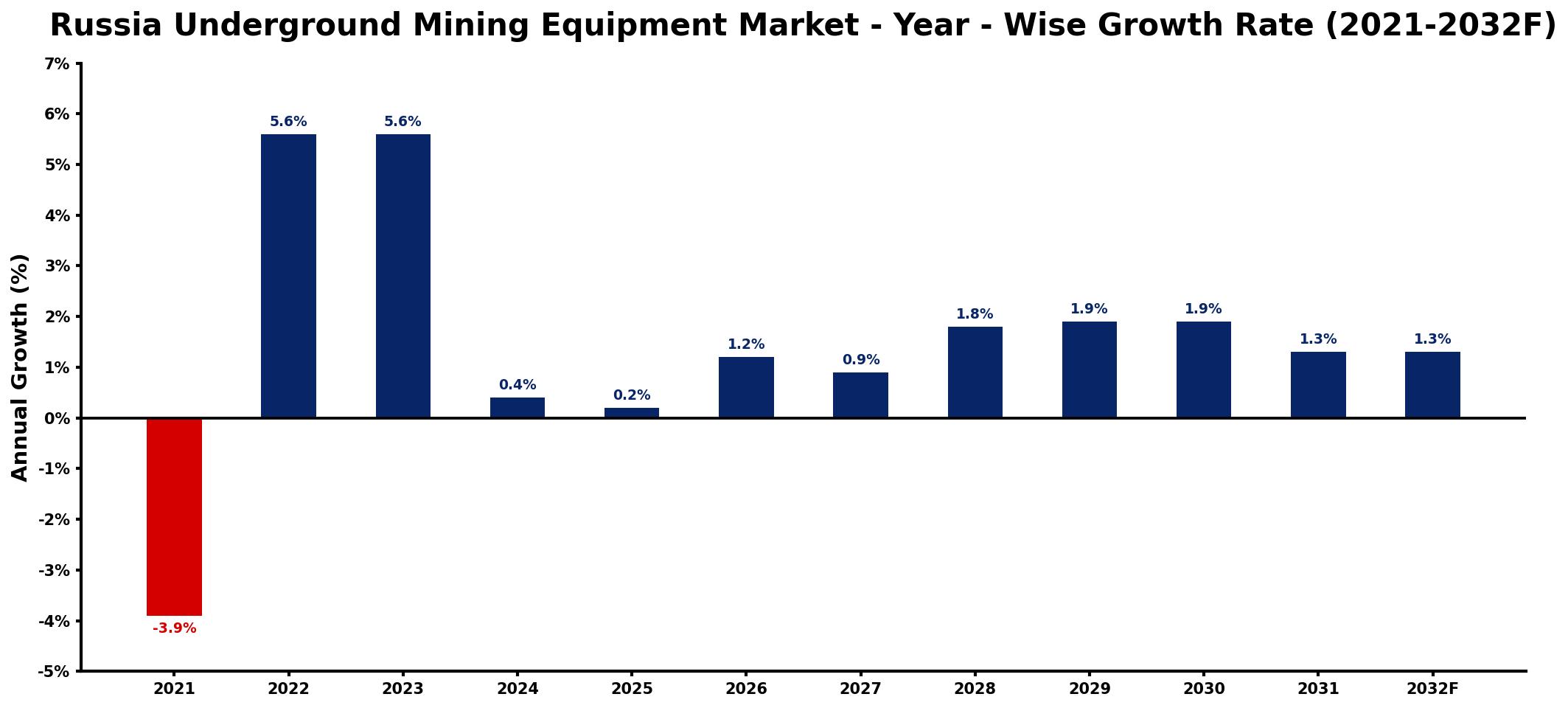
The table below presents the year‑wise growth rates along with the key drivers influencing the market
| Year | Growth Rate | Major Drivers |
| 2021 | -3.9% | decreased investment in infrastructure projects |
| 2022 | 5.6% | surge in energy sector investments |
| 2023 | 5.6% | rising demand for raw materials |
| 2024 | 0.4% | expansion in construction activities |
| 2025 | 0.2% | increased exploration in new regions |
| 2026 | 1.2% | growing focus on automation technologies |
| 2027 | 0.9% | enhanced regulatory support for projects |
| 2028 | 1.8% | development of renewable energy initiatives |
| 2029 | 1.9% | strengthening international trade relations |
| 2030 | 1.9% | rising interest in sustainable practices |
| 2031 | 1.3% | increased collaboration with local firms |
| 2032 | 1.3% | growing emphasis on safety standards |
Note: Market size estimations and growth projections presented in this report are based on 6Wresearch's proprietary forecasting methodology, utilizing the latest available industry data, government publications, and primary research inputs.
Russia Underground Mining Equipment Market Synopsis
The Russia Underground Mining Equipment Market has recently gained momentum due to increased mining activity, particularly in areas like Siberia and the Far East. As operators strive to modernize their fleets, the demand for high-performance equipment is on the rise. This trend contrasts with the market's historical reliance on outdated machinery that no longer meets operational demands.
Looking ahead, the market is set to evolve, influenced by technological innovations and a growing emphasis on sustainability. The shift towards automated systems and eco-friendly practices will play a significant role in reshaping the landscape of underground mining in Russia, offering new avenues for growth and modernization.
Russia Underground Mining Equipment Market Key Takeaways
- Strong demand for advanced machinery to boost productivity and safety in underground mining.
- Increased adoption of automation and digital technologies driving market transformation.
- Government initiatives aimed at promoting local manufacturing and sustainability within the sector.
- Investment opportunities abound in modernizing outdated equipment and implementing eco-friendly practices.
- Challenges such as economic uncertainty and regulatory hurdles present ongoing market dynamics.
Evaluation of Restraints in Russia Underground Mining Equipment Market
Despite the promising outlook, the Russia Underground Mining Equipment Market faces significant restraints. Economic volatility and fluctuating commodity prices hinder investment decisions, impacting the overall growth potential of mining operations. Moreover, regulatory challenges, particularly concerning permit acquisition, create hurdles that companies must navigate. These complexities are compounded by the need for investments in sustainable practices and access to skilled labor, which are critical for effectively deploying advanced mining technologies.
Russia Underground Mining Equipment Market Trends
The market is currently witnessing several transformative trends. There is a pronounced shift towards the use of automated and remote-controlled equipment, enhancing operational efficiency while reducing the risk to human workers. Additionally, the integration of advanced technologies like IoT and artificial intelligence is optimizing mining processes, enabling companies to leverage data analytics for improved productivity. Furthermore, the industry is increasingly adopting environmentally sustainable practices, prompting the development of energy-efficient equipment that aligns with global environmental standards.
Russia Underground Mining Equipment Market Opportunities
The Russia Underground Mining Equipment Market offers substantial investment opportunities, particularly due to the nation's vast mineral wealth and the rising global demand for various metals and minerals. Companies providing cutting-edge machinery and technology tailored to local mining requirements stand to benefit significantly. Furthermore, there exists potential for strategic partnerships with regional mining companies to deliver customized solutions, enhancing both operational efficiencies and market competitiveness.
Government Initiatives in the Russia Underground Mining Equipment Market
The Russian government has introduced various initiatives to bolster the underground mining equipment sector. There is a concerted effort to stimulate domestic production through financial incentives and regulatory frameworks designed to improve local manufacturing capabilities. These policies are aimed not only at enhancing the industrys competitiveness but also at ensuring compliance with safety and environmental standards. The overarching goal of these government actions is to drive innovation and sustainable growth within the mining equipment landscape.
Future Insights of the Russia Underground Mining Equipment Market
Looking towards the future, the Russia Underground Mining Equipment Market is poised for steady growth as it adapts to emerging trends and challenges. The increasing demand for minerals is likely to spur further investments in advanced mining technologies, while government support will catalyze modernization efforts. However, external factors such as geopolitical tensions and economic fluctuations may pose risks to market stability. As innovation and sustainability continue to dictate industry advancements, the future appears bright for those willing to invest in this evolving sector.
Russia Underground Mining Equipment Market Latest Developments (2025 - 2026)
In recent months, the underground mining equipment sector has seen significant movement towards increased automation, with many companies testing remote-controlled machinery in harsh environments. There is also a rising trend in adopting data-driven solutions to streamline operations and enhance safety measures. Concurrently, discussions surrounding regulations aimed at improving environmental practices are shaping the future direction of mining operations, reflecting a broader commitment to sustainability across the industry.
Russia Underground Mining Equipment Market - Key Attractiveness of the Report
- 10 Years of Market Numbers
- Historical Data Starting from 2022 to 2025
- Base Year: 2025
- Forecast Data until 2032
- Key Performance Indicators Impacting the Market
- Major Upcoming Developments and Projects
Key Highlights of the Report:
- Russia Underground Mining Equipment Market Outlook
- Market Size of Russia Underground Mining Equipment Market, 2025
- Forecast of Russia Underground Mining Equipment Market, 2032
- Historical Data and Forecast of Russia Underground Mining Equipment Revenues & Volume for the Period 2022-2032F
- Russia Underground Mining Equipment Market Trend Evolution
- Russia Underground Mining Equipment Market Drivers and Challenges
- Russia Underground Mining Equipment Price Trends
- Russia Underground Mining Equipment Porter's Five Forces
- Russia Underground Mining Equipment Industry Life Cycle
- Historical Data and Forecast of Russia Underground Mining Equipment Market Revenues & Volume By Product Type for the Period 2022-2032F
- Historical Data and Forecast of Russia Underground Mining Equipment Market Revenues & Volume By Mining Loaders for the Period 2022-2032F
- Historical Data and Forecast of Russia Underground Mining Equipment Market Revenues & Volume By Mining Trucks for the Period 2022-2032F
- Historical Data and Forecast of Russia Underground Mining Equipment Market Revenues & Volume By Mining Drills for the Period 2022-2032F
- Historical Data and Forecast of Russia Underground Mining Equipment Market Revenues & Volume By Mining Bolters for the Period 2022-2032F
- Historical Data and Forecast of Russia Underground Mining Equipment Market Revenues & Volume By Mining Shearer for the Period 2022-2032F
- Historical Data and Forecast of Russia Underground Mining Equipment Market Revenues & Volume By Continuous Miners for the Period 2022-2032F
- Historical Data and Forecast of Russia Underground Mining Equipment Market Revenues & Volume By Mining Excavators & Shovels for the Period 2022-2032F
- Historical Data and Forecast of Russia Mining Loaders Underground Mining Equipment Market Revenues & Volume By Mining Scalers for the Period 2022-2032F
- Historical Data and Forecast of Russia Underground Mining Equipment Market Revenues & Volume By Mining Technique for the Period 2022-2032F
- Historical Data and Forecast of Russia Underground Mining Equipment Market Revenues & Volume By Soft Rock Mining for the Period 2022-2032F
- Historical Data and Forecast of Russia Underground Mining Equipment Market Revenues & Volume By Hard Rock Mining for the Period 2022-2032F
- Historical Data and Forecast of Russia Underground Mining Equipment Market Revenues & Volume By End Users for the Period 2022-2032F
- Historical Data and Forecast of Russia Underground Mining Equipment Market Revenues & Volume By Mining Operators for the Period 2022-2032F
- Historical Data and Forecast of Russia Underground Mining Equipment Market Revenues & Volume By Rental Service Provider for the Period 2022-2032F
- Russia Underground Mining Equipment Import Export Trade Statistics
- Market Opportunity Assessment By Product Type
- Market Opportunity Assessment By Mining Technique
- Market Opportunity Assessment By End Users
- Russia Underground Mining Equipment Top Companies Market Share
- Russia Underground Mining Equipment Competitive Benchmarking By Technical and Operational Parameters
- Russia Underground Mining Equipment Company Profiles
- Russia Underground Mining Equipment Key Strategic Recommendations






































