Ghana Underground Mining Equipment Market Size, Share & Growth Rate
The Ghana Underground Mining Equipment Market was estimated at USD 425 Million in 2025 and is projected to reach USD 601 Million by 2032, growing at a CAGR of 5.1% from 2026 to 2032. This growth trajectory is significantly driven by the expansion of mining operations, particularly within the gold, bauxite, and manganese sectors. As Ghana positions itself as a focal point for investment in mineral exploration and production, the demand for advanced underground mining technologies and equipment will continue to escalate.
Ghana Underground Mining Equipment Market Year-wise Growth Rate and Key Drivers
This graph highlights how the Ghana Underground Mining Equipment Market has steadily grown over the years, supported by major growth factors.
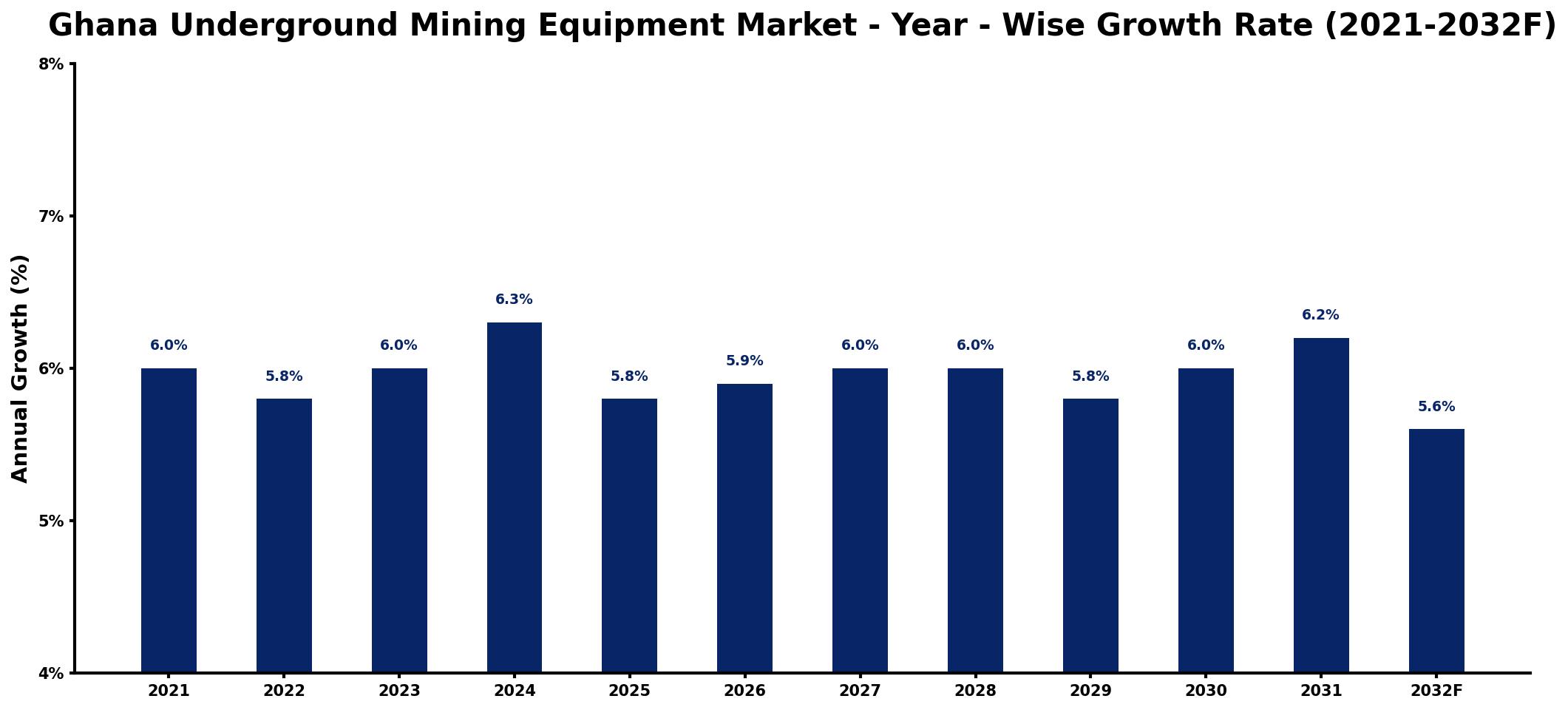
The table below presents the year‑wise growth rates along with the key drivers influencing the market
| Year | Growth Rate | Major Drivers |
| 2021 | 6.0% | Rising investments in infrastructure projects |
| 2022 | 5.8% | Growing demand for mineral resources |
| 2023 | 6.0% | Increased government support initiatives |
| 2024 | 6.3% | Expansion of renewable energy projects |
| 2025 | 5.8% | Technological advancements in automation |
| 2026 | 5.9% | Enhanced safety regulations implementation |
| 2027 | 6.0% | Higher global commodity prices forecast |
| 2028 | 6.0% | Emerging markets demand surge |
| 2029 | 5.8% | Strategic partnerships among industry players |
| 2030 | 6.0% | Focus on sustainable resource management |
| 2031 | 6.2% | Improved logistics and transportation networks |
| 2032 | 5.6% | Diversification of mineral exploration efforts |
Note: Market size estimations and growth projections presented in this report are based on 6Wresearch's proprietary forecasting methodology, utilizing the latest available industry data, government publications, and primary research inputs.
Ghana Underground Mining Equipment Market Synopsis
The most compelling force shaping the Ghana Underground Mining Equipment Market is the country's robust mining sector, characterized by its rich mineral deposits and government support. This environment encourages both local and foreign investments in state-of-the-art mining technologies, further invigorating market dynamics.
Additionally, ongoing infrastructure developments are enhancing access to remote mining sites, which is crucial for efficient operations. These advancements are helping to minimize operational downtime and optimize mineral extraction processes, thereby reinforcing the demand for reliable and sophisticated underground mining equipment.
Ghana Underground Mining Equipment Market Key Takeaways
- The Ghanaian market for underground mining equipment is experiencing steady growth fueled by investment in gold and mineral extraction.
- Government initiatives aimed at promoting sustainable mining practices are creating a favorable environment for equipment manufacturers.
- The demand for technologically advanced solutions, such as automated and semi-automated equipment, is on the rise.
- Partnerships between mining companies and equipment manufacturers are fostering innovation and efficiency in underground operations.
- Training programs and safety regulations are becoming increasingly important for ensuring workforce readiness and compliance.
Evaluation of Restraints in Ghana Underground Mining Equipment Market
Despite a promising outlook, several factors hinder the full potential of the Ghana Underground Mining Equipment Market. Foremost among these is the challenge of ensuring equipment reliability and durability in demanding underground conditions. The harsh environment requires robust equipment designed to withstand significant wear and tear. Furthermore, operator safety remains a critical concern, necessitating rigorous training programs that can often incur additional costs. The overall financial burden of maintenance and equipment replacement can also be prohibitive, particularly for smaller operators. Addressing these challenges will be essential for sustainable market growth.
Ghana Underground Mining Equipment Market Trends
The Ghana Underground Mining Equipment Market is currently influenced by several key trends. A notable shift toward automation is reshaping operational practices, as companies seek to enhance efficiency and safety. Additionally, there is a growing emphasis on environmentally friendly practices, driving demand for equipment that minimizes ecological impact. Digital solutions and data analytics are being increasingly integrated into mining operations, allowing for better decision-making and resource management. These trends reflect a broader industry evolution toward more sustainable and effective mining practices.
Ghana Underground Mining Equipment Market Opportunities
The landscape of opportunities in the Ghana Underground Mining Equipment Market is vibrant. Investment in modern technologies, particularly in areas such as automation and sustainable equipment, presents substantial growth potential. Furthermore, ongoing government initiatives to enhance skills training and safety measures create a conducive environment for innovative equipment solutions. Collaborations between local mining firms and international manufacturers can also accelerate technology transfer, fostering a more competitive and efficient mining sector in Ghana.
Government Initiatives in the Ghana Underground Mining Equipment Market
The government of Ghana is actively implementing policies to enhance the mining sector's sustainability and efficiency. These initiatives include regulations designed to ensure compliance with occupational health and safety standards and environmental impact assessments. Furthermore, there are ongoing efforts to facilitate technology transfer and collaboration between various stakeholders in the industry, including equipment manufacturers and research institutions. This framework not only encourages responsible mining practices but also attracts further investment in modern mining technologies.
Future Insights of the Ghana Underground Mining Equipment Market
Looking ahead to 2026-2032, the Ghana Underground Mining Equipment Market is poised for significant transformation. With continuous investments in exploration and technology, particularly in automation and sustainable practices, the market is expected to evolve rapidly. Demand for advanced equipment will likely intensify as miners seek to improve efficiency and reduce operational costs. Additionally, enhanced training programs and safety measures will cultivate a more skilled workforce, further bolstering the industry's prospects. Overall, the future appears promising for stakeholders in Ghana's underground mining sector.
Ghana Underground Mining Equipment Market Latest Developments (2025 - 2026)
Recent developments in the Ghana Underground Mining Equipment Market indicate a strong focus on innovation and sustainability. Companies are increasingly adopting advanced mining technologies to streamline operations and enhance safety standards. Collaborative efforts between government agencies and private sector players are aimed at improving regulatory frameworks and promoting investments in modern equipment. The ongoing trend towards automation and data-driven decision-making is also gaining traction, positioning the market for a transformative phase in the coming years.
Ghana Underground Mining Equipment Market - Key Attractiveness of the Report
- 10 Years of Market Numbers
- Historical Data Starting from 2022 to 2025
- Base Year: 2025
- Forecast Data until 2032
- Key Performance Indicators Impacting the Market
- Major Upcoming Developments and Projects
Key Highlights of the Report:
- Ghana Underground Mining Equipment Market Outlook
- Market Size of Ghana Underground Mining Equipment Market, 2025
- Forecast of Ghana Underground Mining Equipment Market, 2032
- Historical Data and Forecast of Ghana Underground Mining Equipment Revenues & Volume for the Period 2022-2032F
- Ghana Underground Mining Equipment Market Trend Evolution
- Ghana Underground Mining Equipment Market Drivers and Challenges
- Ghana Underground Mining Equipment Price Trends
- Ghana Underground Mining Equipment Porter's Five Forces
- Ghana Underground Mining Equipment Industry Life Cycle
- Historical Data and Forecast of Ghana Underground Mining Equipment Market Revenues & Volume By Product Type for the Period 2022-2032F
- Historical Data and Forecast of Ghana Underground Mining Equipment Market Revenues & Volume By Mining Loaders for the Period 2022-2032F
- Historical Data and Forecast of Ghana Underground Mining Equipment Market Revenues & Volume By Mining Trucks for the Period 2022-2032F
- Historical Data and Forecast of Ghana Underground Mining Equipment Market Revenues & Volume By Mining Drills for the Period 2022-2032F
- Historical Data and Forecast of Ghana Underground Mining Equipment Market Revenues & Volume By Mining Bolters for the Period 2022-2032F
- Historical Data and Forecast of Ghana Underground Mining Equipment Market Revenues & Volume By Mining Shearer for the Period 2022-2032F
- Historical Data and Forecast of Ghana Underground Mining Equipment Market Revenues & Volume By Continuous Miners for the Period 2022-2032F
- Historical Data and Forecast of Ghana Underground Mining Equipment Market Revenues & Volume By Mining Excavators & Shovels for the Period 2022-2032F
- Historical Data and Forecast of Ghana Mining Loaders Underground Mining Equipment Market Revenues & Volume By Mining Scalers for the Period 2022-2032F
- Historical Data and Forecast of Ghana Underground Mining Equipment Market Revenues & Volume By Mining Technique for the Period 2022-2032F
- Historical Data and Forecast of Ghana Underground Mining Equipment Market Revenues & Volume By Soft Rock Mining for the Period 2022-2032F
- Historical Data and Forecast of Ghana Underground Mining Equipment Market Revenues & Volume By Hard Rock Mining for the Period 2022-2032F
- Historical Data and Forecast of Ghana Underground Mining Equipment Market Revenues & Volume By End Users for the Period 2022-2032F
- Historical Data and Forecast of Ghana Underground Mining Equipment Market Revenues & Volume By Mining Operators for the Period 2022-2032F
- Historical Data and Forecast of Ghana Underground Mining Equipment Market Revenues & Volume By Rental Service Provider for the Period 2022-2032F
- Ghana Underground Mining Equipment Import Export Trade Statistics
- Market Opportunity Assessment By Product Type
- Market Opportunity Assessment By Mining Technique
- Market Opportunity Assessment By End Users
- Ghana Underground Mining Equipment Top Companies Market Share
- Ghana Underground Mining Equipment Competitive Benchmarking By Technical and Operational Parameters
- Ghana Underground Mining Equipment Company Profiles
- Ghana Underground Mining Equipment Key Strategic Recommendations






































