Saudi Arabia Aggregates Market: Import Trend Analysis
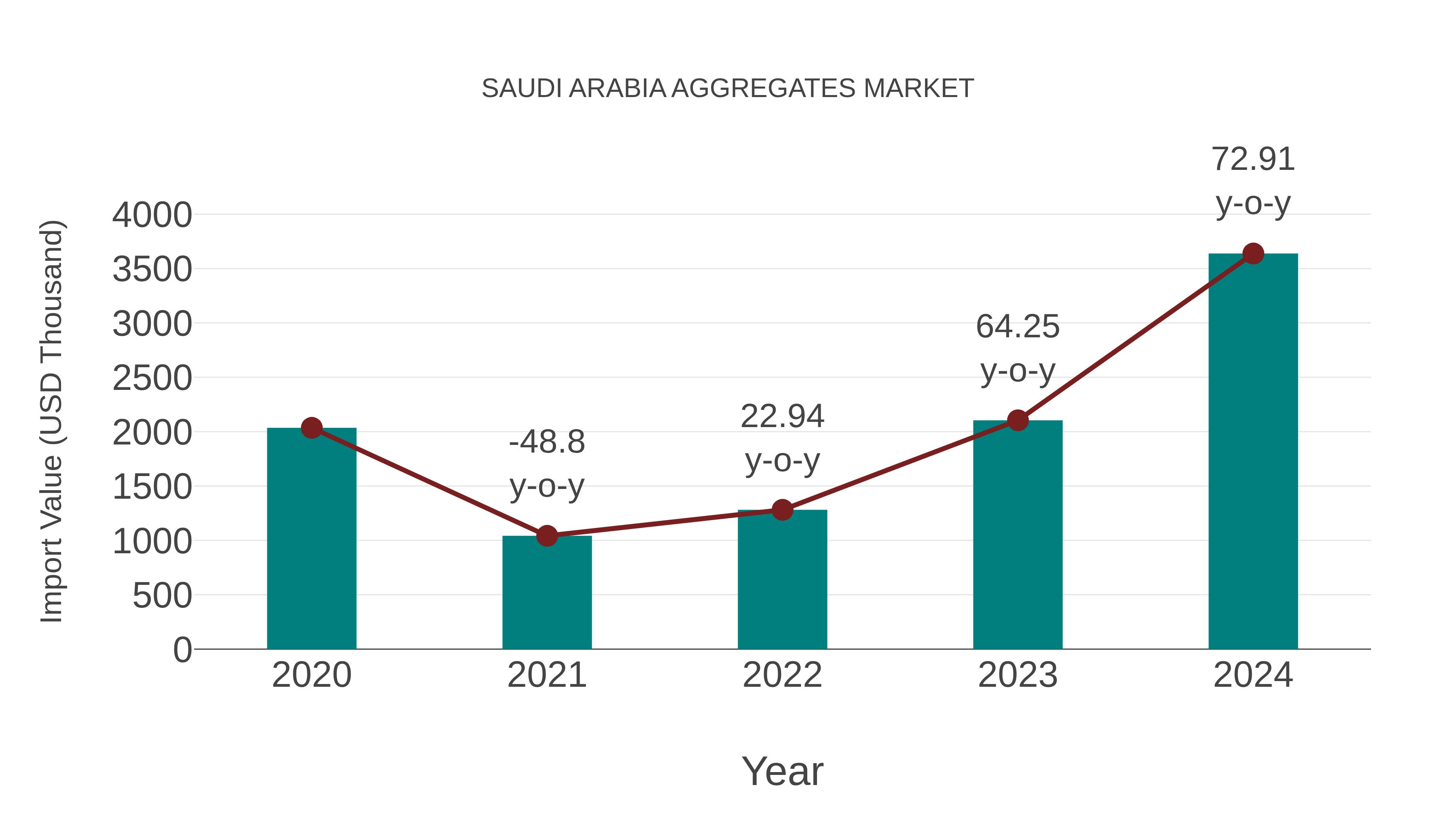
In the Saudi Arabia aggregates market, the import trend showed significant growth from 2023 to 2024, with a growth rate of 72.91%. The compound annual growth rate (CAGR) for the period 2020-2024 stood at 15.63%. This surge in imports can be attributed to a notable shift in demand for construction materials, reflecting robust infrastructure development initiatives in the region.
Saudi Arabia Aggregates Market Overview
The Saudi Arabia aggregates market is witnessing steady growth driven by the country`s significant infrastructure development projects, such as roads, bridges, and residential construction. The demand for aggregates, including sand, gravel, and crushed stones, is fueled by the expanding construction sector and government investments in large-scale projects. The market is highly competitive with key players like Saudi Readymix, Al Rajhi Group, and Al Shuwaikh Crusher leading the industry. Factors such as rapid urbanization, population growth, and ongoing mega-projects like Vision 2030 are expected to further boost the demand for aggregates in Saudi Arabia. However, challenges such as environmental concerns related to quarrying activities and fluctuating oil prices could impact the market`s growth trajectory in the future.
Saudi Arabia Aggregates Market Trends
In Saudi Arabia, the aggregates market is experiencing a growing demand due to the country`s rapid infrastructure development, including construction projects related to Vision 2030. The government`s focus on diversifying the economy has led to increased investments in residential, commercial, and industrial construction, driving the demand for aggregates such as sand, gravel, and crushed stone. Additionally, the emphasis on sustainability and environmentally friendly practices has led to the adoption of recycled aggregates in construction projects. Market players are also expanding their product offerings to meet the specific requirements of various construction applications. Overall, the Saudi Arabia aggregates market is witnessing growth driven by infrastructure development, sustainability initiatives, and evolving customer demands.
Saudi Arabia Aggregates Market Challenges
In the Saudi Arabia aggregates market, some key challenges include fluctuations in oil prices impacting construction projects, regulatory changes affecting the mining industry, scarcity of high-quality natural aggregates leading to a reliance on imported materials, and competition among local and international players. Additionally, infrastructure development and urbanization in the region are driving high demand for aggregates, putting pressure on supply chains and logistics. Environmental concerns related to quarrying activities, such as dust and noise pollution, also pose challenges for sustainable operations in the sector. Overcoming these challenges will require strategic planning, investment in technological advancements for efficient extraction and processing, as well as adherence to stringent regulations to ensure sustainable growth in the Saudi Arabia aggregates market.
Saudi Arabia Aggregates Market Investment Opportunities
In the Saudi Arabia aggregates market, there are several promising investment opportunities. With the country`s ambitious infrastructure development plans, there is a growing demand for construction aggregates such as sand, gravel, and crushed stone. Investors can consider opportunities in aggregate production facilities, transportation and logistics services for aggregate distribution, and technology solutions for efficient extraction and processing of aggregates. Additionally, as sustainability and environmental concerns become more prominent, investments in eco-friendly aggregate production methods like recycled aggregates or use of alternative materials can also be lucrative. Overall, the Saudi Arabia aggregates market presents a favorable landscape for investors looking to capitalize on the country`s construction boom and long-term growth prospects.
Saudi Arabia Aggregates Market Government Policy
In Saudi Arabia, government policies related to the aggregates market are focused on promoting the sustainable extraction and utilization of natural resources while ensuring environmental protection. The government has implemented regulations to regulate the mining and quarrying activities in the country, aiming to balance economic development with environmental conservation. Additionally, there are strict guidelines in place to ensure the safety and well-being of workers in the aggregates industry. The government also encourages investment in the development of infrastructure projects, which drives the demand for aggregates in the construction sector. Overall, Saudi Arabia`s government policies in the aggregates market aim to support the industry`s growth while safeguarding the environment and promoting sustainable practices.
Saudi Arabia Aggregates Market Future Outlook
The Saudi Arabia aggregates market is expected to witness steady growth in the coming years due to the country`s ambitious infrastructure development projects, such as the Vision 2030 plan and the construction of new cities like NEOM. The demand for aggregates is likely to increase further with the expanding construction and transportation sectors. Additionally, the government`s focus on diversifying the economy and reducing its dependence on oil revenues will drive investments in infrastructure, leading to sustained demand for aggregates. However, challenges such as fluctuating oil prices and regulatory constraints may impact market growth. Overall, the Saudi Arabia aggregates market is poised for growth, supported by robust construction activities and infrastructure development initiatives.
Key Highlights of the Report:
- Saudi Arabia Aggregates Market Outlook
- Market Size of Saudi Arabia Aggregates Market, 2025
- Forecast of Saudi Arabia Aggregates Market, 2032
- Historical Data and Forecast of Saudi Arabia Aggregates Revenues & Volume for the Period 2022-2032F
- Saudi Arabia Aggregates Market Trend Evolution
- Saudi Arabia Aggregates Market Drivers and Challenges
- Saudi Arabia Aggregates Price Trends
- Saudi Arabia Aggregates Porter's Five Forces
- Saudi Arabia Aggregates Industry Life Cycle
- Historical Data and Forecast of Saudi Arabia Aggregates Market Revenues & Volume By Product Type for the Period 2022-2032F
- Historical Data and Forecast of Saudi Arabia Aggregates Market Revenues & Volume By Crushed Stone for the Period 2022-2032F
- Historical Data and Forecast of Saudi Arabia Aggregates Market Revenues & Volume By Sand for the Period 2022-2032F
- Historical Data and Forecast of Saudi Arabia Aggregates Market Revenues & Volume By Gravel for the Period 2022-2032F
- Historical Data and Forecast of Saudi Arabia Aggregates Market Revenues & Volume By Recycled Aggregates for the Period 2022-2032F
- Historical Data and Forecast of Saudi Arabia Aggregates Market Revenues & Volume By Application for the Period 2022-2032F
- Historical Data and Forecast of Saudi Arabia Aggregates Market Revenues & Volume By Construction Materials for the Period 2022-2032F
- Historical Data and Forecast of Saudi Arabia Aggregates Market Revenues & Volume By Road Construction for the Period 2022-2032F
- Historical Data and Forecast of Saudi Arabia Aggregates Market Revenues & Volume By Concrete Production for the Period 2022-2032F
- Historical Data and Forecast of Saudi Arabia Aggregates Market Revenues & Volume By Landscaping for the Period 2022-2032F
- Historical Data and Forecast of Saudi Arabia Aggregates Market Revenues & Volume By End User for the Period 2022-2032F
- Historical Data and Forecast of Saudi Arabia Aggregates Market Revenues & Volume By Construction Industry for the Period 2022-2032F
- Historical Data and Forecast of Saudi Arabia Aggregates Market Revenues & Volume By Residential for the Period 2022-2032F
- Historical Data and Forecast of Saudi Arabia Aggregates Market Revenues & Volume By Commercial for the Period 2022-2032F
- Saudi Arabia Aggregates Import Export Trade Statistics
- Market Opportunity Assessment By Product Type
- Market Opportunity Assessment By Application
- Market Opportunity Assessment By End User
- Saudi Arabia Aggregates Top Companies Market Share
- Saudi Arabia Aggregates Competitive Benchmarking By Technical and Operational Parameters
- Saudi Arabia Aggregates Company Profiles
- Saudi Arabia Aggregates Key Strategic Recommendations






































