Saudi Arabia Algorithmic Trading Market Size & Growth Rate (2026-2032)
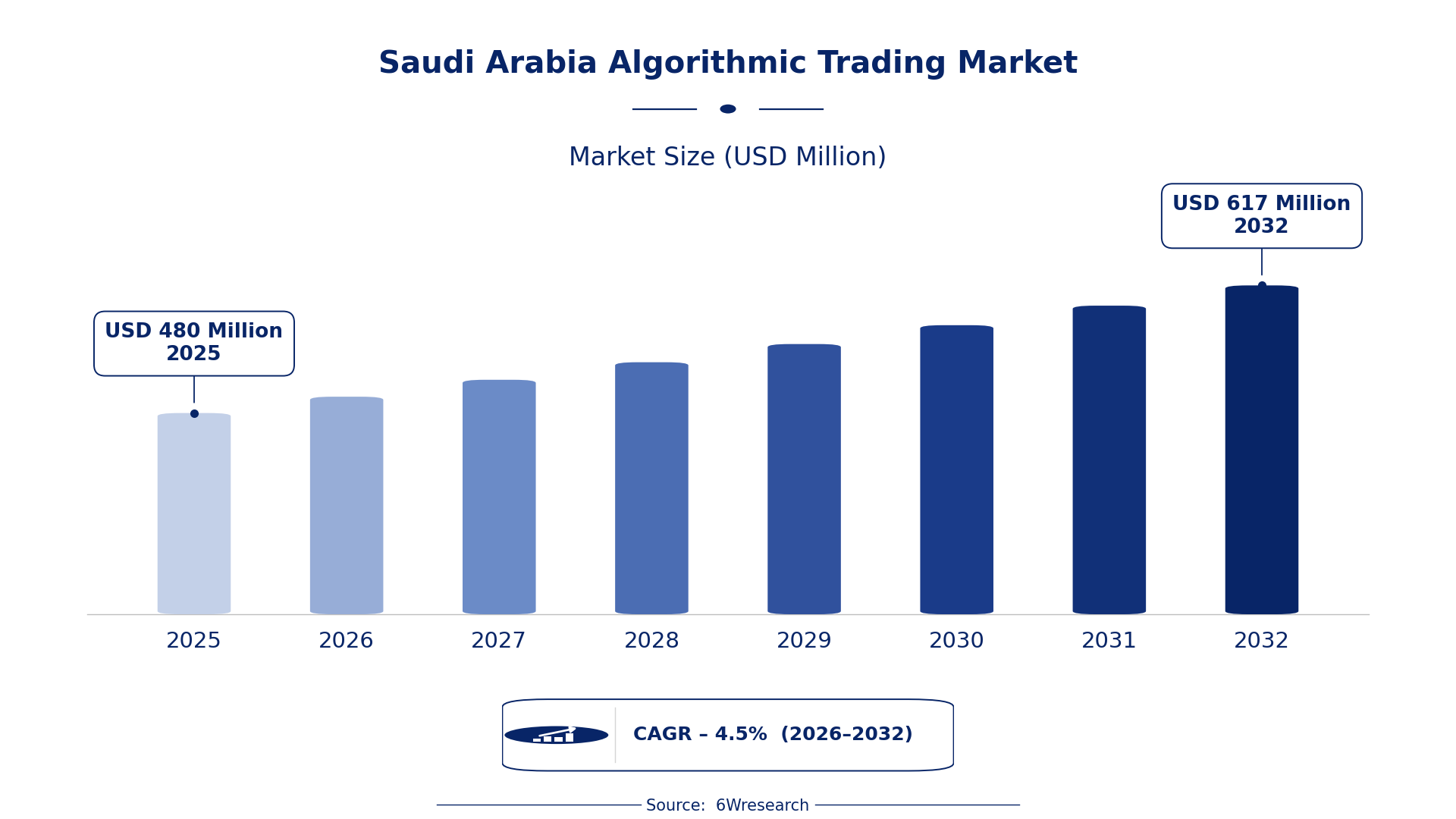
The Saudi Arabia Algorithmic Trading Market was estimated at USD 480 Million in 2025 and is projected to reach USD 617 Million by 2032, growing at a CAGR of 4.5% from 2026 to 2032.
Saudi Arabia Algorithmic Trading Market Synopsis
The Saudi Arabia Algorithmic Trading Market is witnessing a surge in activity, reflecting a broader trend in financial markets where automation is becoming essential. As more institutions and traders adopt algorithmic strategies, the market is not just growing; it’s transforming the way trades are executed and decisions are made.
Looking ahead, the market is expected to evolve as technological advancements continue to drive efficiency and speed. With the integration of AI and advanced analytics, traders will have more tools at their disposal, leading to even more sophisticated trading strategies.
Saudi Arabia Algorithmic Trading Market Year-wise Growth Rate and Key Drivers
This graph illustrates the annual growth rates of the Saudi Arabia Algorithmic Trading Market from 2021 to 2032, highlighting a steady upward trajectory and projected expansion over the forecast period.
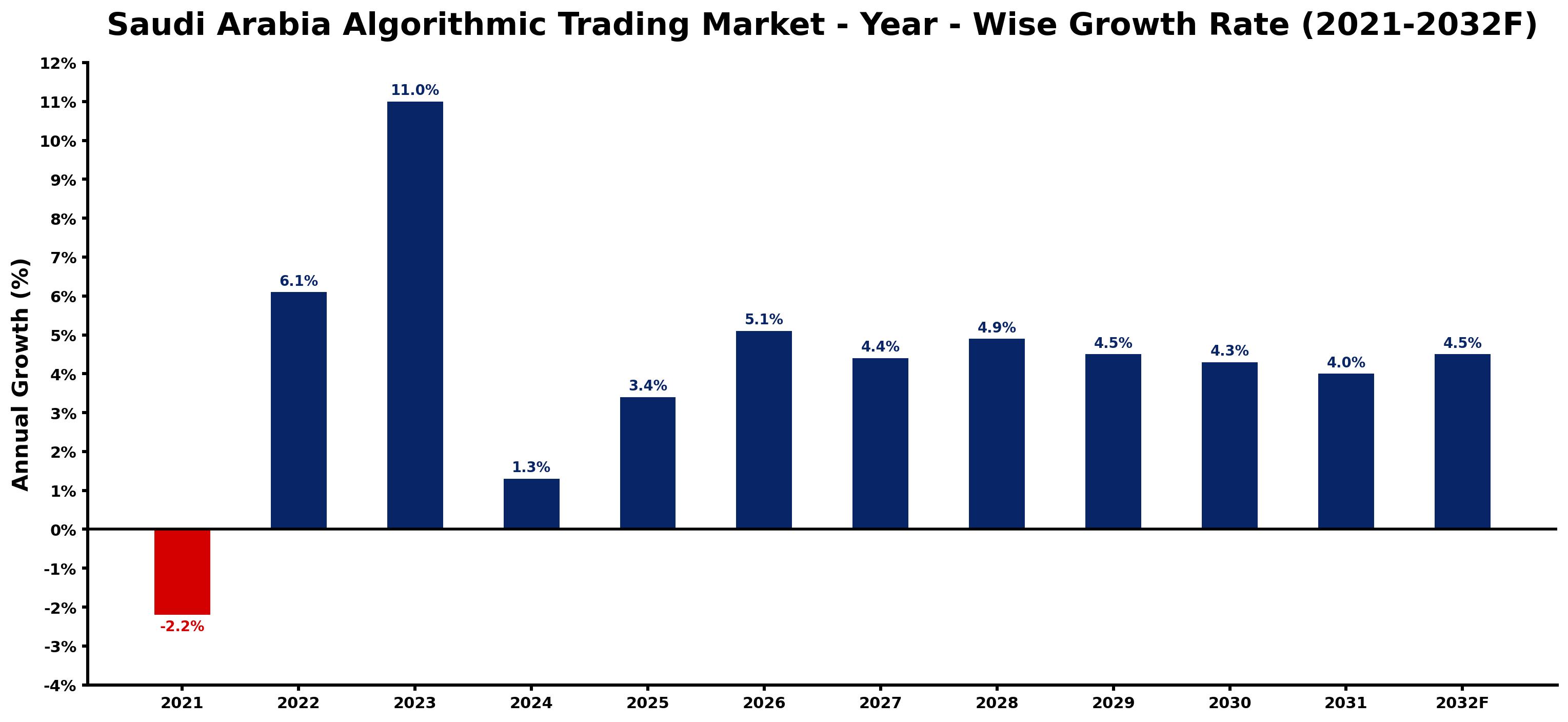
The table below presents the year‑wise growth rates along with the key drivers influencing the market
| Year | Growth Rate | Major Drivers |
| 2021 | -2.2% | Capital Market Authority imposed stricter algorithmic trading regulations. |
| 2022 | 6.1% | Implementation of Financial Sector Development Program initiatives. |
| 2023 | 11.0% | Increased foreign investments due to Vision 2030 reforms. |
| 2024 | 1.3% | Growing participation in Saudi Stock Exchange by retail investors. |
| 2025 | 3.4% | Enhanced market liquidity through algorithmic trading adoption. |
| 2026 | 5.1% | Development of local fintech solutions for trading efficiency. |
| 2027 | 4.4% | Rising popularity of cryptocurrencies among local investors. |
| 2028 | 4.9% | Introduction of AI-powered trading strategies in local markets. |
| 2029 | 4.5% | Regulatory support from the Capital Market Authority initiatives. |
| 2030 | 4.3% | Technological partnerships enhancing data analytics for traders. |
| 2031 | 4.0% | Increased algorithm use for risk management in trading. |
| 2032 | 4.5% | Supportive regulatory environment fostering fintech innovation. |
Note: Market size estimations and growth projections presented in this report are based on 6Wresearch's proprietary forecasting methodology, utilizing the latest available industry data, government publications, and primary research inputs.
Saudi Arabia Algorithmic Trading Market Key Takeaways
Below are some of the specific key takeaways from the market, including:
- The market is projected to experience steady growth, driven by increasing algorithm adoption.
- Enhanced data analytics and AI are pivotal in shaping trading strategies.
- High-frequency trading continues to gain traction among financial institutions.
- Market volatility has accelerated the shift toward algorithmic trading solutions.
- Regulatory frameworks are evolving to support this growing market segment.
Evaluation of Restraints in Saudi Arabia Algorithmic Trading Market
Despite the positive outlook, several factors are limiting the Saudi Arabia Algorithmic Trading Market. Access to real-time market data remains a challenge, as many institutions struggle with latency issues that can impact trading performance. Additionally, the complexity of developing and deploying effective trading algorithms poses significant hurdles for many firms. Compliance with evolving regulations is another concern, as institutions must continuously adapt to maintain adherence while pursuing innovative trading strategies.
Saudi Arabia Algorithmic Trading Market Trends
Several key trends are shaping the Saudi Arabia Algorithmic Trading Market. The rise of machine learning and AI is facilitating the development of more sophisticated trading algorithms, enhancing decision-making processes. There's also a growing emphasis on quantitative trading strategies, as traders seek to leverage data analytics for competitive advantage. Additionally, the integration of cloud technology is improving access to trading platforms, allowing smaller firms to participate more actively in the market.
Saudi Arabia Algorithmic Trading Market Opportunities
The market presents several promising opportunities for growth and investment. As more financial institutions recognize the importance of algorithmic trading, there's a demand for tailored solutions that address specific trading needs. The ongoing digital transformation across financial services is creating a fertile ground for innovative trading technologies. on top of that, collaboration between fintech companies and traditional financial institutions is likely to lead to the development of new trading platforms and services that enhance market participation.
Government Initiatives in the Saudi Arabia Algorithmic Trading Market
Government initiatives are playing a critical role in shaping the Saudi Arabia Algorithmic Trading Market. The regulatory environment is adapting to support technological advancements, ensuring that the market remains competitive and compliant. Public sector priorities are increasingly focused on enhancing the digital infrastructure necessary for modern trading practices.
- A recently completed initiative includes the establishment of a regulatory framework aimed at increasing transparency and efficiency in algorithmic trading.
- A current effort involves upgrading the national financial market infrastructure to improve data access and transaction speed.
- Upcoming plans feature a public-private partnership set to launch in 2026, aimed at fostering innovation in trading technologies.
- The government is also rolling out a program focused on training financial professionals in advanced trading strategies and technologies.
- Ongoing collaborations with international regulatory bodies are expected to harmonize local regulations with global best practices.
Future Insights of the Saudi Arabia Algorithmic Trading Market
Looking ahead to 2026-2032, the Saudi Arabia Algorithmic Trading Market is positioned for significant transformation. The growing reliance on data-driven decision-making will likely drive further adoption of algorithmic strategies. As financial markets continue to grow in complexity, the demand for faster, more efficient trading solutions will expand. Increased collaboration between public and private sectors will enhance the ecosystem, supporting innovation and regulatory compliance.
Saudi Arabia Algorithmic Trading Market Latest Developments
Recent activity in the Saudi Arabia Algorithmic Trading Market reflects a dynamic environment, with various developments enhancing the sector's capabilities. The last 12 months have seen a range of initiatives aimed at integrating advanced technologies into trading practices.
- A major technology vendor announced an ongoing project to develop a new trading platform using AI algorithms, expected to launch by Q2 2026.
- An initiative that began in early 2025 focused on enhancing low-latency trading solutions for financial institutions, currently underway.
- Recently, a leading regional operator completed a rollout of cloud-based trading services, improving access for smaller firms.
- A planned upgrade to market infrastructure is set to begin in late 2025, aimed at increasing transaction speeds across platforms.
- A partnership between a local bank and a fintech company was established in Q1 2026, designed to innovate algorithmic trading solutions.
Saudi Arabia Algorithmic Trading Market - Key Attractiveness of the Report
- 10 Years of Market Numbers
- Historical Data Starting from 2022 to 2025
- Base Year: 2025
- Forecast Data until 2032
- Key Performance Indicators Impacting the Market
- Major Upcoming Developments and Projects
Key Highlights of the Report:
- Saudi Arabia Algorithmic Trading Market Outlook
- Market Size of Saudi Arabia Algorithmic Trading Market, 2025
- Forecast of Saudi Arabia Algorithmic Trading Market, 2032
- Historical Data and Forecast of Saudi Arabia Algorithmic Trading Revenues & Volume for the Period 2022-2032F
- Saudi Arabia Algorithmic Trading Market Trend Evolution
- Saudi Arabia Algorithmic Trading Market Drivers and Challenges
- Saudi Arabia Algorithmic Trading Price Trends
- Saudi Arabia Algorithmic Trading Porter's Five Forces
- Saudi Arabia Algorithmic Trading Industry Life Cycle
- Historical Data and Forecast of Saudi Arabia Algorithmic Trading Market Revenues & Volume By Trading Type for the Period 2022-2032F
- Historical Data and Forecast of Saudi Arabia Algorithmic Trading Market Revenues & Volume By Foreign Exchange (FOREX) for the Period 2022-2032F
- Historical Data and Forecast of Saudi Arabia Algorithmic Trading Market Revenues & Volume By Stock Markets for the Period 2022-2032F
- Historical Data and Forecast of Saudi Arabia Algorithmic Trading Market Revenues & Volume By Exchange-Traded Fund (ETF) for the Period 2022-2032F
- Historical Data and Forecast of Saudi Arabia Algorithmic Trading Market Revenues & Volume By Bonds for the Period 2022-2032F
- Historical Data and Forecast of Saudi Arabia Algorithmic Trading Market Revenues & Volume By Cryptocurrencies for the Period 2022-2032F
- Historical Data and Forecast of Saudi Arabia Algorithmic Trading Market Revenues & Volume By Others for the Period 2022-2032F
- Historical Data and Forecast of Saudi Arabia Algorithmic Trading Market Revenues & Volume By Deployment Mode for the Period 2022-2032F
- Historical Data and Forecast of Saudi Arabia Algorithmic Trading Market Revenues & Volume By Cloud for the Period 2022-2032F
- Historical Data and Forecast of Saudi Arabia Algorithmic Trading Market Revenues & Volume By On-premises for the Period 2022-2032F
- Historical Data and Forecast of Saudi Arabia Algorithmic Trading Market Revenues & Volume By Component for the Period 2022-2032F
- Historical Data and Forecast of Saudi Arabia Algorithmic Trading Market Revenues & Volume By Solutions for the Period 2022-2032F
- Historical Data and Forecast of Saudi Arabia Algorithmic Trading Market Revenues & Volume By Services for the Period 2022-2032F
- Historical Data and Forecast of Saudi Arabia Algorithmic Trading Market Revenues & Volume By Enterprise Size for the Period 2022-2032F
- Historical Data and Forecast of Saudi Arabia Algorithmic Trading Market Revenues & Volume By Small and Medium-sized Enterprises (SMEs) for the Period 2022-2032F
- Historical Data and Forecast of Saudi Arabia Algorithmic Trading Market Revenues & Volume By Large Enterprises for the Period 2022-2032F
- Saudi Arabia Algorithmic Trading Import Export Trade Statistics
- Market Opportunity Assessment By Trading Type
- Market Opportunity Assessment By Deployment Mode
- Market Opportunity Assessment By Component
- Market Opportunity Assessment By Enterprise Size
- Saudi Arabia Algorithmic Trading Top Companies Market Share
- Saudi Arabia Algorithmic Trading Competitive Benchmarking By Technical and Operational Parameters
- Saudi Arabia Algorithmic Trading Company Profiles
- Saudi Arabia Algorithmic Trading Key Strategic Recommendations






































