Saudi Arabia Cargo Shipping Market Size, Share & Growth Rate
The Saudi Arabia Cargo Shipping Market was estimated at USD 292 Million in 2025 and is projected to reach USD 376 Million by 2032, growing at a CAGR of 3.7% from 2026 to 2032. This growth is largely driven by Saudi Arabia's pivotal role as a regional logistics hub, bolstered by significant investments in modernizing its ports and transportation networks. Additionally, the Kingdom's strategic location along global trade routes significantly enhances its cargo shipping capabilities, facilitating increased trade activities.
Saudi Arabia Cargo Shipping Market Year-wise Growth Rate and Key Drivers
This graph highlights how the Saudi Arabia Cargo Shipping Market has steadily grown over the years, supported by major growth factors.
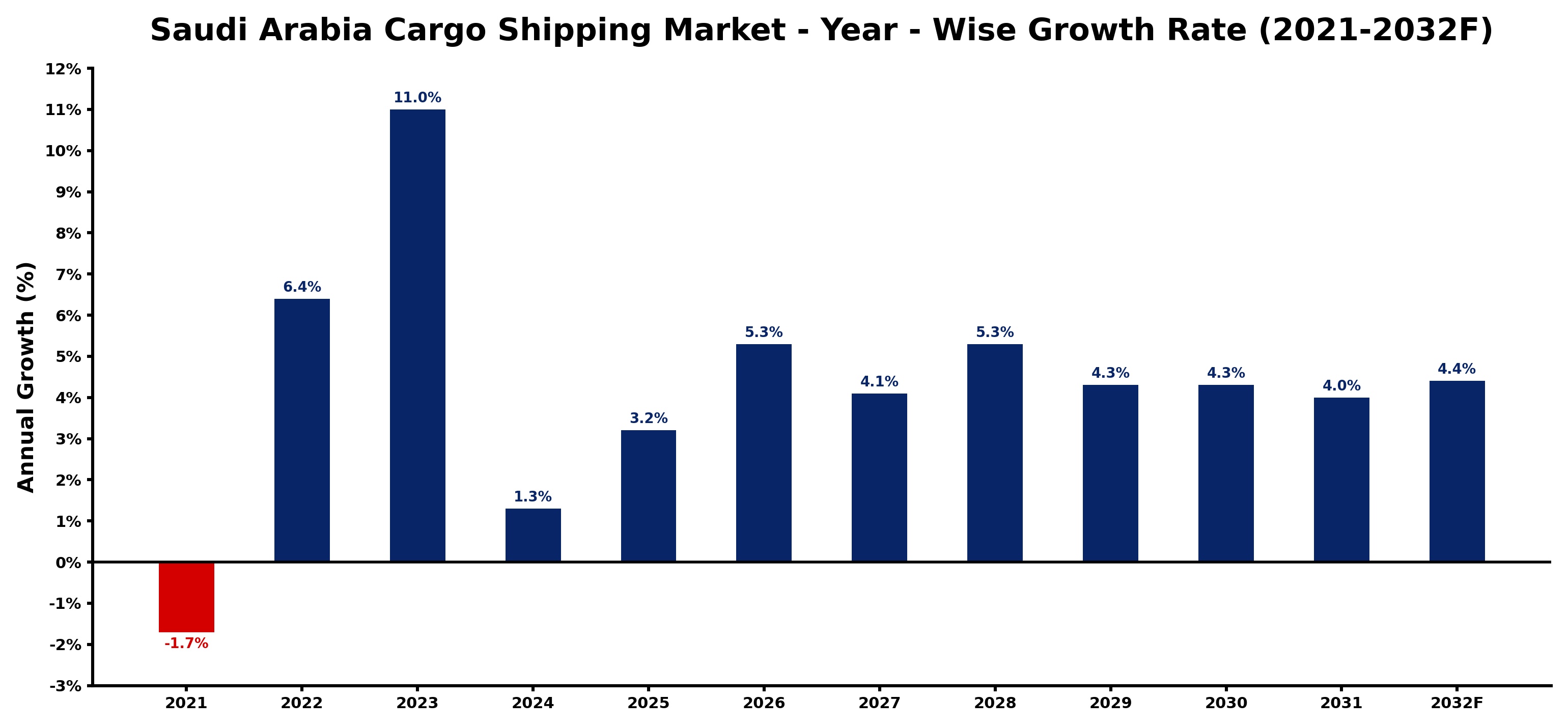
The table below presents the year‑wise growth rates along with the key drivers influencing the market
| Year | Growth Rate | Major Drivers |
| 2021 | -1.7% | Increasing industrial automation investments |
| 2022 | 6.4% | Increasing industrial infrastructure investments |
| 2023 | 11.0% | Expansion of transportation and logistics networks |
| 2024 | 1.3% | Rapid growth in telecom and data center sectors |
| 2025 | 3.2% | Government infrastructure modernization initiatives |
| 2026 | 5.3% | Growing renewable energy integration projects |
| 2027 | 4.1% | Increasing industrial infrastructure investments |
| 2028 | 5.3% | Growing renewable energy integration projects |
| 2029 | 4.3% | Growing urbanization and commercial development |
| 2030 | 4.3% | Expansion of manufacturing activities |
| 2031 | 4.0% | Rapid growth in telecom and data center sectors |
| 2032 | 4.4% | Expansion of transportation and logistics networks |
Note - Market size estimations and growth projections presented in this report are based on 6Wresearch's advanced forecasting approach, validated with industry datasets as of June 2026.
Saudi Arabia Cargo Shipping Market Synopsis
In recent years, the Saudi Arabia cargo shipping market has experienced robust growth, reflecting the nation's commitment to improving its logistics infrastructure. With an estimated one-third of total regional cargo volumes attributed to Saudi Arabia, the market is transitioning from strong domestic operations to a more prominent international player in cargo shipping.
Looking forward, this sector is poised for further expansion, with the government's Vision 2031 initiative prioritizing economic diversification through enhanced shipping and logistics services. This dual focus on infrastructure and trade partnerships is expected to underpin market growth for years to come.
Saudi Arabia Cargo Shipping Market Key Takeaways
- Saudi Arabia dominates the cargo shipping sector in the MENA region, accounting for approximately one-third of total regional cargo volumes.
- Maritime transport services play a crucial role, handling about 90% of all cargo shipments, highlighting the industry's reliance on shipping vessels.
- The shift towards digitalization and technological advancements is improving efficiency and reducing operational costs within the cargo shipping market.
- Increased governmental investments in infrastructure are set to enhance shipping capacity and streamline logistics operations.
- Cross-border trade activities are rising, driving demand for reliable cargo shipping solutions tailored to meet evolving market needs.
Evaluation of Restraints in Saudi Arabia Cargo Shipping Market
Despite its impressive growth trajectory, the Saudi Arabia cargo shipping market faces various restraints. Global economic fluctuations, political instability, and changes in trade policies can lead to uncertainties affecting shipping routes and operations. Furthermore, the need for consistent improvements in cargo security and efficiency poses ongoing challenges, particularly as demand for shipping services escalates. As such, market participants must navigate these obstacles while continuing to enhance service delivery and operational resilience.
Saudi Arabia Cargo Shipping Market Trends
Several trends are currently shaping the Saudi Arabia cargo shipping market. The emphasis on sustainability is leading to a rise in eco-friendly shipping practices and investments in green technologies. Additionally, advancements in digital technologies, such as automated cargo handling systems and real-time tracking solutions, are revolutionizing logistics. There is also a growing shift towards integrated multimodal transport systems, offering more seamless supply chain solutions for businesses.
Saudi Arabia Cargo Shipping Market Opportunities
The Saudi Arabia cargo shipping market presents various growth and investment opportunities, particularly in the realm of infrastructure development. The continuous expansion and modernization of ports and transportation networks will create a more efficient logistics ecosystem. Moreover, the increasing volume of imports and exports, driven by economic diversification strategies, indicates a robust demand for enhanced shipping services. Additionally, partnerships with technology firms to implement digital solutions could further optimize operations and improve customer experiences.
Government Initiatives in the Saudi Arabia Cargo Shipping Market
The Saudi government has implemented several initiatives aimed at bolstering the cargo shipping industry. These include strategic investments in port infrastructure, transportation networks, and the establishment of economic zones to facilitate trade. Furthermore, programs encouraging private sector participation and innovation in shipping logistics are being prioritized to enhance operational efficiencies and competitiveness in the global market.
Future Insights of the Saudi Arabia Cargo Shipping Market
Looking ahead to the period from 2026 to 2032, the Saudi Arabia cargo shipping market is likely to witness significant advancements in logistics capabilities. With the government's focus on economic diversification and regional trade enhancement, increased cargo volumes are anticipated. Innovations in technology and sustainable practices will also shape the industry's evolution, positioning Saudi Arabia as a leading player in the global shipping landscape.
Saudi Arabia Cargo Shipping Market Latest Developments (May 2025 - June 2026)
Recent developments in the Saudi Arabia cargo shipping market indicate a strong push towards modernization and efficiency. Efforts to expand key ports and improve intermodal transport connections have been prioritized, enabling smoother logistics and faster delivery times. Additionally, increased collaboration between shipping companies and technology providers is becoming more prevalent, with the aim of implementing advanced tracking and management systems to enhance operational effectiveness.
Saudi Arabia Cargo Shipping Market - Key Attractiveness of the Report
- 10 Years of Market Numbers
- Historical Data Starting from 2022 to 2025
- Base Year: 2025
- Forecast Data until 2032
- Key Performance Indicators Impacting the Market
- Major Upcoming Developments and Projects
Key Highlights of the Report:
- Saudi Arabia Cargo Shipping Market Outlook
- Market Size of Saudi Arabia Cargo Shipping Market, 2025
- Forecast of Saudi Arabia Cargo Shipping Market, 2032
- Historical Data and Forecast of Saudi Arabia Cargo Shipping Revenues & Volume for the Period 2022-2032F
- Saudi Arabia Cargo Shipping Market Trend Evolution
- Saudi Arabia Cargo Shipping Market Drivers and Challenges
- Saudi Arabia Cargo Shipping Price Trends
- Saudi Arabia Cargo Shipping Porter's Five Forces
- Saudi Arabia Cargo Shipping Industry Life Cycle
- Historical Data and Forecast of Saudi Arabia Cargo Shipping Market Revenues & Volume By Cargo Infrastructure for the Period 2022-2032F
- Historical Data and Forecast of Saudi Arabia Cargo Shipping Market Revenues & Volume By Port Developments in Asia for the Period 2022-2032F
- Historical Data and Forecast of Saudi Arabia Cargo Shipping Market Revenues & Volume By Port Developments in Europe for the Period 2022-2032F
- Historical Data and Forecast of Saudi Arabia Cargo Shipping Market Revenues & Volume By Port Developments in North America for the Period 2022-2032F
- Historical Data and Forecast of Saudi Arabia Cargo Shipping Market Revenues & Volume By Port Developments in South America for the Period 2022-2032F
- Historical Data and Forecast of Saudi Arabia Cargo Shipping Market Revenues & Volume By Port Developments in Africa for the Period 2022-2032F
- Historical Data and Forecast of Saudi Arabia Cargo Shipping Market Revenues & Volume By Cargo Type for the Period 2022-2032F
- Historical Data and Forecast of Saudi Arabia Cargo Shipping Market Revenues & Volume By Container Cargo for the Period 2022-2032F
- Historical Data and Forecast of Saudi Arabia Cargo Shipping Market Revenues & Volume By Bulk Cargo for the Period 2022-2032F
- Historical Data and Forecast of Saudi Arabia Cargo Shipping Market Revenues & Volume By General Cargo for the Period 2022-2032F
- Historical Data and Forecast of Saudi Arabia Cargo Shipping Market Revenues & Volume By Oil & Gas for the Period 2022-2032F
- Historical Data and Forecast of Saudi Arabia Cargo Shipping Market Revenues & Volume By Industry Type for the Period 2022-2032F
- Historical Data and Forecast of Saudi Arabia Cargo Shipping Market Revenues & Volume By Food, Manufacturing for the Period 2022-2032F
- Historical Data and Forecast of Saudi Arabia Cargo Shipping Market Revenues & Volume By Oil & Ores for the Period 2022-2032F
- Historical Data and Forecast of Saudi Arabia Cargo Shipping Market Revenues & Volume By Electrical & Electronics for the Period 2022-2032F
- Saudi Arabia Cargo Shipping Import Export Trade Statistics
- Market Opportunity Assessment By Cargo Infrastructure
- Market Opportunity Assessment By Cargo Type
- Market Opportunity Assessment By Industry Type
- Saudi Arabia Cargo Shipping Top Companies Market Share
- Saudi Arabia Cargo Shipping Competitive Benchmarking By Technical and Operational Parameters
- Saudi Arabia Cargo Shipping Company Profiles
- Saudi Arabia Cargo Shipping Key Strategic Recommendations






































