Saudi Arabia Chatbot Market Size & Growth Rate (2026-2032)
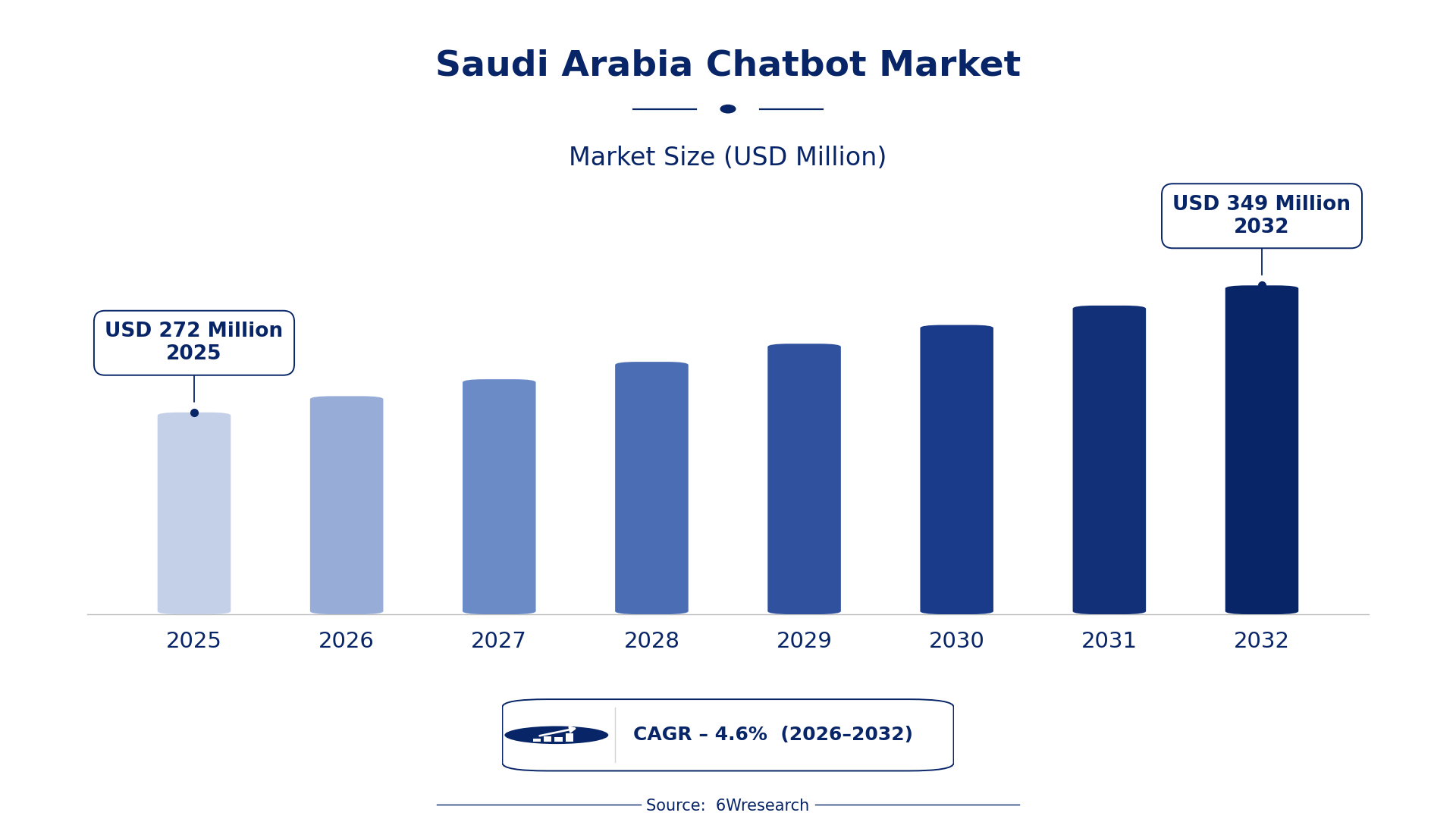
The Saudi Arabia Chatbot Market was estimated at USD 272 Million in 2025 and is projected to reach USD 349 Million by 2032, growing at a CAGR of 4.6% from 2026 to 2032.
Saudi Arabia Chatbot Market Synopsis
The chatbot market in Saudi Arabia is experiencing a surge in adoption, driven by the growing need for enhanced customer interactions across various sectors. This momentum is fueled by businesses recognizing the importance of real-time engagement and the efficiency that chatbots offer.
As organizations continue to prioritize customer-centric strategies, the future of the Saudi Arabia chatbot market looks promising. The integration of advanced AI technologies is set to redefine user experiences, making chatbots an indispensable tool for companies aiming to stay competitive.
Saudi Arabia Chatbot Market Year-wise Growth Rate and Key Drivers
This graph illustrates the annual growth rates of the Saudi Arabia Chatbot Market from 2021 to 2032, highlighting a steady upward trajectory and projected expansion over the forecast period.
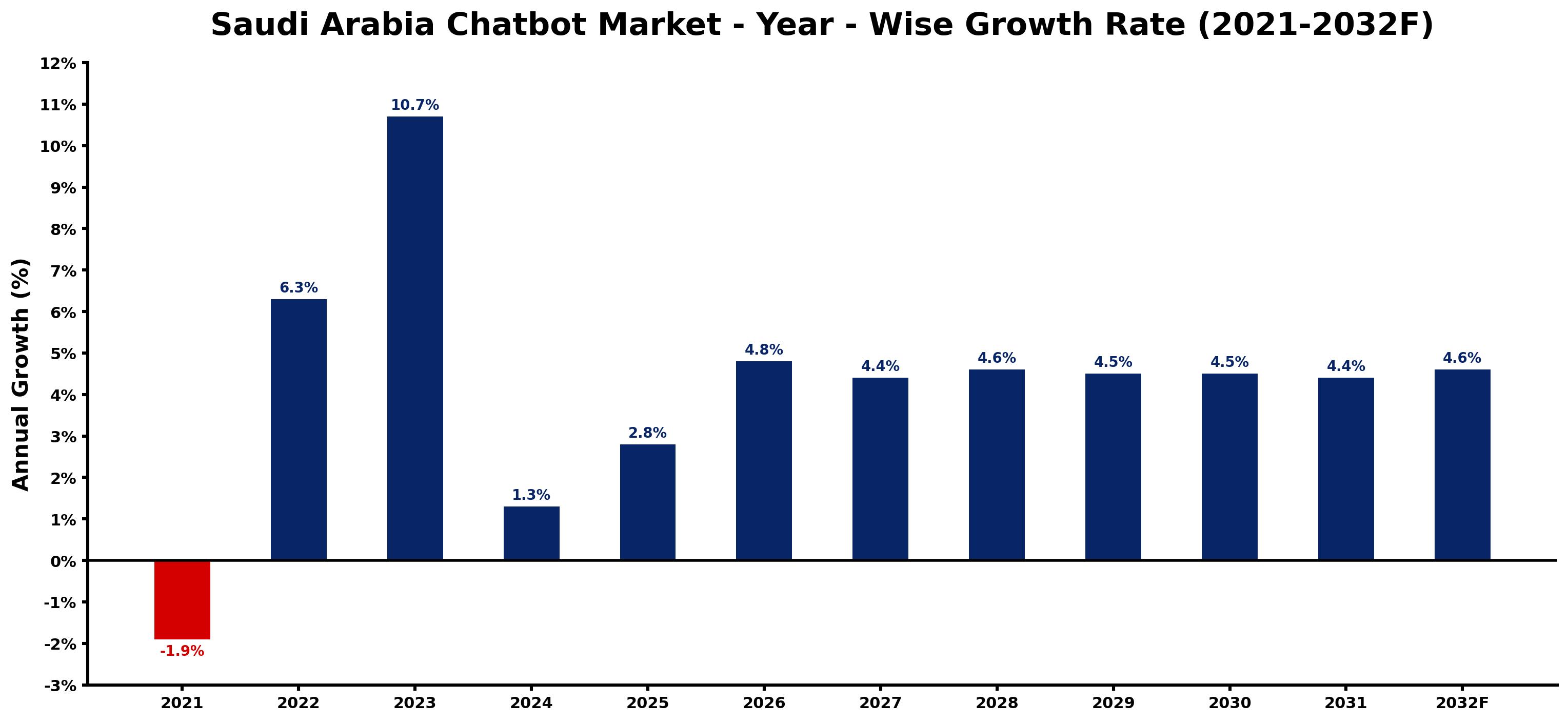
The table below presents the year‑wise growth rates along with the key drivers influencing the market
| Year | Growth Rate | Major Drivers |
| 2021 | -1.9% | Lack of local regulatory support for AI technologies |
| 2022 | 6.3% | Government Vision 2030 enabling AI adoption in businesses |
| 2023 | 10.7% | Increased demand for virtual customer support in retail |
| 2024 | 1.3% | Growth in e-commerce driving chatbot implementations |
| 2025 | 2.8% | Banking sector integrating chatbots for customer service |
| 2026 | 4.8% | Telecommunication companies investing in AI-driven solutions |
| 2027 | 4.4% | Healthcare sector adopting chatbots for patient engagement |
| 2028 | 4.6% | Educational institutions enhancing learning with chatbots |
| 2029 | 4.5% | Large enterprises optimizing operations using automated systems |
| 2030 | 4.5% | Tourism sector using chatbots for travel assistance |
| 2031 | 4.4% | Social media platforms incorporating chatbot features |
| 2032 | 4.6% | Influence of local startups promoting innovative chatbot solutions |
Note: Market size estimations and growth projections presented in this report are based on 6Wresearch's proprietary forecasting methodology, utilizing the latest available industry data, government publications, and primary research inputs.
Saudi Arabia Chatbot Market Key Takeaways
Below are some of the specific key takeaways from the market, including:
- The market is set to grow significantly, reflecting a shift towards automated customer support solutions.
- Adoption spans multiple sectors, including e-commerce, healthcare, and customer service.
- Real-time interaction capabilities are becoming a key requirement for businesses.
- Data security and regulatory compliance remain critical considerations in chatbot implementations.
- COVID-19 has accelerated the demand for chatbots as businesses adapt to changing consumer behaviors.
Evaluation of Restraints in Saudi Arabia Chatbot Market
Several factors are restraining the growth of the chatbot market in Saudi Arabia. Chief among these is the challenge of ensuring effective natural language understanding, which is crucial for delivering satisfactory customer interactions. Businesses are also grappling with data security concerns, as customer data privacy becomes a growing priority amid increasing regulatory scrutiny. Striking a balance between performance and compliance remains a hurdle for many organizations.
Saudi Arabia Chatbot Market Trends
Current trends indicate a shift towards more personalized and context-aware chatbots, which enhance user experiences by adapting to individual customer needs. Additionally, the integration of machine learning algorithms is enabling chatbots to evolve and improve over time, thus providing smarter responses. As organizations invest in these technologies, the focus on AI-driven analytics is also increasing, allowing businesses to gain insights into customer behavior and preferences.
Saudi Arabia Chatbot Market Opportunities
There are substantial opportunities for growth within the Saudi Arabia chatbot market, particularly in sectors such as healthcare and e-commerce. The demand for 24/7 customer support solutions is driving investments in chatbot technology. on top of that, as businesses seek to enhance their operational efficiency, the implementation of chatbots for routine tasks presents a compelling avenue for expansion. Companies that can innovate and provide tailored chatbot solutions are well-positioned to capture market share.
Government Initiatives in the Saudi Arabia Chatbot Market
The Saudi government is actively promoting the adoption of digital technologies, including chatbots, to enhance public services and stimulate economic growth. With a focus on digital transformation, these initiatives aim to improve customer engagement and streamline processes across various sectors. The government's regulatory framework is evolving to support innovation while ensuring data security and privacy.
- A recently completed initiative involved the launch of a national digital customer service program aimed at integrating chatbots into government services.
- Currently ongoing is a public-private partnership initiative designed to enhance chatbot capabilities in the healthcare sector.
- A planned upcoming initiative will focus on establishing guidelines for chatbot compliance and data protection, expected to roll out in the coming years.
- The introduction of a regulatory framework in 2025 is set to standardize chatbot implementations across industries.
- There is a national digital infrastructure upgrade program underway to enhance connectivity and support chatbot technologies.
Future Insights of the Saudi Arabia Chatbot Market
Looking ahead to 2026-2032, the Saudi Arabia chatbot market is poised for continued growth, fueled by advancements in AI technology and an increasing emphasis on customer satisfaction. As businesses become more adept at using chatbots to address customer needs, the technology will evolve to provide even greater value. The integration of chatbots into omnichannel strategies will further enhance their effectiveness, making them a cornerstone of customer engagement efforts.
Saudi Arabia Chatbot Market Latest Developments
Recent activity in the Saudi Arabia chatbot market has been characterized by a flurry of developments aimed at enhancing customer interactions and operational efficiency. Companies are rapidly adopting innovative technologies to stay competitive, reflecting the market's dynamic nature.
- A leading regional operator launched an advanced chatbot platform in early 2025, enabling businesses to automate customer support across multiple channels.
- An initiative that began in mid-2025 is currently underway, focusing on integrating machine learning capabilities into existing chatbot systems.
- A major technology vendor is planning a rollout expected to begin in the second half of 2026, aimed at enhancing chatbot analytics for better customer insights.
- In Q1 2025, a new service upgrade was introduced, expanding chatbot functionalities to include voice recognition capabilities.
- A collaborative project initiated in late 2025 aims to create industry standards for chatbot development and deployment.
Saudi Arabia Chatbot Market - Key Attractiveness of the Report
- 10 Years of Market Numbers
- Historical Data Starting from 2022 to 2025
- Base Year: 2025
- Forecast Data until 2032
- Key Performance Indicators Impacting the Market
- Major Upcoming Developments and Projects
Key Highlights of the Report:
- Saudi Arabia Chatbot Market Outlook
- Market Size of Saudi Arabia Chatbot Market, 2025
- Forecast of Saudi Arabia Chatbot Market, 2032
- Historical Data and Forecast of Saudi Arabia Chatbot Revenues & Volume for the Period 2022-2032F
- Saudi Arabia Chatbot Market Trend Evolution
- Saudi Arabia Chatbot Market Drivers and Challenges
- Saudi Arabia Chatbot Price Trends
- Saudi Arabia Chatbot Porter's Five Forces
- Saudi Arabia Chatbot Industry Life Cycle
- Historical Data and Forecast of Saudi Arabia Chatbot Market Revenues & Volume By Component for the Period 2022-2032F
- Historical Data and Forecast of Saudi Arabia Chatbot Market Revenues & Volume By Solutions for the Period 2022-2032F
- Historical Data and Forecast of Saudi Arabia Chatbot Market Revenues & Volume By Services for the Period 2022-2032F
- Historical Data and Forecast of Saudi Arabia Chatbot Market Revenues & Volume By Type for the Period 2022-2032F
- Historical Data and Forecast of Saudi Arabia Chatbot Market Revenues & Volume By Rule Based for the Period 2022-2032F
- Historical Data and Forecast of Saudi Arabia Chatbot Market Revenues & Volume By AI Based for the Period 2022-2032F
- Historical Data and Forecast of Saudi Arabia Chatbot Market Revenues & Volume By Deployment Mode for the Period 2022-2032F
- Historical Data and Forecast of Saudi Arabia Chatbot Market Revenues & Volume By On-premises for the Period 2022-2032F
- Historical Data and Forecast of Saudi Arabia Chatbot Market Revenues & Volume By Cloud for the Period 2022-2032F
- Historical Data and Forecast of Saudi Arabia Chatbot Market Revenues & Volume By Channel Integration for the Period 2022-2032F
- Historical Data and Forecast of Saudi Arabia Chatbot Market Revenues & Volume By Websites for the Period 2022-2032F
- Historical Data and Forecast of Saudi Arabia Chatbot Market Revenues & Volume By Contact Centers for the Period 2022-2032F
- Historical Data and Forecast of Saudi Arabia Chatbot Market Revenues & Volume By Social Media for the Period 2022-2032F
- Historical Data and Forecast of Saudi Arabia Chatbot Market Revenues & Volume By Mobile Applications for the Period 2022-2032F
- Historical Data and Forecast of Saudi Arabia Chatbot Market Revenues & Volume By Organization Size for the Period 2022-2032F
- Historical Data and Forecast of Saudi Arabia Chatbot Market Revenues & Volume By Large Enterprises for the Period 2022-2032F
- Historical Data and Forecast of Saudi Arabia Chatbot Market Revenues & Volume By SMEs for the Period 2022-2032F
- Historical Data and Forecast of Saudi Arabia Chatbot Market Revenues & Volume By Business Function for the Period 2022-2032F
- Historical Data and Forecast of Saudi Arabia Chatbot Market Revenues & Volume By Information Technology Service Management for the Period 2022-2032F
- Historical Data and Forecast of Saudi Arabia Chatbot Market Revenues & Volume By Human Resources for the Period 2022-2032F
- Historical Data and Forecast of Saudi Arabia Chatbot Market Revenues & Volume By Sales and Marketing for the Period 2022-2032F
- Historical Data and Forecast of Saudi Arabia Chatbot Market Revenues & Volume By Finance for the Period 2022-2032F
- Historical Data and Forecast of Saudi Arabia Chatbot Market Revenues & Volume By Application for the Period 2022-2032F
- Historical Data and Forecast of Saudi Arabia Chatbot Market Revenues & Volume By Customer Service for the Period 2022-2032F
- Historical Data and Forecast of Saudi Arabia Chatbot Market Revenues & Volume By Personal Assistant for the Period 2022-2032F
- Historical Data and Forecast of Saudi Arabia Chatbot Market Revenues & Volume By Branding and Advertisement for the Period 2022-2032F
- Historical Data and Forecast of Saudi Arabia Chatbot Market Revenues & Volume By Customer Engagement and Retention for the Period 2022-2032F
- Historical Data and Forecast of Saudi Arabia Chatbot Market Revenues & Volume By Data Privacy and Compliance for the Period 2022-2032F
- Historical Data and Forecast of Saudi Arabia Chatbot Market Revenues & Volume By Employee Engagement and On Boarding for the Period 2022-2032F
- Historical Data and Forecast of Saudi Arabia Chatbot Market Revenues & Volume By Payment Processing for the Period 2022-2032F
- Historical Data and Forecast of Saudi Arabia Chatbot Market Revenues & Volume By Others for the Period 2022-2032F
- Historical Data and Forecast of Saudi Arabia Chatbot Market Revenues & Volume By Vertical for the Period 2022-2032F
- Historical Data and Forecast of Saudi Arabia Chatbot Market Revenues & Volume By BFSI for the Period 2022-2032F
- Historical Data and Forecast of Saudi Arabia Chatbot Market Revenues & Volume By IT and Telecom for the Period 2022-2032F
- Historical Data and Forecast of Saudi Arabia Chatbot Market Revenues & Volume By Retail and Ecommerce for the Period 2022-2032F
- Historical Data and Forecast of Saudi Arabia Chatbot Market Revenues & Volume By Healthcare and Life Sciences for the Period 2022-2032F
- Historical Data and Forecast of Saudi Arabia Chatbot Market Revenues & Volume By Transportation and Logistics for the Period 2022-2032F
- Historical Data and Forecast of Saudi Arabia Chatbot Market Revenues & Volume By Government for the Period 2022-2032F
- Historical Data and Forecast of Saudi Arabia Chatbot Market Revenues & Volume By Travel and Hospitality for the Period 2022-2032F
- Historical Data and Forecast of Saudi Arabia Chatbot Market Revenues & Volume By Media and Entertainment for the Period 2022-2032F
- Saudi Arabia Chatbot Import Export Trade Statistics
- Market Opportunity Assessment By Component
- Market Opportunity Assessment By Type
- Market Opportunity Assessment By Deployment Mode
- Market Opportunity Assessment By Channel Integration
- Market Opportunity Assessment By Organization Size
- Market Opportunity Assessment By Business Function
- Market Opportunity Assessment By Application
- Market Opportunity Assessment By Vertical
- Saudi Arabia Chatbot Top Companies Market Share
- Saudi Arabia Chatbot Competitive Benchmarking By Technical and Operational Parameters
- Saudi Arabia Chatbot Company Profiles
- Saudi Arabia Chatbot Key Strategic Recommendations






































