Saudi Arabia Container Security Market Size & Growth Rate (2026-2032)
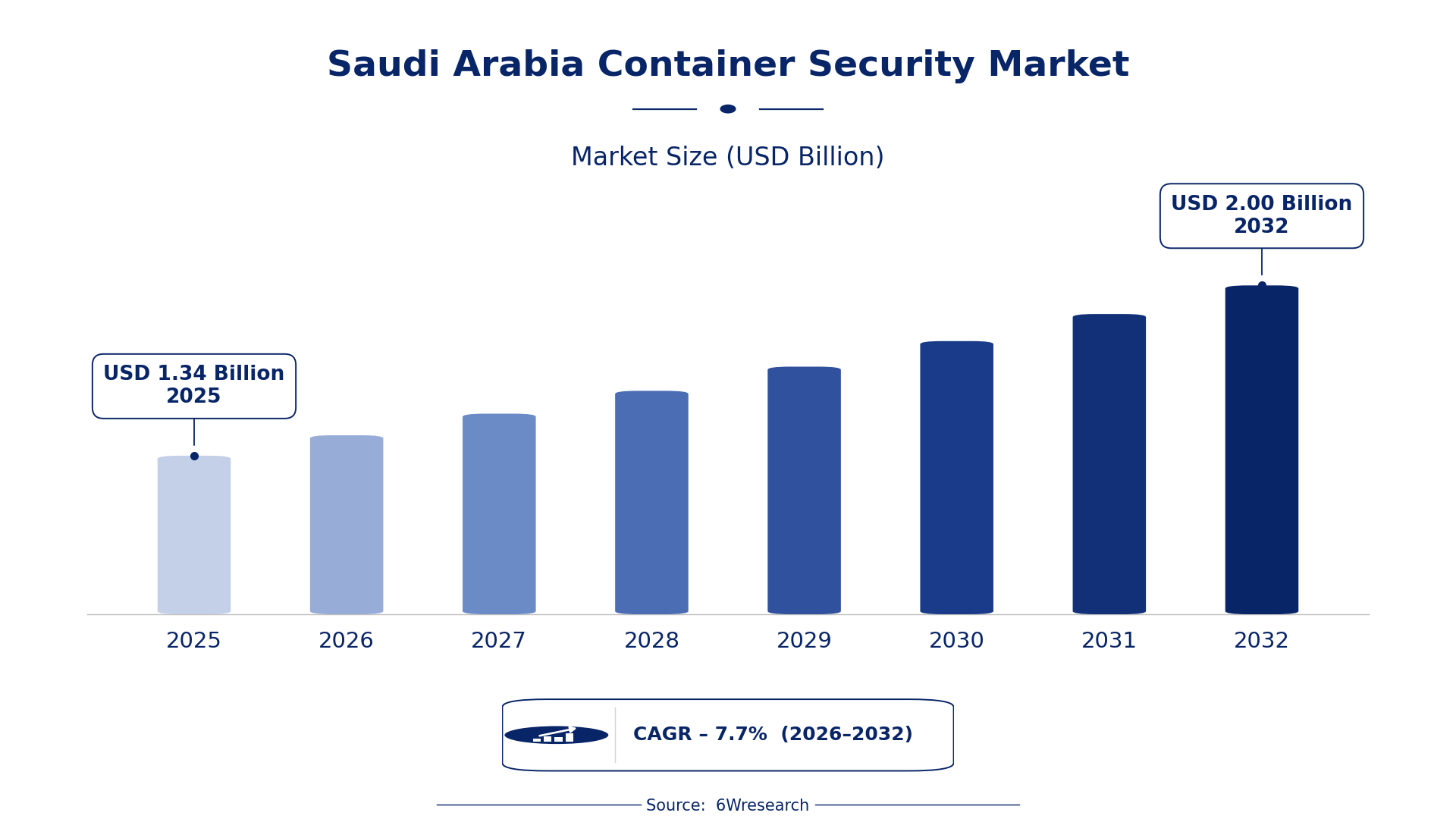
The Saudi Arabia Container Security Market was estimated at USD 1345 Million in 2025 and is projected to reach USD 1995 Million by 2032, growing at a CAGR of 7.7% from 2026 to 2032.
Saudi Arabia Container Security Market Synopsis
In recent years, the Saudi Arabia Container Security Market has experienced notable growth, driven largely by a surge in the adoption of containerized applications and microservices. As organizations increasingly rely on these technologies, the need for effective security measures has become paramount. This momentum is expected to persist as businesses prioritize securing their digital assets against evolving threats.
Looking ahead, the market is set to face both opportunities and challenges. The ongoing government support for technological advancements in the region, alongside a growing demand for container security solutions, will propel further growth. However, businesses must remain vigilant in addressing the vulnerabilities associated with container technology and adapting to the dynamic nature of the software development landscape.
Saudi Arabia Container Security Market Year-wise Growth Rate and Key Drivers
This graph illustrates the annual growth rates of the Saudi Arabia Container Security Market from 2021 to 2032, highlighting a steady upward trajectory and projected expansion over the forecast period.
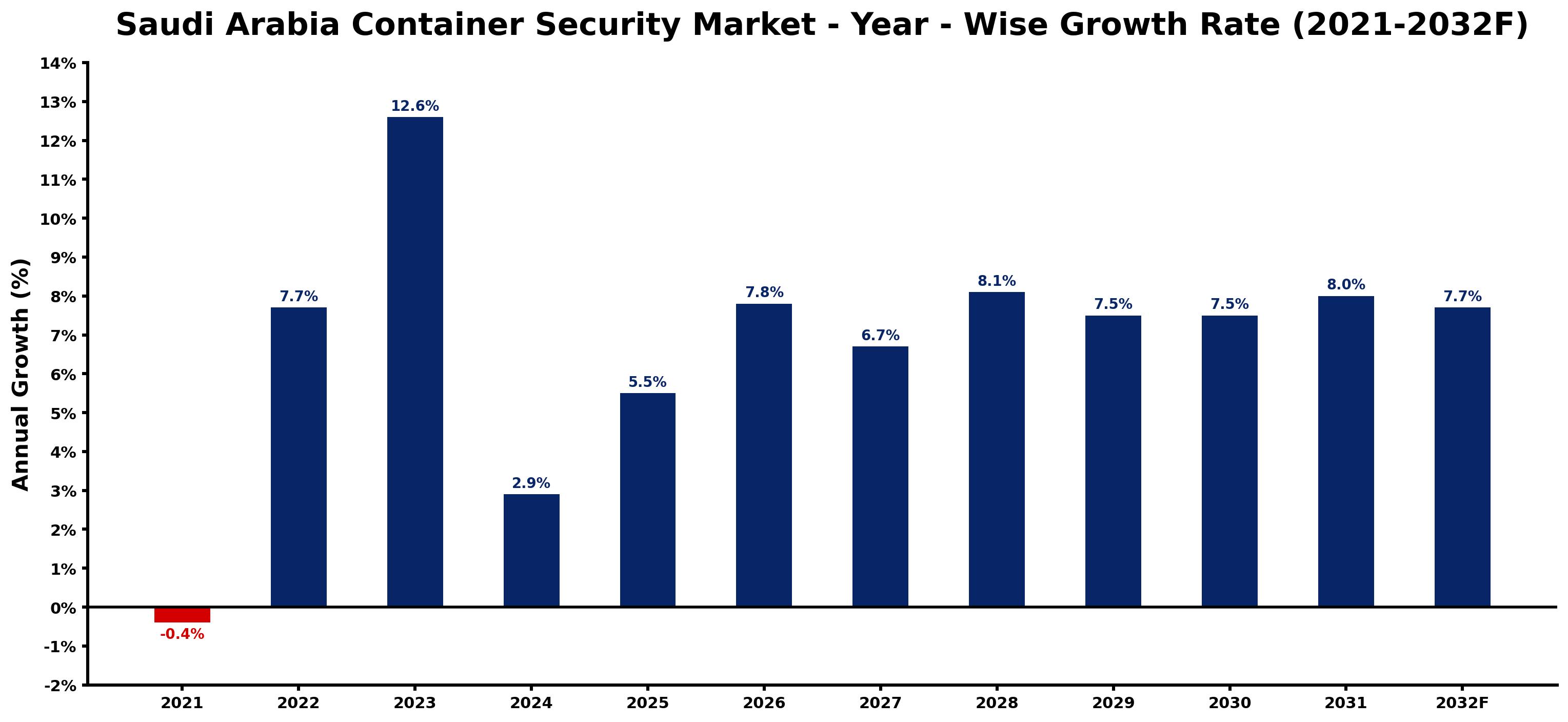
The table below presents the year‑wise growth rates along with the key drivers influencing the market
| Year | Growth Rate | Major Drivers |
| 2021 | -0.4% | COVID-19 restrictions delayed government procurement processes. |
| 2022 | 7.7% | Implementation of Saudi Vision 2030 bolstering trade security initiatives |
| 2023 | 12.6% | Increased collaboration with global shipping security bodies |
| 2024 | 2.9% | Launch of new container security technology incubator programs |
| 2025 | 5.5% | Growing focus on cyber-physical security integration in ports |
| 2026 | 7.8% | Enhancements in local maritime security training programs |
| 2027 | 6.7% | Government investment in advanced scanning technologies for containers |
| 2028 | 8.1% | Accession to global supply chain security partnerships |
| 2029 | 7.5% | Increased awareness of supply chain vulnerabilities post-pandemic |
| 2030 | 7.5% | Targeted screening procedures in line with G20 regulations |
| 2031 | 8.0% | Adoption of blockchain for tamper-proof container tracking solutions |
| 2032 | 7.7% | Emergence of local firms specializing in container tracking tech |
Note: Market size estimations and growth projections presented in this report are based on 6Wresearch's proprietary forecasting methodology, utilizing the latest available industry data, government publications, and primary research inputs.
Saudi Arabia Container Security Market Key Takeaways
Below are some of the specific key takeaways from the market, including:
- The increasing adoption of container security solutions reflects a broader trend toward cloud-based applications.
- Threat detection and vulnerability assessments are becoming standard features in container security offerings.
- Government initiatives are fostering an environment conducive to innovation and secure container technology.
- Ongoing challenges include managing the unique vulnerabilities inherent in containerized applications.
- Major technology vendors are enhancing their product lines to cater to rising security demands in this space.
Evaluation of Restraints in Saudi Arabia Container Security Market
Despite the evident growth trajectory, several factors are holding back the Saudi Arabia Container Security Market. Chief among them is the complexity of managing security across dynamic and ephemeral container environments. Organizations often struggle with a lack of skilled personnel who can effectively implement and manage container security solutions. Additionally, the rapid pace of technological advancement can outstrip the current security measures in place, leaving gaps that could be exploited by malicious actors. Addressing these constraints will be essential for market stakeholders aiming for sustained growth.
Saudi Arabia Container Security Market Trends
Several trends are shaping the Saudi Arabia Container Security Market. Firstly, the shift towards adopting DevOps and agile methodologies is driving the need for integrated security solutions that can keep pace with rapid development cycles. Secondly, the emphasis on automation in security processes is becoming increasingly apparent, as organizations seek to streamline operations while maintaining robust security postures. Lastly, the rise of artificial intelligence and machine learning in security applications is creating new avenues for threat detection and response, further enhancing the capabilities of container security solutions.
Saudi Arabia Container Security Market Opportunities
Opportunities abound in the Saudi Arabia Container Security Market, particularly as organizations continue to migrate to cloud-native architectures. Investment in comprehensive security frameworks that encompass not just containers, but also the broader microservices ecosystem, presents a lucrative avenue for growth. Additionally, the increasing focus on compliance with data protection regulations opens up prospects for innovative security solutions tailored to meet specific regulatory requirements. Companies that can effectively address these demands stand to gain a competitive edge in the market.
Government Initiatives in the Saudi Arabia Container Security Market
The Saudi Arabian government is increasingly recognizing the importance of cybersecurity as a foundational element of its digital transformation agenda. Public policy is geared towards fostering secure digital environments, which is critical for the advancement of container technologies. Strategic investments in cybersecurity frameworks are being made to support this growth, ensuring that the market remains secure and resilient.
- A national cybersecurity strategy launched in early 2023 aims to enhance the protection of digital infrastructure, including containerized applications.
- Ongoing collaboration between the public and private sectors is fostering innovation in container security technologies through various initiatives.
- A planned regulatory framework to be introduced by 2025 will set standards for security protocols specifically tailored for container technologies.
- Current initiatives involve workshops and training programs to develop cybersecurity talent focused on container security.
Future Insights of the Saudi Arabia Container Security Market
From 2026 to 2032, the Saudi Arabia Container Security Market is expected to experience continued expansion fueled by the proliferation of container technologies across various sectors. As organizations increasingly adopt microservices and cloud-native approaches, the demand for robust security solutions will grow. This period will see enhanced collaboration between government bodies and the private sector to develop comprehensive security frameworks. Consequently, stakeholders that focus on innovation, compliance, and skilled personnel will find themselves well-positioned for success.
Saudi Arabia Container Security Market Latest Developments
Recent activity in the Saudi Arabia Container Security Market indicates a vibrant and evolving sector. Over the past year, various players have ramped up efforts to introduce advanced security solutions tailored for containerized environments. The focus has largely been on enhancing the security features of existing products and exploring new technological integrations.
- A prominent regional operator announced an upgrade of its container security platform in Q3 2025, featuring enhanced threat detection capabilities.
- An initiative that started in early 2025 is currently underway to develop a training academy focused on cybersecurity skills specific to container security.
- A major technology vendor launched a new container security solution in mid-2025 aimed at small to medium enterprises.
- A strategic partnership was formed in late 2024 to co-develop security tools tailored for cloud-native applications, with ongoing developments expected through 2026.
Saudi Arabia Container Security Market - Key Attractiveness of the Report
- 10 Years of Market Numbers
- Historical Data Starting from 2022 to 2025
- Base Year: 2025
- Forecast Data until 2032
- Key Performance Indicators Impacting the Market
- Major Upcoming Developments and Projects
The growth is primarily driven by the increasing adoption of containerization and microservices architecture across organizations, alongside the government’s commitment to supporting container technologies and ensuring robust security measures.
Key Highlights of the Report:
- Saudi Arabia Container Security Market Outlook
- Market Size of Saudi Arabia Container Security Market, 2025
- Forecast of Saudi Arabia Container Security Market, 2032
- Historical Data and Forecast of Saudi Arabia Container Security Revenues & Volume for the Period 2022-2032F
- Saudi Arabia Container Security Market Trend Evolution
- Saudi Arabia Container Security Market Drivers and Challenges
- Saudi Arabia Container Security Price Trends
- Saudi Arabia Container Security Porter's Five Forces
- Saudi Arabia Container Security Industry Life Cycle
- Historical Data and Forecast of Saudi Arabia Container Security Market Revenues & Volume By Component for the Period 2022-2032F
- Historical Data and Forecast of Saudi Arabia Container Security Market Revenues & Volume By Container Security Products for the Period 2022-2032F
- Historical Data and Forecast of Saudi Arabia Container Security Market Revenues & Volume By Services (Professional, Managed) for the Period 2022-2032F
- Historical Data and Forecast of Saudi Arabia Container Security Market Revenues & Volume By Deployment Type for the Period 2022-2032F
- Historical Data and Forecast of Saudi Arabia Container Security Market Revenues & Volume By Cloud for the Period 2022-2032F
- Historical Data and Forecast of Saudi Arabia Container Security Market Revenues & Volume By On-premises for the Period 2022-2032F
- Historical Data and Forecast of Saudi Arabia Container Security Market Revenues & Volume By Vertical for the Period 2022-2032F
- Historical Data and Forecast of Saudi Arabia Container Security Market Revenues & Volume By BFSI for the Period 2022-2032F
- Historical Data and Forecast of Saudi Arabia Container Security Market Revenues & Volume By Retail for the Period 2022-2032F
- Historical Data and Forecast of Saudi Arabia Container Security Market Revenues & Volume By Government for the Period 2022-2032F
- Historical Data and Forecast of Saudi Arabia Container Security Market Revenues & Volume By Healthcare for the Period 2022-2032F
- Saudi Arabia Container Security Import Export Trade Statistics
- Market Opportunity Assessment By Component
- Market Opportunity Assessment By Deployment Type
- Market Opportunity Assessment By Vertical
- Saudi Arabia Container Security Top Companies Market Share
- Saudi Arabia Container Security Competitive Benchmarking By Technical and Operational Parameters
- Saudi Arabia Container Security Company Profiles
- Saudi Arabia Container Security Key Strategic Recommendations






































