Saudi Arabia Electronic Components Market Summary
The saudi arabia electronic components market was estimated at USD 441 Million in 2025 and is projected to reach USD 568 Million by 2032, growing at a CAGR of 5.2% from 2026 to 2032.
Saudi Arabia Electronic Components Market Year-wise Growth Rate and Key Drivers
This graph highlights how the Saudi Arabia Electronic Components Market has steadily grown over the past five years, supported by major growth factors.
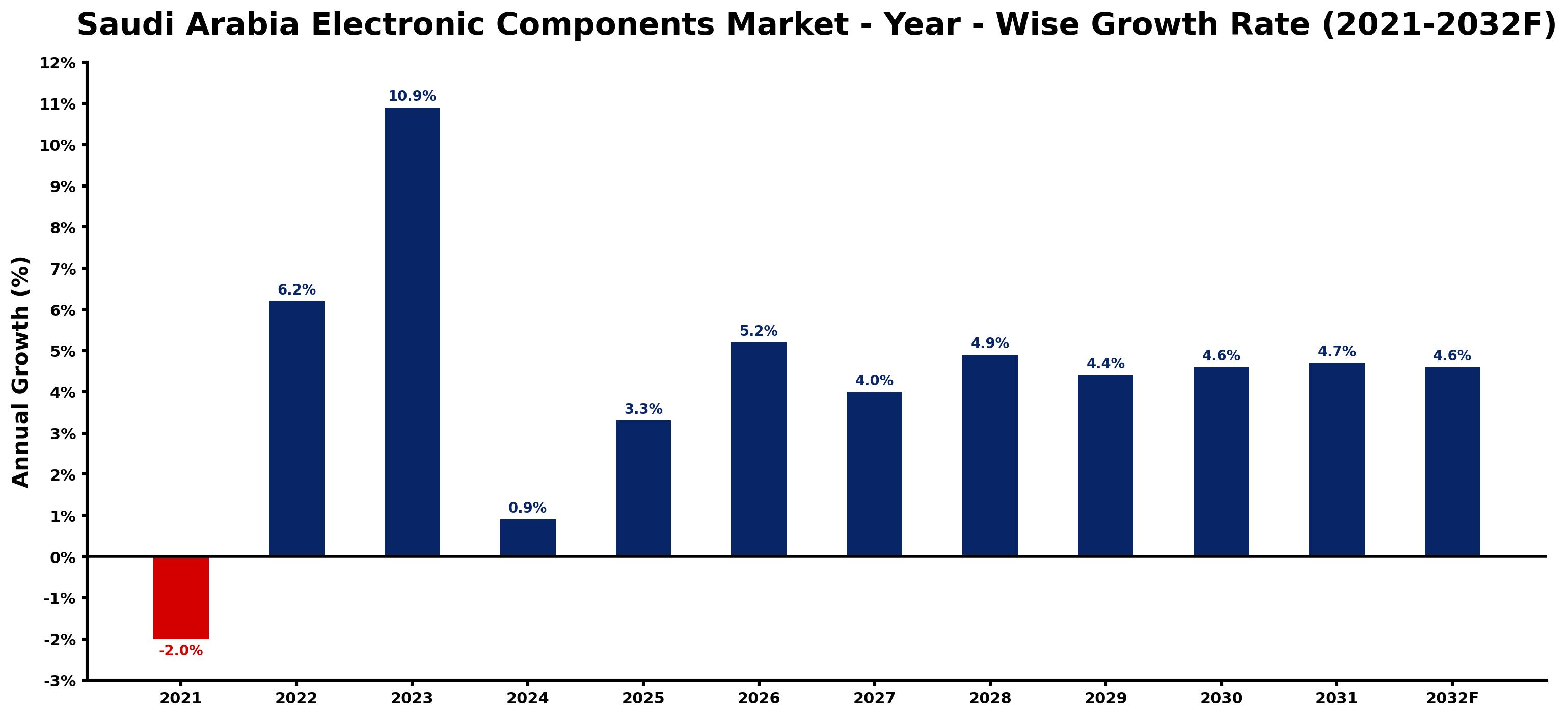
The table below presents the year wise growth rates along with the key drivers influencing the market
| Year | Growth Rate | Major Drivers |
| 2021 | -2.0% | Supply chain disruptions hindered production schedules, leading to delayed deliveries and reduced market availability. |
| 2022 | 6.2% | Regional manufacturers began localizing production to reduce supply chain vulnerabilities. |
| 2023 | 10.9% | Major construction projects in NEOM highlighted the need for advanced electronic solutions. |
| 2024 | 0.9% | Increased investments in telecommunications infrastructure bolstered the electronics supply chain. |
| 2025 | 3.3% | Collaboration between tech firms and startups fostered innovation within the electronic sector. |
| 2026 | 5.2% | Emerging trends in renewable energy drive interest in energy-efficient electronic components. |
| 2027 | 4.0% | The automotive industry's shift towards electric vehicles necessitated advanced electronic systems. |
| 2028 | 4.9% | Expanding internet penetration rates opened new markets for consumer electronic products. |
| 2029 | 4.4% | Technological convergence prompted demand for components in IoT applications and smart homes. |
| 2030 | 4.6% | Regional trade agreements enhanced access to international markets for electronic goods. |
| 2031 | 4.7% | Sustainability initiatives required manufacturers to adopt eco-friendly electronic production methods. |
| 2032 | 4.6% | Investment in advanced manufacturing technologies transformed production efficiency and capacity. |
Note - Market size estimations and growth projections presented in this report are based on 6Wresearch's advanced forecasting approach, validated with industry datasets as of June 2026.
Saudi Arabia Electronic Components Market Synopsis
The Saudi Arabia Electronic Components Market is projected to reach 5.2% and witness significant growth during the forecast period (2026-2032). This anticipated expansion can be attributed to a confluence of factors such as increasing investments in the industrial sector, rising construction activities, and heightened consumer electronics spending. The surge in mobile phone ownership alongside an expanding population further amplifies the demand for electronic components. Furthermore, government initiatives, notably Vision 2031, aim to diversify the economy through projects emphasizing advanced technology and digitalization, which are also expected to stimulate demand for electronic components.
Saudi Arabia Electronic Components Market Growth Drivers
The growth trajectory of the Saudi Arabia Electronic Components Market is underpinned by several pivotal drivers:
- The significant investment in the industrial sector reflects the government's commitment to enhancing local manufacturing capabilities, offering ample opportunities for both domestic and international investors to establish or expand operations requiring extensive electronic components.
- Rapid urbanization coupled with a surge in government-funded infrastructure projects has propelled construction activities across the kingdom. This uptick necessitates a broad array of electrical equipment, such as switches, sensors, and relays, thereby substantially increasing demand for electronic components.
- The proliferation of mobile technology has led to an uptick in smartphone ownership, resulting in a rising demand for sophisticated electronic gadgets. This, in turn, drives the need for integrated circuits (ICs) and other essential components critical for device functionality.
- Consumer electronics spending is on the rise, fueled by changing lifestyles and the growing affinity for advanced technological products, which contribute to the increasing demand for electronic components.
- Key government initiatives focused on digital transformation and technological advancement, such as Vision 2031, are expected to enhance the overall market environment, creating further opportunities for growth within the electronic components sector.
Saudi Arabia Electronic Components Market Challenges and Restraints
Despite the positive outlook, the Saudi Arabia Electronic Components Market faces notable challenges:
- A significant shortage of skilled labor familiar with installation and maintenance of electronic components is limiting the industry's growth potential. Companies often need to engage foreign labor, incurring additional costs for training to meet local safety standards.
- The fluctuating global supply chain dynamics, influenced by geopolitical tensions and trade policies, can adversely affect the availability and pricing of electronic components, posing risks to market stability.
- The rapid pace of technological advancement necessitates constant innovation; however, the industry may struggle to keep up with these changes, potentially leading to obsolescence of products.
- Regulatory challenges related to compliance with international quality and safety standards can create hurdles for manufacturers aiming to enter or expand within the market, particularly for smaller entities.
- Economic fluctuations, exacerbated by global events such as pandemics, can lead to unpredictable market conditions, impacting both consumer demand and investment in the sector.
Saudi Arabia Electronic Components Market Government Investment and Initiatives
The government's strategic focus on enhancing the industrial sector through investments plays a critical role in shaping the future of the Saudi Arabia Electronic Components Market. Comprehensive initiatives under Vision 2031 are designed to foster economic diversification and promote advanced technology adoption across various segments. This includes substantial public spending on infrastructure, which not only creates immediate demand for electronic components but also paves the way for sustainable growth in the long term. Incentives for innovation and R&D in the electronic sector are emphasized, encouraging local enterprises to enhance their capabilities and compete on a global scale. The establishment of technology parks and industrial zones further supports the ecosystem, attracting both local and foreign investments aimed at developing manufacturing facilities to meet the increasing demand for electronic components.
Saudi Arabia Electronic Components Market Latest Developments (May 2025 - June 2026)
Recent developments within the Saudi Arabia Electronic Components Market indicate a strategic shift towards enhancing local production capabilities. Companies are increasingly investing in smart manufacturing technologies to meet the burgeoning demand for electronic components driven by local industries. Notable advancements in regulatory frameworks have been introduced to support foreign direct investment, facilitating advanced partnerships that focus on technology transfer and skill development. Initiatives aimed at promoting local startups specializing in electronic component manufacturing have gained momentum, contributing to a more robust market landscape. Additionally, collaborations between private sector players and educational institutions are being prioritized to address the skills gap in the workforce, ensuring a steady supply of qualified personnel in the industry. The market is gradually recovering from previous disruptions caused by the COVID-19 pandemic, with supply chains stabilizing and production schedules returning to normal.
Saudi Arabia Electronic Components Market - Key Attractiveness of the Report
- 10 Years of Market Numbers
- Historical Data Starting from 2022 to 2025
- Base Year: 2025
- Forecast Data until 2032
- Key Performance Indicators Impacting the Market
- Major Upcoming Developments and Projects
Key Highlights of the Report:
- Saudi Arabia Electronic Components Market Outlook
- Market Size of Saudi Arabia Electronic Components Market, 2025
- Forecast of Saudi Arabia Electronic Components Market, 2032
- Historical Data and Forecast of Saudi Arabia Electronic Components Revenues & Volume for the Period 2022-2032F
- Saudi Arabia Electronic Components Market Trend Evolution
- Saudi Arabia Electronic Components Market Drivers and Challenges
- Saudi Arabia Electronic Components Price Trends
- Saudi Arabia Electronic Components Porter's Five Forces
- Saudi Arabia Electronic Components Industry Life Cycle
- Historical Data and Forecast of Saudi Arabia Electronic Components Market Revenues & Volume By Types for the Period 2022-2032F
- Historical Data and Forecast of Saudi Arabia Electronic Components Market Revenues & Volume By Passive for the Period 2022-2032F
- Historical Data and Forecast of Saudi Arabia Electronic Components Market Revenues & Volume By Active for the Period 2022-2032F
- Historical Data and Forecast of Saudi Arabia Electronic Components Market Revenues & Volume By Electro Mechanic for the Period 2022-2032F
- Historical Data and Forecast of Saudi Arabia Electronic Components Market Revenues & Volume By Applications for the Period 2022-2032F
- Historical Data and Forecast of Saudi Arabia Electronic Components Market Revenues & Volume By Automotive for the Period 2022-2032F
- Historical Data and Forecast of Saudi Arabia Electronic Components Market Revenues & Volume By Communications for the Period 2022-2032F
- Historical Data and Forecast of Saudi Arabia Electronic Components Market Revenues & Volume By Industrial for the Period 2022-2032F
- Historical Data and Forecast of Saudi Arabia Electronic Components Market Revenues & Volume By Computing Applications for the Period 2022-2032F
- Historical Data and Forecast of Saudi Arabia Electronic Components Market Revenues & Volume By Others for the Period 2022-2032F
- Saudi Arabia Electronic Components Import Export Trade Statistics
- Market Opportunity Assessment By Types
- Market Opportunity Assessment By Applications
- Saudi Arabia Electronic Components Top Companies Market Share
- Saudi Arabia Electronic Components Competitive Benchmarking By Technical and Operational Parameters
- Saudi Arabia Electronic Components Company Profiles
- Saudi Arabia Electronic Components Key Strategic Recommendations






































