Saudi Arabia Energy Efficient Lighting Market Size, Share & Growth Rate
The Saudi Arabia Energy Efficient Lighting Market was estimated at USD 220 Million in 2025 and is projected to reach USD 280 Million by 2032, growing at a CAGR of 3.5% from 2026 to 2032. This robust growth is fueled by a combination of government initiatives aimed at energy efficiency and an increasing public awareness of sustainability. As the country aims to reduce its carbon emissions and diversify its economy, the shift towards energy-efficient lighting solutions becomes not just a trend, but a crucial component of Saudi Arabia's broader energy strategy.
Saudi Arabia Energy Efficient Lighting Market Year-wise Growth Rate and Key Drivers
This graph highlights how the Saudi Arabia Energy Efficient Lighting Market has steadily grown over the years, supported by major growth factors.
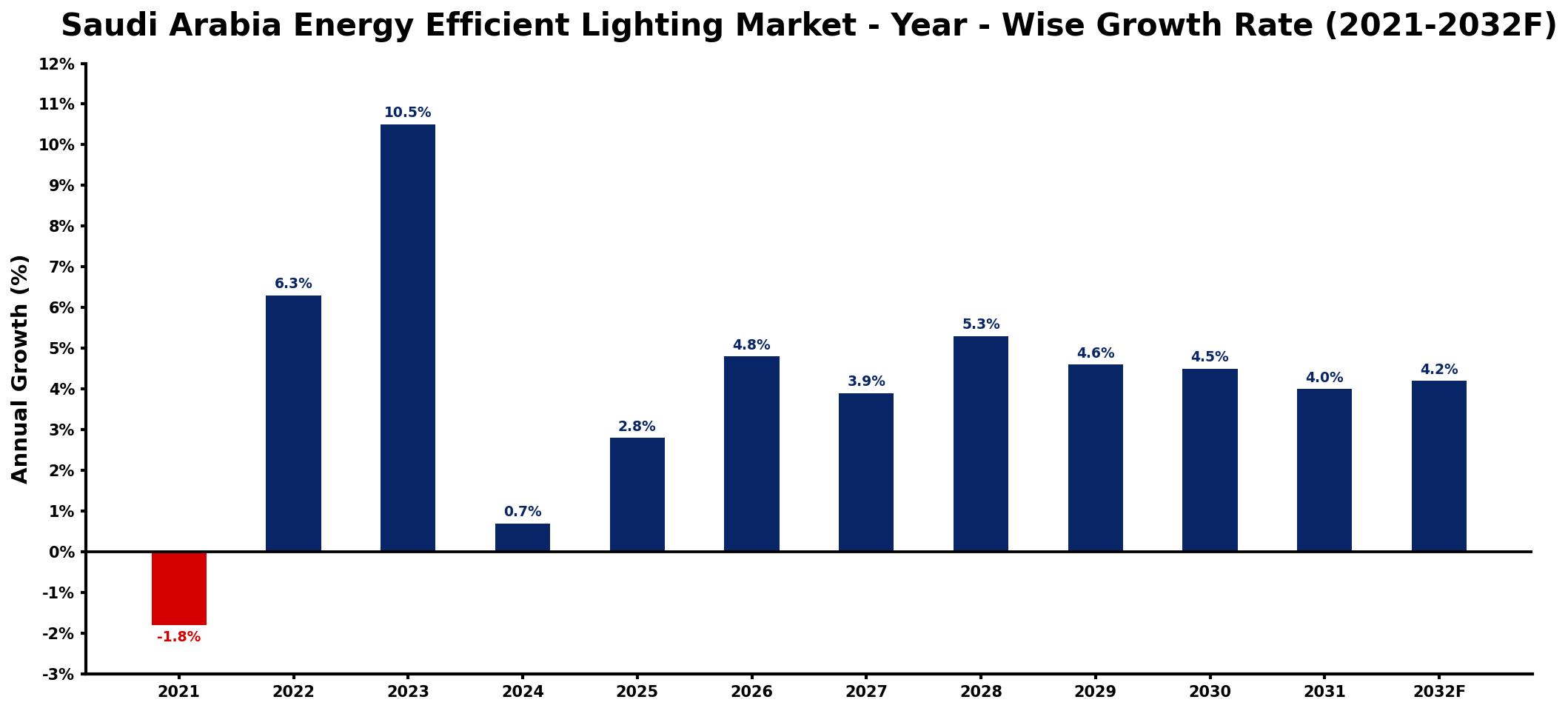
The table below presents the year‑wise growth rates along with the key drivers influencing the market
| Year | Growth Rate | Major Drivers |
| 2021 | -1.8% | decreased construction activity levels |
| 2022 | 6.3% | growing focus on sustainability initiatives |
| 2023 | 10.5% | rising consumer awareness about benefits |
| 2024 | 0.7% | increased government funding for projects |
| 2025 | 2.8% | expansion of commercial sector investments |
| 2026 | 4.8% | advancements in technology and innovation |
| 2027 | 3.9% | growing urbanization and infrastructure development |
| 2028 | 5.3% | increased demand from retail sector |
| 2029 | 4.6% | rising adoption in residential applications |
| 2030 | 4.5% | stronger distribution network expansion |
| 2031 | 4.0% | growing interest in smart solutions |
| 2032 | 4.2% | rising infrastructure development spending |
Note: Market size estimations and growth projections presented in this report are based on 6Wresearch's proprietary forecasting methodology, utilizing the latest available industry data, government publications, and primary research inputs.
Saudi Arabia Energy Efficient Lighting Market Synopsis
In recent years, the Saudi Arabia Energy Efficient Lighting Market has gained significant momentum, driven by heightened government interest and consumer demand for greener solutions. This positive trend is projected to accelerate as industries and households alike recognize the long-term economic benefits of adopting energy-efficient technologies.
Looking ahead, the market is well-positioned for continuous expansion. With the transition to advanced lighting systems such as LEDs becoming increasingly mainstream, the demand for energy-efficient products is set to reshape the lighting landscape in Saudi Arabia, aligning closely with national sustainability goals.
Saudi Arabia Energy Efficient Lighting Market Key Takeaways
- The market is poised for growth, driven by governmental policies promoting energy efficiency.
- Adoption of LED technology is increasing due to its cost-effectiveness and longevity.
- Consumer awareness of the environmental benefits of energy-efficient lighting is rising.
- Challenges related to initial costs and compatibility with existing systems remain critical focus areas.
- Collaborative efforts between public and private sectors are essential for market development.
Evaluation of Restraints in Saudi Arabia Energy Efficient Lighting Market
Despite the positive trajectory of the Saudi Arabia Energy Efficient Lighting Market, several restraints hinder its full potential. The high initial investment costs associated with energy-efficient lighting systems often deter consumers and businesses from making the transition. Additionally, there is a noticeable gap in understanding the long-term financial benefits of such systems, further complicating adoption efforts. The compatibility of new lighting technologies with existing infrastructures presents another challenge. To overcome these barriers, an emphasis on educational campaigns and financial incentives is essential, fostering a more informed consumer base.
Saudi Arabia Energy Efficient Lighting Market Trends
Several trends are shaping the demand for energy-efficient lighting in Saudi Arabia. The increasing focus on sustainable architecture and green building practices is pushing developers and businesses to adopt energy-saving lighting solutions. Furthermore, smart lighting technologies that enable users to customize lighting levels and integrate with building management systems are gaining traction. As energy prices fluctuate and sustainability continues to be a priority, the shift towards innovative lighting solutions is expected to accelerate.
Saudi Arabia Energy Efficient Lighting Market Opportunities
The market for energy-efficient lighting in Saudi Arabia presents numerous growth opportunities. Investment in renewable energy sources offers a pathway for integrating advanced lighting technologies within sustainable frameworks. Furthermore, public sector projects aimed at modernizing infrastructure provide fertile ground for energy-efficient lighting solutions. Targeting both residential and commercial sectors with tailored marketing campaigns can significantly enhance market penetration, creating lasting partnerships that support the shift towards sustainability.
Government Initiatives in the Saudi Arabia Energy Efficient Lighting Market
The Saudi government is taking proactive measures to enhance energy efficiency across various sectors, including lighting. Initiatives include regulatory frameworks promoting the adoption of energy-efficient technologies and offering financial incentives for businesses and homeowners to switch to sustainable lighting solutions. Public awareness campaigns are also in place, emphasizing the importance of reducing energy consumption and carbon footprints, making energy-efficient lighting a central theme in national energy strategy.
Future Insights of the Saudi Arabia Energy Efficient Lighting Market
Looking towards 2026-2032, the Saudi Arabia Energy Efficient Lighting Market is expected to witness remarkable evolution. With ongoing efforts from both the government and private sectors to promote sustainable practices, the market will likely see a continuous influx of innovative products and solutions. As technology advances and costs decrease, the adoption of energy-efficient lighting will likely become standard across all sectors, thereby significantly contributing to the country's long-term environmental goals.
Saudi Arabia Energy Efficient Lighting Market Latest Developments (2025 - 2026)
Recent developments in the Saudi Arabia Energy Efficient Lighting Market point towards a heightened focus on smart lighting solutions and integration with IoT technologies. Initiatives aimed at improving infrastructure and the energy grid have gained traction, promoting the installation of advanced lighting systems. As stakeholders continue to collaborate, the emphasis on sustainability remains evident, ensuring that energy-efficient lighting remains a key player in the nation's energy transition.
Saudi Arabia Energy Efficient Lighting Market - Key Attractiveness of the Report
- 10 Years of Market Numbers
- Historical Data Starting from 2022 to 2025
- Base Year: 2025
- Forecast Data until 2032
- Key Performance Indicators Impacting the Market
- Major Upcoming Developments and Projects
Key Highlights of the Report:
- Saudi Arabia Energy Efficient Lighting Market Outlook
- Market Size of Saudi Arabia Energy Efficient Lighting Market, 2025
- Forecast of Saudi Arabia Energy Efficient Lighting Market, 2032
- Historical Data and Forecast of Saudi Arabia Energy Efficient Lighting Revenues & Volume for the Period 2022-2032F
- Saudi Arabia Energy Efficient Lighting Market Trend Evolution
- Saudi Arabia Energy Efficient Lighting Market Drivers and Challenges
- Saudi Arabia Energy Efficient Lighting Price Trends
- Saudi Arabia Energy Efficient Lighting Porter's Five Forces
- Saudi Arabia Energy Efficient Lighting Industry Life Cycle
- Historical Data and Forecast of Saudi Arabia Energy Efficient Lighting Market Revenues & Volume By Product Type for the Period 2022-2032F
- Historical Data and Forecast of Saudi Arabia Energy Efficient Lighting Market Revenues & Volume By Incandescent Lamp for the Period 2022-2032F
- Historical Data and Forecast of Saudi Arabia Energy Efficient Lighting Market Revenues & Volume By Light Emitting Diode for the Period 2022-2032F
- Historical Data and Forecast of Saudi Arabia Energy Efficient Lighting Market Revenues & Volume By Arc Lamp for the Period 2022-2032F
- Historical Data and Forecast of Saudi Arabia Energy Efficient Lighting Market Revenues & Volume By Gas Discharge Lamps for the Period 2022-2032F
- Historical Data and Forecast of Saudi Arabia Energy Efficient Lighting Market Revenues & Volume By Application for the Period 2022-2032F
- Historical Data and Forecast of Saudi Arabia Energy Efficient Lighting Market Revenues & Volume By Commercial for the Period 2022-2032F
- Historical Data and Forecast of Saudi Arabia Energy Efficient Lighting Market Revenues & Volume By Residential for the Period 2022-2032F
- Historical Data and Forecast of Saudi Arabia Energy Efficient Lighting Market Revenues & Volume By Government for the Period 2022-2032F
- Historical Data and Forecast of Saudi Arabia Energy Efficient Lighting Market Revenues & Volume By Correlated Color Temperature for the Period 2022-2032F
- Historical Data and Forecast of Saudi Arabia Energy Efficient Lighting Market Revenues & Volume By 2700K-3000K for the Period 2022-2032F
- Historical Data and Forecast of Saudi Arabia Energy Efficient Lighting Market Revenues & Volume By 3500K??4000K for the Period 2022-2032F
- Historical Data and Forecast of Saudi Arabia Energy Efficient Lighting Market Revenues & Volume By 4000K-5000K for the Period 2022-2032F
- Historical Data and Forecast of Saudi Arabia Energy Efficient Lighting Market Revenues & Volume By 5000K-6500K for the Period 2022-2032F
- Historical Data and Forecast of Saudi Arabia Energy Efficient Lighting Market Revenues & Volume By More Than 6500K for the Period 2022-2032F
- Saudi Arabia Energy Efficient Lighting Import Export Trade Statistics
- Market Opportunity Assessment By Product Type
- Market Opportunity Assessment By Application
- Market Opportunity Assessment By Correlated Color Temperature
- Saudi Arabia Energy Efficient Lighting Top Companies Market Share
- Saudi Arabia Energy Efficient Lighting Competitive Benchmarking By Technical and Operational Parameters
- Saudi Arabia Energy Efficient Lighting Company Profiles
- Saudi Arabia Energy Efficient Lighting Key Strategic Recommendations






































