Saudi Arabia Glass Lens Market Size, Share & Growth Rate
The Saudi Arabia Glass Lens Market was estimated at USD 376 Million in 2025 and is projected to reach USD 483 Million by 2032, growing at a CAGR of 3.6% from 2026 to 2032. This growth trajectory is driven by the increasing demand for high-quality optics across multiple sectors, including automotive and healthcare. As consumers lean towards premium optical products and technological advancements in lens manufacturing continue, the market is well-positioned for steady expansion.
Saudi Arabia Glass Lens Market Year-wise Growth Rate and Key Drivers
This graph highlights how the Saudi Arabia Glass Lens Market has steadily grown over the years, supported by major growth factors.
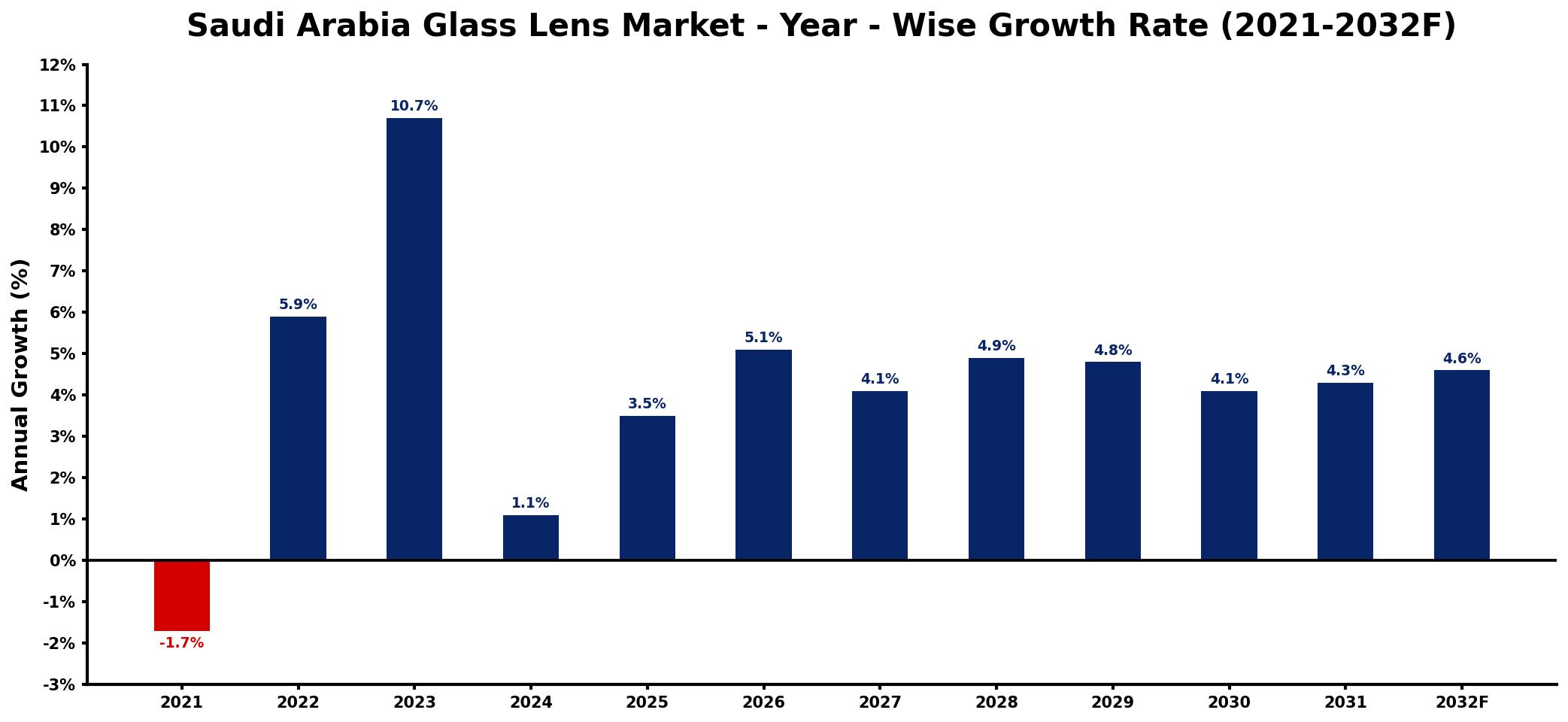
The table below presents the year‑wise growth rates along with the key drivers influencing the market
| Year | Growth Rate | Major Drivers |
| 2021 | -1.7% | decreased consumer spending on eyewear |
| 2022 | 5.9% | increased demand for vision correction |
| 2023 | 10.7% | growing adoption of digital devices |
| 2024 | 1.1% | expansion of retail eyewear outlets |
| 2025 | 3.5% | rising awareness of eye health |
| 2026 | 5.1% | innovation in eyewear technology |
| 2027 | 4.1% | increase in fashion eyewear trends |
| 2028 | 4.9% | growth in online eyewear sales |
| 2029 | 4.8% | rising disposable income levels |
| 2030 | 4.1% | enhanced marketing strategies for eyewear |
| 2031 | 4.3% | increased collaboration with healthcare providers |
| 2032 | 4.6% | improved raw material availability |
Note: Market size estimations and growth projections presented in this report are based on 6Wresearch's proprietary forecasting methodology, utilizing the latest available industry data, government publications, and primary research inputs.
Saudi Arabia Glass Lens Market Synopsis
The Saudi Arabia glass lens market has shown resilience in the face of challenges, especially during recent global disruptions. Currently, the market is transitioning towards a phase of gradual recovery, reflecting renewed consumer confidence and a surge in demand for quality optics in various applications.
As the landscape evolves, the focus on advanced optical technologies becomes paramount. Innovations in manufacturing processes and the integration of new materials are paving the way for enhanced lens performance. The expected influx of population and consumer preferences further amplifies the potential for growth in the eyewear and imaging sectors.
Saudi Arabia Glass Lens Market Key Takeaways
- Growing consumer demand for premium optical products fuels market expansion.
- Technological advancements in lens manufacturing drive innovation and efficiency.
- Increased application of glass lenses across various industries enhances their market relevance.
- Market recovery post-COVID-19 showcases resilience and adaptability in key sectors.
- Strategic focus on high-quality optical components remains a top priority for manufacturers.
Evaluation of Restraints in Saudi Arabia Glass Lens Market
Despite its growth prospects, the Saudi Arabia glass lens market faces several restraints that may impact its potential. Maintaining optical clarity and durability while adapting to specific application requirements presents a significant challenge for manufacturers. Additionally, the necessity for lenses that can withstand diverse environmental conditions, along with the demand for advanced coatings to enhance performance, complicates the production process. These challenges require continuous innovation and investment to ensure that products not only meet current standards but also anticipate future demands.
Saudi Arabia Glass Lens Market Trends
Several key trends are shaping the Saudi Arabia glass lens market landscape. The integration of smart technology into eyewear, such as augmented reality features, is gaining traction and driving innovation. Furthermore, the shift towards sustainable manufacturing practices is prompting companies to explore eco-friendly materials and processes. The rising preference for personalized eyewear solutions indicates a growing market for customized glass lenses, enhancing consumer engagement and satisfaction.
Saudi Arabia Glass Lens Market Opportunities
With increasing investments in healthcare and automotive sectors, the Saudi Arabia glass lens market presents significant growth opportunities. The expansion of the eyewear market, coupled with a rise in disposable incomes, allows for a broader consumer base eager for high-quality optical solutions. Additionally, exploring untapped segments, such as sports eyewear and safety glasses, can further fuel market growth. As technology continues to advance, embracing innovations such as anti-reflective coatings and high-index materials will also open new avenues for investment.
Government Initiatives in the Saudi Arabia Glass Lens Market
The Saudi government is actively promoting initiatives aimed at boosting the optical and manufacturing sectors, which have positive implications for the glass lens market. Public spending on healthcare and technology is set to increase, driving demand for medical devices and high-quality optical products. Various programs encourage research and development within the optics industry, while incentives aimed at fostering local production capabilities may help reduce reliance on imports and stimulate domestic manufacturing.
Future Insights of the Saudi Arabia Glass Lens Market
Looking ahead, the Saudi Arabia glass lens market is poised for a dynamic evolution from 2026 to 2032. As consumer preferences shift towards more technologically advanced and personalized optical products, manufacturers will need to adapt swiftly. The anticipated growth in sectors such as healthcare and automotive will likely drive sustained demand for specialized glass lenses. Strategic collaborations and investments in innovative manufacturing processes are essential to meeting the heightened expectations of consumers in this rapidly changing landscape.
Saudi Arabia Glass Lens Market Latest Developments (2025 - 2026)
Recent developments in the Saudi Arabia glass lens market highlight a focus on innovation and sustainability. Companies are increasingly prioritizing advanced lens technologies that enhance visual performance while addressing environmental concerns. Furthermore, collaboration between industry stakeholders is becoming more common, fostering knowledge sharing and resource optimization to enhance product offerings. As the market rebounds from previous disruptions, players are strategically positioning themselves to leverage emerging trends and opportunities.
Saudi Arabia Glass Lens Market - Key Attractiveness of the Report
- 10 Years of Market Numbers
- Historical Data Starting from 2022 to 2025
- Base Year: 2025
- Forecast Data until 2032
- Key Performance Indicators Impacting the Market
- Major Upcoming Developments and Projects
Key Highlights of the Report:
- Saudi Arabia Glass Lens Market Outlook
- Market Size of Saudi Arabia Glass Lens Market, 2025
- Forecast of Saudi Arabia Glass Lens Market, 2032
- Historical Data and Forecast of Saudi Arabia Glass Lens Revenues & Volume for the Period 2022-2032F
- Saudi Arabia Glass Lens Market Trend Evolution
- Saudi Arabia Glass Lens Market Drivers and Challenges
- Saudi Arabia Glass Lens Price Trends
- Saudi Arabia Glass Lens Porter's Five Forces
- Saudi Arabia Glass Lens Industry Life Cycle
- Historical Data and Forecast of Saudi Arabia Glass Lens Market Revenues & Volume By Product Type for the Period 2022-2032F
- Historical Data and Forecast of Saudi Arabia Glass Lens Market Revenues & Volume By Single Vision Lenses for the Period 2022-2032F
- Historical Data and Forecast of Saudi Arabia Glass Lens Market Revenues & Volume By Progressive Lenses for the Period 2022-2032F
- Historical Data and Forecast of Saudi Arabia Glass Lens Market Revenues & Volume By Bifocal and Trifocal Lenses for the Period 2022-2032F
- Historical Data and Forecast of Saudi Arabia Glass Lens Market Revenues & Volume By Photochromic Lenses for the Period 2022-2032F
- Historical Data and Forecast of Saudi Arabia Glass Lens Market Revenues & Volume By Polarized Lenses for the Period 2022-2032F
- Historical Data and Forecast of Saudi Arabia Glass Lens Market Revenues & Volume By Others for the Period 2022-2032F
- Historical Data and Forecast of Saudi Arabia Glass Lens Market Revenues & Volume By Coating for the Period 2022-2032F
- Historical Data and Forecast of Saudi Arabia Glass Lens Market Revenues & Volume By Anti-Reflective for the Period 2022-2032F
- Historical Data and Forecast of Saudi Arabia Glass Lens Market Revenues & Volume By Blue Light Reduction for the Period 2022-2032F
- Historical Data and Forecast of Saudi Arabia Glass Lens Market Revenues & Volume By Scratch-Resistant for the Period 2022-2032F
- Historical Data and Forecast of Saudi Arabia Glass Lens Market Revenues & Volume By UV Protection for the Period 2022-2032F
- Historical Data and Forecast of Saudi Arabia Glass Lens Market Revenues & Volume By Distribution Channel for the Period 2022-2032F
- Historical Data and Forecast of Saudi Arabia Glass Lens Market Revenues & Volume By Offline for the Period 2022-2032F
- Historical Data and Forecast of Saudi Arabia Glass Lens Market Revenues & Volume By Online for the Period 2022-2032F
- Saudi Arabia Glass Lens Import Export Trade Statistics
- Market Opportunity Assessment By Product Type
- Market Opportunity Assessment By Coating
- Market Opportunity Assessment By Distribution Channel
- Saudi Arabia Glass Lens Top Companies Market Share
- Saudi Arabia Glass Lens Competitive Benchmarking By Technical and Operational Parameters
- Saudi Arabia Glass Lens Company Profiles
- Saudi Arabia Glass Lens Key Strategic Recommendations






































