Saudi Arabia High Strength Steel Market Size, Share & Growth Rate
The Saudi Arabia High Strength Steel Market was estimated at USD 366 Million in 2025 and is projected to reach USD 470 Million by 2032, growing at a CAGR of 3.6% from 2026 to 2032. This growth trajectory is primarily driven by the rapid expansion of construction projects across the nation, coupled with the increasing demand for lightweight yet robust materials in automotive manufacturing. As Saudi Arabia continues to invest heavily in infrastructure and technological advancements, the requirement for high-strength steel to meet these industrial needs becomes more pronounced.
Saudi Arabia High Strength Steel Market Year-wise Growth Rate and Key Drivers
This graph highlights how the Saudi Arabia High Strength Steel Market has steadily grown over the years, supported by major growth factors.
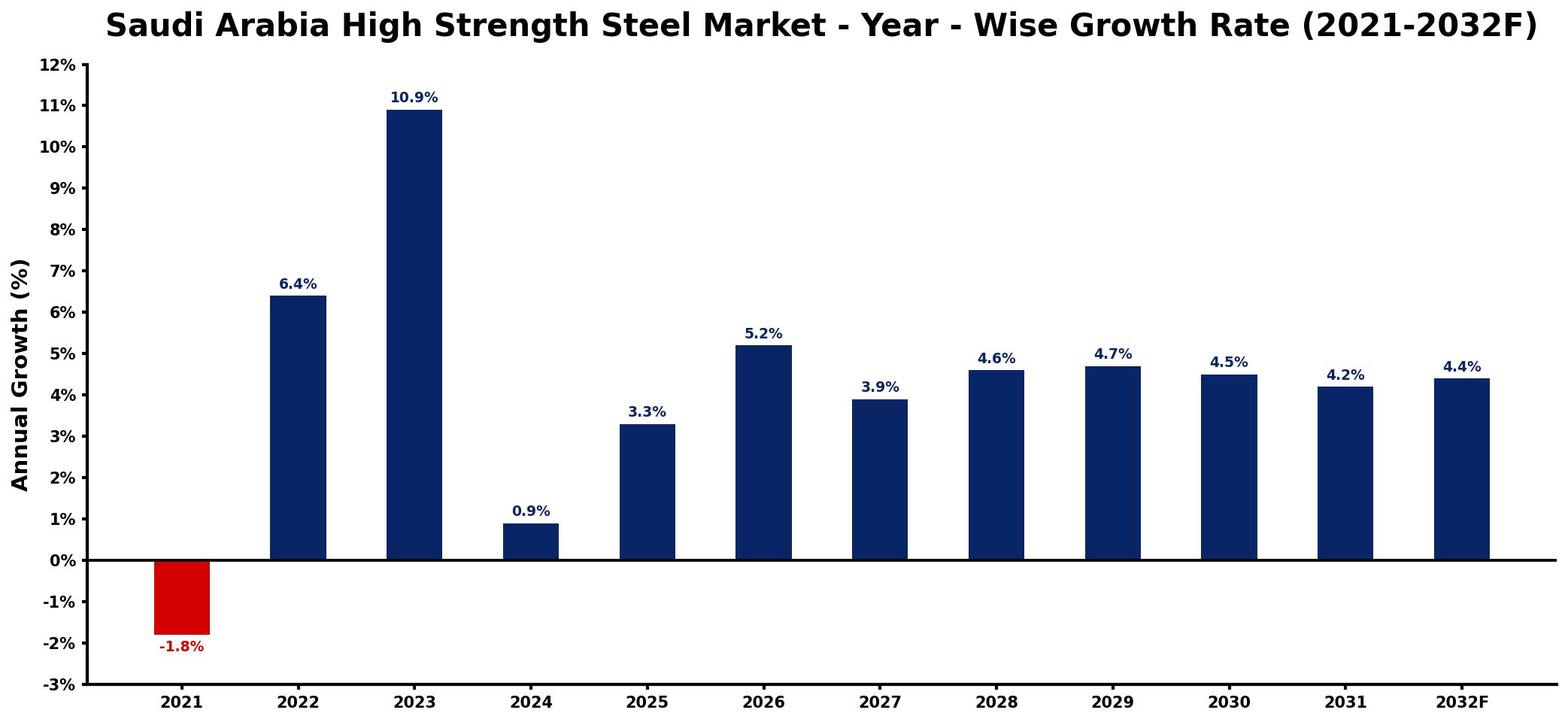
The table below presents the year‑wise growth rates along with the key drivers influencing the market
| Year | Growth Rate | Major Drivers |
| 2021 | -1.8% | Decreased construction and infrastructure projects |
| 2022 | 6.4% | Rising demand from automotive sector |
| 2023 | 10.9% | Increased investment in renewable energy |
| 2024 | 0.9% | Expansion of manufacturing capabilities |
| 2025 | 3.3% | Growing demand from construction industry |
| 2026 | 5.2% | Technological advancements in production |
| 2027 | 3.9% | Increase in export opportunities |
| 2028 | 4.6% | Surge in infrastructure development projects |
| 2029 | 4.7% | improved processing technologies adoption |
| 2030 | 4.5% | Growing focus on sustainability initiatives |
| 2031 | 4.2% | growing automotive sector requirements |
| 2032 | 4.4% | Increased government infrastructure investments |
Note: Market size estimations and growth projections presented in this report are based on 6Wresearch's proprietary forecasting methodology, utilizing the latest available industry data, government publications, and primary research inputs.
Saudi Arabia High Strength Steel Market Synopsis
The demand for high-strength steel in Saudi Arabia is fueled by the government's ambitious Vision 2030 initiative, which aims to diversify the economy and boost the construction sector. This strategic focus not only ensures the need for durable materials but also promotes sustainable practices, making high-strength steel a vital component in the construction of resilient structures.
Moreover, the automotive industry's growth in the region places additional pressure on suppliers to deliver high-performance materials. The shift towards electric vehicles and lightweight designs further highlights the essential role of high-strength steel in meeting new standards for efficiency and safety in automotive applications.
Saudi Arabia High Strength Steel Market Key Takeaways
- The market is set for steady growth driven by construction and automotive sectors.
- High-strength steel offers solutions to achieve greater load-bearing capacity while reducing weight.
- Strategic investments in R&D are enhancing steel compositions to meet evolving industry demands.
- COVID-19 disruptions are fading, allowing for gradual market recovery and renewed investment.
- Key partnerships between local and international players are strengthening market dynamics.
Evaluation of Restraints in Saudi Arabia High Strength Steel Market
While the Saudi Arabia high-strength steel market is witnessing growth, it faces inherent restraints that may limit its potential. Achieving optimal strength levels while ensuring formability and weldability presents a significant challenge for manufacturers. This balance is critical, as industries demand versatile materials that can withstand stress without compromising workability. Additionally, fluctuations in raw material costs and dependency on global supply chains can create uncertainties that impact pricing strategies and profitability in the high-strength steel sector.
Saudi Arabia High Strength Steel Market Trends
Current trends in the Saudi Arabia high-strength steel market indicate a shift towards innovative steel processing techniques that enhance performance. Companies are increasingly focused on developing advanced coatings and treatments that improve corrosion resistance and longevity. Furthermore, the integration of smart technology in manufacturing processes is enabling greater precision and efficiency, aligning with global trends towards automation. The rising emphasis on sustainability is also prompting research into eco-friendly production methods, which are likely to redefine market standards in the near future.
Saudi Arabia High Strength Steel Market Opportunities
The high-strength steel market in Saudi Arabia is ripe with opportunities, particularly as the nation pursues various mega-projects under Vision 2030. Investment in renewable energy infrastructure, such as wind and solar farms, presents a lucrative avenue for high-strength steel applications. Additionally, the push towards electric vehicles opens new markets for lightweight, high-performance materials. By focusing on innovation and strategic collaborations, stakeholders can capitalize on these emerging opportunities to drive growth in the sector.
Government Initiatives in the Saudi Arabia High Strength Steel Market
The Saudi government is actively supporting the high-strength steel market through initiatives aimed at fostering industrial growth and innovation. Investment in infrastructure projects is being prioritized, with significant funding allocated to enhance construction capabilities across the country. Additionally, policies promoting public-private partnerships are designed to bolster domestic steel production, while incentives for adopting advanced manufacturing technologies align with global best practices. Such initiatives are creating a conducive environment for the high-strength steel market to thrive.
Future Insights of the Saudi Arabia High Strength Steel Market
Looking ahead to the period between 2026 and 2032, the Saudi Arabia high-strength steel market is poised for a transformative phase. Continued investment in research and development will lead to breakthroughs in steel formulations, enhancing performance attributes to meet stringent industry demands. The expected surge in infrastructure spending, coupled with the automotive sector's pivot towards efficiency, will solidify high-strength steel's role as an essential material. As the market navigates challenges and leverages opportunities, strategic foresight and adaptability will be key to sustaining growth.
Saudi Arabia High Strength Steel Market Latest Developments (2025 - 2026)
In the latest developments within the Saudi Arabia high-strength steel market, companies are reporting a renewed focus on advanced manufacturing techniques to enhance production efficiencies. Collaborative efforts between local manufacturers and international partners are becoming more prevalent, emphasizing the importance of innovation in steel technology. Additionally, market participants are increasingly investing in automation and digital solutions to streamline operations, reflecting broader trends in the global steel industry.
Saudi Arabia High Strength Steel Market - Key Attractiveness of the Report
- 10 Years of Market Numbers
- Historical Data Starting from 2022 to 2025
- Base Year: 2025
- Forecast Data until 2032
- Key Performance Indicators Impacting the Market
- Major Upcoming Developments and Projects
Key Highlights of the Report:
- Saudi Arabia High Strength Steel Market Outlook
- Market Size of Saudi Arabia High Strength Steel Market, 2025
- Forecast of Saudi Arabia High Strength Steel Market, 2032
- Historical Data and Forecast of Saudi Arabia High Strength Steel Revenues & Volume for the Period 2022-2032F
- Saudi Arabia High Strength Steel Market Trend Evolution
- Saudi Arabia High Strength Steel Market Drivers and Challenges
- Saudi Arabia High Strength Steel Price Trends
- Saudi Arabia High Strength Steel Porter's Five Forces
- Saudi Arabia High Strength Steel Industry Life Cycle
- Historical Data and Forecast of Saudi Arabia High Strength Steel Market Revenues & Volume By Product Type for the Period 2022-2032F
- Historical Data and Forecast of Saudi Arabia High Strength Steel Market Revenues & Volume By Dual Phase Steel for the Period 2022-2032F
- Historical Data and Forecast of Saudi Arabia High Strength Steel Market Revenues & Volume By Bake Hardenable Steel for the Period 2022-2032F
- Historical Data and Forecast of Saudi Arabia High Strength Steel Market Revenues & Volume By Carbon Manganese Steel for the Period 2022-2032F
- Historical Data and Forecast of Saudi Arabia High Strength Steel Market Revenues & Volume By Other Product Types for the Period 2022-2032F
- Historical Data and Forecast of Saudi Arabia High Strength Steel Market Revenues & Volume By Application for the Period 2022-2032F
- Historical Data and Forecast of Saudi Arabia High Strength Steel Market Revenues & Volume By Automotive for the Period 2022-2032F
- Historical Data and Forecast of Saudi Arabia High Strength Steel Market Revenues & Volume By Construction for the Period 2022-2032F
- Historical Data and Forecast of Saudi Arabia High Strength Steel Market Revenues & Volume By Yellow Goods and Mining Equipment for the Period 2022-2032F
- Historical Data and Forecast of Saudi Arabia High Strength Steel Market Revenues & Volume By Aviation and Marine for the Period 2022-2032F
- Historical Data and Forecast of Saudi Arabia High Strength Steel Market Revenues & Volume By Other Applications for the Period 2022-2032F
- Saudi Arabia High Strength Steel Import Export Trade Statistics
- Market Opportunity Assessment By Product Type
- Market Opportunity Assessment By Application
- Saudi Arabia High Strength Steel Top Companies Market Share
- Saudi Arabia High Strength Steel Competitive Benchmarking By Technical and Operational Parameters
- Saudi Arabia High Strength Steel Company Profiles
- Saudi Arabia High Strength Steel Key Strategic Recommendations






































