Saudi Arabia Household furniture Market Summary
The saudi arabia household furniture market was estimated at USD 323 Million in 2025 and is projected to reach USD 412 Million by 2032, growing at a CAGR of 5.1% from 2026 to 2032.
Saudi Arabia Household furniture Market Year-wise Growth Rate and Key Drivers
This graph highlights how the Saudi Arabia Household furniture Market has steadily grown over the past five years, supported by major growth factors.
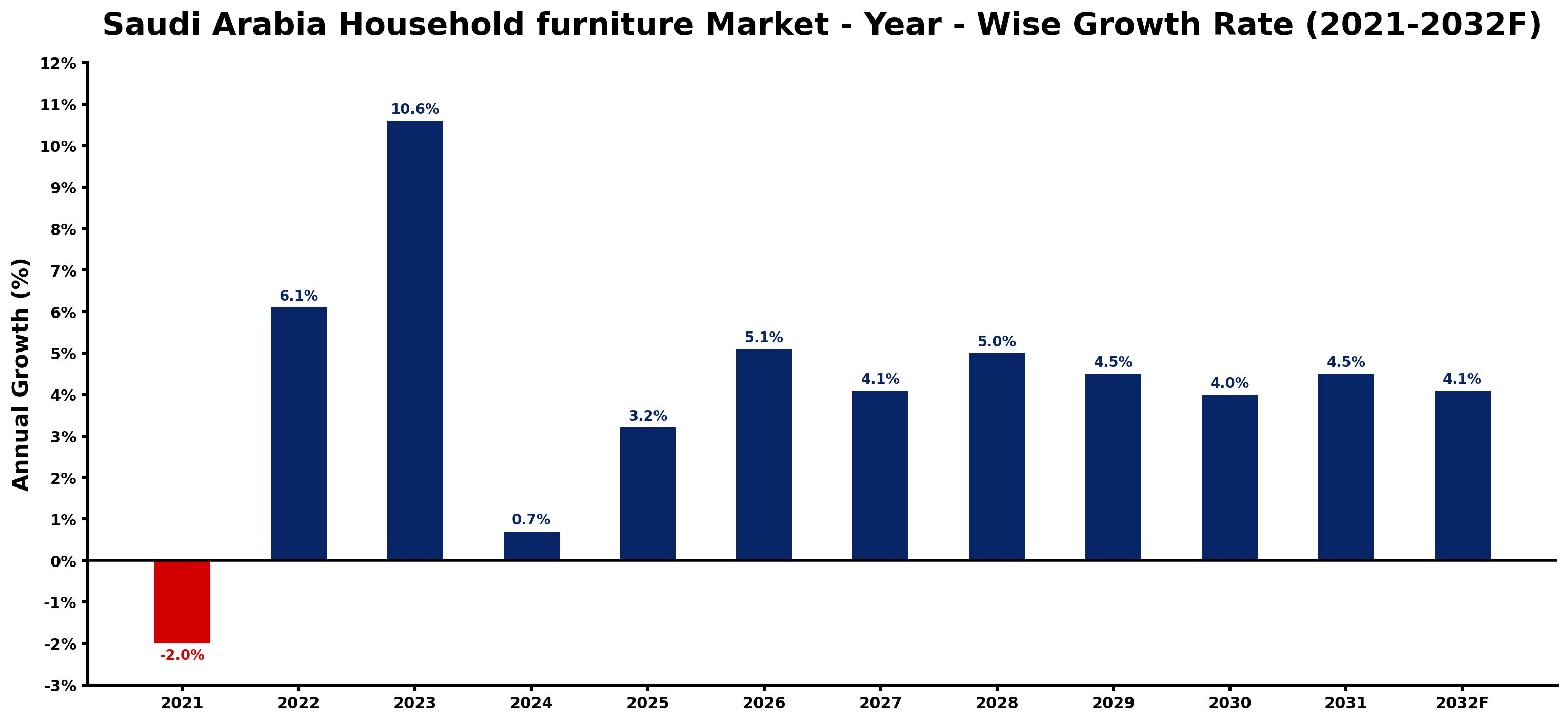
The table below presents the year wise growth rates along with the key drivers influencing the market
| Year | Growth Rate | Major Drivers |
| 2021 | -2.0% | Supply chain disruptions hindered product availability, significantly impacting consumer purchases in the furniture sector. |
| 2022 | 6.1% | Increased urbanization in Saudi cities created demand for modern furniture designs. |
| 2023 | 10.6% | Local manufacturers began introducing products tailored to regional aesthetic preferences. |
| 2024 | 0.7% | A shift towards sustainable materials gained traction among environmentally conscious consumers. |
| 2025 | 3.2% | The Neom project drove investments into innovative home construction and furnishing solutions. |
| 2026 | 5.1% | Urban lifestyle changes led to higher demand for multifunctional and space-saving furniture. |
| 2027 | 4.1% | E-commerce platforms expanded, making furniture shopping more accessible to households. |
| 2028 | 5.0% | Increased disposable income encouraged families to invest in premium furniture brands. |
| 2029 | 4.5% | Home automation trends influenced furniture design towards tech-integrated solutions. |
| 2030 | 4.0% | Luxury lifestyle segments grew, pushing demand for bespoke and high-end furniture options. |
| 2031 | 4.5% | Shifts in consumer preferences favored locally sourced materials over imported goods. |
| 2032 | 4.1% | Integration of AR technology in retail transformed the shopping experience for furniture. |
Note - Market size estimations and growth projections presented in this report are based on 6Wresearch's advanced forecasting approach, validated with industry datasets as of June 2026.
Saudi Arabia Household furniture Market Synopsis
The Saudi Arabia Household furniture Market is projected to reach 5.1% and witness significant growth during the forecast period (2026-2032). The market's expansion can be attributed to multifaceted factors including rising disposable incomes, urbanization, and supportive government initiatives aimed at bolstering local manufacturing industries. Over the years, the household furniture sector has increasingly become a pivotal part of the broader retail landscape in Saudi Arabia, with a marked rise in consumer interest and spending.
Saudi Arabia Household furniture Market Growth Drivers
The growth trajectory of the Saudi Arabia Household furniture Market is significantly influenced by several key drivers:
- The rising demand from the millennial demographic has reshaped consumer preferences, pushing for innovative and multifunctional furniture solutions that cater to a modern lifestyle.
- Production costs in Saudi Arabia remain relatively low compared to other regions, allowing manufacturers to offer competitive pricing for their products while maintaining profitability.
- The increase in residential construction projects, fuelled by population growth and urban migration, has created a burgeoning market for household furniture as new homes necessitate furnishings.
- Purchasing power parity among Saudi consumers continues to rise, enabling a broader section of the population to invest in home furnishings, further propelling market growth.
- Government initiatives, such as the Saudization programs, actively promote the local manufacturing sector, leading to increased self-sufficiency and a boost in export capabilities.
Saudi Arabia Household furniture Market Trends and Opportunities
Several emerging trends within the Saudi Arabia Household furniture Market present significant opportunities for stakeholders:
- The penetration of online retailing platforms is facilitating access to a wide array of furniture options, enhancing the consumer shopping experience and accelerating purchase decisions.
- Technological advancements, such as the implementation of automated production systems, are driving efficiency and reducing costs in manufacturing, thus improving profit margins.
- Increased focus on sustainable and eco-friendly materials is shaping new product offerings, aligning with global consumption trends that prioritize environmental consciousness.
- Customization and personalization in furniture design are gaining traction, catering to the unique preferences of consumers and enhancing brand loyalty.
- Collaborations between traditional furniture makers and e-commerce platforms are creating synergies that amplify outreach and enhance market penetration.
Saudi Arabia Household furniture Market Challenges and Restraints
Despite the positive growth outlook, the Saudi Arabia Household furniture Market faces several challenges that could hinder its progress:
- Access to raw materials remains a critical concern as stringent regulations on imports can disrupt the supply chain, leading to potential shortages and increased costs for manufacturers.
- Small and medium-sized enterprises (SMEs) often encounter difficulties in securing credit facilities, which can impede their operations and lead to higher production costs.
- High employment rates can create challenges in attracting and retaining talent in the furniture sector, impacting overall productivity and service quality.
- The impacts of the global COVID-19 pandemic have left lingering effects, particularly concerning shifts in consumer behavior and supply chain disruptions that could affect the market's recovery.
Saudi Arabia Household furniture Market Government Investment and Initiatives
The government of Saudi Arabia plays an instrumental role in shaping the Household furniture Market through various investments and initiatives:
- Ongoing efforts to diversify the economy under Vision 2030 aim to promote local manufacturing and reduce reliance on oil revenues, directly impacting the household furniture sector.
- Public spending on infrastructure projects is expected to increase, which will drive demand for residential housing and, by extension, household furniture.
- Incentives for local manufacturers, including tax breaks and subsidies, encourage businesses to invest in production capabilities and reduce import dependency.
- Government partnerships with private sectors to enhance training programs for skilled labor aim to address workforce shortages in the manufacturing sector.
- Regulatory reforms aimed at streamlining the business environment are fostering a more conducive atmosphere for investment, supporting the overall growth of the household furniture market.
Saudi Arabia Household furniture Market Latest Developments (May 2025 - June 2026)
In the recent period between May 2025 and June 2026, the Saudi Arabia Household furniture Market has witnessed some noteworthy developments:
- Companies are increasingly adopting sustainable practices in sourcing and production, responding to a growing consumer demand for environmentally responsible products.
- The online sales channel has seen exponential growth, with many retailers enhancing their digital presence to cater to evolving consumer shopping habits.
- Local manufacturers have ramped up their marketing efforts to highlight the quality and craftsmanship of Saudi-made furniture, bolstering national pride and consumer support.
- Innovations in design and functionality are being prioritized, with manufacturers exploring smart furniture solutions that integrate technology into everyday living.
- Collaborative ventures between local furniture makers and international brands are emerging, enriching the product portfolio available to consumers and enhancing global market outreach.
Saudi Arabia Household furniture Market - Key Attractiveness of the Report
- 10 Years of Market Numbers
- Historical Data Starting from 2022 to 2025
- Base Year: 2025
- Forecast Data until 2032
- Key Performance Indicators Impacting the Market
- Major Upcoming Developments and Projects
Key Highlights of the Report:
- Saudi Arabia Household furniture Market Outlook
- Market Size of Saudi Arabia Household furniture Market, 2025
- Forecast of Saudi Arabia Household furniture Market, 2032
- Historical Data and Forecast of Saudi Arabia Household furniture Revenues & Volume for the Period 2022-2032F
- Saudi Arabia Household furniture Market Trend Evolution
- Saudi Arabia Household furniture Market Drivers and Challenges
- Saudi Arabia Household furniture Price Trends
- Saudi Arabia Household furniture Porter's Five Forces
- Saudi Arabia Household furniture Industry Life Cycle
- Historical Data and Forecast of Saudi Arabia Household furniture Market Revenues & Volume By Types for the Period 2022-2032F
- Historical Data and Forecast of Saudi Arabia Household furniture Market Revenues & Volume By Wood Furniture for the Period 2022-2032F
- Historical Data and Forecast of Saudi Arabia Household furniture Market Revenues & Volume By Metal Furniture for the Period 2022-2032F
- Historical Data and Forecast of Saudi Arabia Household furniture Market Revenues & Volume By Plastic Furniture for the Period 2022-2032F
- Historical Data and Forecast of Saudi Arabia Household furniture Market Revenues & Volume By Others for the Period 2022-2032F
- Historical Data and Forecast of Saudi Arabia Household furniture Market Revenues & Volume By Area of Use for the Period 2022-2032F
- Historical Data and Forecast of Saudi Arabia Household furniture Market Revenues & Volume By ?Bedroom Furniture for the Period 2022-2032F
- Historical Data and Forecast of Saudi Arabia Household furniture Market Revenues & Volume By Living Room Furniture for the Period 2022-2032F
- Historical Data and Forecast of Saudi Arabia Household furniture Market Revenues & Volume By Dining Room Furniture for the Period 2022-2032F
- Historical Data and Forecast of Saudi Arabia Household furniture Market Revenues & Volume By Household Furniture for the Period 2022-2032F
- Historical Data and Forecast of Saudi Arabia Household furniture Market Revenues & Volume By Others for the Period 2022-2032F
- Saudi Arabia Household furniture Import Export Trade Statistics
- Market Opportunity Assessment By Types
- Market Opportunity Assessment By Area of Use
- Saudi Arabia Household furniture Top Companies Market Share
- Saudi Arabia Household furniture Competitive Benchmarking By Technical and Operational Parameters
- Saudi Arabia Household furniture Company Profiles
- Saudi Arabia Household furniture Key Strategic Recommendations






































