Saudi Arabia Household Textile Market Summary
The saudi arabia household textile market was estimated at USD 366 Million in 2025 and is projected to reach USD 471 Million by 2032, growing at a CAGR of 5.2% from 2026 to 2032.
Saudi Arabia Household Textile Market Year-wise Growth Rate and Key Drivers
This graph highlights how the Saudi Arabia Household Textile Market has steadily grown over the past five years, supported by major growth factors.
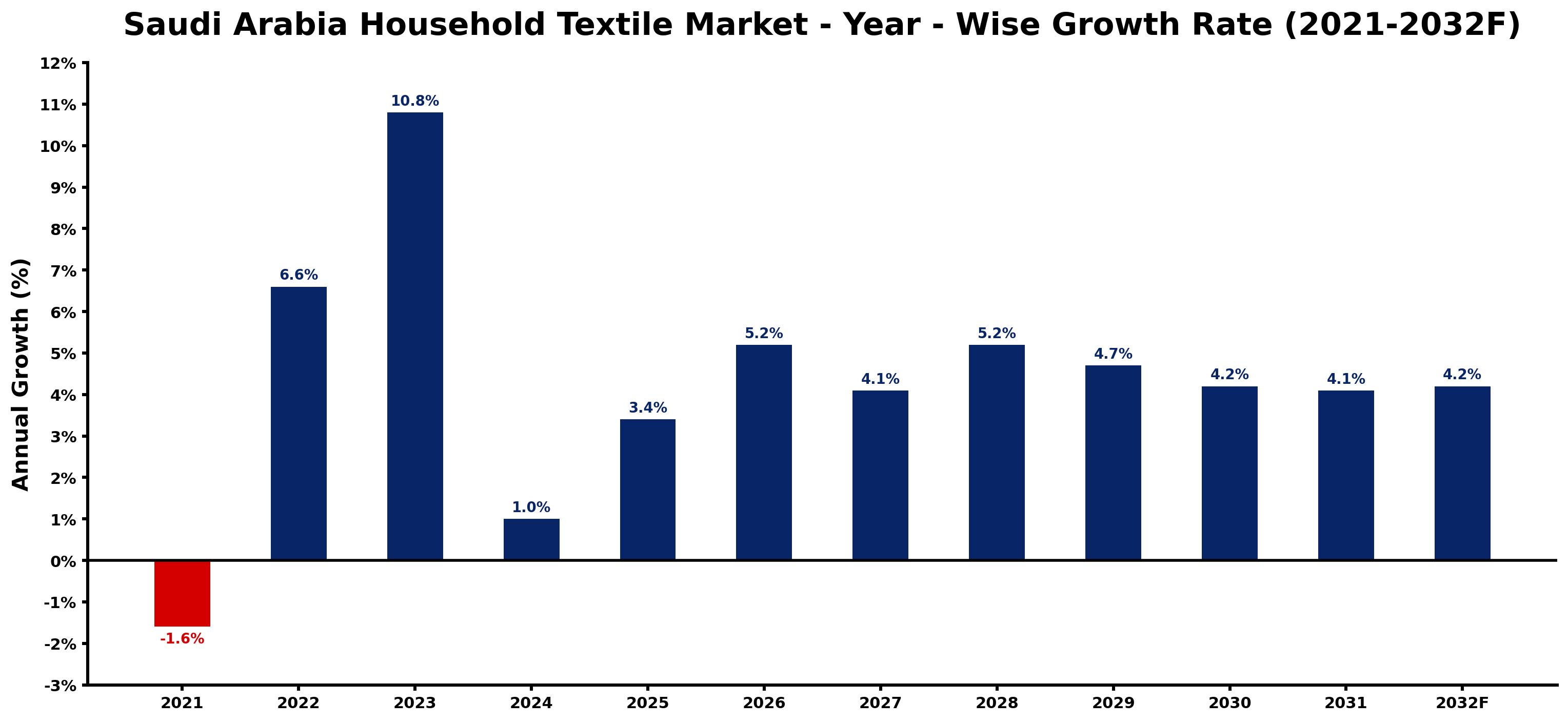
The table below presents the year wise growth rates along with the key drivers influencing the market
| Year | Growth Rate | Major Drivers |
| 2021 | -1.6% | Heightened economic uncertainty led to decreased discretionary spending on nonessential household textile items. |
| 2022 | 6.6% | E-commerce platforms significantly enhance accessibility for textile purchases across Saudi Arabia. |
| 2023 | 10.8% | A surge in home renovations fuels demand for stylish and functional textile products. |
| 2024 | 1.0% | Growing expatriate population drives diverse textile needs and influences market trends. |
| 2025 | 3.4% | Increased disposable income among Saudi families creates opportunities for premium textile brands. |
| 2026 | 5.2% | Sustainability trends prompt consumers to seek eco-friendly textile options in the market. |
| 2027 | 4.1% | Emerging local brands offer unique products that cater to cultural preferences and aesthetics. |
| 2028 | 5.2% | Event-driven sales during Ramadan and Eid boost household textile market performance significantly. |
| 2029 | 4.7% | The expansion of residential projects accelerates demand for textiles in new housing developments. |
| 2030 | 4.2% | Technological advancements in manufacturing lead to innovative and customizable textile solutions. |
| 2031 | 4.1% | Collaboration between designers and textile manufacturers enhances product diversity and appeal. |
| 2032 | 4.2% | Focus on wellness influences the popularity of textiles that promote comfort and relaxation. |
Note - Market size estimations and growth projections presented in this report are based on 6Wresearch's advanced forecasting approach, validated with industry datasets as of June 2026.
Saudi Arabia Household Textile Market Synopsis
The Saudi Arabia Household Textile Market is projected to reach 5.2% and witness significant growth during the forecast period (2026-2032). This growth is primarily driven by an expanding population, increasing disposable incomes, and evolving lifestyle preferences within the country. Furthermore, the rise in tourism, aligned with the goals of Vision 2031, has fueled demand for household textiles, particularly in the hospitality sector, where hotels and resorts seek to enhance their offerings. Government programs such as the Made in KSA initiative and the expansion of e-commerce platforms are also contributing to improved access to high-quality household textile products at competitive prices, thereby stimulating market growth.
Saudi Arabia Household Textile Market Growth Drivers
The Saudi Arabia Household Textile Market is set to benefit from several key drivers that underscore its growth potential:
- Population Growth: As Saudi Arabia's population is anticipated to exceed 34 million by 2025, there will be an increased demand for household textiles. This demographic shift is expected to influence purchasing behavior as more households emerge.
- Rising Disposable Income: The steady increase in per capita income in Saudi Arabia, bolstered by higher energy exports, is transforming spending patterns. Enhanced purchasing power enables families to invest in premium home furnishing and textiles.
- Shifting Lifestyle Trends: The evolving societal norms and lifestyle choices are driving consumers toward modern designs and sustainable products in the household textile arena. Consumers are increasingly interested in quality and aesthetics.
- Boost from Tourism: The Vision 2031 framework promotes tourism, attracting international visitors and consequently escalating the demand for upscale textiles in hotels and resorts, further solidifying market growth.
- Government Initiatives: The Saudi government has implemented initiatives like the Made in KSA program, which supports local manufacturing, thereby enhancing the availability of domestic household textiles.
Saudi Arabia Household Textile Market Challenges and Restraints
While there are numerous growth opportunities, the Saudi Arabia Household Textile Market faces certain challenges that could impede progress:
- Low E-Commerce Penetration: Despite advancements in digital technology, a significant portion of retail still relies on offline transactions. This limitation restricts the growth potential of e-commerce, particularly for consumers who prefer online platforms for purchasing textiles.
- Impact of COVID-19: The pandemic had adverse effects on the household textile sector, disrupting production and sales channels. The resulting economic slowdown has, at times, impacted profitability and operational capacity.
- Market Saturation: With an influx of various international brands, the market is becoming increasingly competitive. The challenge for local producers lies in differentiating their offerings while ensuring quality and affordability.
- Consumer Preferences: Changes in consumer tastes and preferences, particularly towards sustainability, demand that manufacturers innovate continuously to meet evolving expectations.
- Supply Chain Disruptions: Fluctuations in raw material availability and transportation issues can hinder manufacturing processes, affecting product availability in the market.
Saudi Arabia Household Textile Market Government Investment and Initiatives
The Saudi government has taken significant steps to stimulate the household textile market through various initiatives and investments:
- Made in KSA Program: This initiative aims to bolster local manufacturing capabilities, encouraging businesses to produce household textiles domestically, which in turn supports job creation and economic diversification.
- Public Spending on Infrastructure: With significant investments in infrastructure under Vision 2030, the government is facilitating improved logistics, which is crucial for the distribution of household textile products.
- Support for E-Commerce Growth: Government efforts to promote digitalization include incentivizing e-commerce platforms, making it easier for consumers to purchase household textiles online.
- Tourism Development Initiatives: Investments aimed at enhancing the tourism industry are likely to benefit the household textile market, as increasing tourist numbers demand better-quality textiles in hospitality.
- Trade Agreements: The facilitation of trade agreements and partnerships with other countries enhances the import of quality raw materials, which is essential for the household textile sector's growth.
Saudi Arabia Household Textile Market Latest Developments (May 2025 - June 2026)
Recent developments in the Saudi Arabia Household Textile Market between May 2025 and June 2026 indicate a shift towards sustainability and innovation:
- Emergence of Eco-Friendly Products: Manufacturers are increasingly focusing on sustainable materials and processes to cater to the growing consumer demand for environmentally friendly textiles.
- Investment in Smart Textiles: The innovation of smart textiles that integrate technology into home furnishings is gaining traction, reflecting a trend towards enhanced functionality and user experience.
- Collaboration Across Sectors: Partnerships between textile producers and technology firms are becoming more common, facilitating the introduction of advanced textile solutions that meet modern lifestyle demands.
- Expansion of Retail Channels: Retailers are enhancing their omnichannel strategies, combining online and offline experiences to improve customer engagement and streamline purchasing processes.
- Focus on Local Production: A concerted effort to promote locally manufactured textiles is noted, contributing to a reduction in import dependency and supporting the domestic economy.
Saudi Arabia Household Textile Market - Key Attractiveness of the Report
- 10 Years of Market Numbers
- Historical Data Starting from 2022 to 2025
- Base Year: 2025
- Forecast Data until 2032
- Key Performance Indicators Impacting the Market
- Major Upcoming Developments and Projects
Key Highlights of the Report:
- Saudi Arabia Household Textile Market Outlook
- Market Size of Saudi Arabia Household Textile Market, 2025
- Forecast of Saudi Arabia Household Textile Market, 2032
- Historical Data and Forecast of Saudi Arabia Household Textile Revenues & Volume for the Period 2022-2032F
- Saudi Arabia Household Textile Market Trend Evolution
- Saudi Arabia Household Textile Market Drivers and Challenges
- Saudi Arabia Household Textile Price Trends
- Saudi Arabia Household Textile Porter's Five Forces
- Saudi Arabia Household Textile Industry Life Cycle
- Historical Data and Forecast of Saudi Arabia Household Textile Market Revenues & Volume By Type for the Period 2022-2032F
- Historical Data and Forecast of Saudi Arabia Household Textile Market Revenues & Volume By Non-woven Textile for the Period 2022-2032F
- Historical Data and Forecast of Saudi Arabia Household Textile Market Revenues & Volume By Woven Textile for the Period 2022-2032F
- Historical Data and Forecast of Saudi Arabia Household Textile Market Revenues & Volume By Application for the Period 2022-2032F
- Historical Data and Forecast of Saudi Arabia Household Textile Market Revenues & Volume By Bed for the Period 2022-2032F
- Historical Data and Forecast of Saudi Arabia Household Textile Market Revenues & Volume By Furniture for the Period 2022-2032F
- Historical Data and Forecast of Saudi Arabia Household Textile Market Revenues & Volume By Door & Window for the Period 2022-2032F
- Historical Data and Forecast of Saudi Arabia Household Textile Market Revenues & Volume By Dining & Wash for the Period 2022-2032F
- Historical Data and Forecast of Saudi Arabia Household Textile Market Revenues & Volume By Ground for the Period 2022-2032F
- Saudi Arabia Household Textile Import Export Trade Statistics
- Market Opportunity Assessment By Type
- Market Opportunity Assessment By Application
- Saudi Arabia Household Textile Top Companies Market Share
- Saudi Arabia Household Textile Competitive Benchmarking By Technical and Operational Parameters
- Saudi Arabia Household Textile Company Profiles
- Saudi Arabia Household Textile Key Strategic Recommendations






































