Saudi Arabia Instrumentation Valves and Fittings Market Size, Share & Growth Rate
The Saudi Arabia Instrumentation Valves and Fittings Market was estimated at USD 235 Million in 2025 and is projected to reach USD 300 Million by 2032, growing at a CAGR of 3.6% from 2026 to 2032. This growth trajectory is primarily driven by the continuous expansion of critical industries such as oil and gas, petrochemicals, and power generation. The increasing emphasis on safety and precision in fluid management, alongside the gradual recovery from the pandemic, is poised to strengthen demand for high-quality instrumentation components across various sectors.
Saudi Arabia Instrumentation Valves and Fittings Market Year-wise Growth Rate and Key Drivers
This graph highlights how the Saudi Arabia Instrumentation Valves and Fittings Market has steadily grown over the years, supported by major growth factors.
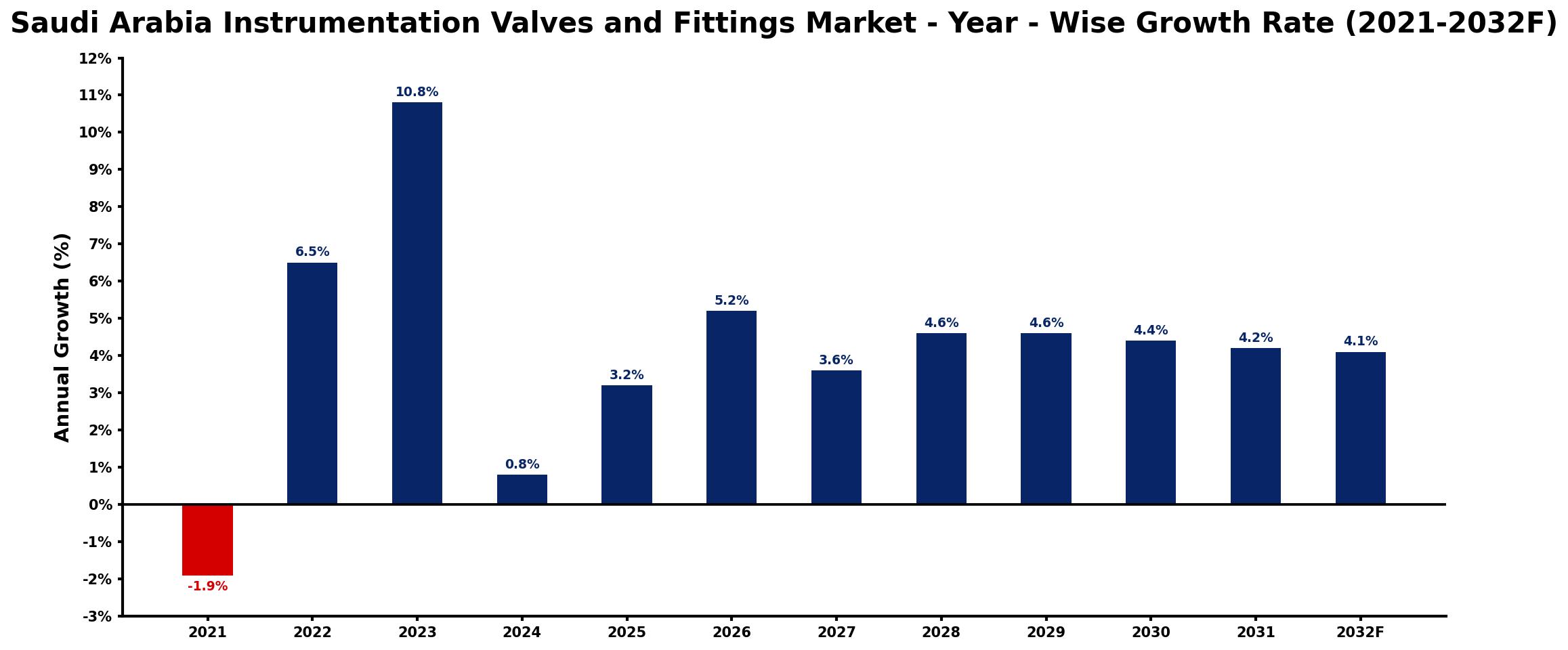
The table below presents the year‑wise growth rates along with the key drivers influencing the market
| Year | Growth Rate | Major Drivers |
| 2021 | -1.9% | Decreased industrial project investments |
| 2022 | 6.5% | Rising demand from oil sector |
| 2023 | 10.8% | Increased infrastructure development projects |
| 2024 | 0.8% | Growth in renewable energy initiatives |
| 2025 | 3.2% | Expansion of manufacturing capabilities |
| 2026 | 5.2% | Higher demand in construction sector |
| 2027 | 3.6% | Investments in water management systems |
| 2028 | 4.6% | Technological advancements in automation |
| 2029 | 4.6% | rising procurement volume requirements |
| 2030 | 4.4% | Growing demand for safety regulations |
| 2031 | 4.2% | Increased focus on environmental sustainability |
| 2032 | 4.1% | strengthening underlying market demand |
Note: Market size estimations and growth projections presented in this report are based on 6Wresearch's proprietary forecasting methodology, utilizing the latest available industry data, government publications, and primary research inputs.
Saudi Arabia Instrumentation Valves and Fittings Market Synopsis
Currently, the most significant force shaping the Saudi Arabia Instrumentation Valves and Fittings Market is the rapid industrialization fueled by government initiatives aimed at diversifying the economy. As the country moves towards Vision 2030, investments in infrastructure and energy projects are surging, leading to heightened demand for reliable instrumentation solutions.
Instrumentation valves and fittings are vital for ensuring precise control and measurement of gas and fluid flows across numerous applications. Their importance in enhancing process efficiency, safety, and operational accuracy is becoming more pronounced as industries look to optimize production while adhering to stringent regulatory standards.
Saudi Arabia Instrumentation Valves and Fittings Market Key Takeaways
- The market is projected to grow from USD 235 Million in 2025 to USD 300 Million by 2032.
- Technological advancements are a major driver of market growth, enabling improved product performance.
- The oil and gas sector remains the largest consumer of instrumentation valves and fittings in the region.
- Government initiatives aimed at economic diversification are creating new growth avenues for industrial equipment suppliers.
- The emphasis on safety and regulatory compliance continues to push demand for high-quality instrumentation solutions.
Evaluation of Restraints in Saudi Arabia Instrumentation Valves and Fittings Market
Despite the positive outlook, the Saudi Arabia Instrumentation Valves and Fittings Market faces several restraints. Ensuring precision engineering while maintaining leak-proof performance in critical applications poses significant challenges. Moreover, stringent industry standards necessitate rigorous quality control measures, which can be costly and time-consuming. Building trust among end-users, who are increasingly discerning about the reliability and durability of products, remains an ongoing hurdle that suppliers must navigate.
Saudi Arabia Instrumentation Valves and Fittings Market Trends
Several trends are shaping the future of the Saudi Arabia Instrumentation Valves and Fittings Market. The increasing adoption of smart technologies and IoT-enabled devices in industrial applications is enhancing monitoring and control capabilities. Additionally, a shift towards sustainable practices is driving demand for instrumentation products that support eco-friendly operations. Manufacturers are focusing on developing innovative materials and designs to meet the evolving needs of the market.
Saudi Arabia Instrumentation Valves and Fittings Market Opportunities
Opportunities for growth in the Saudi Arabia Instrumentation Valves and Fittings Market lie in the expansion of industrial projects and modernization of existing infrastructure. Investment in renewable energy projects presents a burgeoning opportunity, as these systems require precise instrumentation to ensure efficiency and safety. Furthermore, the growing emphasis on automation within industrial operations is likely to stimulate demand for advanced instrumentation solutions.
Government Initiatives in the Saudi Arabia Instrumentation Valves and Fittings Market
The Saudi government has launched numerous initiatives to foster economic diversification and industrial development. Programs aimed at enhancing the local manufacturing capabilities and supporting foreign investment play a crucial role in stimulating the instrumentation valves and fittings market. Additionally, public spending on infrastructure projects, particularly in energy and water management, directly benefits the demand for reliable instrumentation solutions.
Future Insights of the Saudi Arabia Instrumentation Valves and Fittings Market
Looking ahead to 2026-2032, the Saudi Arabia Instrumentation Valves and Fittings Market is expected to witness significant developments driven by the ongoing economic transformation. With a focus on sustainability, safety, and operational efficiency, the industry will likely see advancements in technology and materials that cater to these needs. Collaborative efforts between manufacturers and industrial clients will further shape the evolution of tailored solutions, ensuring that the market remains responsive to the changing landscape.
Saudi Arabia Instrumentation Valves and Fittings Market Latest Developments (2025 - 2026)
In the recent months leading up to mid-2026, the instrumentation valves and fittings market has experienced a surge in activity, driven by increased project approvals in the oil and gas sector. Additionally, notable strides in automation technology have encouraged companies to invest in sophisticated instrumentation systems. Collaborative ventures focusing on sustainability have also gained traction, as players in the market aim to align with global standards of environmental responsibility.
Saudi Arabia Instrumentation Valves and Fittings Market - Key Attractiveness of the Report
- 10 Years of Market Numbers
- Historical Data Starting from 2022 to 2025
- Base Year: 2025
- Forecast Data until 2032
- Key Performance Indicators Impacting the Market
- Major Upcoming Developments and Projects
Key Highlights of the Report:
- Saudi Arabia Instrumentation Valves and Fittings Market Outlook
- Market Size of Saudi Arabia Instrumentation Valves and Fittings Market, 2025
- Forecast of Saudi Arabia Instrumentation Valves and Fittings Market, 2032
- Historical Data and Forecast of Saudi Arabia Instrumentation Valves and Fittings Revenues & Volume for the Period 2022-2032F
- Saudi Arabia Instrumentation Valves and Fittings Market Trend Evolution
- Saudi Arabia Instrumentation Valves and Fittings Market Drivers and Challenges
- Saudi Arabia Instrumentation Valves and Fittings Price Trends
- Saudi Arabia Instrumentation Valves and Fittings Porter's Five Forces
- Saudi Arabia Instrumentation Valves and Fittings Industry Life Cycle
- Historical Data and Forecast of Saudi Arabia Instrumentation Valves and Fittings Market Revenues & Volume By Types for the Period 2022-2032F
- Historical Data and Forecast of Saudi Arabia Instrumentation Valves and Fittings Market Revenues & Volume By Tube for the Period 2022-2032F
- Historical Data and Forecast of Saudi Arabia Instrumentation Valves and Fittings Market Revenues & Volume By Pipe for the Period 2022-2032F
- Historical Data and Forecast of Saudi Arabia Instrumentation Valves and Fittings Market Revenues & Volume By Biopharm for the Period 2022-2032F
- Historical Data and Forecast of Saudi Arabia Instrumentation Valves and Fittings Market Revenues & Volume By Hose for the Period 2022-2032F
- Historical Data and Forecast of Saudi Arabia Instrumentation Valves and Fittings Market Revenues & Volume By Weld for the Period 2022-2032F
- Historical Data and Forecast of Saudi Arabia Instrumentation Valves and Fittings Market Revenues & Volume By Others for the Period 2022-2032F
- Historical Data and Forecast of Saudi Arabia Instrumentation Valves and Fittings Market Revenues & Volume By Applications for the Period 2022-2032F
- Historical Data and Forecast of Saudi Arabia Instrumentation Valves and Fittings Market Revenues & Volume By Oil & Gas for the Period 2022-2032F
- Historical Data and Forecast of Saudi Arabia Instrumentation Valves and Fittings Market Revenues & Volume By Marine & Shipbuilding for the Period 2022-2032F
- Historical Data and Forecast of Saudi Arabia Instrumentation Valves and Fittings Market Revenues & Volume By Industrial for the Period 2022-2032F
- Historical Data and Forecast of Saudi Arabia Instrumentation Valves and Fittings Market Revenues & Volume By Others for the Period 2022-2032F
- Historical Data and Forecast of Saudi Arabia Instrumentation Valves and Fittings Market Revenues & Volume By Products for the Period 2022-2032F
- Historical Data and Forecast of Saudi Arabia Instrumentation Valves and Fittings Market Revenues & Volume By Instrumentation Valves for the Period 2022-2032F
- Historical Data and Forecast of Saudi Arabia Instrumentation Valves and Fittings Market Revenues & Volume By Instrumentation Fittings for the Period 2022-2032F
- Saudi Arabia Instrumentation Valves and Fittings Import Export Trade Statistics
- Market Opportunity Assessment By Types
- Market Opportunity Assessment By Applications
- Market Opportunity Assessment By Products
- Saudi Arabia Instrumentation Valves and Fittings Top Companies Market Share
- Saudi Arabia Instrumentation Valves and Fittings Competitive Benchmarking By Technical and Operational Parameters
- Saudi Arabia Instrumentation Valves and Fittings Company Profiles
- Saudi Arabia Instrumentation Valves and Fittings Key Strategic Recommendations






































