United States (US) Instrumentation Valves and Fittings Market Size, Share & Growth Rate
The United States (US) Instrumentation Valves and Fittings Market was estimated at USD 169 Million in 2025 and is projected to reach USD 199 Million by 2032, growing at a CAGR of 2.4% from 2026 to 2032. This growth trajectory is primarily fueled by advancements in industrial automation, particularly in sectors such as oil and gas and pharmaceuticals. Furthermore, the increasing regulatory demands for safety and environmental sustainability are propelling the adoption of high-quality instrumentation solutions that ensure precise control and monitoring of industrial processes.
United States (US) Instrumentation Valves and Fittings Market Year-wise Growth Rate and Key Drivers
This graph highlights how the United States (US) Instrumentation Valves and Fittings Market has steadily grown over the years, supported by major growth factors.
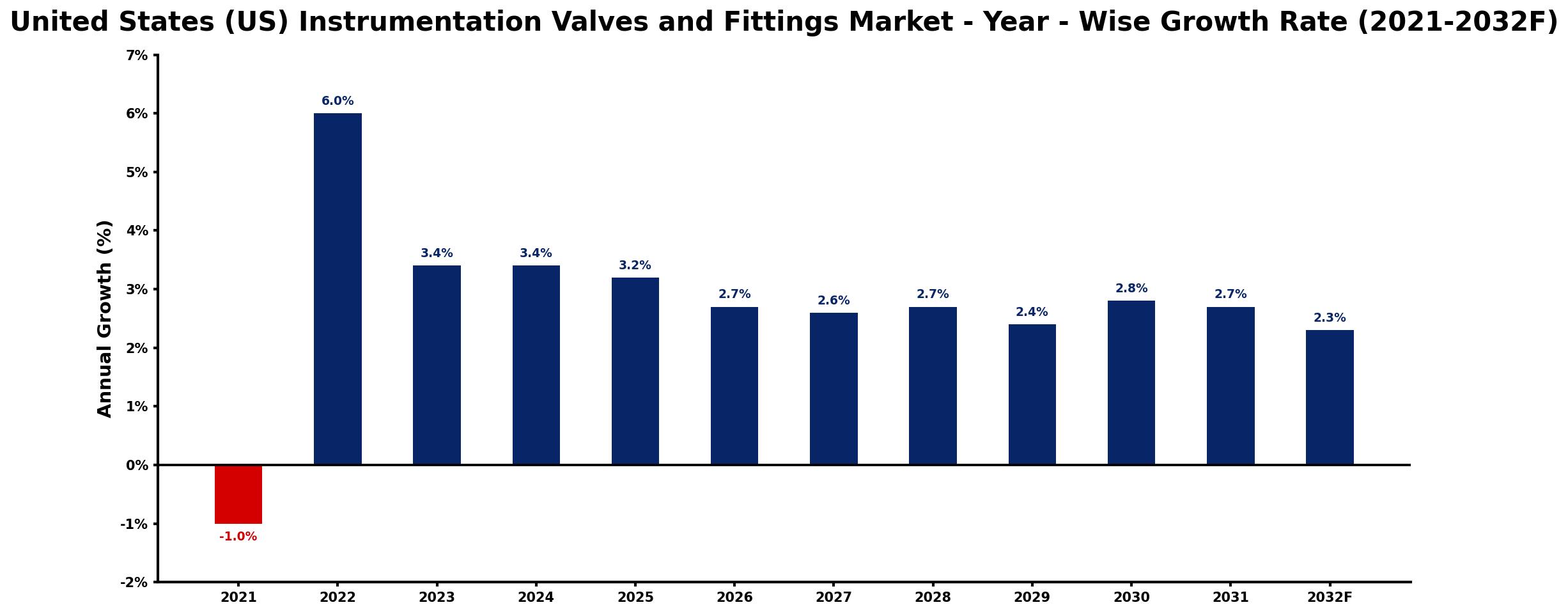
The table below presents the year‑wise growth rates along with the key drivers influencing the market
| Year | Growth Rate | Major Drivers |
| 2021 | -1.0% | Manufacturing output decreased significantly |
| 2022 | 6.0% | Increased investment in energy sector |
| 2023 | 3.4% | Growth in renewable energy projects |
| 2024 | 3.4% | Expansion of industrial automation systems |
| 2025 | 3.2% | Rising demand for process optimization |
| 2026 | 2.7% | Increased focus on environmental regulations |
| 2027 | 2.6% | Technological advancements in automation |
| 2028 | 2.7% | growing downstream application demand |
| 2029 | 2.4% | rising export shipment volumes |
| 2030 | 2.8% | Increased demand for smart technologies |
| 2031 | 2.7% | Rising investments in construction projects |
| 2032 | 2.3% | increased domestic production output |
Note: Market size estimations and growth projections presented in this report are based on 6Wresearch's proprietary forecasting methodology, utilizing the latest available industry data, government publications, and primary research inputs.
United States (US) Instrumentation Valves and Fittings Market Synopsis
The demand for high-performance instrumentation valves and fittings has surged due to their critical role in enhancing operational efficiency within complex industrial systems. Industries such as chemical processing and water treatment are particularly reliant on these components to maintain process integrity and safety. The market comprises a variety of products, including ball valves and check valves, each designed to meet specific operational needs.
As technological innovation accelerates, players in the US Instrumentation Valves and Fittings Market are increasingly focusing on the integration of smart technologies. This trend allows for real-time data analytics and remote monitoring, enabling better predictive maintenance and operational efficiency. The result is a market that not only meets current demands but is also poised to adapt to future challenges and advancements.
United States (US) Instrumentation Valves and Fittings Market Key Takeaways
- The market is experiencing significant growth due to advancements in industrial automation and control systems.
- Compliance with stringent regulations regarding safety and environmental standards is driving demand for high-quality products.
- Digitalization and IoT integration are becoming essential components in instrumentation solutions.
- Investment opportunities are abundant, especially in research and development of innovative valves and fittings.
- Major trends include an emphasis on sustainability and energy efficiency in product design.
Evaluation of Restraints in United States (US) Instrumentation Valves and Fittings Market
Despite its promising growth, the US Instrumentation Valves and Fittings Market faces notable constraints. One significant factor is the heightened competition from international manufacturers who can offer lower-priced alternatives, pressuring domestic players to differentiate themselves through quality and innovation. Furthermore, the stringent regulatory landscape necessitates continuous compliance, often resulting in increased operational costs for manufacturers. As the market evolves, fluctuations in raw material prices could also impact profit margins, complicating pricing strategies and financial forecasting.
United States (US) Instrumentation Valves and Fittings Market Trends
Several emerging trends are shaping the US Instrumentation Valves and Fittings Market. The push towards automation in industrial settings is driving demand for advanced instrumentation that ensures operational precision. There's also an increasing focus on sustainability, with companies developing eco-friendly products to minimize environmental impact. In addition, the trend of incorporating smart technology into instrumentation systems allows for enhanced performance through predictive analytics and remote diagnostics, aligning with the larger movement towards smart manufacturing.
United States (US) Instrumentation Valves and Fittings Market Opportunities
The market offers various growth and investment opportunities, particularly in sectors where precision control is paramount. Companies that specialize in the development of innovative instrumentation valves and fittings are well-positioned to capture market share as industries increasingly prioritize efficiency and safety. Additionally, there are significant opportunities in providing related services such as maintenance, repair, and calibration, catering to the growing demand for comprehensive service solutions in an increasingly automated landscape.
Government Initiatives in the United States (US) Instrumentation Valves and Fittings Market
Government policies play a crucial role in shaping the landscape of the US Instrumentation Valves and Fittings Market. Regulatory bodies enforce stringent safety and quality standards, compelling manufacturers to meet high-performance benchmarks. Furthermore, public investment in infrastructure and industrial modernization supports demand for advanced instrumentation solutions. Initiatives aimed at promoting energy efficiency and environmental sustainability further underscore the importance of innovative valves and fittings in meeting regulatory requirements.
Future Insights of the United States (US) Instrumentation Valves and Fittings Market
Looking ahead to 2026-2032, the US Instrumentation Valves and Fittings Market is expected to continue its steady growth, spurred by ongoing investments in automation and process control technologies. As industries prioritize safety and efficiency, the demand for high-quality instrumentation solutions will persist. The integration of smart technologies will further drive innovation, setting the stage for a market that evolves in tandem with technological advancements. Nevertheless, challenges such as fluctuating raw material prices and international competition will require strategic navigation by industry players.
United States (US) Instrumentation Valves and Fittings Market Latest Developments (2025 - 2026)
The US Instrumentation Valves and Fittings Market has recently seen a notable shift towards the adoption of digital solutions, with companies focusing on IoT integration to enhance product functionalities. Innovations in materials and manufacturing processes are also emerging, driven by the need for greater energy efficiency and sustainability. Additionally, partnerships and collaborations among industry players are becoming more common as companies seek to strengthen their market position and expand their product offerings.
United States (US) Instrumentation Valves and Fittings Market - Key Attractiveness of the Report
- 10 Years of Market Numbers
- Historical Data Starting from 2022 to 2025
- Base Year: 2025
- Forecast Data until 2032
- Key Performance Indicators Impacting the Market
- Major Upcoming Developments and Projects
Key Highlights of the Report:
- United States (US) Instrumentation Valves and Fittings Market Outlook
- Market Size of United States (US) Instrumentation Valves and Fittings Market, 2025
- Forecast of United States (US) Instrumentation Valves and Fittings Market, 2032
- Historical Data and Forecast of United States (US) Instrumentation Valves and Fittings Revenues & Volume for the Period 2022-2032F
- United States (US) Instrumentation Valves and Fittings Market Trend Evolution
- United States (US) Instrumentation Valves and Fittings Market Drivers and Challenges
- United States (US) Instrumentation Valves and Fittings Price Trends
- United States (US) Instrumentation Valves and Fittings Porter's Five Forces
- United States (US) Instrumentation Valves and Fittings Industry Life Cycle
- Historical Data and Forecast of United States (US) Instrumentation Valves and Fittings Market Revenues & Volume By Types for the Period 2022-2032F
- Historical Data and Forecast of United States (US) Instrumentation Valves and Fittings Market Revenues & Volume By Tube for the Period 2022-2032F
- Historical Data and Forecast of United States (US) Instrumentation Valves and Fittings Market Revenues & Volume By Pipe for the Period 2022-2032F
- Historical Data and Forecast of United States (US) Instrumentation Valves and Fittings Market Revenues & Volume By Biopharm for the Period 2022-2032F
- Historical Data and Forecast of United States (US) Instrumentation Valves and Fittings Market Revenues & Volume By Hose for the Period 2022-2032F
- Historical Data and Forecast of United States (US) Instrumentation Valves and Fittings Market Revenues & Volume By Weld for the Period 2022-2032F
- Historical Data and Forecast of United States (US) Instrumentation Valves and Fittings Market Revenues & Volume By Others for the Period 2022-2032F
- Historical Data and Forecast of United States (US) Instrumentation Valves and Fittings Market Revenues & Volume By Applications for the Period 2022-2032F
- Historical Data and Forecast of United States (US) Instrumentation Valves and Fittings Market Revenues & Volume By Oil & Gas for the Period 2022-2032F
- Historical Data and Forecast of United States (US) Instrumentation Valves and Fittings Market Revenues & Volume By Marine & Shipbuilding for the Period 2022-2032F
- Historical Data and Forecast of United States (US) Instrumentation Valves and Fittings Market Revenues & Volume By Industrial for the Period 2022-2032F
- Historical Data and Forecast of United States (US) Instrumentation Valves and Fittings Market Revenues & Volume By Others for the Period 2022-2032F
- Historical Data and Forecast of United States (US) Instrumentation Valves and Fittings Market Revenues & Volume By Products for the Period 2022-2032F
- Historical Data and Forecast of United States (US) Instrumentation Valves and Fittings Market Revenues & Volume By Instrumentation Valves for the Period 2022-2032F
- Historical Data and Forecast of United States (US) Instrumentation Valves and Fittings Market Revenues & Volume By Instrumentation Fittings for the Period 2022-2032F
- United States (US) Instrumentation Valves and Fittings Import Export Trade Statistics
- Market Opportunity Assessment By Types
- Market Opportunity Assessment By Applications
- Market Opportunity Assessment By Products
- United States (US) Instrumentation Valves and Fittings Top Companies Market Share
- United States (US) Instrumentation Valves and Fittings Competitive Benchmarking By Technical and Operational Parameters
- United States (US) Instrumentation Valves and Fittings Company Profiles
- United States (US) Instrumentation Valves and Fittings Key Strategic Recommendations






































