Saudi Arabia LED Professional Lighting Market Summary
The saudi arabia led professional lighting market was estimated at USD 159 Million in 2025 and is projected to reach USD 203 Million by 2032, growing at a CAGR of 5.0% from 2026 to 2032.
Saudi Arabia LED Professional Lighting Market Year-wise Growth Rate and Key Drivers
This graph highlights how the Saudi Arabia LED Professional Lighting Market has steadily grown over the past five years, supported by major growth factors.
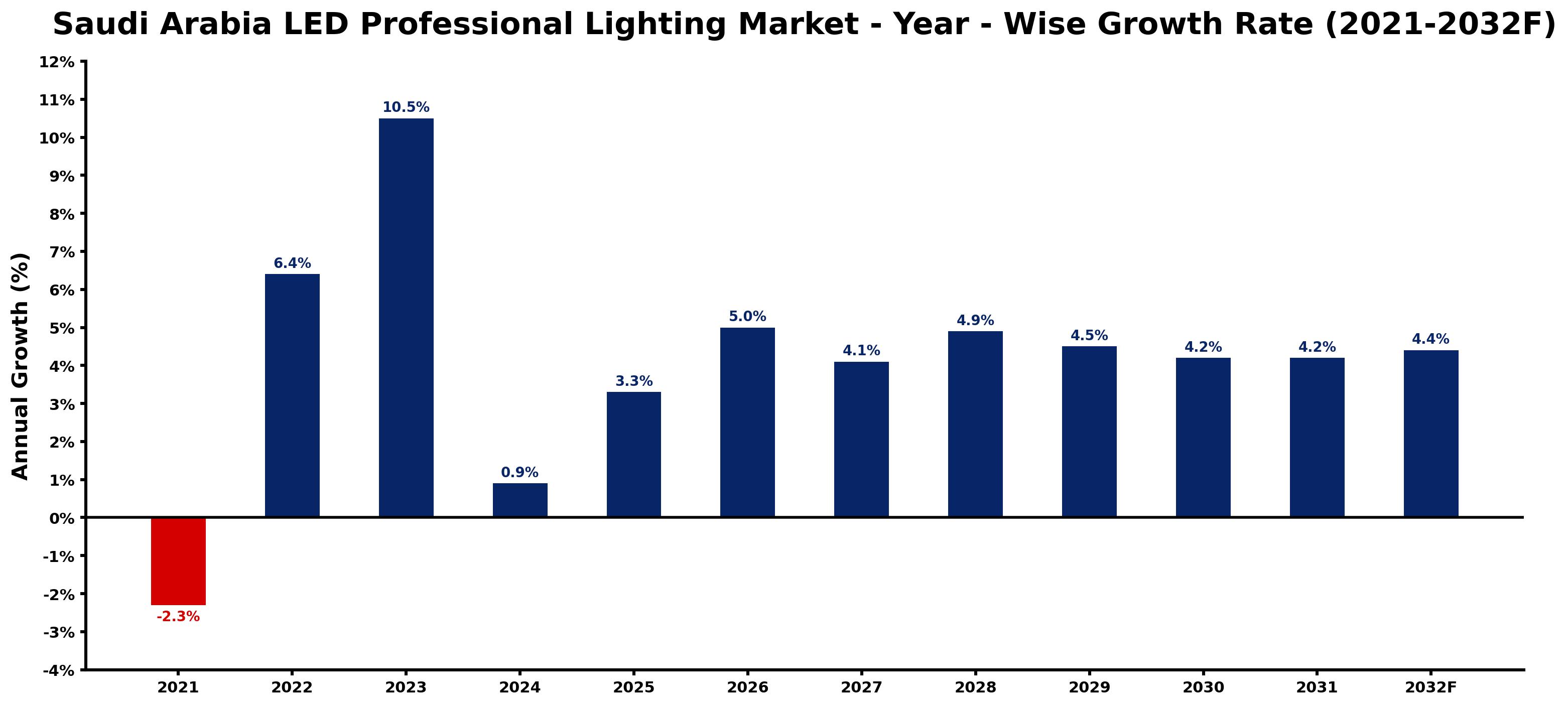
The table below presents the year wise growth rates along with the key drivers influencing the market
| Year | Growth Rate | Major Drivers |
| 2021 | -2.3% | Increased competition from costeffective alternative lighting solutions eroded market share for premium LED products. |
| 2022 | 6.4% | Saudi urbanization projects heighten demand for sustainable lighting solutions in new developments. |
| 2023 | 10.5% | Technological innovation leads to more affordable LED options in commercial sectors. |
| 2024 | 0.9% | Rising awareness of environmental sustainability shapes consumer preferences for LED lighting. |
| 2025 | 3.3% | Major construction projects in NEOM drive significant lighting infrastructure investments. |
| 2026 | 5.0% | Retail sector recovery positions LED lighting as a key focus for enhanced ambiance. |
| 2027 | 4.1% | Integration of smart technologies into LED systems attracts tech-savvy consumers. |
| 2028 | 4.9% | Corporate sustainability targets create new procurement strategies for energy-efficient solutions. |
| 2029 | 4.5% | Local manufacturers emerge, boosting production capacity and reducing import reliance. |
| 2030 | 4.2% | Trade partnerships strengthen supply chains for innovative lighting technologies across the region. |
| 2031 | 4.2% | Public awareness campaigns highlight long-term savings from LED lighting adoption. |
| 2032 | 4.4% | Legacy energy infrastructure challenges accelerate the transition to modern lighting solutions. |
Note - Market size estimations and growth projections presented in this report are based on 6Wresearch's advanced forecasting approach, validated with industry datasets as of June 2026.
Saudi Arabia LED Professional Lighting Market Synopsis
The Saudi Arabia LED Professional Lighting Market is projected to reach 5.0% and witness significant growth during the forecast period (2026-2032). The market is expected to expand at a compound annual growth rate (CAGR) of 7.7%, driven by the rising demand for energy-efficient lighting solutions across various industrial and commercial sectors. Increasing implementation of stringent environmental regulations, coupled with government initiatives aimed at promoting sustainable practices, further bolster this growth trajectory. However, the high initial costs associated with LED professional lighting fixtures may pose challenges to market expansion.
Saudi Arabia LED Professional Lighting Market Growth Drivers
The growth of the Saudi Arabia LED Professional Lighting Market is primarily influenced by several key drivers:
- The demand for energy-efficient lighting has surged as consumers become more aware of the environmental and economic benefits associated with reduced energy consumption.
- Government regulations mandating energy efficiency have encouraged manufacturers to innovate and provide more sustainable lighting solutions, particularly within commercial and industrial frameworks.
- Technological advancements have led to the development of high-performance LED lighting products that offer extended lifespans and improved illumination quality.
- Public awareness campaigns aimed at reducing greenhouse gas emissions have accelerated the transition to LED technologies, particularly in newly constructed residential and commercial buildings.
- Moreover, the growing focus on urban development projects, including smart cities and infrastructure improvements, is amplifying the adoption of advanced lighting solutions.
Saudi Arabia LED Professional Lighting Market Challenges and Restraints
Despite the considerable advantages that LEDs offer, several challenges may inhibit broader market acceptance:
- The high initial cost of LED fixtures remains a significant barrier, as many consumers and businesses are deterred by the upfront investment compared to traditional lighting solutions.
- Complex manufacturing processes and the need for advanced technology in production contribute to elevated pricing, limiting accessibility, especially for smaller businesses and consumers.
- Additionally, there is a learning curve associated with adopting new lighting technologies, which could result in hesitance from stakeholders accustomed to traditional lighting systems.
- Supply chain disruptions, particularly those exacerbated by events such as the COVID-19 pandemic, can lead to delayed availability of LED products, further discouraging adoption.
- Lastly, the competition from alternative lighting technologies such as compact fluorescent lamps (CFLs) may also hinder the market's growth potential.
Saudi Arabia LED Professional Lighting Market Government Investment and Initiatives
The Saudi Arabian government plays a pivotal role in fostering the growth of the LED professional lighting market through various investment initiatives and regulatory frameworks:
- Government policies focused on sustainability are driving public spending toward the development of energy-efficient infrastructure projects, creating significant demand for LED lighting solutions.
- Ambitious national visions, such as Vision 2030, emphasize the importance of environmental sustainability, prompting increased investments in renewable energy and energy-efficient technologies.
- Incentives for manufacturers to invest in eco-friendly alternatives are being introduced, which include grants and subsidies aimed at reducing the cost burden of transition to LED technologies.
- Several municipalities have initiated programs to retrofit public spaces with LED solutions, thereby demonstrating the government's commitment to modernizing urban infrastructure.
- The Saudi government is actively collaborating with industry stakeholders to develop standards and certifications that ensure the quality and reliability of LED products in the market.
Saudi Arabia LED Professional Lighting Market Latest Developments (May 2025 - June 2026)
Recent developments in the Saudi Arabia LED Professional Lighting Market highlight several notable trends and shifts:
- There has been an acceleration in the rollout of smart city infrastructure that incorporates advanced LED lighting systems, emphasizing connectivity and energy efficiency.
- Innovations in LED technology, such as tunable white lighting and human-centric designs, have been gaining traction, enhancing user experiences in various environments.
- Market stakeholders are increasingly investing in research and development to optimize energy efficiency and product performance, addressing consumer demands for quality and sustainability.
- Collaborative efforts between the government and private sector to promote energy efficiency awareness have led to increased adoption rates of LED lighting systems in both public and private spaces.
- Additionally, ongoing challenges related to global supply chains have prompted local manufacturers to explore alternative sourcing and production strategies to mitigate interruptions.
Saudi Arabia LED Professional Lighting Market - Key Attractiveness of the Report
- 10 Years of Market Numbers
- Historical Data Starting from 2022 to 2025
- Base Year: 2025
- Forecast Data until 2032
- Key Performance Indicators Impacting the Market
- Major Upcoming Developments and Projects
- What factors are contributing to the growth of the Saudi Arabia LED Professional Lighting Market?
- What challenges does the market face?
- How is the government supporting the LED professional lighting market?
- What are the recent trends in this market?
Key Highlights of the Report:
- Saudi Arabia LED Professional Lighting Market Outlook
- Market Size of Saudi Arabia LED Professional Lighting Market, 2025
- Forecast of Saudi Arabia LED Professional Lighting Market, 2032
- Historical Data and Forecast of Saudi Arabia LED Professional Lighting Revenues & Volume for the Period 2022-2032F
- Saudi Arabia LED Professional Lighting Market Trend Evolution
- Saudi Arabia LED Professional Lighting Market Drivers and Challenges
- Saudi Arabia LED Professional Lighting Price Trends
- Saudi Arabia LED Professional Lighting Porter's Five Forces
- Saudi Arabia LED Professional Lighting Industry Life Cycle
- Historical Data and Forecast of Saudi Arabia LED Professional Lighting Market Revenues & Volume By Product Type for the Period 2022-2032F
- Historical Data and Forecast of Saudi Arabia LED Professional Lighting Market Revenues & Volume By LED Bulbs for the Period 2022-2032F
- Historical Data and Forecast of Saudi Arabia LED Professional Lighting Market Revenues & Volume By LED Fixtures for the Period 2022-2032F
- Historical Data and Forecast of Saudi Arabia LED Professional Lighting Market Revenues & Volume By Bare LED Tubes for the Period 2022-2032F
- Historical Data and Forecast of Saudi Arabia LED Professional Lighting Market Revenues & Volume By LED Down lights for the Period 2022-2032F
- Historical Data and Forecast of Saudi Arabia LED Professional Lighting Market Revenues & Volume By Applications for the Period 2022-2032F
- Historical Data and Forecast of Saudi Arabia LED Professional Lighting Market Revenues & Volume By Indoor for the Period 2022-2032F
- Historical Data and Forecast of Saudi Arabia LED Professional Lighting Market Revenues & Volume By Outdoor for the Period 2022-2032F
- Historical Data and Forecast of Saudi Arabia LED Professional Lighting Market Revenues & Volume By Automotive for the Period 2022-2032F
- Historical Data and Forecast of Saudi Arabia LED Professional Lighting Market Revenues & Volume By Backlighting for the Period 2022-2032F
- Saudi Arabia LED Professional Lighting Import Export Trade Statistics
- Market Opportunity Assessment By Product Type
- Market Opportunity Assessment By Applications
- Saudi Arabia LED Professional Lighting Top Companies Market Share
- Saudi Arabia LED Professional Lighting Competitive Benchmarking By Technical and Operational Parameters
- Saudi Arabia LED Professional Lighting Company Profiles
- Saudi Arabia LED Professional Lighting Key Strategic Recommendations






































