Saudi Arabia Mass Spectrometry Market Size, Share & Growth Rate
The Saudi Arabia Mass Spectrometry Market was estimated at USD 377 Million in 2025 and is projected to reach USD 483 Million by 2032, growing at a CAGR of 3.6% from 2026 to 2032. This growth trajectory is primarily driven by the increasing demand for advanced analytical techniques across sectors such as pharmaceuticals and environmental testing. Furthermore, heightened investments in research and development initiatives are catalyzing the adoption of mass spectrometry technologies, enhancing the market's potential.
Saudi Arabia Mass Spectrometry Market Year-wise Growth Rate and Key Drivers
This graph highlights how the Saudi Arabia Mass Spectrometry Market has steadily grown over the years, supported by major growth factors.
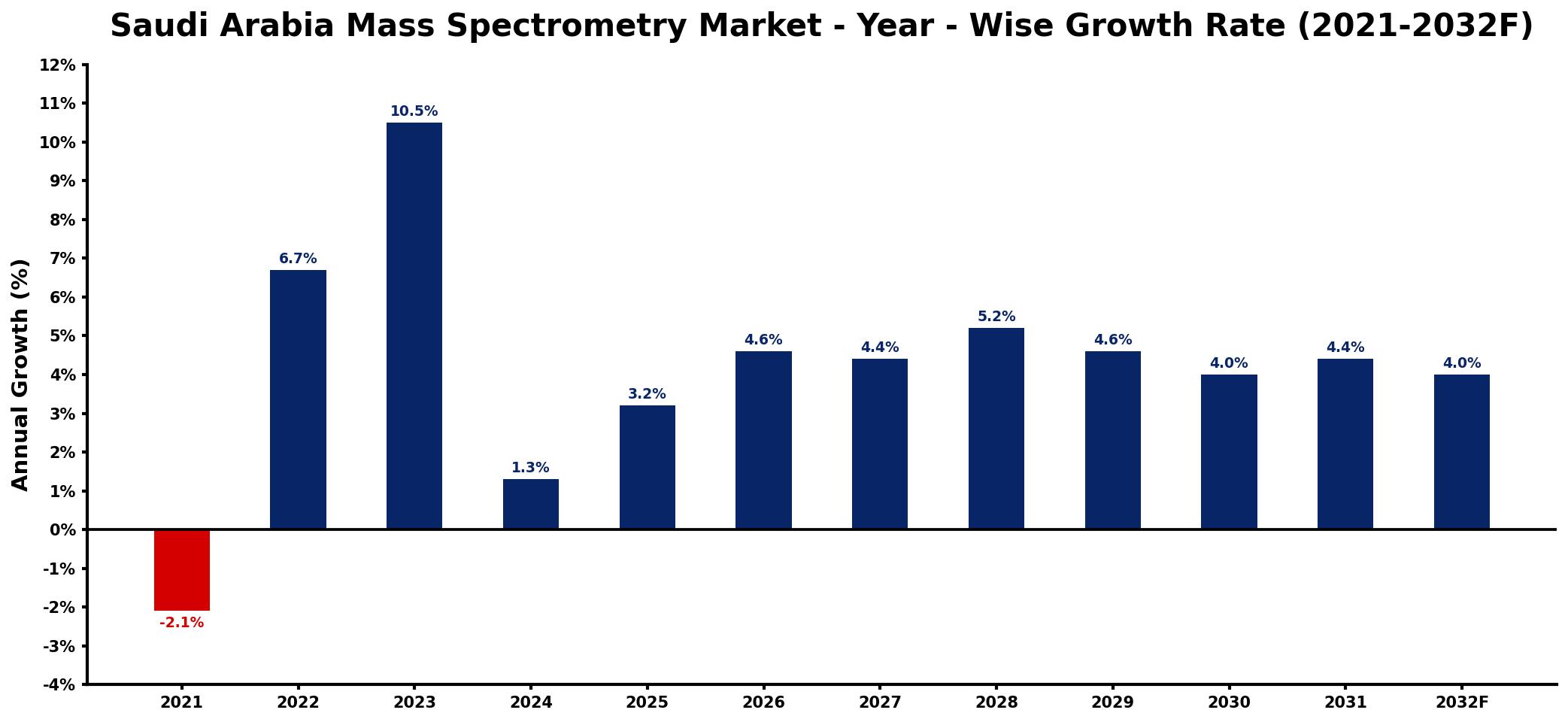
The table below presents the year‑wise growth rates along with the key drivers influencing the market
| Year | Growth Rate | Major Drivers |
| 2021 | -2.1% | decreased funding for research projects |
| 2022 | 6.7% | growing pharmaceutical industry investments |
| 2023 | 10.5% | increased demand for analytical solutions |
| 2024 | 1.3% | expansion of healthcare diagnostics sector |
| 2025 | 3.2% | rising environmental monitoring requirements |
| 2026 | 4.6% | enhanced focus on food safety |
| 2027 | 4.4% | development of innovative testing technologies |
| 2028 | 5.2% | boost in academic research initiatives |
| 2029 | 4.6% | growing biotechnology sector applications |
| 2030 | 4.0% | increased regulatory compliance needs |
| 2031 | 4.4% | growing emerging market penetration |
| 2032 | 4.0% | rising interest in personalized medicine |
Note: Market size estimations and growth projections presented in this report are based on 6Wresearch's proprietary forecasting methodology, utilizing the latest available industry data, government publications, and primary research inputs.
Saudi Arabia Mass Spectrometry Market Synopsis
The Saudi Arabia mass spectrometry market has experienced notable advancements in recent years, marked by its growing integration into academic and industrial settings. The expanding applications of this analytical technique are paving the way for increased adoption and innovation, particularly in the realm of pharmaceuticals and environmental safety.
Looking ahead, the market is poised for further growth fueled by technological innovations and a stronger emphasis on research capabilities. The shift toward more sensitive and accurate analytical methods is driving both public and private investments, which promises to elevate the market's profile significantly over the coming years.
Saudi Arabia Mass Spectrometry Market Key Takeaways
- Significant growth anticipated in the mass spectrometry market driven by rising demand in pharmaceuticals and environmental analysis.
- Technological advancements are enhancing the capabilities and applications of mass spectrometry in various sectors.
- Increased government support and funding for research and development initiatives are bolstering market growth.
- The COVID-19 pandemic has highlighted the necessity for advanced diagnostic tools, further fueling mass spectrometry adoption.
- Ongoing challenges in data analysis and instrument complexity present opportunities for innovative solutions in the market.
Evaluation of Restraints in Saudi Arabia Mass Spectrometry Market
Despite its promising growth prospects, the Saudi Arabia mass spectrometry market faces notable restraints that may hinder its expansion. One major concern lies in the need for enhanced detection sensitivity to accurately analyze complex mixtures, which presents a significant challenge to manufacturers. Additionally, the intricacies involved in data analysis can limit the efficiency of mass spectrometry, necessitating ongoing improvements. Furthermore, as laboratories seek to integrate these technologies, the inherent complexity of mass spectrometry instruments can pose barriers to wider adoption, especially in smaller research facilities.
Saudi Arabia Mass Spectrometry Market Trends
Emerging trends within the Saudi Arabia mass spectrometry market indicate a notable shift towards automation and the integration of artificial intelligence. These advancements are streamlining data analysis and enhancing the accuracy of results, addressing some of the inherent complexities of traditional methods. Additionally, there is a growing focus on miniaturization, with more compact devices being developed for on-site testing in various applications. This trend towards accessibility promises to open new avenues for mass spectrometry use across industries.
Saudi Arabia Mass Spectrometry Market Opportunities
There are substantial growth opportunities within the Saudi Arabia mass spectrometry market, especially in niche areas such as personalized medicine and forensic science. The increasing emphasis on precision diagnostics in healthcare, coupled with the demand for high-throughput screening methods in pharmaceuticals, positions mass spectrometry as a critical tool. Additionally, environmental monitoring and food safety sectors are ripe for innovation, as regulatory pressures and consumer safety concerns drive demand for accurate analytical solutions.
Government Initiatives in the Saudi Arabia Mass Spectrometry Market
The Saudi government has implemented several initiatives aimed at enhancing research capabilities, which in turn bolster the mass spectrometry market. Increased funding for scientific research and the establishment of partnerships with educational institutions are part of a broader strategy to foster innovation and technology transfer. Additionally, regulatory frameworks are being developed to ensure quality and safety in pharmaceuticals and environmental monitoring, further encouraging the adoption of advanced analytical techniques like mass spectrometry.
Future Insights of the Saudi Arabia Mass Spectrometry Market
Looking toward the future, the Saudi Arabia mass spectrometry market is set to advance considerably through 2026-2032. The integration of advanced technologies, such as machine learning and enhanced automation, is expected to transform analytical capabilities and improve efficiency. Additionally, as research initiatives continue to receive robust support, mass spectrometry will likely become an indispensable tool across diverse industries. This growth will hinge on the sector's adaptability to meet evolving analytical demands while capitalizing on technological innovations.
Saudi Arabia Mass Spectrometry Market Latest Developments (2025 - 2026)
Recent developments in the Saudi Arabia mass spectrometry market reflect a dynamic shift towards enhanced technologies and applications. Efforts are underway to improve instrument capabilities and data analysis methodologies, which are crucial for staying competitive in the global market. Concurrently, the expansion of research facilities and collaborations between academic institutions and industry stakeholders is anticipated to drive innovation and increase the adoption of mass spectrometry techniques across various sectors.
Saudi Arabia Mass Spectrometry Market - Key Attractiveness of the Report
- 10 Years of Market Numbers
- Historical Data Starting from 2022 to 2025
- Base Year: 2025
- Forecast Data until 2032
- Key Performance Indicators Impacting the Market
- Major Upcoming Developments and Projects
Key Highlights of the Report:
- Saudi Arabia Mass Spectrometry Market Outlook
- Market Size of Saudi Arabia Mass Spectrometry Market, 2025
- Forecast of Saudi Arabia Mass Spectrometry Market, 2032
- Historical Data and Forecast of Saudi Arabia Mass Spectrometry Revenues & Volume for the Period 2022-2032F
- Saudi Arabia Mass Spectrometry Market Trend Evolution
- Saudi Arabia Mass Spectrometry Market Drivers and Challenges
- Saudi Arabia Mass Spectrometry Price Trends
- Saudi Arabia Mass Spectrometry Porter's Five Forces
- Saudi Arabia Mass Spectrometry Industry Life Cycle
- Historical Data and Forecast of Saudi Arabia Mass Spectrometry Market Revenues & Volume By Technology for the Period 2022-2032F
- Historical Data and Forecast of Saudi Arabia Mass Spectrometry Market Revenues & Volume By Hybrid Mass Spectrometry for the Period 2022-2032F
- Historical Data and Forecast of Saudi Arabia Mass Spectrometry Market Revenues & Volume By Single Mass Spectrometry for the Period 2022-2032F
- Historical Data and Forecast of Saudi Arabia Mass Spectrometry Market Revenues & Volume By Application for the Period 2022-2032F
- Historical Data and Forecast of Saudi Arabia Mass Spectrometry Market Revenues & Volume By Pharmaceutical for the Period 2022-2032F
- Historical Data and Forecast of Saudi Arabia Mass Spectrometry Market Revenues & Volume By Biotechnology for the Period 2022-2032F
- Historical Data and Forecast of Saudi Arabia Mass Spectrometry Market Revenues & Volume By Security for the Period 2022-2032F
- Historical Data and Forecast of Saudi Arabia Mass Spectrometry Market Revenues & Volume By Industrial chemistry for the Period 2022-2032F
- Historical Data and Forecast of Saudi Arabia Mass Spectrometry Market Revenues & Volume By Environmental testing for the Period 2022-2032F
- Historical Data and Forecast of Saudi Arabia Mass Spectrometry Market Revenues & Volume By Food & beverage testing for the Period 2022-2032F
- Historical Data and Forecast of Saudi Arabia Mass Spectrometry Market Revenues & Volume By Forensic for the Period 2022-2032F
- Historical Data and Forecast of Saudi Arabia Mass Spectrometry Market Revenues & Volume By Clinical for the Period 2022-2032F
- Saudi Arabia Mass Spectrometry Import Export Trade Statistics
- Market Opportunity Assessment By Technology
- Market Opportunity Assessment By Application
- Saudi Arabia Mass Spectrometry Top Companies Market Share
- Saudi Arabia Mass Spectrometry Competitive Benchmarking By Technical and Operational Parameters
- Saudi Arabia Mass Spectrometry Company Profiles
- Saudi Arabia Mass Spectrometry Key Strategic Recommendations






































