Saudi Arabia Mirrors Market Summary
The saudi arabia mirrors market was estimated at USD 462 Million in 2025 and is projected to reach USD 590 Million by 2032, growing at a CAGR of 4.8% from 2026 to 2032.
Saudi Arabia Mirrors Market Year-wise Growth Rate and Key Drivers
This graph highlights how the Saudi Arabia Mirrors Market has steadily grown over the past five years, supported by major growth factors.
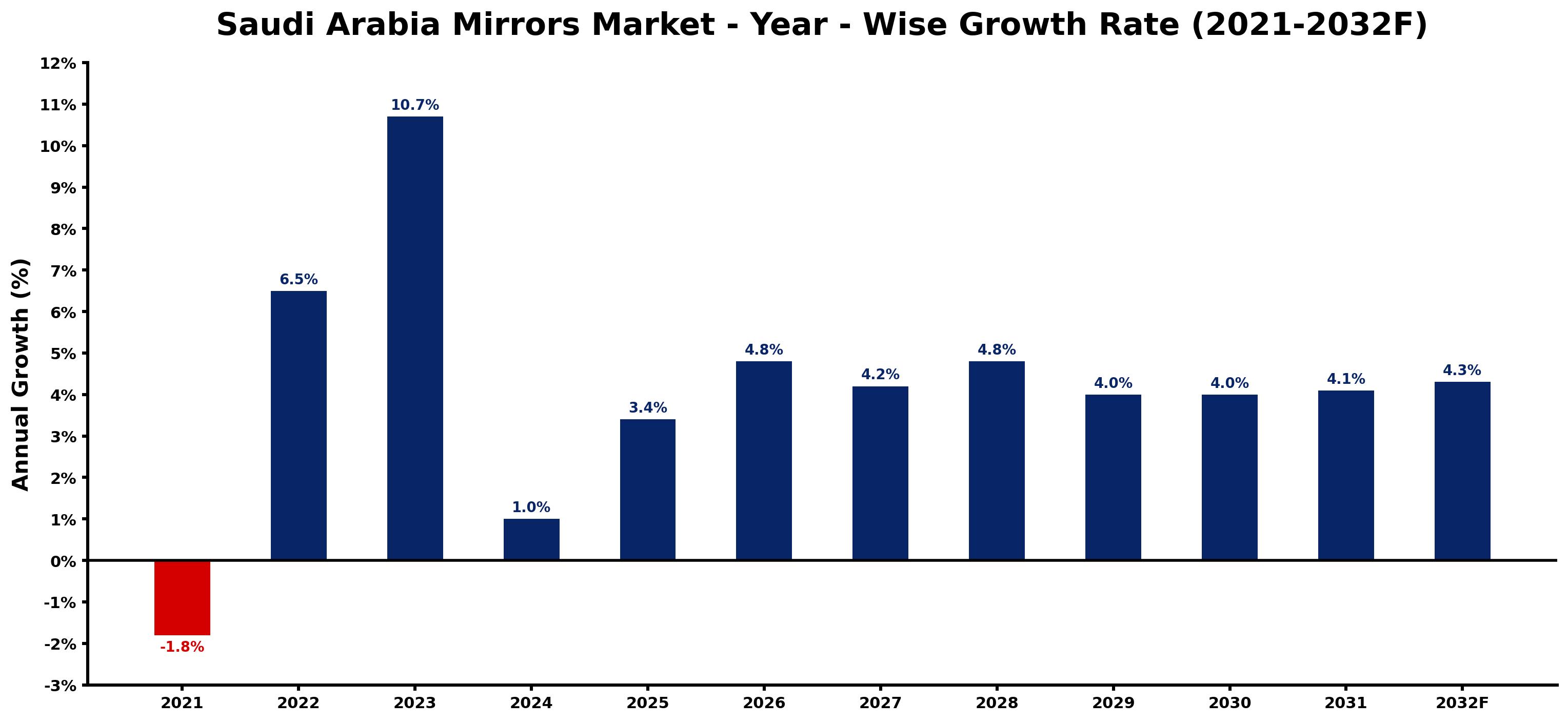
The table below presents the year wise growth rates along with the key drivers influencing the market
| Year | Growth Rate | Major Drivers |
| 2021 | -1.8% | Heightened supply chain disruptions during the pandemic hindered mirror manufacturing and led to inventory shortages. |
| 2022 | 6.5% | Local artisans gained prominence, enhancing craftsmanship in mirror production and design. |
| 2023 | 10.7% | Construction sectors emphasized modern, energy-efficient homes, elevating demand for stylish mirrors. |
| 2024 | 1.0% | Urbanization trends led to an increase in residential complexes, boosting mirror installations. |
| 2025 | 3.4% | The focus on luxury living spaces has made bespoke mirrors a sought-after commodity. |
| 2026 | 4.8% | E-commerce platforms streamlined access to unique mirrors, reshaping consumer purchasing behaviors. |
| 2027 | 4.2% | Home renovation activities surged, driving interest in premium decorative mirrors for interiors. |
| 2028 | 4.8% | Technological integration enabled smart mirrors, introducing features aligning with contemporary lifestyles. |
| 2029 | 4.0% | Increased tourism brought upscale hotel developments, requiring sophisticated mirror fixtures in rooms. |
| 2030 | 4.0% | Sustainable materials gained traction, appealing to eco-conscious consumers in the mirror market. |
| 2031 | 4.1% | Architectural trends favored minimalist designs, promoting demand for sleek, streamlined mirrors. |
| 2032 | 4.3% | Cultural shifts emphasized self-expression, influencing personalized mirror choices in Saudi homes. |
Note - Market size estimations and growth projections presented in this report are based on 6Wresearch's advanced forecasting approach, validated with industry datasets as of June 2026.
Saudi Arabia Mirrors Market Synopsis
The Saudi Arabia Mirrors Market is projected to reach 4.8% and witness significant growth during the forecast period (2026-2032). The market is being driven by various factors, including a rising demand for bathroom furniture, an increasing trend in interior decoration, and a growing number of construction projects across the region. With disposable incomes on the rise, consumers are showing increased purchasing power which positively influences demand for home decor products, particularly mirrors. Moreover, steady growth in GDP per capita in Saudi Arabia provides further opportunities for high-end product acquisitions, thereby energizing mirror sales within this market. The Saudi government's initiatives to attract foreign investments and create job opportunities have also contributed to the economic expansion, subsequently increasing the demand for luxury items like decorative mirrors.
Saudi Arabia Mirrors Market Growth Drivers
The growth trajectory of the Saudi Arabia Mirrors Market can be attributed to a number of key drivers:
- The influx of tourists and the subsequent expansion of hotel infrastructure have substantially fueled the demand for mirrors, which are integral to upscale bathroom aesthetics.
- The rise in the number of luxury resorts and villas throughout the Middle East has heightened the need for premium-quality mirror designs, thus enhancing sales prospects for manufacturers.
- Consumers in Saudi Arabia are increasingly willing to invest in home renovation and decoration, with designer mirrors playing a significant role in these projects.
- The burgeoning disposable income among the local population has facilitated greater spending on home decor items, positioning the mirrors market for robust growth.
- Growing awareness about modern interior design trends encourages consumers to incorporate stylish mirrors into their homes, further propelling market demand.
Saudi Arabia Mirrors Market Challenges and Restraints
Despite its positive outlook, the Saudi Arabia Mirrors Market faces certain challenges that could impede its growth:
- The local market is dominated by a limited number of suppliers, which significantly influences pricing and restricts competitive dynamics, making it challenging for consumers to find cost-effective options.
- The lack of competition from larger multinational brands in certain areas can inhibit innovation and variety in product offerings, affecting consumer choices.
- Economic fluctuations within the MENA region could impact consumer spending on non-essential items such as decorative mirrors, potentially straining market growth.
- With the aftermath of the COVID-19 pandemic, many consumers remain cautious with discretionary spending, which may result in reduced demand for luxury home decor.
- The ongoing adjustments in supply chains could affect product availability, leading to delays and increased costs in the procurement of mirrors.
Saudi Arabia Mirrors Market Government Investment and Initiatives
The Saudi Arabian government has been actively involved in fostering an environment conducive to market growth through various investment initiatives. Public spending on infrastructure projects has led to increased construction activity, necessitating the use of mirrors in residential and commercial spaces. Additionally, government policies encouraging foreign investments simplify the entry of new players into the market, enhancing competition and product diversity. Plans aimed at urban development and housing projects are also expected to positively influence the mirrors market. Moreover, economic diversification efforts outlined in Vision 2030 aim to bolster various sectors of the economy, including tourism and hospitality, which will further amplify the demand for mirrors in these environments.
Saudi Arabia Mirrors Market Latest Developments (May 2025 - June 2026)
In the period from May 2025 to June 2026, the Saudi Arabia Mirrors Market has experienced notable shifts aimed at improving product offerings and market accessibility. Efforts have intensified to streamline supply chains, ensuring that manufacturers can meet the rising demand more efficiently. Additionally, a trend towards sustainable practices has begun to shape product development, with an increasing number of businesses focusing on eco-friendly materials and manufacturing processes. The competitive landscape has seen strategic partnerships and collaborations, allowing companies to leverage each other's strengths in technology and design innovation. Furthermore, consumer engagement strategies have evolved, with brands employing digital platforms to reach a broader audience and enhance brand loyalty.
Saudi Arabia Mirrors Market - Key Attractiveness of the Report
- 10 Years of Market Numbers
- Historical Data Starting from 2022 to 2025
- Base Year: 2025
- Forecast Data until 2032
- Key Performance Indicators Impacting the Market
- Major Upcoming Developments and Projects
Key Highlights of the Report:
- Saudi Arabia Mirrors Market Outlook
- Market Size of Saudi Arabia Mirrors Market, 2025
- Forecast of Saudi Arabia Mirrors Market, 2032
- Historical Data and Forecast of Saudi Arabia Mirrors Revenues & Volume for the Period 2022-2032F
- Saudi Arabia Mirrors Market Trend Evolution
- Saudi Arabia Mirrors Market Drivers and Challenges
- Saudi Arabia Mirrors Price Trends
- Saudi Arabia Mirrors Porter's Five Forces
- Saudi Arabia Mirrors Industry Life Cycle
- Historical Data and Forecast of Saudi Arabia Mirrors Market Revenues & Volume By Types for the Period 2022-2032F
- Historical Data and Forecast of Saudi Arabia Mirrors Market Revenues & Volume By Silver Mirror for the Period 2022-2032F
- Historical Data and Forecast of Saudi Arabia Mirrors Market Revenues & Volume By Plated Mirror for the Period 2022-2032F
- Historical Data and Forecast of Saudi Arabia Mirrors Market Revenues & Volume By Others for the Period 2022-2032F
- Historical Data and Forecast of Saudi Arabia Mirrors Market Revenues & Volume By End-users for the Period 2022-2032F
- Historical Data and Forecast of Saudi Arabia Mirrors Market Revenues & Volume By Bathroom for the Period 2022-2032F
- Historical Data and Forecast of Saudi Arabia Mirrors Market Revenues & Volume By Make-up for the Period 2022-2032F
- Historical Data and Forecast of Saudi Arabia Mirrors Market Revenues & Volume By Dressing for the Period 2022-2032F
- Historical Data and Forecast of Saudi Arabia Mirrors Market Revenues & Volume By Decorative for the Period 2022-2032F
- Historical Data and Forecast of Saudi Arabia Mirrors Market Revenues & Volume By Advertising for the Period 2022-2032F
- Historical Data and Forecast of Saudi Arabia Mirrors Market Revenues & Volume By Others for the Period 2022-2032F
- Saudi Arabia Mirrors Import Export Trade Statistics
- Market Opportunity Assessment By Types
- Market Opportunity Assessment By End-users
- Saudi Arabia Mirrors Top Companies Market Share
- Saudi Arabia Mirrors Competitive Benchmarking By Technical and Operational Parameters
- Saudi Arabia Mirrors Company Profiles
- Saudi Arabia Mirrors Key Strategic Recommendations






































