Saudi Arabia Personal computers (PC) Market Summary
The saudi arabia personal computers (pc) market was estimated at USD 181 Million in 2025 and is projected to reach USD 232 Million by 2032, growing at a CAGR of 5.2% from 2026 to 2032.
Saudi Arabia Personal computers (PC) Market Year-wise Growth Rate and Key Drivers
This graph highlights how the Saudi Arabia Personal computers (PC) Market has steadily grown over the past five years, supported by major growth factors.
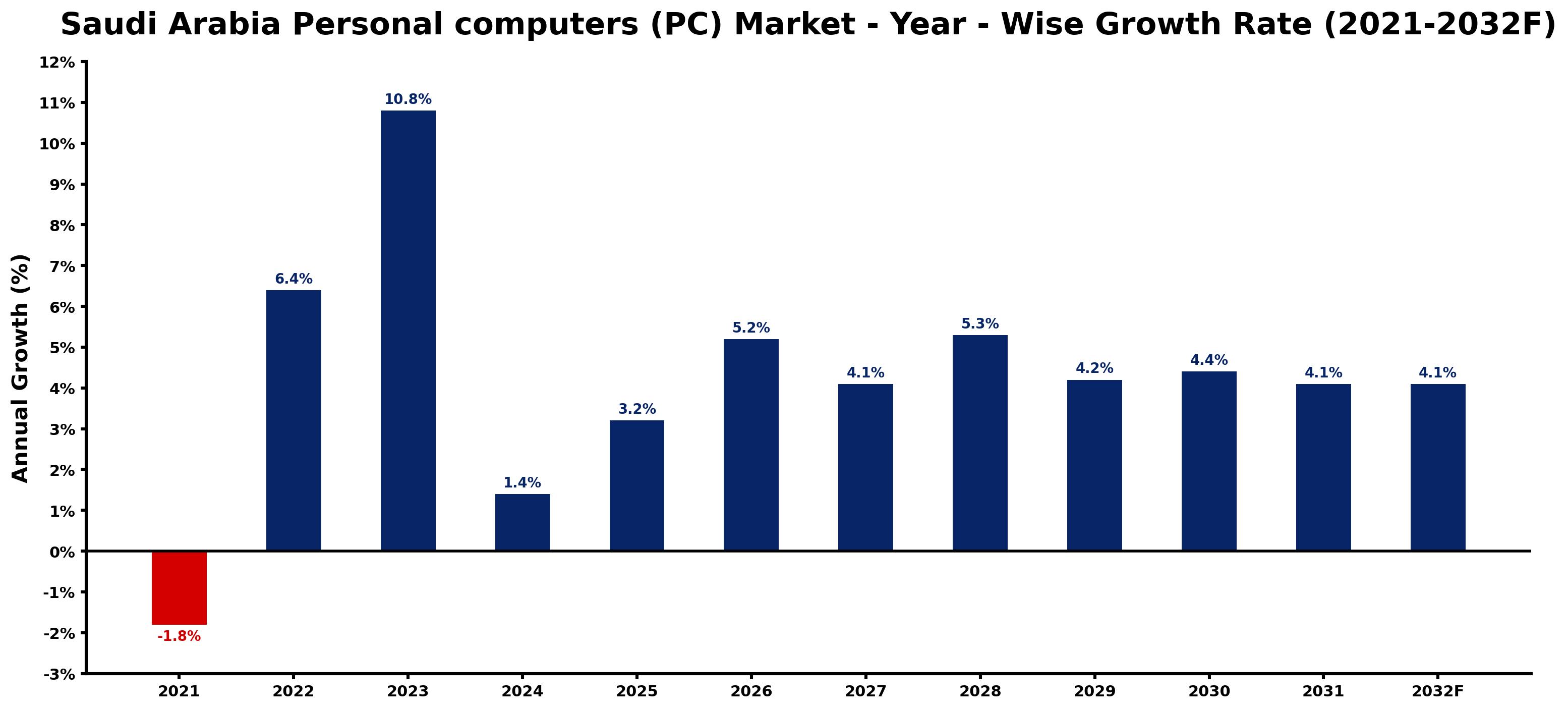
The table below presents the year wise growth rates along with the key drivers influencing the market
| Year | Growth Rate | Major Drivers |
| 2021 | -1.8% | A significant shift towards mobile devices led to declining demand for traditional personal computers. |
| 2022 | 6.4% | Education systems increasingly incorporate digital tools, enhancing PC demand for students. |
| 2023 | 10.8% | E-commerce expansion encourages consumers to upgrade their personal computing capabilities. |
| 2024 | 1.4% | Local gaming market development attracts investment in high-performance personal computers. |
| 2025 | 3.2% | Smart city initiatives drive demand for technological integration in everyday life. |
| 2026 | 5.2% | Increased digital content creation leads to higher requirements for advanced PCs. |
| 2027 | 4.1% | 5G infrastructure rollout supports enhanced connectivity, fueling PC market growth. |
| 2028 | 5.3% | Corporate digital transformation strategies prioritize modern PCs for workforce efficiency. |
| 2029 | 4.2% | Cybersecurity awareness drives organizations to invest in secure personal computing solutions. |
| 2030 | 4.4% | Sustainable technology trends push manufacturers towards eco-friendly PC production methods. |
| 2031 | 4.1% | Social media influence encourages younger demographics to prioritize gaming and multimedia PCs. |
| 2032 | 4.1% | Economic diversification efforts in Saudi Arabia stimulate innovation in the tech sector. |
Note - Market size estimations and growth projections presented in this report are based on 6Wresearch's advanced forecasting approach, validated with industry datasets as of June 2026.
Saudi Arabia Personal computers (PC) Market Synopsis
The Saudi Arabia Personal computers (PC) Market is projected to reach 5.2% and witness significant growth during the forecast period (2026-2032). This expansion is primarily driven by an increase in the number of users and growing technological proficiency among the population. With over 70% of its citizens having internet access, Saudi Arabia boasts one of the highest internet penetration rates globally. This connectivity has catalyzed a marked increase in digital activities, including gaming, e-commerce, online education, and social media, thus augmenting demand across multiple PC segments. Furthermore, government initiatives like Vision 2031 are facilitating a push towards digital transformation across various sectors, further enhancing opportunities for personal computer manufacturers.
Saudi Arabia Personal computers (PC) Market Growth Drivers
The Saudi Arabia Personal computers (PC) Market is fortified by several significant growth drivers. The rapid advancements in technology have led to a noticeable uptick in PC consumption across diverse industries, which include:
- Banking and finance sectors are increasingly adopting PCs to enhance operational efficiency and enable digital banking solutions.
- In the healthcare realm, personal computers are utilized for telemedicine and electronic health records, improving patient care outcomes.
- The education sector is transitioning towards digital curricula, necessitating the integration of PCs within classrooms and for remote learning initiatives.
- As businesses emphasize online operations, the demand for PCs continues to rise, aligning with the broader trend of digitization across various sectors.
- Improved living standards and higher purchasing power among consumers have led to increased spending on personal computing devices, contributing to the market's growth trajectory.
Saudi Arabia Personal computers (PC) Market Challenges and Restraints
While the Saudi Arabia Personal computers (PC) Market shows promise, several challenges could impede its growth. Predominantly, price sensitivity remains a critical factor affecting consumer purchasing behavior. Many potential buyers find the costs of PCs and accessories in Saudi Arabia to be prohibitively expensive compared to similar products available in international markets. Additionally, there exists a notable lack of awareness surrounding the latest technologies, leading consumers to make ill-informed purchasing decisions. Poor awareness can result in wasted resources and hinder productivity in both corporate and residential environments. Moreover, despite the positive effects of COVID-19 on the market, the pandemic has also created fluctuations in supply chains and production capacities, which continue to be problematic.
Saudi Arabia Personal computers (PC) Market Government Investment and Initiatives
The government of Saudi Arabia has implemented a range of initiatives aimed at bolstering the personal computer sector. Vision 2031 underscores a commitment to digital transformation and innovation, promoting the integration of IT systems across various public and private sectors. Moreover, public spending in infrastructure development is set to enhance connectivity, further stimulating the demand for personal computers. Additionally, various policies are designed to empower local firms to advance in the technology landscape through funding and resource allocation. The government also encourages educational institutions to adopt digital tools, fostering a technology-centric culture in the younger population and driving demand for PCs.
Saudi Arabia Personal computers (PC) Market Latest Developments (May 2025 - June 2026)
In the period from May 2025 to June 2026, the Saudi Arabia Personal computers (PC) Market witnessed significant developments that reflect the broader trends in the technology landscape. The surge in remote work and e-learning prompted an uptick in the demand for affordable laptops and Chromebooks. Vendors responded to this trend with promotional offers and competitive pricing strategies, which have collectively escalated consumer spending in the PC segment. Furthermore, several key initiatives focusing on enhancing digital literacy among citizens were launched, aiming to ensure that a larger proportion of the population can effectively utilize personal computers for various applications. These trends indicate a positive trajectory for the market as it adapts to the changing demands of consumers and businesses alike.
Saudi Arabia Personal computers (PC) Market - Key Attractiveness of the Report
- 10 Years of Market Numbers
- Historical Data Starting from 2022 to 2025
- Base Year: 2025
- Forecast Data until 2032
- Key Performance Indicators Impacting the Market
- Major Upcoming Developments and Projects
Key Highlights of the Report:
- Saudi Arabia Personal computers (PC) Market Outlook
- Market Size of Saudi Arabia Personal computers (PC) Market, 2025
- Forecast of Saudi Arabia Personal computers (PC) Market, 2032
- Historical Data and Forecast of Saudi Arabia Personal computers (PC) Revenues & Volume for the Period 2022-2032F
- Saudi Arabia Personal computers (PC) Market Trend Evolution
- Saudi Arabia Personal computers (PC) Market Drivers and Challenges
- Saudi Arabia Personal computers (PC) Price Trends
- Saudi Arabia Personal computers (PC) Porter's Five Forces
- Saudi Arabia Personal computers (PC) Industry Life Cycle
- Historical Data and Forecast of Saudi Arabia Personal computers (PC) Market Revenues & Volume By Product for the Period 2022-2032F
- Historical Data and Forecast of Saudi Arabia Personal computers (PC) Market Revenues & Volume By Commercial Desktop for the Period 2022-2032F
- Historical Data and Forecast of Saudi Arabia Personal computers (PC) Market Revenues & Volume By Commercial Notebook for the Period 2022-2032F
- Historical Data and Forecast of Saudi Arabia Personal computers (PC) Market Revenues & Volume By Consumer Desktop for the Period 2022-2032F
- Historical Data and Forecast of Saudi Arabia Personal computers (PC) Market Revenues & Volume By Consumer Notebook and Workstation for the Period 2022-2032F
- Historical Data and Forecast of Saudi Arabia Personal computers (PC) Market Revenues & Volume By Distribution Channel for the Period 2022-2032F
- Historical Data and Forecast of Saudi Arabia Personal computers (PC) Market Revenues & Volume By Online for the Period 2022-2032F
- Historical Data and Forecast of Saudi Arabia Personal computers (PC) Market Revenues & Volume By Offline for the Period 2022-2032F
- Saudi Arabia Personal computers (PC) Import Export Trade Statistics
- Market Opportunity Assessment By Product
- Market Opportunity Assessment By Distribution Channel
- Saudi Arabia Personal computers (PC) Top Companies Market Share
- Saudi Arabia Personal computers (PC) Competitive Benchmarking By Technical and Operational Parameters
- Saudi Arabia Personal computers (PC) Company Profiles
- Saudi Arabia Personal computers (PC) Key Strategic Recommendations






































