Saudi Arabia Pressure Sensor Market Size Growth Rate
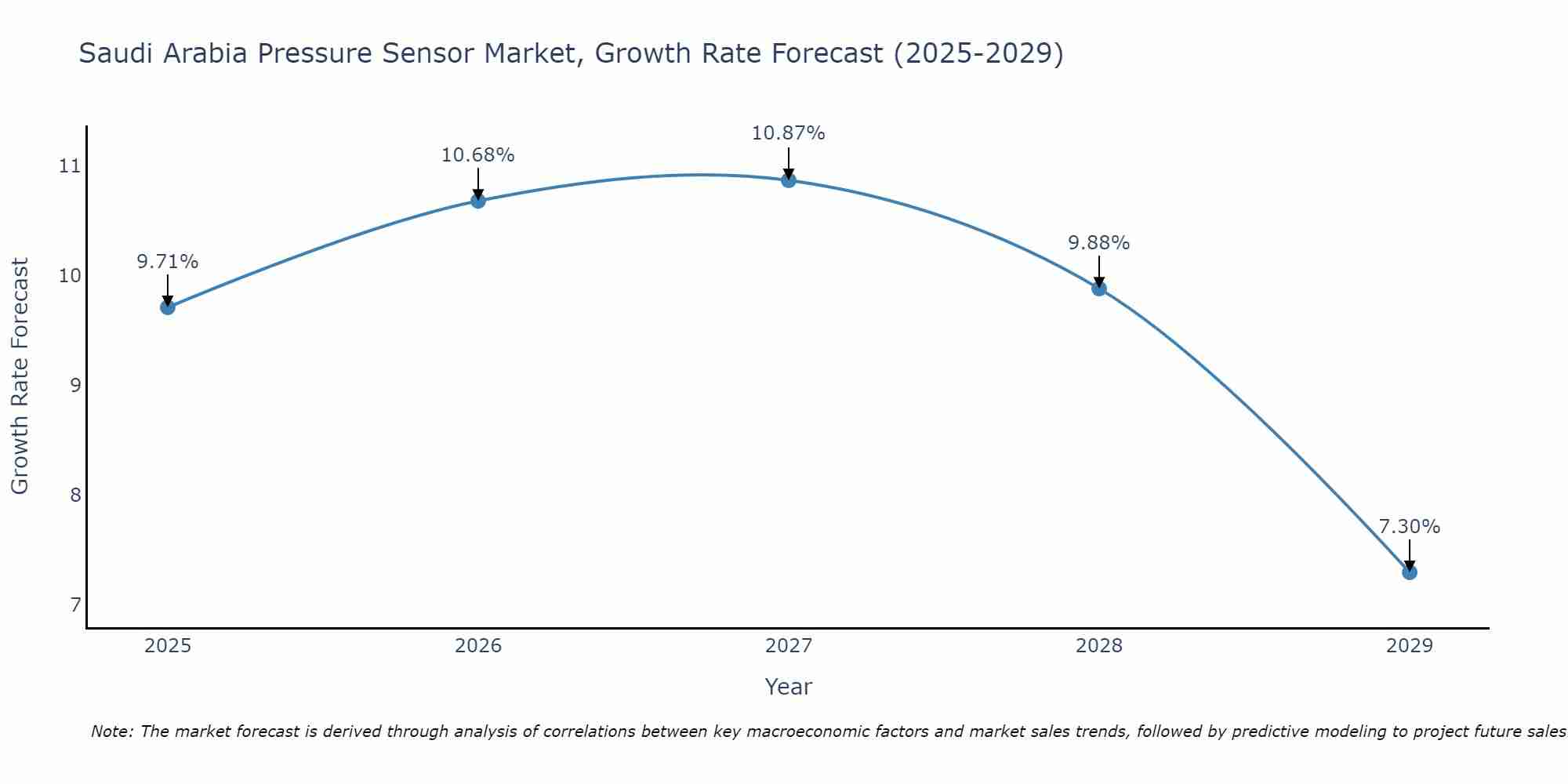
The Saudi Arabia Pressure Sensor Market is projected to witness mixed growth rate patterns during 2025 to 2029. Growth accelerates to 10.87% in 2027, following an initial rate of 9.71%, before easing to 7.30% at the end of the period.
Saudi Arabia Pressure Sensor Market Synopsis
Pressure sensors have found widespread utility in Saudi Arabia across industries like automotive, aerospace, and consumer electronics. These sensors detect and measure pressure changes in various environments and processes, providing essential data for control, monitoring, and safety purposes. The pressure sensor market`s expansion is attributed to its role in enhancing efficiency, optimizing performance, and preventing equipment failures. Industries in Saudi Arabia value pressure sensors as integral components for maintaining accurate pressure levels and ensuring the reliability of critical systems.
Drivers of the Market
The Saudi Arabia pressure sensor market is propelled by the increasing need for real-time pressure monitoring and data-driven decision-making in industries. Pressure sensors find application in various sectors, including automotive, aerospace, healthcare, and industrial automation. The demand for precision manufacturing, efficient energy usage, and process optimization is encouraging industries to integrate pressure sensors into their systems. Furthermore, the growth of the Internet of Things (IoT) and Industry 4.0 initiatives is driving the adoption of smart pressure sensors that can provide real-time data for remote monitoring and control.
Challenges of the Market
In the Saudi Arabia Pressure Sensor Market, challenges center around enhancing the accuracy and reliability of pressure measurement devices. Industries ranging from automotive to healthcare rely on pressure sensors for critical operations, making precision a paramount concern. Calibrating sensors to deliver consistent and accurate readings, regardless of the environment they operate in, is a persistent challenge. Ensuring the sensors can withstand harsh conditions, such as extreme temperatures and high pressures, while maintaining their performance further complicates the manufacturing process. Additionally, as industries demand miniaturization and integration of pressure sensors into various devices, the market faces challenges in developing compact yet robust solutions.
COVID-19 Impact on the Market
The pressure sensor market in Saudi Arabia faced disruptions due to the COVID-19 pandemic`s impact on industries such as automotive, manufacturing, and aerospace. With reduced consumer spending and disruptions in supply chains, industries that use pressure sensors experienced a decline in production and demand. Sectors like automotive manufacturing were directly affected by factory closures and supply chain interruptions. As the economy and industries rebounded, the pressure sensor market showed signs of recovery, driven by increased demand for process automation and safety in various applications.
Key Players in the Market
The key players in the Saudi Arabia pressure sensor market include ABB Ltd., Honeywell International Inc., Schneider Electric SE, Siemens AG, Rockwell Automation Inc., First Sensor AG, Endress+Hauser Management AG & Co. KG, NXP Semiconductor N.V., STMicroelectronics N.V., TE Connectivity Ltd., and Amphenol Corporation.
Key Highlights of the Report:
- Saudi Arabia Pressure Sensor Market Outlook
- Market Size of Saudi Arabia Pressure Sensor Market, 2024
- Forecast of Saudi Arabia Pressure Sensor Market, 2031
- Historical Data and Forecast of Saudi Arabia Pressure Sensor Revenues & Volume for the Period 2021-2031
- Saudi Arabia Pressure Sensor Market Trend Evolution
- Saudi Arabia Pressure Sensor Market Drivers and Challenges
- Saudi Arabia Pressure Sensor Price Trends
- Saudi Arabia Pressure Sensor Porter's Five Forces
- Saudi Arabia Pressure Sensor Industry Life Cycle
- Historical Data and Forecast of Saudi Arabia Pressure Sensor Market Revenues & Volume By Application for the Period 2021-2031
- Historical Data and Forecast of Saudi Arabia Pressure Sensor Market Revenues & Volume By Automotive for the Period 2021-2031
- Historical Data and Forecast of Saudi Arabia Pressure Sensor Market Revenues & Volume By Medical for the Period 2021-2031
- Historical Data and Forecast of Saudi Arabia Pressure Sensor Market Revenues & Volume By Consumer Electronics for the Period 2021-2031
- Historical Data and Forecast of Saudi Arabia Pressure Sensor Market Revenues & Volume By Industrial for the Period 2021-2031
- Historical Data and Forecast of Saudi Arabia Pressure Sensor Market Revenues & Volume By Aerospace and Defense for the Period 2021-2031
- Historical Data and Forecast of Saudi Arabia Pressure Sensor Market Revenues & Volume By Food and Beverage for the Period 2021-2031
- Historical Data and Forecast of Saudi Arabia Pressure Sensor Market Revenues & Volume By HVAC for the Period 2021-2031
- Saudi Arabia Pressure Sensor Import Export Trade Statistics
- Market Opportunity Assessment By Application
- Saudi Arabia Pressure Sensor Top Companies Market Share
- Saudi Arabia Pressure Sensor Competitive Benchmarking By Technical and Operational Parameters
- Saudi Arabia Pressure Sensor Company Profiles
- Saudi Arabia Pressure Sensor Key Strategic Recommendations






































