Saudi Arabia Sulphate Resistant Cement Market Size, Share & Growth Rate
The Saudi Arabia Sulphate Resistant Cement Market was estimated at USD 266 Million in 2025 and is projected to reach USD 340 Million by 2032, growing at a CAGR of 3.6% from 2026 to 2032. This growth trajectory is fueled by the relentless expansion of infrastructure and residential projects throughout the kingdom. With the unique challenges presented by sulfate-rich environments in Saudi Arabia, there is an increasing demand for specialized cement solutions that provide durability and longevity in construction.
Saudi Arabia Sulphate Resistant Cement Market Year-wise Growth Rate and Key Drivers
This graph highlights how the Saudi Arabia Sulphate Resistant Cement Market has steadily grown over the years, supported by major growth factors.
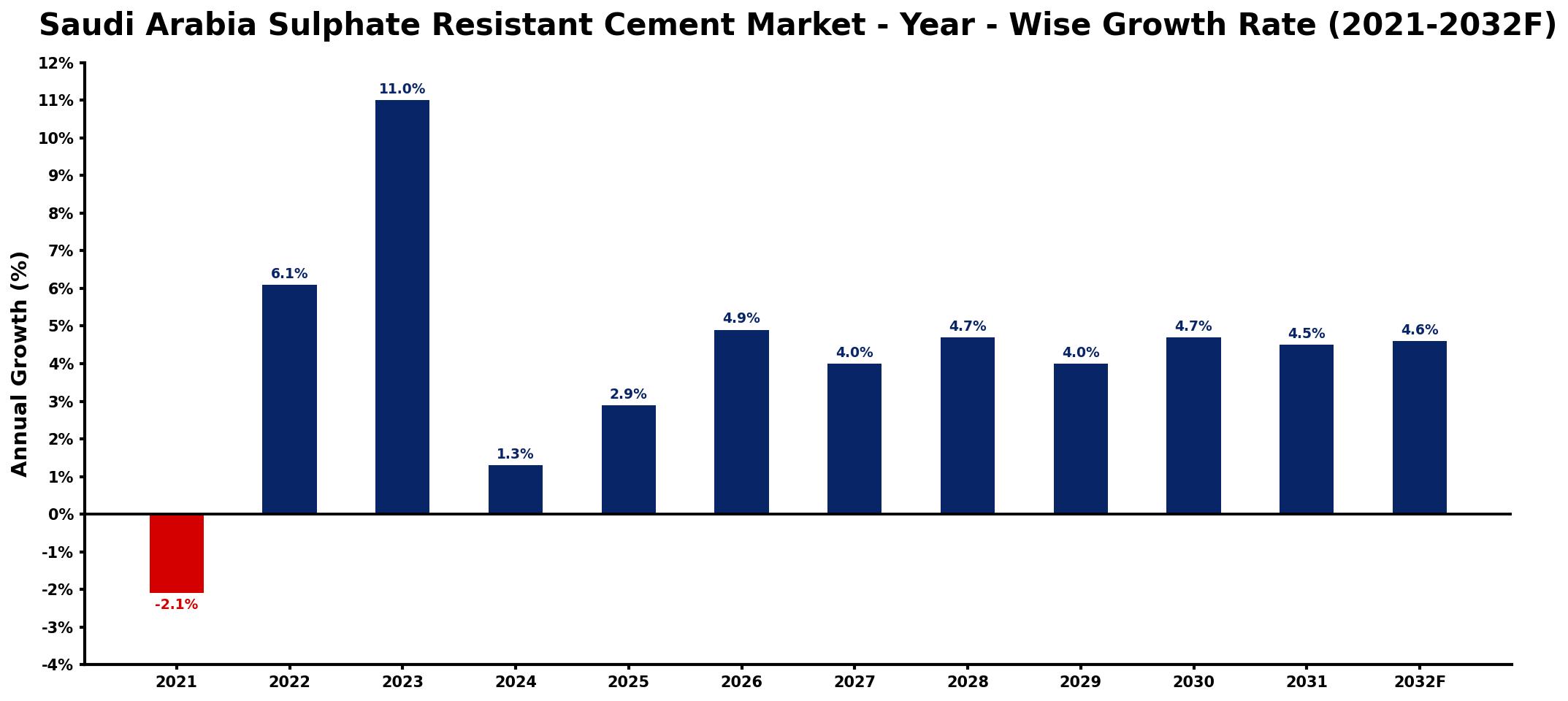
The table below presents the year‑wise growth rates along with the key drivers influencing the market
| Year | Growth Rate | Major Drivers |
| 2021 | -2.1% | decreased construction project investments |
| 2022 | 6.1% | increased infrastructure development projects |
| 2023 | 11.0% | growing demand for durable materials |
| 2024 | 1.3% | expansion of construction sector activities |
| 2025 | 2.9% | rising urbanization and housing needs |
| 2026 | 4.9% | enhanced government spending initiatives |
| 2027 | 4.0% | emerging renewable energy projects |
| 2028 | 4.7% | strengthened commercial construction investments |
| 2029 | 4.0% | growing focus on sustainable building |
| 2030 | 4.7% | increased public-private partnership projects |
| 2031 | 4.5% | rising procurement volume requirements |
| 2032 | 4.6% | development of transportation infrastructure |
Note: Market size estimations and growth projections presented in this report are based on 6Wresearch's proprietary forecasting methodology, utilizing the latest available industry data, government publications, and primary research inputs.
Saudi Arabia Sulphate Resistant Cement Market Synopsis
Saudi Arabia's sulphate resistant cement market is essential for mitigating the risks of cement deterioration due to sulfate exposure, especially in construction sites where groundwater and soil are rich in sulfates. As the nation undertakes ambitious infrastructure projects, the demand for robust cement formulations to ensure structural integrity has surged.
In addition to infrastructure, the residential and commercial sectors are adopting sulphate resistant cement for their projects, recognizing its long-term benefits. The need for quality construction is paramount as the country pushes for urban development that aligns with Vision 2030 goals.
Saudi Arabia Sulphate Resistant Cement Market Key Takeaways
- The market is positioned for steady growth, driven by ongoing infrastructure investments.
- There is increasing awareness of the benefits of sulphate resistant cement in construction.
- Applications in various sectors, including residential and commercial, are expanding.
- Challenges related to cost and quality consistency are pivotal for market players.
- Government initiatives aimed at enhancing construction quality are supportive of market growth.
Evaluation of Restraints in Saudi Arabia Sulphate Resistant Cement Market
Despite its growth potential, the Saudi Arabia sulphate resistant cement market faces several restraints. One significant barrier is the higher cost associated with these specialized cements, which can deter some construction firms from adopting them in favor of traditional options. Furthermore, there is a need for greater education within the construction industry regarding the long-term advantages of using sulphate resistant cement, which can lead to its underutilization. Consistency in quality and availability also poses a challenge, impacting project timelines and budgets.
Saudi Arabia Sulphate Resistant Cement Market Trends
A growing trend in the Saudi Arabia sulphate resistant cement market is the emphasis on sustainability and eco-friendly practices. Builders are increasingly looking for materials that not only meet durability standards but also align with environmental regulations. Moreover, innovation in cement formulations and manufacturing processes is driving advancements in quality, further enhancing product appeal. As the construction sector becomes more tech-driven, the integration of digital solutions for supply chain management and project monitoring is also emerging.
Saudi Arabia Sulphate Resistant Cement Market Opportunities
Significant opportunities lie within the growing infrastructure initiatives backed by the Saudi government, particularly in transportation and urban development. As cities expand and new mega-projects are initiated, the demand for durable cement solutions will continue to rise. Additionally, the rising trend of sustainable construction presents a chance for manufacturers to innovate and offer environmentally-friendly sulphate resistant options, appealing to an increasingly conscientious market.
Government Initiatives in the Saudi Arabia Sulphate Resistant Cement Market
The Saudi government is actively investing in infrastructure development as part of its Vision 2030 plan, which prioritizes quality construction and sustainability. Initiatives aimed at improving construction standards and supporting local manufacturers are crucial for the growth of the sulphate resistant cement market. Furthermore, public spending on infrastructure projects enhances demand for durable materials, ensuring that construction practices meet evolving regulatory frameworks and quality expectations.
Future Insights of the Saudi Arabia Sulphate Resistant Cement Market
Looking ahead to 2026-2032, the Saudi Arabia sulphate resistant cement market is expected to thrive, driven by an ongoing commitment to infrastructure development and urbanization. As construction practices evolve, there will be an increasing reliance on innovative materials designed for extreme environmental conditions. The market is also poised to benefit from advancements in technology, which will facilitate improved manufacturing practices and distribution, ultimately enhancing market access and growth.
Saudi Arabia Sulphate Resistant Cement Market Latest Developments (2025 - 2026)
Recent developments in the Saudi Arabia sulphate resistant cement market indicate a shift towards more advanced and sustainable production techniques. The focus is on improving product quality to meet the demands of upcoming mega-projects. Additionally, collaborations between construction companies and cement manufacturers are increasing, aimed at developing customized solutions that address specific challenges presented by sulfate-rich environments.
Saudi Arabia Sulphate Resistant Cement Market - Key Attractiveness of the Report
- 10 Years of Market Numbers
- Historical Data Starting from 2022 to 2025
- Base Year: 2025
- Forecast Data until 2032
- Key Performance Indicators Impacting the Market
- Major Upcoming Developments and Projects
Key Highlights of the Report:
- Saudi Arabia Sulphate Resistant Cement Market Outlook
- Market Size of Saudi Arabia Sulphate Resistant Cement Market, 2025
- Forecast of Saudi Arabia Sulphate Resistant Cement Market, 2032
- Historical Data and Forecast of Saudi Arabia Sulphate Resistant Cement Revenues & Volume for the Period 2022-2032F
- Saudi Arabia Sulphate Resistant Cement Market Trend Evolution
- Saudi Arabia Sulphate Resistant Cement Market Drivers and Challenges
- Saudi Arabia Sulphate Resistant Cement Price Trends
- Saudi Arabia Sulphate Resistant Cement Porter's Five Forces
- Saudi Arabia Sulphate Resistant Cement Industry Life Cycle
- Historical Data and Forecast of Saudi Arabia Sulphate Resistant Cement Market Revenues & Volume By Types for the Period 2022-2032F
- Historical Data and Forecast of Saudi Arabia Sulphate Resistant Cement Market Revenues & Volume By C3A Content C3A Content 3%-5% for the Period 2022-2032F
- Historical Data and Forecast of Saudi Arabia Sulphate Resistant Cement Market Revenues & Volume By Sulphate Resistant Cement (SRC) for the Period 2022-2032F
- Historical Data and Forecast of Saudi Arabia Sulphate Resistant Cement Market Revenues & Volume By Applications for the Period 2022-2032F
- Historical Data and Forecast of Saudi Arabia Sulphate Resistant Cement Market Revenues & Volume By Effluent and Drainage Works for the Period 2022-2032F
- Historical Data and Forecast of Saudi Arabia Sulphate Resistant Cement Market Revenues & Volume By Coastal Protective Works for the Period 2022-2032F
- Historical Data and Forecast of Saudi Arabia Sulphate Resistant Cement Market Revenues & Volume By Road and Bridge Works for the Period 2022-2032F
- Historical Data and Forecast of Saudi Arabia Sulphate Resistant Cement Market Revenues & Volume By Others for the Period 2022-2032F
- Saudi Arabia Sulphate Resistant Cement Import Export Trade Statistics
- Market Opportunity Assessment By Types
- Market Opportunity Assessment By Applications
- Saudi Arabia Sulphate Resistant Cement Top Companies Market Share
- Saudi Arabia Sulphate Resistant Cement Competitive Benchmarking By Technical and Operational Parameters
- Saudi Arabia Sulphate Resistant Cement Company Profiles
- Saudi Arabia Sulphate Resistant Cement Key Strategic Recommendations






































