Saudi Arabia Telehealth Market Summary
The saudi arabia telehealth market was estimated at USD 362 Million in 2025 and is projected to reach USD 461 Million by 2032, growing at a CAGR of 4.8% from 2026 to 2032.
Saudi Arabia Telehealth Market Year-wise Growth Rate and Key Drivers
This graph highlights how the Saudi Arabia Telehealth Market has steadily grown over the past five years, supported by major growth factors.
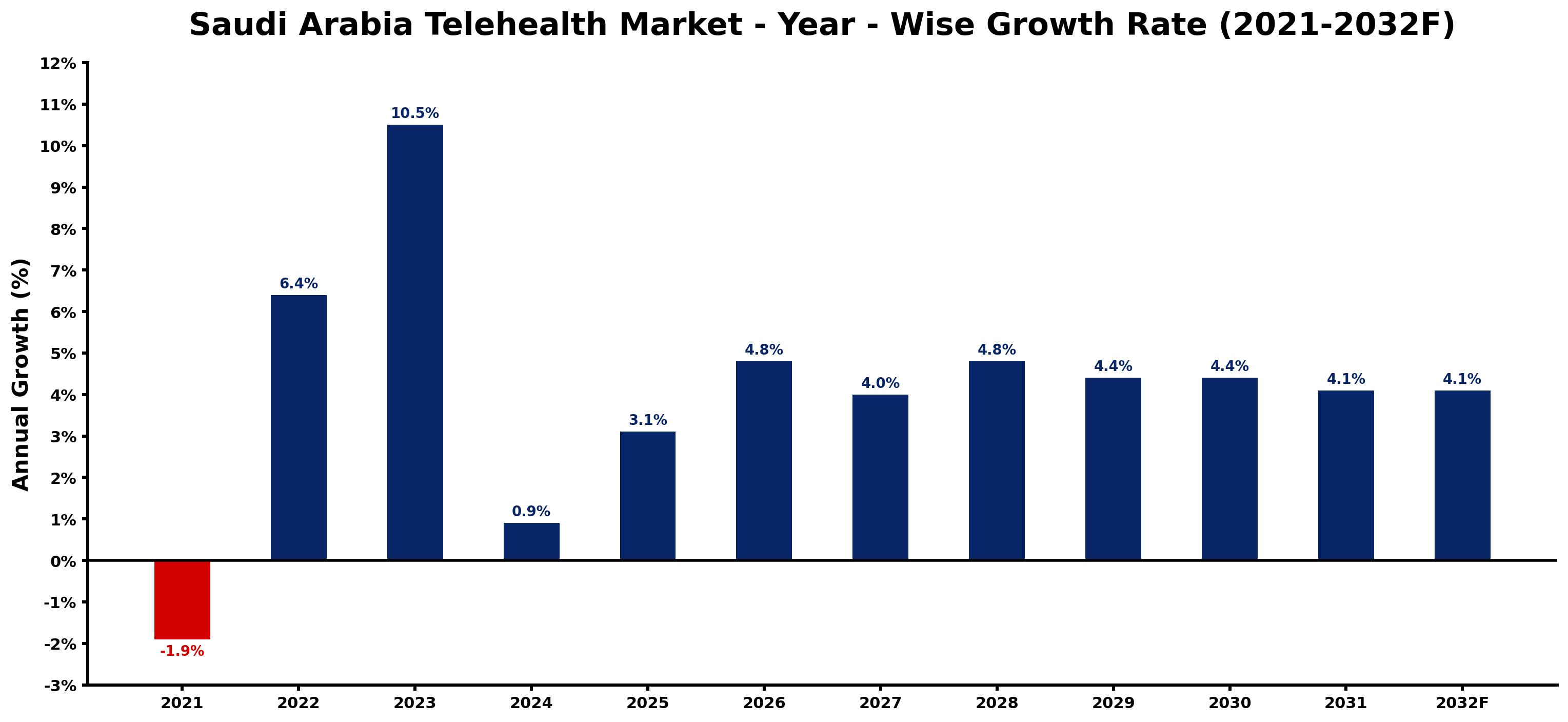
The table below presents the year wise growth rates along with the key drivers influencing the market
| Year | Growth Rate | Major Drivers |
| 2021 | -1.9% | Increased cybersecurity concerns deterred users from adopting telehealth solutions, leading to market stagnation. |
| 2022 | 6.4% | Investments in digital infrastructure improved internet access in remote areas, fostering telehealth use. |
| 2023 | 10.5% | Healthcare providers began integrating telehealth into traditional services, enhancing patient engagement and satisfaction. |
| 2024 | 0.9% | Increased awareness of chronic diseases prompted individuals to seek remote consultations and management. |
| 2025 | 3.1% | Collaborations between tech firms and healthcare providers led to innovative telehealth solutions and platforms. |
| 2026 | 4.8% | Urbanization trends drove health service expansions, necessitating virtual consultations for convenient access. |
| 2027 | 4.0% | Patient demand for personalized care solutions encouraged telehealth services tailored to individual needs. |
| 2028 | 4.8% | Emergence of AI-driven analytics improved efficiency in telehealth diagnostics and treatment options. |
| 2029 | 4.4% | Insurance companies began covering telehealth services more comprehensively, promoting wider utilization. |
| 2030 | 4.4% | Public health campaigns highlighted telehealth benefits, increasing public acceptance and usage rates. |
| 2031 | 4.1% | Continued investment in medical technology innovation optimized remote patient monitoring systems significantly. |
| 2032 | 4.1% | A focus on sustainable healthcare solutions linked telehealth growth with environmental considerations across services. |
Note - Market size estimations and growth projections presented in this report are based on 6Wresearch's advanced forecasting approach, validated with industry datasets as of June 2026.
Saudi Arabia Telehealth Market Synopsis
The Saudi Arabia Telehealth Market is projected to reach 4.8% and witness significant growth during the forecast period (2026-2032). This growth is primarily driven by government initiatives aimed at enhancing healthcare delivery through digital platforms. The adoption of telehealth services in Saudi Arabia reflects a crucial shift in healthcare provision, bolstered by technological advancements and a demand for more accessible healthcare solutions, particularly for the geriatric population.
Saudi Arabia Telehealth Market Growth Drivers
Several key factors are propelling the growth of the Saudi Arabia Telehealth Market. Among these, the urgency for cost-effective healthcare solutions plays a pivotal role. As healthcare costs continue to rise, telehealth offers a more affordable alternative for remote consultations, significantly benefiting patients unable to access traditional healthcare services. Additionally, the increasing prevalence of chronic diseases has created a pressing need for effective management solutions that telehealth can provide.
- The COVID-19 pandemic has significantly accelerated the adoption of telehealth services. As patients sought to minimize exposure to infection, remote healthcare options became a necessity. This shift has not only heightened awareness of telehealth benefits but also encouraged healthcare providers to incorporate these services into their offerings.
- Technological innovations and improvements in digital infrastructure have further supported the expansion of the telehealth landscape. Enhanced internet connectivity and mobile technology have made remote consultations more feasible and efficient, ultimately improving patient outcomes.
- Government policies aimed at promoting digital health solutions have laid the groundwork for robust market growth. These initiatives prioritize the integration of technology in healthcare, ensuring that telehealth services are accessible to a larger segment of the population.
- The growing awareness and acceptance of telehealth among healthcare providers and patients alike are crucial components of market growth. As more individuals experience the convenience of virtual consultations, demand for these services is expected to increase substantially.
- Challenges associated with healthcare accessibility, especially in remote areas, have also driven the uptake of telehealth services. With persistent barriers to traditional healthcare, telehealth stands as a promising solution to bridge the gap between patients and healthcare providers.
Saudi Arabia Telehealth Market Challenges and Restraints
While the Saudi Arabia Telehealth Market exhibits promising growth potential, several challenges and constraints could impede its advancement. One notable challenge is the regulatory landscape surrounding telehealth. Healthcare regulations, while evolving, still pose barriers to the seamless integration of telehealth services, often leading to uncertainty among stakeholders.
- Data privacy and security concerns are paramount in the telehealth sector. As digital health solutions proliferate, ensuring the confidentiality and security of patient information remains a significant challenge for providers.
- Technological disparities across regions can hinder effective telehealth implementation. Areas lacking adequate digital infrastructure may struggle to access telehealth services, creating disparities in healthcare delivery.
- Cultural attitudes towards remote healthcare can also act as a barrier. In regions where traditional face-to-face consultations are preferred, overcoming resistance and encouraging acceptance of telehealth may take time.
- The need for continual technological upgrades poses a financial burden on healthcare providers, particularly smaller practices that may lack the resources to invest in advanced telehealth solutions.
- Lastly, reimbursement policies for telehealth services can vary, leading to confusion over payment models and potentially discouraging healthcare providers from offering such services.
Saudi Arabia Telehealth Market Government Investment and Initiatives
The Saudi government has recognized the pivotal role of telehealth in revolutionizing healthcare delivery. Initiatives aimed at enhancing digital health services are gaining momentum, underpinning the growth of the Saudi Arabia Telehealth Market. The Vision 2030 strategy includes specific directives to bolster health initiatives, focusing on patient accessibility and quality of care.
Moreover, public spending on health information technology has seen a significant increase, with investments directed toward the development of telehealth platforms and digital health applications. This financial commitment supports the creation of an integrated healthcare system where telehealth services can thrive, ensuring a more efficient and responsive healthcare environment.
The Ministry of Health is actively promoting telehealth programs, working to standardize practices and enhance the quality of remote healthcare services. Efforts include training healthcare professionals in digital health practices and increasing public awareness about telehealth offerings.
Saudi Arabia Telehealth Market Latest Developments (May 2025 - June 2026)
The period from May 2025 to June 2026 has witnessed significant developments in the Saudi Arabia Telehealth Market. Innovations in technology have led to improved patient experiences and streamlined telehealth services, increasing the overall appeal of these offerings.
Healthcare providers have increasingly embraced new telehealth solutions, reflecting a broader trend towards integrated healthcare delivery models. Enhanced partnerships between technology firms and healthcare institutions have fostered the development of cutting-edge telehealth applications, expanding service availability.
Public awareness campaigns have effectively educated the population about the advantages of telehealth, leading to greater acceptance and utilization of these services. This heightened awareness is crucial for patient engagement and the continued growth of the market.
Saudi Arabia Telehealth Market - Key Attractiveness of the Report
- 10 Years of Market Numbers
- Historical Data Starting from 2022 to 2025
- Base Year: 2025
- Forecast Data until 2032
- Key Performance Indicators Impacting the Market
- Major Upcoming Developments and Projects
Key Highlights of the Report:
- Saudi Arabia Telehealth Market Overview
- Saudi Arabia Telehealth Market Outlook
- Saudi Arabia Telehealth Market Forecast
- Historical Data of Saudi Arabia Telehealth Market Revenues & Volume for the Period 2022-2032F
- Saudi Arabia Telehealth Market Size and Saudi Arabia Telehealth Market Forecast of Revenues & Volume, Until 2032F
- Historical Data of Saudi Arabia Telehealth Market Revenues & Volume, by Types, for the Period 2022-2032F
- Market Size & Forecast of Saudi Arabia Telehealth Market Revenues & Volume, by Types, Until 2032F
- Historical Data of Saudi Arabia Telehealth Market Revenues, by Component, for the Period 2022-2032F
- Market Size & Forecast of Saudi Arabia Telehealth Market Revenues, by Component, Until 2032F
- Historical Data of Central Region Telehealth Market Revenues, for the Period 2022-2032F
- Market Size & Forecast of Central Region Telehealth Market Revenues, Until 2032F
- Historical Data of Western Region Telehealth Market Revenues, for the Period 2022-2032F
- Market Size & Forecast of Western Region Telehealth Market Revenues, Until 2032F
- Historical Data of Southern Region Telehealth Market Revenues, for the Period 2022-2032F
- Market Size & Forecast of Southern Region Telehealth Market Revenues, Until 2032F
- Historical Data of Eastern Region Telehealth Market Revenues, for the Period 2022-2032F
- Market Size & Forecast of Eastern Region Telehealth Market Revenues, Until 2032F
- Market Drivers and Restraints
- Saudi Arabia Telehealth Market Trends and Industry Life Cycle
- Porter’s Five Force Analysis
- Market Opportunity Assessment
- Saudi Arabia Telehealth Market Share, By Players
- Saudi Arabia Telehealth Market Share, By Regions
- Saudi Arabia Telehealth Market Overview on Competitive Benchmarking
- Company Profiles
- Key Strategic Recommendations
Markets Covered
The Saudi Arabia Telehealth Market report provides a detailed analysis of the following market segments:
- By Types:
- Tele Hospitals
- Tele Homes
- mHealth (Mobile Health)
- By Component:
- Product
- Hardware
- Software
- Other Types
- Services
- Teleradiology
- Telecardiology
- Teledermatology
- Telepsychiatry
- Other Services
- Product






































