Saudi Arabia Television Market Summary
The saudi arabia television market was estimated at USD 811 Million in 2025 and is projected to reach USD 1180 Million by 2032, growing at a CAGR of 6.8% from 2026 to 2032.
Saudi Arabia Television Market Year-wise Growth Rate and Key Drivers
This graph highlights how the Saudi Arabia Television Market has steadily grown over the past five years, supported by major growth factors.
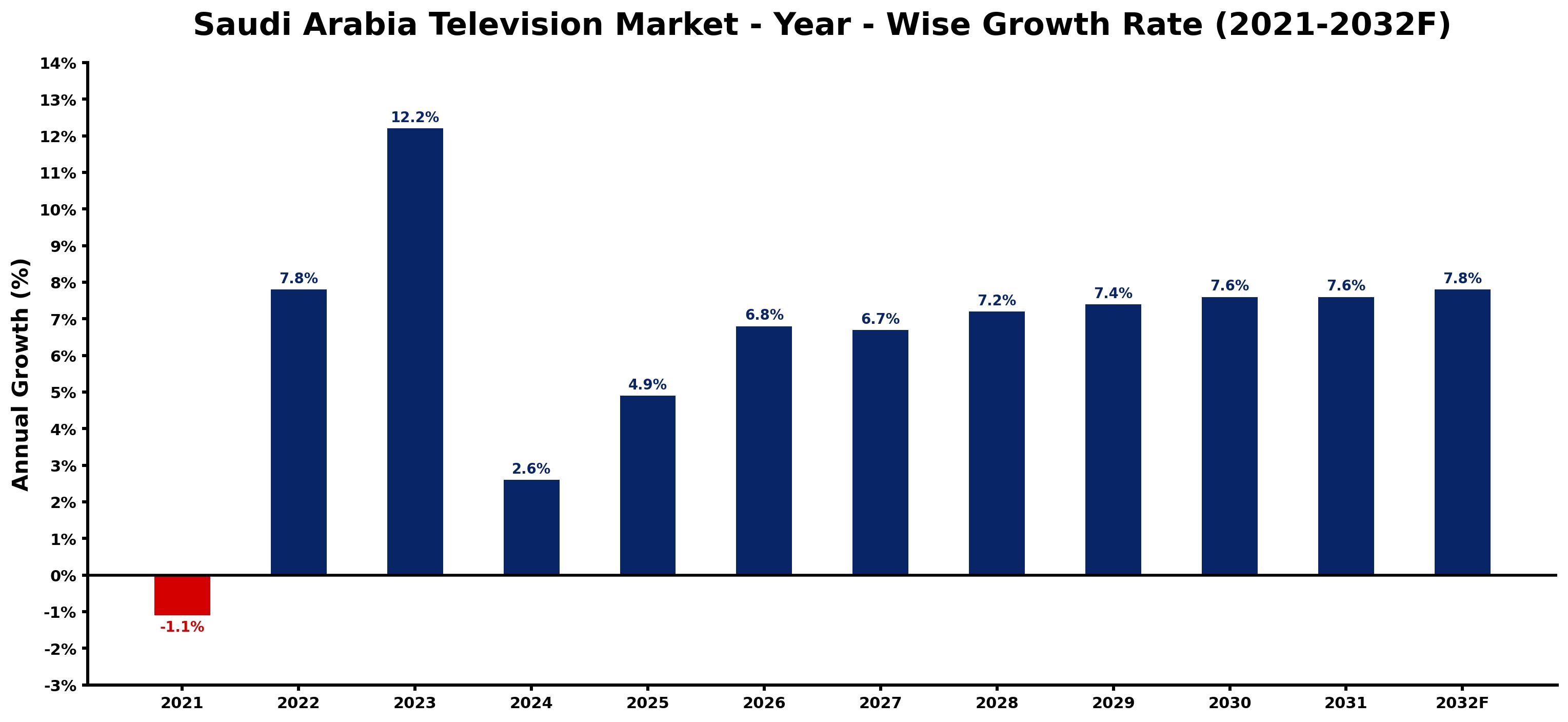
The table below presents the year wise growth rates along with the key drivers influencing the market
| Year | Growth Rate | Major Drivers |
| 2021 | -1.1% | Heightened competition from streaming platforms diminished traditional television viewership and advertising revenues in Saudi Arabia. |
| 2022 | 7.8% | New streaming platforms emerged, increasing competition and diversifying viewing choices for audiences. |
| 2023 | 12.2% | Emerging technologies in broadcasting enhanced viewer engagement through interactivity and personalization. |
| 2024 | 2.6% | Smart TV sales expanded, enabling more households to access premium streaming services seamlessly. |
| 2025 | 4.9% | Social media integrations with TV content became commonplace, fostering community discussions among viewers. |
| 2026 | 6.8% | Major sporting events showcased on local networks attracted significant advertising investments and viewership. |
| 2027 | 6.7% | Cultural partnerships with local filmmakers enriched the storytelling landscape in Saudi productions. |
| 2028 | 7.2% | Government funding for creative industries amplified original content creation and international collaborations. |
| 2029 | 7.4% | Digital advertisement spending on streaming services grew, shifting focus from traditional TV channels. |
| 2030 | 7.6% | Technological innovations in satellite broadcasting improved service reach in remote areas of Saudi Arabia. |
| 2031 | 7.6% | Consumer preferences shifted towards on-demand content, reducing linear TV viewership trends significantly. |
| 2032 | 7.8% | Content localization strategies became critical as regional competitors sought to dominate the market. |
Note - Market size estimations and growth projections presented in this report are based on 6Wresearch's advanced forecasting approach, validated with industry datasets as of June 2026.
Saudi Arabia Television Market Synopsis
The Saudi Arabia Television Market is projected to reach 6.8% and witness significant growth during the forecast period (2026-2032). With an estimated compound annual growth rate (CAGR) of 5.82%, the market's expansion is driven by various factors, including an increase in disposable income, governmental support for digital infrastructure enhancements, and a heightened consumer demand for high-quality viewing experiences.
Saudi Arabia Television Market Growth Drivers
The growth of the Saudi Arabia television market is predominantly influenced by several key drivers:
- The rise in disposable income among the Saudi population has significantly increased consumer spending on electronics, specifically televisions. This trend has paved the way for a surge in sales as households invest in advanced viewing technologies.
- Government initiatives aimed at improving digital infrastructure, particularly in underserved rural areas, are crucial. Programs designed to enhance broadband access enable residents to adopt modern viewing solutions, such as Smart TVs, which support online streaming services.
- Technological advancements in television manufacturing, including higher resolution displays and enhanced sound systems, have attracted consumers seeking superior viewing experiences. The increasing popularity of 4K and 8K televisions is part of this trend.
- Competitive pricing strategies among manufacturers have made television sets more affordable for consumers. As vendors strive to capture market share, the emergence of economically priced models has stimulated demand across diverse consumer segments.
- The growing inclination toward content consumption through online streaming platforms and Internet Protocol Television (IPTV) has transformed consumer viewing habits, further driving the demand for Smart TVs that facilitate these services.
Saudi Arabia Television Market Challenges and Restraints
Despite the positive outlook, the Saudi Arabia television market faces several challenges:
- Price sensitivity among consumers remains a significant barrier to market growth. Many individuals prefer purchasing budget-friendly models, which complicates pricing strategies for manufacturers and can negatively impact revenue generation.
- Economic fluctuations can also affect consumer confidence and spending patterns. Economic downturns may lead to reduced discretionary spending on electronics, including televisions.
- The ongoing effects of the COVID-19 pandemic have disrupted global supply chains, leading to delays in product availability and fluctuations in pricing. This has created uncertainty for both manufacturers and consumers.
- Limited access to high-speed internet in certain regions continues to restrict the adoption of online viewing platforms. Areas with inadequate digital infrastructure may fall behind in terms of technological advancement.
- Consumer preferences are rapidly evolving, and manufacturers must stay attuned to these changes to remain competitive. Failing to innovate and keep pace with market trends could result in lost market share.
Saudi Arabia Television Market Government Investment and Initiatives
The Saudi Arabian government has launched several initiatives aimed at promoting the growth of the television market as part of its broader digital transformation goals. Programs to enhance digital infrastructure, such as expanding broadband capabilities, are critical to encouraging the adoption of modern television technology.
Moreover, the government has initiated projects that focus on increasing internet access in rural regions, allowing underserved communities to benefit from the latest broadcasting technologies. These initiatives not only aim to improve the quality of life but also stimulate economic activity within the region.
Additionally, regulatory frameworks that promote competition among service providers play a vital role in enhancing service delivery. This competitive landscape encourages television manufacturers to innovate, leading to better products for consumers.
Saudi Arabia Television Market Latest Developments (May 2025 - June 2026)
During the period from May 2025 to June 2026, the Saudi Arabia television market has experienced notable developments. The focus has shifted significantly towards the enhancement of Smart TV features, with increased emphasis on user-friendly interfaces and integrated streaming services.
Market players have been actively engaging in partnerships with local content providers to enrich the viewing experience for consumers. This trend indicates a growing recognition of the importance of localized content in satisfying diverse viewer preferences.
Additionally, there has been a marked increase in public awareness campaigns aimed at promoting digital literacy in connection with new television technologies. Such initiatives encourage consumers to explore advanced features, thereby enhancing market growth.
Saudi Arabia Television Market - Key Attractiveness of the Report
- 10 Years of Market Numbers
- Historical Data Starting from 2022 to 2025
- Base Year: 2025
- Forecast Data until 2032
- Key Performance Indicators Impacting the Market
- Major Upcoming Developments and Projects
Key Highlights of the Report:
- Saudi Arabia Television Market Outlook
- Market Size of Saudi Arabia Television Market, 2025
- Forecast of Saudi Arabia Television Market, 2032
- Historical Data and Forecast of Saudi Arabia Television Revenues & Volume for the Period 2022-2032F
- Saudi Arabia Television Market Trend Evolution
- Saudi Arabia Television Market Drivers and Challenges
- Saudi Arabia Television Price Trends
- Saudi Arabia Television Porter's Five Forces
- Saudi Arabia Television Industry Life Cycle
- Historical Data and Forecast of Saudi Arabia Television Market Revenues & Volume By Resolution for the Period 2022-2032F
- Historical Data and Forecast of Saudi Arabia Television Market Revenues & Volume By LCD TVs for the Period 2022-2032F
- Historical Data and Forecast of Saudi Arabia Television Market Revenues & Volume By OLED TVs for the Period 2022-2032F
- Historical Data and Forecast of Saudi Arabia Television Market Revenues & Volume By Types for the Period 2022-2032F
- Historical Data and Forecast of Saudi Arabia Television Market Revenues & Volume By 2D TVs for the Period 2022-2032F
- Historical Data and Forecast of Saudi Arabia Television Market Revenues & Volume By 3D TVs for the Period 2022-2032F
- Saudi Arabia Television Import Export Trade Statistics
- Market Opportunity Assessment By Resolution
- Market Opportunity Assessment By Types
- Saudi Arabia Television Top Companies Market Share
- Saudi Arabia Television Competitive Benchmarking By Technical and Operational Parameters
- Saudi Arabia Television Company Profiles
- Saudi Arabia Television Key Strategic Recommendations






































